

Summerfield Girls Find Their Stride, Claim 1st League Title Since 1990
By
Doug Donnelly
Special for MHSAA.com
May 20, 2026
David Raymond has heard it before.
 “I always laugh because I've definitely gone on the recruiting trail in our hallways and tried to get kids to come out (for track & field), and one of the answers I always get was, ‘I don't even like running.’ I tell them, ‘Great, you'll fit right in because there's a bunch of kids that run track that don't like running.’”
Running track is a little more fun these days, however, at Petersburg Summerfield, where Raymond is the head coach. His Bulldogs recently celebrated winning their first league championship in more than three decades and have a bunch of qualifiers heading into next week’s Lower Peninsula Division 4 Finals.
“When you win, people start talking it up positively within the hallways,” Raymond said. “That helps when you're trying to recruit kids. It's kind of funny how when you win, all of a sudden people are a little bit more interested and want to see what it's all about.”
Raymond is a 1999 Summerfield graduate. He played multiple sports in high school and was part of teams that won District basketball and a Regional track titles his senior year. He was named the Summerfield varsity girls basketball coach at age 23 and eventually switched to become the boys varsity coach. He would coach the Bulldogs for seven seasons, win 100 games, and become the winningest coach in school history before stepping down to spend more time with his family, which includes three daughters.
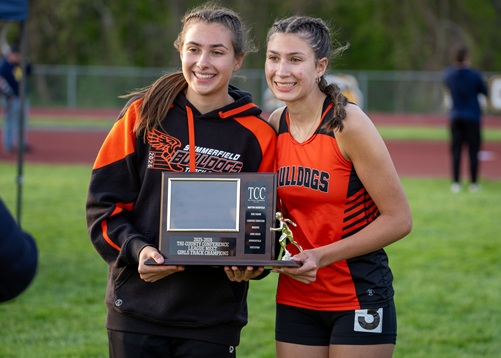
 Two of those daughters are now on the Summerfield varsity track team. Both are headed to the Finals meet next weekend – Abby in the low hurdles and three relays and Grace in the 800 and three relays.
“I'm very blessed to be able to coach my daughters,” Raymond said.
When Grace was a freshman, she was Summerfield’s only Finals qualifier. This year she and Abby lead a parade of nine Bulldogs who have earned a trip.
Grace set a school record in the 800 at Friday’s Regional and was part of the 3,200 relay with her sister, Makenzie Wolfe and Allison Ost that set a school record and qualified as well.
Grace and Abby are part of the Finals-qualifying 400 relay with Emma Jacob and Sophia Stanger and part of the 1,600 relay with Alice VanCamp and Ost. Abby Zilka (high jump), Ost (1600), Wolfe (3200) and Gabi Myshock (discus) are other qualifiers. Abby will also compete in the low hurdles next weekend.
“Having nine girls qualify for the state meet shows how far the program has come over the last 3-5 years,” Raymond said. “It’s been incredible. The team has come a long way. We’ve had good kids come in, obviously. You need talent in order to be successful, and we have that. The girls have worked hard and put the time in. I am thankful they have been able to put it all together this year.”
Winning Summerfield’s first girls Tri-County Conference track championship since 1990 was a pleasant surprise.
“Winning a league title was a different experience for us because a lot of times, we kind of knew going into certain meets we didn’t have a chance,” he said. “Our focus has always been Regionals. This year, we had a much different mindset that we were going to try and win it. The hard work paid off. That’s what was so exciting.”
 While he ran on the track team in high school, he didn’t start coaching the sport until about five years ago as an unofficial assistant to the previous head coach, Kelly Thompson. She stepped away from the head coaching role when her son started running in college. He has surrounded himself with several great assistants, he said, including two classmates from high school.
“There was an opening, and it was an opportunity for me to, again, be with my kids a little bit more, and that's kind of how I ended up in the role,” he said. “I learned that track is not a sport where you can coach by yourself; you need quality people around you.”
Raymond decided he wanted to be a teacher and coach in high school.
“I had good coaches growing up,” he said. “Ron Estes was my varsity basketball coach when I decided to go into teaching. I had a number of people like him that influenced me and showed me that teaching can be a great career and, when you get the opportunity, to coach.
“I've obviously loved sports my entire life. At first coaching was a way to be around sports. As you grow older, you start to see the impact that you can have on kids, which is even different than what the impact that you can have on somebody in a classroom is. It's always been an avenue that has allowed me to impact kids in a positive way.”
 Doug Donnelly has served as a news and sports reporter at the Adrian Daily Telegram and the Monroe News for 30 years, including 10 years as city editor in Monroe. He's written a book on high school basketball in Monroe County and compiles record books for various schools in southeast Michigan. He is now publisher and editor of The Blissfield Advance, a weekly newspaper. E-mail him at [email protected] with story ideas for Jackson, Washtenaw, Hillsdale, Lenawee and Monroe counties.
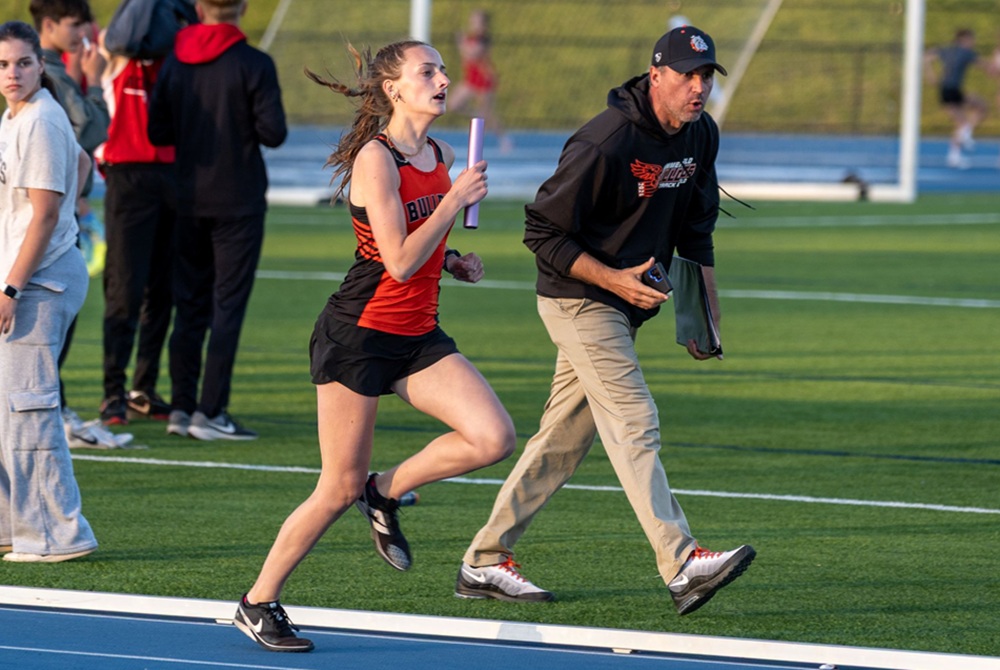
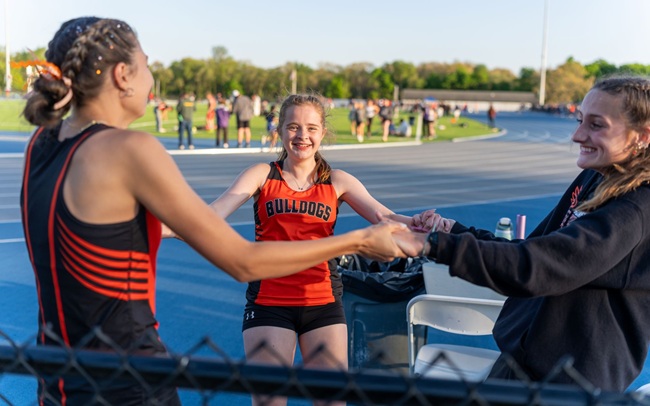
PHOTOS (Top) Petersburg Summerfield coach David Raymond encourages Allison Ost during a relay race this season. (Middle) Summerfield 1,600 relay racers (left to right) Abby Raymond, Alice Van Camp and Ost get together to “Triple A Power Up.” (Below) Grace Raymond (left) and Abby Raymond hold up Summerfield's first league title trophy won since 1990. (Photos by Tom Westrick.)
Jokela Stars Again, Lake Linden-Hubbell Reigns This Time as Outright Champ
By
John Vrancic
Special for MHSAA.com
June 2, 2024
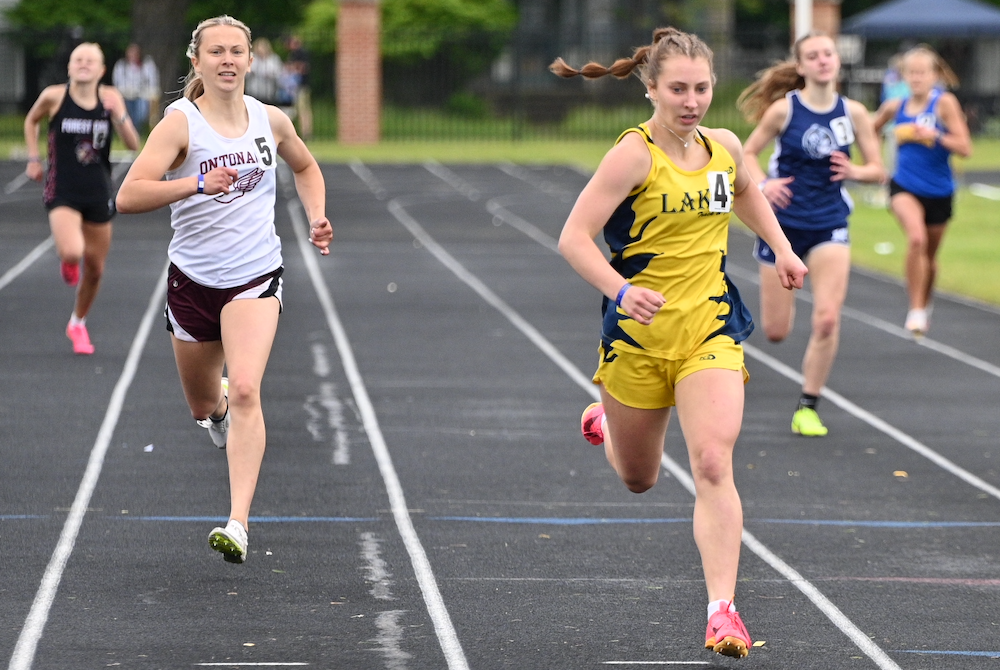
KINGSFORD — Lake Linden-Hubbell junior Emily Jokela had quite a workout here Saturday and has three individual victories to show for it.
The Lakes also benefitted from her effort as they earned the Upper Peninsula Division 3 track & field team championship.
LL-H, which shared the title with Stephenson a year ago, scored 72 points this time. Newberry edged Stephenson 64-62 for the runner-up trophy.
“Our Regional has been tough since 2016,” Lakes’ coach Gary Guisfredi said. “Since that time, teams from our Regional have won the U.P. Finals eight times. Emily scored 38 points alone today. Our shot putter (sophomore Maddy Dudenas) taking third and our girl (sophomore Cleo Milkey) taking fourth in long jump were big points. We knew Newberry and Stephenson were going to be tough.”
Jokela opened with a victory in the 100-meter dash in 13.04 seconds. Later, she set UPD3 Finals records in back-to-back races, taking the 400 (58.61) and 300 hurdles (44.8) prior to placing second in the 200 (27.03).
“My starts were better than usual,” she said. “Those (open 400 and 300 hurdles) are tough races, but you just got to push through that. You always try to prepare for that in practice. I just try to beat everybody to the next hurdle.”
Her effort in the 400 topped the old mark (58.7) by Superior Central’s Lauren Spranger in 2011, and in the hurdles she bested her own record (45.63) from a year ago.
The Lakes, who finished undefeated this year, also won the 800 relay at 1:52.52.
 “I think our handoffs were good,” senior Rebecca Lyons said. “It feels great to be U.P. champions. We were really excited about this meet. We knew Newberry and Stephenson were pretty good.”
Dollar Bay got a first on sophomore Kiera Isaacson’s leap of 5-3 in high jump.
Newberry, coming off a solid cross country season from last fall, showed its strength in the distances. Sophomore Samantha Taylor set the meet record in the 1,600 (5:14.9), topping the previous best (5:17.2) by Amy Kerst of Munising in 2011. She was followed by freshman Abby Taylor (5:22.7), Stephenson sophomore Faith Cappaert (5:36.7) and Newberry senior Kaylen Clark (5:37.49), who will run at Davenport University this fall.
Clark added a first in the 3,200 (12:33.7), withstanding a challenge from North Dickinson’s Mya Grunlund (12:43.65).
“I knew I had my kick and had to use it today,” Clark said. “I just wanted to defend my title one more time. I think my conditioning from cross country helped me. I missed three meets because of bronchitis. Once I got over that, I did a lot of slow miles. It was a struggle.
“I’ll get to run against Lola (Korpi) again in college. I’m real excited about that. It will also be exciting to do something new.”
Newberry also overcame a slow start to win the 3,200 relay (10:24.16).
“We weren’t too worried,” Abby Taylor said after anchoring that relay. “We knew Kaylen and Sam would close it. I felt pretty relaxed and confident in the final leg.”
Cappaert won the 800 (2:25.91), followed by Abby Taylor (2:33.34) and Clark (2:35.52), and senior Kayela Putnam added a first for the Eagles in pole vault (10-0).
Fourth-place Carney-Nadeau got the bulk of its points in the field events where senior Samantha Kedsch set a meet and school record in long jump at 16-11. Her effort also topped the previous best jump of 16-7½ by Ontonagon’s Olivia Suomis in 2012.
Junior teammate Mariska Laurila won discus with a school-record throw of 114-1 and added a first in shot put (33-1¼), with senior Kelsie Smith taking second (32-5).
Big Bay de Noc got a first from Destiny Bleau, who was clocked at 26.73 in the 200.
PHOTOS (Top) Lake Linden-Hubbell's Emily Jokela sets a meet record in the 400 with a winning time of 58.61 on Saturday. (Middle) Stephenson's Faith Cappaert (11) takes the lead and doesn't relinquish it while winning the 800. (Click for more from Cara Kamps/RunMichigan.com.)