

Upper Peninsula Teams Find Successful Footing at Hancock Invitational
By
John Vrancic
Special for MHSAA.com
May 7, 2026
HANCOCK — Whatever happened to the days of smaller track & field meets?
 Are they gone?
Answer: No.
The Hancock Bulldogs held their invitational this past Saturday in the Copper Country.
“This is the first time we’ve held this meet on a Saturday,” Hancock coach Jennifer Smith said. “This is also the first time we’ve held the varsity and middle school meets on the same day. We had a beautiful day and had a lot of PRs (personal records).”
The Bulldogs, showing superior numbers, swept both girls and boys titles in their lone home meet this season.
“It’s nice to have a home invitational, but it’s kinda scary having the only relay team in the race,” Bulldogs’ junior Olivia Kangas said after anchoring their 800 relay. “All the eyes are on you. The downside of that is you don’t have any competition, but it’s still a motivator and counts as a win.”
The Hancock girls scored 174 points, followed by Dollar Bay with 82 and Ontonagon at 60.
Sophomore Alena Pietila provided the Bulldogs with firsts in the 800 (2:41.48), 1,600 (6:03.68) and 3,200 (13:28.19).
“This was a phenomenal day for Alena, and our captain Rebekah Barrette and Olivia Kangas had solid days,” Smith added. “The rest of the kids are younger.”
The Hancock boys collected 145 points. They were followed by Dollar Bay with 70 and Calumet Copper Island Academy with 51.
“The smaller numbers make for a more relaxed atmosphere,” Hancock sophomore Robert Comstock said. “It was fun and it’s motivation to run against the seniors. It’s better on your home track. I’m looking forward to next year’s meet.”
Hancock sophomore Sawyer Martens, who anchored three winning relays, placed second in the boys 200-meter dash in 26.42 seconds on the asphalt surface.
“I really pushed myself and ran hard in every race,” he said. “This is a good meet, and it’s really fun. This is way better than practice. We fought real hard. Running against older people builds confidence.”
Although the meet drew six relatively small schools, some of the events were quite competitive.
The girls 400-meter dash was an example of that as Ontonagon senior Violet Amos pulled away in the home stretch to win in 1:07.2. Her opponent, Dollar Bay sophomore Emma Myllyoja, was clocked at 1:10.88 on a sunny and mild day.
“I could have run better,” Amos said. “Although, she’s a decent runner. It’s a good meet. There’s not many teams here, but it’s fun. We’ve lost a couple meets due to the weather. It’s nice to be able to fill a gap in our schedule.”
Amos, who will attend classes at Bay College this fall, also won the 100 (13.5) and 200 (28.31).
“We didn’t have everybody here, but some of the kids came out on a Saturday which shows they like what they’re doing,” Ontonagon coach Brian Amos said. “We didn’t make any changes. We kind of let them do their thing. We just want to see some progress.”
Dollar Bay junior Laila Bell won long jump (15-7½) and pole vault (7-6) and placed second in the 100 (14.08) and 800 (3:00.81).
“This is definitely not what I was expecting (in the 800),” she said. “I need to work on pacing. In the last meet, I was not very good in long jump. I just needed to fix some things and got a PR in the 100, which I’m happy about.”
Chassell sophomore Jordan Holombo took the 100 hurdles (17.69) and 300s (49.31).
“It’s awesome having another opportunity to compete,” Chassell coach Casana Ryynanen said. “We had a girl run the 100 hurdles for the first time and had another doing the 1,600 for the first time. The kids are doing an awesome job.”
 John Vrancic has covered high school sports in the Upper Peninsula since joining the Escanaba Daily Press staff in 1985. He is known most prominently across the peninsula for his extensive coverage of cross country and track & field that frequently appears in newspapers from the Wisconsin border to Lake Huron. He received the James Trethewey Award for Distinguished Service in 2015 from the Upper Peninsula Sportswriters and Sportscasters Association.
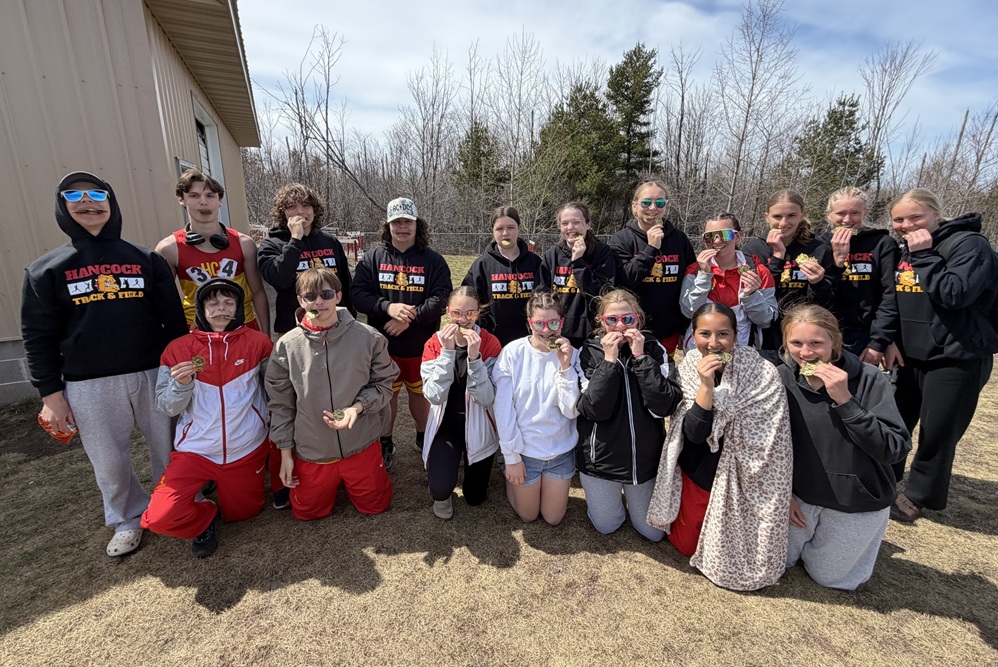
PHOTO Hancock athletes bite down on their medals won at their home invitational.
Pickford Wins Matchup of Reigning Champions to Run Title Streak to 3
By
John Vrancic
Special for MHSAA.com
June 2, 2024
KINGSFORD — The Pickford boys extended their championship reign here Saturday, retaining top honors at the Upper Peninsula Division 2 Track & Field Finals with 137 points.
They were followed by Munising with 106 and Ishpeming with 79. The team championship was the Panthers’ third straight, as they also won Division 3 in 2022.
Sophomore Gunner Bennin was a double-winner for Pickford, taking the 200-meter dash in 23.85 seconds and 400 at 53.36.
“It feels great to come here and win a couple events as a sophomore,” he said. “We knew Iron Mountain had some good sprinters, and Munising is tough. We needed the points. I started faster than I usually do, especially in the 400.
Senior Hayden Hagen provided the Panthers with a first in the 800 (2:05.03), and sophomore John Anderson won high jump at 5 feet, 8 inches.
Panthers junior Tom Storey was runner-up in pole vault (10-6) and high jump (5-7). Hagen was runner-up to Munising junior Dan Goss in the 1,600 (4:39.84) and 3,200 (10:30.81).
Goss ran a personal-best 4:33.98 in the 1,600 and was clocked at 10:23.9 in the 3,200, and anchored the winning 3,200 relay (8:50.22).
 “I like the weather today,” he said. “It was a little humid during the 3,200. Otherwise, it was a good day for running. That was a 10-second PR (personal record) in the 1,600. I’m real happy with that. I’ve been training my tail off the last two weeks.
“The field events hurt us, but overall I’m happy with how our team did. I had a PR in every event including a split of 2 minutes flat in the 3,200 relay.”
Munising – the Division 3 champion in 2023 – also took the 800 relay (1:36.19), and Pickford was runner-up (1:38.18). The Panthers claimed the 1,600 relay (3:43.36) and placed second in the 3,200 (8:52.74).
Munising senior Joe Kelley added firsts in the 110 hurdles (16.46) and the 300s (42.12) and helped the Mustangs take second in the 400 relay (46.19) and 1,600 (3:48.86). Mustangs’ senior Trevor Nolan added a third in the 1,600 (4:43.41), followed by Bark River-Harris freshman Ben Knauf in a personal-best 4:48.04.
Ishpeming got a first on senior Brayden Martin’s throw of 123-9¼ in discus, and Hancock senior Myles Lewis took shot put (42-11½).
The Hematites got seconds from senior Tramon Gauthier in long jump (18-7¾), 110 hurdles (16.47) and 300s (43.62), and freshman Kemper Gearhart was third in the 3,200 (10:41.5).
Ironwood sophomore Talon Hughes placed second in the 100 (11.51) and 200 (23.98) and third in the 110 hurdles (16.55).
Iron Mountain senior Matt Colavecchi had a hand in three firsts, taking the 100 (11.44), long jump (19-8¼) and anchoring the winning 400 relay (45.92).
Rudyard got a first on junior Jaydon Niemi-Alcorn’s leap of 11-6 in pole vault. Taking runner-up for the Bulldogs were senior teammate Kaeden Sistrunk in shot put (40-8) and junior Ethan Hoolsema in discus (120-0).
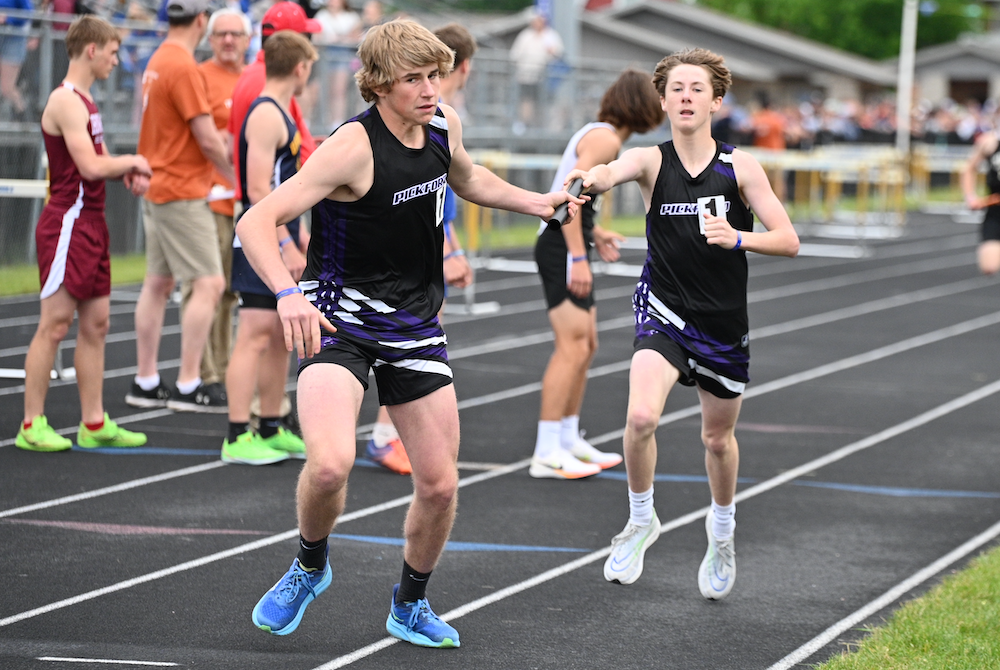
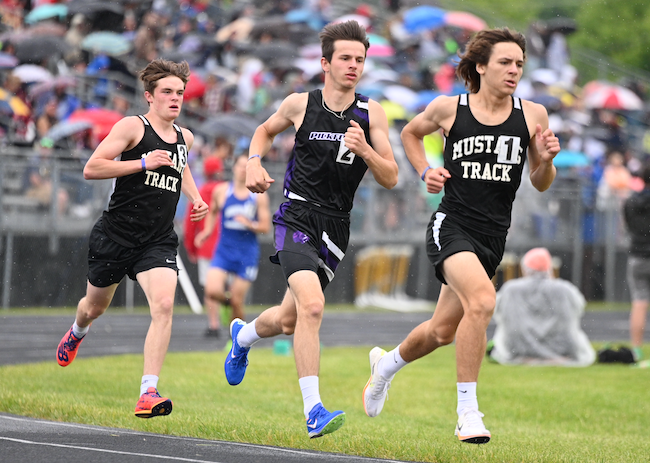
PHOTOS (Top) Pickford's Jacob Mitchell hands off the baton to Eli MacDonald for the last leg of the 3,200 relay Saturday at Kingsford. (Middle) During a rainy 1,600, Munising's Dan Goss (1) leads the race with Pickford's Hayden Hagen (2) and Munising's Trevor Nolan (3) right behind him. (Click for more from Cara Kamps/RunMichigan.com.)