

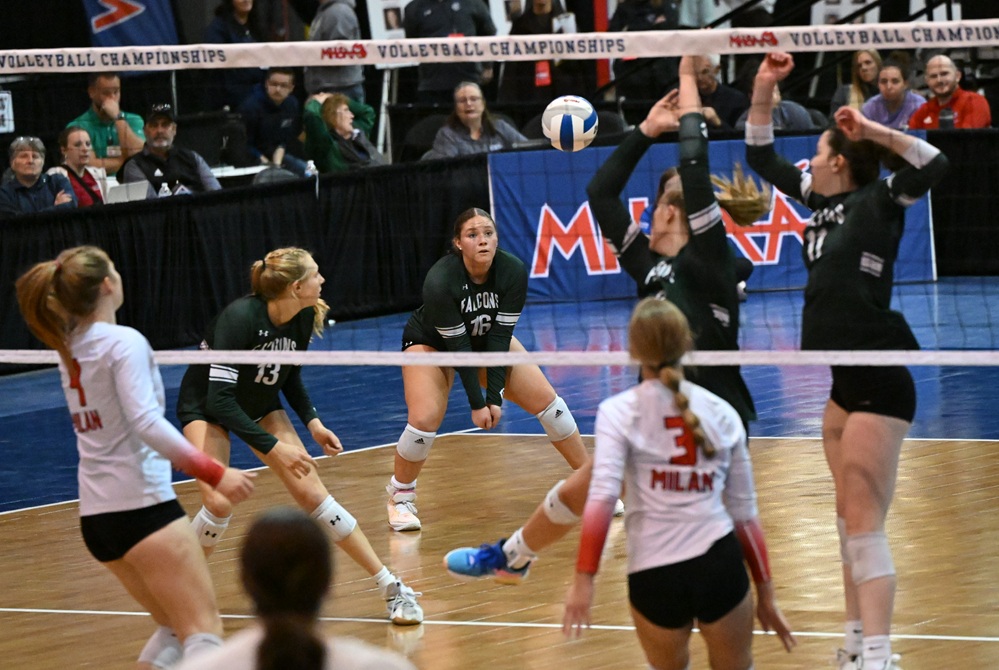
Be the Referee: Illegal Attack
By
Paige Winne
MHSAA Director of Brand Management
November 11, 2026
Be The Referee is a series of short messages designed to help educate people on the rules of different sports, to help them better understand the art of officiating, and to recruit officials.
Below is this week's segment – Illegal Attack - Listen
A volleyball scenario for you today:
A back-row player attacks the ball from in front of the attack line and the ball is higher than the net. Is this allowed?
Sort of.
Simply being a back-row player and contacting the ball higher than the net in front of the attack line is not illegal.
Completing the attack makes it illegal.
An attack is considered complete when the ball either crosses the net completely or is legally contacted by the opponent.
The referee should wait until the attack is completed before making the call.
If this happens, the play is whistled dead for an illegal attack.
Previous 2026-27 editions
Nov. 3: Pass Interference - Listen
Oct. 27: Field Hockey Substitutions - Listen
Oct. 20: Foot Save in Volleyball - Listen
Oct. 13: Soccer Advantage - Listen
Oct. 6: Defensive Holding - Listen
Sept. 29: Minimum Number of Volleyball Players - Listen
Sept 22: Soccer Changes - Listen
Sept: 15: Dead Ball Penalty - Listen
Sept. 8: Libero Ejected - Listen
Sept. 1: Soccer Foul After Shot on Goal - Listen
Aug. 25: Fumble Out of Bounds - Listen

Be the Referee: Lodged Ball
May 15, 2019
This week, assistant director Brent Rice offers a baseball/softball "You Make the Call" regarding a batted ball that becomes lodged in the fence.
Be The Referee is a series of short messages designed to help educate people on the rules of different sports, to help them better understand the art of officiating, and to recruit officials.
Below is this week's segment – Lodged Ball - Listen
Let’s test your rules knowledge with a “You Make The Call” on this baseball-softball situation.
The batter hits a line drive – and the ball caroms directly off first base into foul territory and wedges itself into a gate near a dugout without ever touching the ground. What’s the call?
First, the batted ball is a fair ball because it struck a base. At this point, it’s still a live ball. Then, when the ball became wedged in the dugout gate, it became a dead ball. By rule, the batter would be awarded second base, and any other runners on base would be awarded two bases at the time of the pitch.
Past editions
May 9: Bounced Pitch - Listen
May 2: Boys Lacrosse Safety - Listen
April 25: Softball Illegal Pitch - Listen
March 21: Instant Replay in Basketball - Listen
March 14: Basket Interference - Listen
March 7: Primary Areas - Listen
February 28: Under the Bus - Listen
February 21: You Make the Call - Listen
February 14: Because They Love It - Listen
February 7: Coach/Official Communication - Listen
January 31: Backcourt Violation? - Listen
January 24: Required Hockey Equipment - Listen
January 17: You Make the Call: 10-Second Clock - Listen
January 10: Tripping in Hockey - Listen
January 3: Sliding in Basketball - Listen
December 27: Stalling in Wrestling - Listen
December 20: Basketball: You Make the Call - Listen
December 13: Basketball Uniform Safety - Listen
December 6: Coaching Box Expansion - Listen
November 29: Video Review, Part 2 - Listen
November 22: Video Review, Part 1 - Listen
November 15: You Make the Call - Sleeper Play - Listen
November 8: 7-Person Football Crews - Listen
November 1: Overtime Differences - Listen
October 25: Trickery & Communication - Listen
October 18: Punts & Missed Field Goals - Listen
October 11: What Officials Don't Do - Listen
October 4: Always 1st-and-Goal - Listen
September 27: Unique Kickoff Option - Listen
September 20: Uncatchable Pass - Listen
September 13: Soccer Rules Change - Listen
September 6: You Make the Call: Face Guarding - Listen
August 30: 40-Second Play Clock - Listen
August 23: Football Rules Changes - Listen