

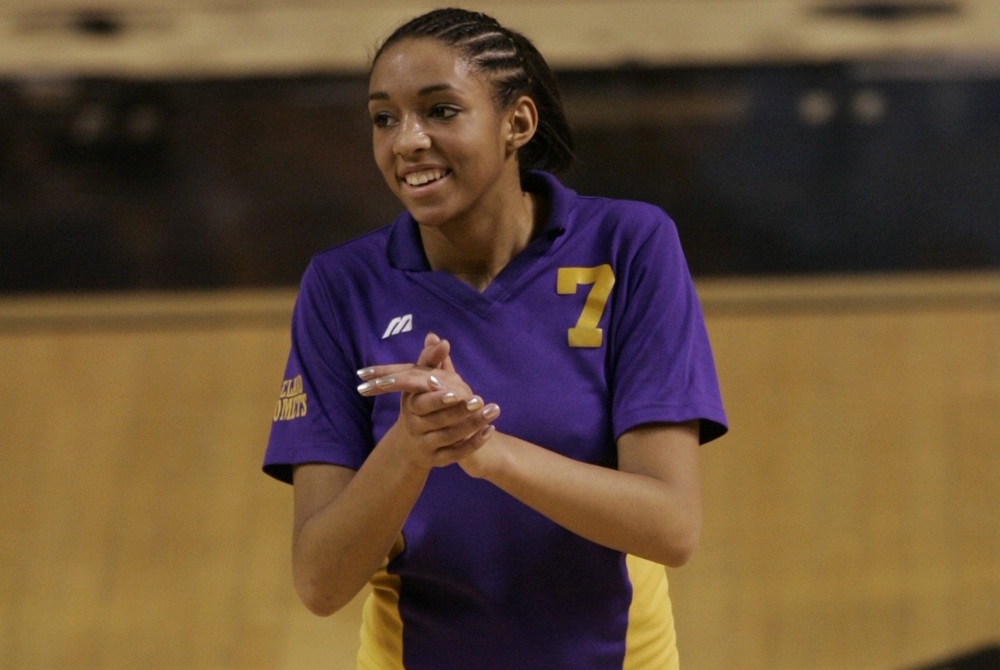
Leland's Glass Childress Selected as 11th Michigan Inductee Into NFHS Hall of Fame
By
Geoff Kimmerly
MHSAA.com senior editor
March 9, 2026
More than two decades have passed since Alisha Glass took her final swing at a volleyball in a Leland High School uniform, and yet her accomplishments for her small-town school in Northern Michigan remain among the most notable in that sport’s history not just statewide, but at the national level.
Glass, now Alisha Glass Childress – who went on to star on three Penn State national championship teams and help the U.S. national team to a bronze medal at the 2016 Olympics – will have her record-setting high school career enshrined this summer as one of 12 honorees announced today as this year’s inductees into the National High School Hall of Fame by the National Federation of State High School Associations (NFHS).
 Childress will be inducted as part of the 43rd Hall of Fame class at a ceremony during the NFHS summer meeting June 29 in Salt Lake City. The rest of the class is made up of four more athletes, three coaches, two game officials, one former state association administrator and one former fine arts educator. Childress was nominated by the Michigan High School Athletic Association.
She will become the Hall of Fame’s 11th inductee from Michigan, joining the MHSAA’s first full-time Executive Director Charles E. Forsythe (inducted 1983), River Rouge boys basketball coach Lofton Greene (1986), Warren Regina athletic director, softball and basketball coach Diane Laffey (2000), Fennville basketball and baseball standout Richie Jordan (2001), Grosse Pointe Woods University Liggett boys and girls tennis coach Bob Wood (2005), Bloomfield Hills Cranbrook hockey standout Jim Johnson (2007), Owosso football, basketball and baseball all-stater Brad Van Pelt (2011); Vermontville Maple Valley baseball national record holder Ken Beardslee (2016), retired MHSAA Executive Director John E. “Jack” Roberts (2022) and Dearborn Heights Robichaud football, basketball and track & field star Tyrone Wheatley (2024).
“My high school career at Leland, surrounded by such an amazing support system and community, was the essential first chapter of my story. It cultivated the grit and the fundamental love for the game that allowed me to reach the highest levels of athletics,” Childress said. “I’m proud of every medal and trophy, but I’m just as proud of the roots I planted back in high school that made them all possible.”
Childress graduated from Leland in 2006 with national high school career records of 3,584 kills, 680 blocks and 937 aces, and 296 aces for one season as a junior. Her aces records still stand, her career kills record stood until broken in 2024 by Shelby’s Navea Gauthier, and she remains third on the career blocks list. Glass continues to hold MHSAA records for single-season and career aces and also for her 48 kills in Leland’s 2005-06 Class D Final win over Battle Creek St. Philip. Childress also led Leland to a Class D runner-up finish in 2004-05 and the Semifinals in 2003-04. (All three tournament runs took place while girls volleyball was still played during the winter season before moving to the fall to begin the 2007-08 school year).
Childress earned the Miss Volleyball Award and Gatorade Player of the Year Award for Michigan as a senior, and her name is listed 19 times throughout the MHSAA girls volleyball record book. She also made Michigan's Class D all-state first team on the basketball court as both a junior and senior, averaging 18 points and 11 rebounds per game as a junior and 16 points, 10 rebounds and 3.7 blocked shots per game as a senior while leading her basketball team to Class D Quarterfinals both of those seasons.
“As our staff researched our first 50 years of female sports for our ‘Title IX at 50’ celebration during the 2021-22 school year, they told stories of several standouts who went on to collegiate, Olympic and professional stardom – and Alisha Glass stands out even among the greats,” MHSAA Executive Director Mark Uyl said. “Taking into account everything she accomplished individually and with her teams, and not just in volleyball but basketball as well, it’s a strong argument that Alisha Glass continues to set the bar as not only our state’s best female athlete all-time, but arguably the most accomplished volleyball player in national high school history. We are thrilled that she will be inducted into the National High School Hall of Fame.”
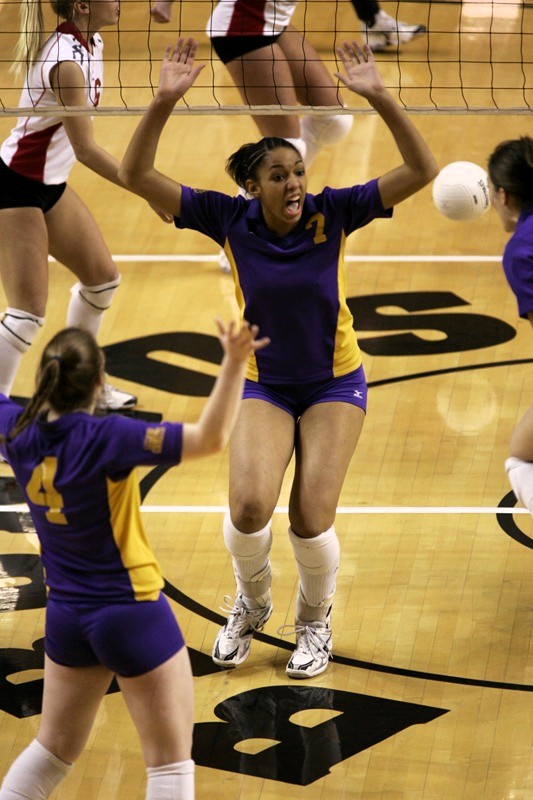 Also during high school, Childress played on the 2004 and 2005 USA youth national volleyball teams and helped the 2004 team to the North, Central America and Caribbean Volleyball Confederation (NORECA) championship, and was named Best Server at that event. After high school, she started all four seasons at national power Penn State and set the Nittany Lions to three straight NCAA championships, being named to the American Volleyball Coaches Association (AVCA) All-America first team twice and second team once.
Childress continued her career professionally and internationally, playing professionally in the United States and Puerto Rico, Italy, Turkey, Poland and Brazil and being named USA Volleyball Indoor Female Athlete of the Year for both 2013 and 2014. She led the U.S. national team to bronze at 2016 Olympics and was named Best Setter of the tournament, after being selected as an alternate for the 2012 Olympic team.
Most recently, Childress played for the Pro Volleyball Federation's Vegas Thrill in 2024 and 2025 and played in the league's first All-Star Match last season. She’s currently the head coach of the San Diego Mojo of Major League Volleyball and last summer also completed her first season as a coach with Athletes Unlimited. She previously served as an assistant coach with the Stanford University women’s volleyball program from 2019-21 – including during the team’s run to the Division I national title in 2019 – and also served as an assistant for the gold medal-winning U.S. national team during the 2018 Pan American Cup.
Childress is the daughter of Laurie Glass, who retired from coaching Leland after the 2023 season and ranks seventh in MHSAA girls volleyball coaching history for victories with a career record of 1,259-410-124. Glass led Leland to three Class D championships and five runner-up finishes. Childress’ grandfather Larry Glass ranks on the MHSAA girls basketball coaching victory list with a 388-110 record and led Leland to three straight Class D titles from 1980-82. He also coached the Northwestern University men’s basketball team for six seasons.
Additionally, Childress is married to past Stanford basketball star Josh Childress, who went on to play eight seasons in the NBA and several more overseas. They have three daughters, Maya, Mina and Amara.
The National High School Hall of Fame was started in 1982 by the NFHS. The 12 individuals were chosen after a two-level selection process involving a screening committee composed of active high school state association administrators, coaches and officials, and a final selection committee composed of coaches, former athletes, state association officials, media representatives and educational leaders. Nominations were made through NFHS member associations. Also chosen for this class were athletes Joe Carter (Oklahoma), Jordan Larson (Nebraska), Krissy Wendell-Pohl (Minnesota) and Patrick Willis (Tennessee); sport coaches Jan Barker (Texas), David Gentry (North Carolina) and Flo Valdez (New Mexico); game officials Burney Jenkins (Kentucky) and Mary Lou Thimas (Massachusetts), former state association administrator Steve Savarese (Alabama) and former fine arts educator Craig Ihnen (Iowa).
For more on this year’s Hall of Fame class, visit the NFHS Website.
Fear the Socks: Cadillac Volleyball Success Never Out of Style
By
Tom Spencer
Special for MHSAA.com
September 22, 2023
Cadillac’s girls volleyball team is quite accustomed to getting flack from opposing teams’ student sections about their socks.
 That’s not likely to continue much longer though, thanks to the Vikings’ performance on the court and major college teams becoming similarly equipped.
And their new warm-up shirts tell it all.
“My team has always worn knee socks,” said 23-year veteran Cadillac coach Michelle Brines. “So people will make fun of the team, or they’ll cheer ‘put your socks down’ and this kind of thing.
“This year we finally got shirts saying ‘Fear the Socks,’” she continued. “The knee socks were in back in the day, and we’ve always worn them.”
Now college powerhouse clubs like Texas and Nebraska wear knee socks. The Cornhuskers just went back to them last season — a year calumniating with an appearance in the national championship match. Nebraska and Texas regularly make runs to and beyond the NCAA Elite Eight.
Under Brines, Cadillac too is used to deep postseason runs including six MHSAA Semifinal appearances. The Vikings made their first appearance in the Division 2 Final last November, falling to North Branch.
Cadillac is off to a 17-3-2 start this fall preparing for Division 1 competition, as they moved into that division for this season. The Vikings have their sights on another Big North Conference championship too as they prepare for District play in Grand Haven at the end of October. Cadillac is 4-1 in league play.
 The Vikings have been led again this year by all-state middle hitter Carissa Musta. The 6-foot-4 senior is handling the pressure well. Teams celebrating a block of Musta’s hit are quickly shaken off, according to Brines.
“It’s got to be tough when somebody gets all crazy because they just blocked you, but Carissa is very composed,” Brines said. “She never comes off the floor.
“She’s pretty darn good in the back row,” Brines continued. “I am very impressed with her growth and composure.”
Musta topped the 1,000-kill mark earlier this season and became the school’s career leader in blocks this week in a three-set win over Petoskey.
Senior Makenzie Johns, a 6-1 outside hitter, is also an offensive powerhouse for the Vikings. Senior setter Cassie Jenema comes through regularly with kills in addition to her strong defense and serving.
“We have 11 players on our team, and they all play an important role,” Brines noted. “Even though we have a few that really, really stand out, we are not going to be successful if we’re not all doing our job.”
The Vikings also regularly feature three sophomores: Ari Bryant, Grace Zubak and Sophia Clough. All three were on the freshman team last year because of the team’s depth.
Cadillac shared the Big North championship last year with Traverse City Central. They both suffered home losses to each other but picked up road wins. That trend has continued this year as Central handed Cadillac its lone league loss in five sets on the Vikings’ court. They will play again Oct. 4 in Traverse City.
Brines is pleased with her team’s progress at midseason. The Vikings host Alpena on Wednesday and then battle in the Portage Invitational.
“I have never had a season moving people around as much as I have,” Brines said. “I expect to see a lot of growth out of my team as we go into the second half of the season.”
Brines hopes the Vikings will make a run to the Final again this fall so she can become accustomed to a new routine.
“We finally broke through and won that (Friday Semifinal) night game and got to play the next day, which had never happened,” Brines recalled. “I didn’t really know what to do because usually I was going out for dinner with my team because we lost.”
***
The knee socks are the Vikings' signature also at the freshman and junior varsity levels. “We have all of our levels wear them — it is kind of our thing,” Brines pointed out. “When we walk in we have knee socks, people know we’re Cadillac.
“It’s kind of fun,” she continued. “I am old school.”
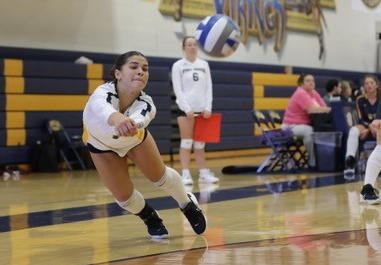 Crew socks are allowed in practice, however. Brines and the Vikings seriously considered getting away from their long-standing tradition.
“I used to make them wear them in practice,” Brines said. “One of my players that went on to coach some college and be a head coach herself said ‘Coach, you can’t do (stop wearing them) because that’s what you kind of always done and nobody else wears knee socks.’”
A spokesperson for Nebraska said there’s no real reason Nebraska went back to wearing long socks beyond player preference, and that it seems like that trend is coming back in volleyball.
“Very cool,” Brines said with a smile when she learned of the Cornhuskers response. “So basically, we never went out of style.”
 Tom Spencer is a longtime MHSAA-registered basketball and soccer official, and former softball and baseball official, and he also has coached in the northern Lower Peninsula area. He previously has written for the Saginaw News, Bay County Sports Page and Midland Daily News. He can be reached at [email protected] with story ideas for Manistee, Wexford, Missaukee, Roscommon, Ogemaw, Iosco, Alcona, Oscoda, Crawford, Kalkaska, Grand Traverse, Benzie, Leelanau, Antrim, Otsego, Montmorency, Alpena, Presque Isle, Cheboygan, Charlevoix and Emmet counties.
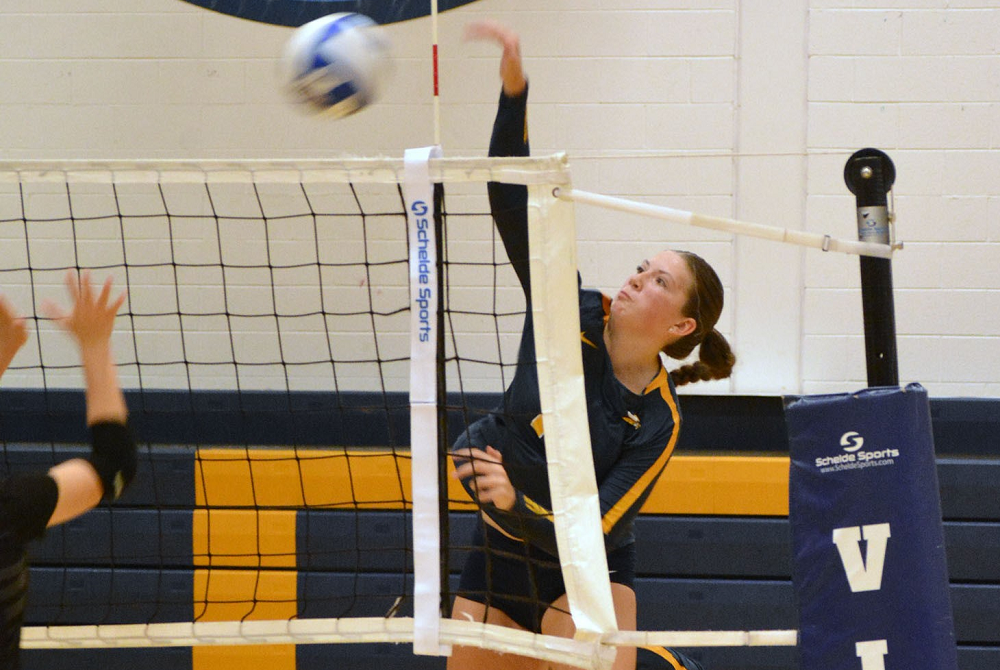
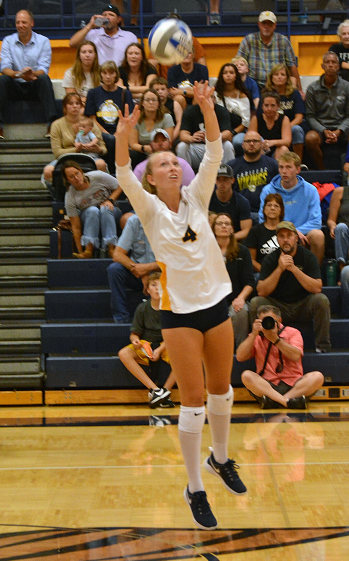
PHOTOS (Top) Cadillac's McKenzie Johns unloads on an attempt during a match. (Middle) Cassie Jenema sets for a teammate during a match. (Below) Ari Bryant keeps the ball in play. (Photos by Marc Vieau/Cadillac News).