


MHSA(Q&A): Grand Ledge Gymnastics' Duane Haring
March 15, 2012
 Duane Haring first took over the Grand Ledge gymnastics program in 2002 because his daughter Allison and her friends kept asking. He left to work as an assistant coach at Michigan State from 2005-06 -- but realized Allison and her teammates were on to something.
Haring returned to the Comets in 2006-07, and last weekend led them to a record fifth-straight MHSAA team championship. Grand Ledge senior Christine Wilson and junior Sara Peltier also won the Division 1 and 2 individual titles, respectively, making it two straight seasons Grand Ledge has swept all three competitions.
This winter's Team Final came down to Grand Ledge's last apparatus, bars, after a below-expectations performance on vault. But just as they have for a decade, Haring's Comets came through when it counted. And although Allison graduated nearly a decade ago, Duane plans to keep the winning streak rolling for years to come.
What was the conversation you had between your third and four apparatus? How would you paraphrase it?
I was sitting with the parents and I told them I was really angry because we can vault. We're a good vaulting team. I think we're the best vaulting team in the state, and we didn't do it. So I told them I just have to go for a walk, because I can't talk to them right now. I started to walk way, and I thought, “Oh yes I can.” I dragged them off the bleachers, and went out in the hallway. Trust me; they were wide awake for bars. They understood, loud and clear.
I know what they can do. All year I've been waiting for them to do bars like that.
Are all these championships different for you, or are they the same?
They're all nerve-wracking. This is supposed to be fun ... (he laughed). It's nerve-wracking.
How do you get them to come back and want to do six?
We lit a fire under them when we first did this. The community loves these guys. Most communities talk about football and basketball, and they still do. But more and more people in Grand Ledge talk about gymnastics. Almost everywhere you go, how about that gymnastics team? They're 75-0 ... that's in the paper, and people pay attention to that. They're into their gymnastics team in Grand Ledge.
Does this make you happy you came back and did this a second time?
It does. I'm glad. It's a good fit for me.
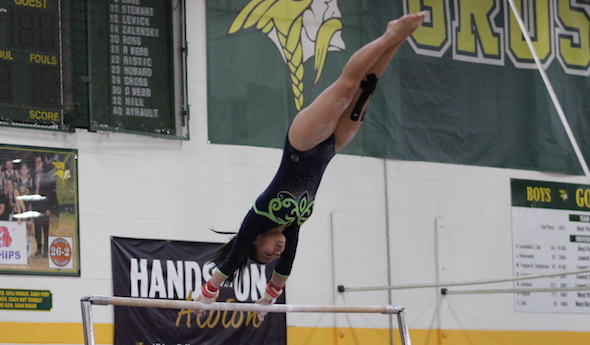
Performance: GP United's Isabelle Nguyen
February 27, 2017
 Isabelle Nguyen
Grosse Pointe North senior – Gymnastics
After taking fifth, second and second, respectively, in the MHSAA Finals Division 1 competition her first three years of competition, Grosse Pointe United’s Nguyen faced high expectations heading into her final season of high school gymnastics – and has met them all. Nguyen scored an all-around 37.975 to win Division 1 at the Great Lakes League Championships on Feb. 18 and earn the Michigan Army National Guard “Performance of the Week” for Feb. 13-19, and she’s won all of her invitationals this season, including the prestigious Canton event that yearly draws the top competition from all over the state.
Nguyen won on all four apparatuses at the league meet, and also posted a 37.150 all-around Wednesday against Canton. She holds every record for Grosse Pointe United, and next will lead her team into the Regional on Saturday at Walled Lake Central. Like many gymnasts, Nguyen also dives – she qualified for the Lower Peninsula Division 2 Finals in the fall and just missed making the final round of competition. She also will return for her third season of lacrosse this spring after sitting out last season with an injury.
 Injuries also will keep Nguyen from pursuing college gymnastics, but she’s got other goals set. She will attend Wayne State University and study computer technology after cultivating an interest in coding during a technology class she took as a junior at North. She carries a 3.5 grade-point average and also is interested in coaching when her competing days are done – which likely will be in two weeks, and potentially after she celebrates a Division 1 all-around title.
Coach Kristin Remillet said: “Watching her success over the past four years has been such a fun experience for me as a coach. It’s great to see a deserving, hardworking young lady like Izzy get the recognition she deserves each and every meet. As an individual competitor, she is peaking this season, her senior year, and has won the all-around title in every single invitational she has competed in this season. … She’s a great all-around gymnast who is a standout competitor in every event. That’s really Izzy’s strength; she is so well-rounded across all four apparatuses, it makes her tough to beat in the all-around competition. … Every time Izzy competes for our team in a large-scale meet, I’m impressed with her focus and her ability to shine in times of pressure. Another of Izzy’s strengths that I’m very impressed with is her ability to lead others in our gym. She’s not just a phenomenal athlete, she is also a great teammate and friend. Whether you have been on the team with her for two years, or two weeks, she makes so many teammates feel comfortable, welcomed, and loves to help them improve as well.”
Performance Point: “Most of my (league) performance, I was pretty happy with; on beam, I haven’t been landing my skills lately, so I was pretty scared about that, but on bar I was pretty satisfied (because) I almost had a fall but I was able to save it,” Nguyen said. “Overall, I was really proud of myself. … I still want (to win MHSAA Finals). It still makes me want to work hard seeing how close other girls were to me. I’m still pushing myself in practice, getting ready for Regionals and states. I’ve just been trying to work on hitting everything.”
Taking flight: “My favorite (apparatus) is uneven bars. I feel like I’m just more free. I feel like I’m flying. When I first started learning it, just started giants, I started liking it all. It’s not something I’m scared of; on beam I’m more scared of doing stuff than on bars.”
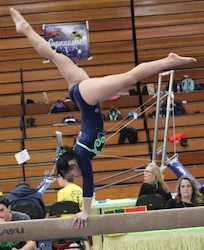 Sport for every season: “It’s mostly keeping me in shape. Diving is the flipping; I just like flipping a lot. In lacrosse, I like to meet new people too who like other sports, and (I like) the running. I’m kinda a fan of running.”
More than tough enough: “Last year, the week of states, I hurt my knee. I have extra bones in my feet, and I just hurt my ankle. … I’d say (gymnasts) are pretty tough. A lot of people don’t think we’re strong. It’s because they think we’re small; they think we’re weak. It’s really not (true). I love gymnastics. I just wanted to keep doing it. I knew I had to take breaks and everything, but it’s something I really like.”
Call me Coach (next year): “Right now I coach little kids, just for fun, but my (high school) coach is planning to have me coach next year if I can. I like seeing new girls like the sport that I like, and it makes me happy helping everyone so they can get better.”
- Geoff Kimmerly, Second Half editor
Every week during the 2016-17 school year, Second Half and the Michigan National Guard will recognize a “Performance of the Week" from among the MHSAA's 750 member high schools.
The Michigan Army National Guard provides trained and ready forces in support of the National Military Strategy, and responds as needed to state, local, and regional emergencies to ensure peace, order, and public safety. The Guard adds value to our communities through continuous interaction. National Guard soldiers are part of the local community. Guardsmen typically train one weekend per month and two weeks in the summer. This training maintains readiness when needed, be it either to defend our nation's freedom or protect lives and property of Michigan citizens during a local natural disaster.
Previous 2016-17 honorees:
Feb. 16: Dakota Hurbis, Saline swimming & diving – Read
Feb. 2: Foster Loyer, Clarkston basketball – Read
Jan. 26: Nick Jenkins, Detroit Catholic Central wrestling – Read
Jan. 19: Eileene Naniseni, Mancelona basketball – Read
Jan. 12: Rory Anderson, Calumet hockey – Read
Dec. 15: Demetri Martin, Big Rapids basketball – Read
Dec. 1: Rodney Hall, Detroit Cass Tech football – Read
Nov. 24: Ally Cummings, Novi volleyball – Read
Nov. 17: Chloe Idoni, Fenton volleyball – Read
Nov. 10: Adelyn Ackley, Hart cross country – Read
Nov. 3: Casey Kirkbride, Mattawan soccer – Read
Oct. 27: Colton Yesney, Negaunee cross country – Read
Oct. 20: Varun Shanker, Midland Dow tennis – Read
Oct. 13: Anne Forsyth, Ann Arbor Pioneer cross country – Read
Oct. 6: Shuaib Aljabaly, Coldwater cross country – Read
Sept. 29: Taylor Seaman, Brighton swimming & diving – Read
Sept. 22: Maggie Farrell, Battle Creek Lakeview cross country – Read
Sept. 15: Franki Strefling, Buchanan volleyball – Read
Sept. 8: Noah Jacobs, Corunna cross country – Read
PHOTOS: (Top) Grosse Pointe United's Isabelle Nguyen competes on uneven parallel bars this season. (Middle) Nguyen performs on balance beam at last season's MHSAA Finals. (Photos courtesy of Grosse Pointe United gymnastics.)