


MHSA(Q&A): Grand Ledge Gymnastics' Duane Haring
March 15, 2012
 Duane Haring first took over the Grand Ledge gymnastics program in 2002 because his daughter Allison and her friends kept asking. He left to work as an assistant coach at Michigan State from 2005-06 -- but realized Allison and her teammates were on to something.
Haring returned to the Comets in 2006-07, and last weekend led them to a record fifth-straight MHSAA team championship. Grand Ledge senior Christine Wilson and junior Sara Peltier also won the Division 1 and 2 individual titles, respectively, making it two straight seasons Grand Ledge has swept all three competitions.
This winter's Team Final came down to Grand Ledge's last apparatus, bars, after a below-expectations performance on vault. But just as they have for a decade, Haring's Comets came through when it counted. And although Allison graduated nearly a decade ago, Duane plans to keep the winning streak rolling for years to come.
What was the conversation you had between your third and four apparatus? How would you paraphrase it?
I was sitting with the parents and I told them I was really angry because we can vault. We're a good vaulting team. I think we're the best vaulting team in the state, and we didn't do it. So I told them I just have to go for a walk, because I can't talk to them right now. I started to walk way, and I thought, “Oh yes I can.” I dragged them off the bleachers, and went out in the hallway. Trust me; they were wide awake for bars. They understood, loud and clear.
I know what they can do. All year I've been waiting for them to do bars like that.
Are all these championships different for you, or are they the same?
They're all nerve-wracking. This is supposed to be fun ... (he laughed). It's nerve-wracking.
How do you get them to come back and want to do six?
We lit a fire under them when we first did this. The community loves these guys. Most communities talk about football and basketball, and they still do. But more and more people in Grand Ledge talk about gymnastics. Almost everywhere you go, how about that gymnastics team? They're 75-0 ... that's in the paper, and people pay attention to that. They're into their gymnastics team in Grand Ledge.
Does this make you happy you came back and did this a second time?
It does. I'm glad. It's a good fit for me.
Finals Preview: Grand Ledge Seeks 7
March 6, 2014
By Geoff Kimmerly
Second Half editor
Arguably the most impressive current winning streak in any MHSAA sport will be on the line Friday at Plymouth High School.
The Grand Ledge gymnastics team has won more than 100 straight events – duals and invitationals – and will compete for a seventh straight MHSAA Finals team championship.
The reigning Division 1 and 2 individual champions also will be back for Saturday’s competition – and this time both compete in Division 1.
Team Finals are Friday beginning at 2 p.m., with Individual Finals at noon Saturday. Click for a complete list of qualifiers, Regional results and this weekend’s rotation schedules, and see below for some of the teams and individuals who could make a run at the top.
Team contenders
Grand Ledge – At this point, the championship is Grand Ledge’s to lose. Grand Ledge’s 145.050 was the second-highest Regional score in the state, and five of last season’s top seven gymnasts should make the Comets a contender again – even if numerically they may not be the favorite this time.
Canton – After three straight runner-up finishes, Canton could finally end Grand Ledge’s winning streak featuring a number of top athletes who have gained plenty of experience the last few seasons. Canton’s 147.650 was the highest Regional score in the state last week, and the Chiefs also won their invite – generally the most prestigious event of the regular season – in February.
Grand Rapids Forest Hills – With three Division 1 contributors and a host of veterans, Forest Hills looks good to move up from last season’s sixth-place finish. Its 144.075 to finish second at the Regional indicates the potential to push into the top three.
Farmington – The state’s power program before Grand Ledge and runner-up to the Comets in 2010 and 2008, Farmington is back in the mix after finishing third at last season’s Final. The 144.575 score to win the Regional was the third highest in the state last week.
Division 1
Presley Allison, Grand Ledge senior – Last year’s Division 2 individual champion is a contender again after moving up a level. She won vault and beam at her Regional and finished second only to teammate Rachel Hogan with an all-around score of 37.975.
Paige Blythe, Howell senior – Tied for first at the Kensington Lakes Activities Association meet with a score of 36.875 and finished runner-up at her Regional after taking 13th at last season’s Division 1 Final.
Melissa Green, Canton senior – Last season’s fourth-place finisher in Division 1 at the MHSAA Final, she won a tough Regional last week with a score of 37.550 while finishing first on floor and vault.
Rachel Hogan, Grand Ledge sophomore – Contributed on last season’s team champion despite being a freshman. She also finished 10th in the Division 1 individual standings and won the championship on floor. She won her Regional last weekend in 38.100.
Morgan Korf, Rockford/Sparta sophomore – Finished 11th in the Division 1 all-around as a freshman and took third at her Regional with a score of 36.025, finishing just behind the pair of Grand Ledge standouts.
Jocelyn Moraw, Canton junior – Won the Division 1 Final on beam in 2013 and is an all-around contender as well after placing fifth last season. Moraw finished second to teammate Green at the Regional with a score of 37.475.
Christina Shabet, Troy senior – The reigning Division 1 individual champion pulled off an all-around effort last season with places of second, fifth, tied for seventh and 12th on the four apparatuses. She distanced herself at last weekend’s Regional with a 38.525 score to win.
Carina Wright, Farmington sophomore – The only one who hung with Shabet at their Regional, Wright finished second with 37 points. She hung with Shabet at last season’s Final as well, finishing a close third, only .325 points back of the champion.
Division 2
Lauren DeHaan, Lowell junior – Finished second at her Regional with a score of 35.350 after competing on beam and vault at the 2013 Division 2 Final.
Hailey Hodgson, Canton sophomore – Tied teammate Erica Lucas for the Regional championship with an all-around score of 35.825; she placed second on two apparatuses, tied for fourth and finished fifth on the other two.
Meredith Jonik, Farmington senior – Last season’s fourth-place finisher in Division 2 is one of the favorites again. She won her Regional with a score of 36.400, placing first on bars.
Erica Lucas, Canton senior – Won the Division 2 vault championship the last two seasons and might be the all-around favorite. She tied for first at her Regional with Hodgson with a score of 35.825 after finishing ninth all-around at last season’s Final.
Julia Mastracci, Troy Athens/Avondale – Finished runner-up to Jonik at their Regional with an all-around score of 35.800. She was eighth at last season’s Final and should push for a top-five finish this time.
Brianna Rhoad, Livonia Blue – Finished seventh at last season’s Division 2 Final. She took an impressive third behind the Canton pair at their Regional with a score of 35.700.
Cassidy Terhorst, Grand Rapids Forest Hills sophomore – Finished first at her Regional with a score of 36.500 after taking first places on three apparatuses.
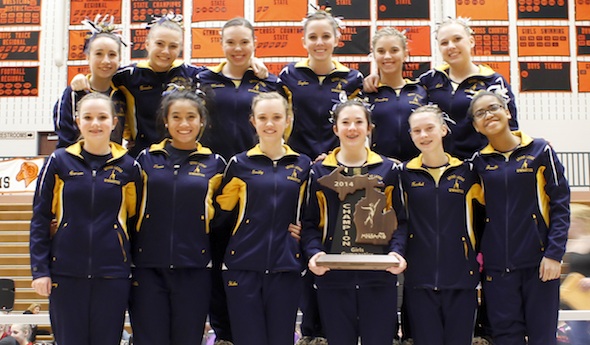
PHOTO: Grand Ledge poses with its championship trophy after winning its Regional last week. (Photo courtesy of Greg Long).