

Be the Referee: Hockey Delayed Offside
By
Brent Rice
MHSAA Assistant Director
February 16, 2022
Be The Referee is a series of short messages designed to help educate people on the rules of different sports, to help them better understand the art of officiating, and to recruit officials.
Below is this week's segment – Hockey Delayed Offside - Listen
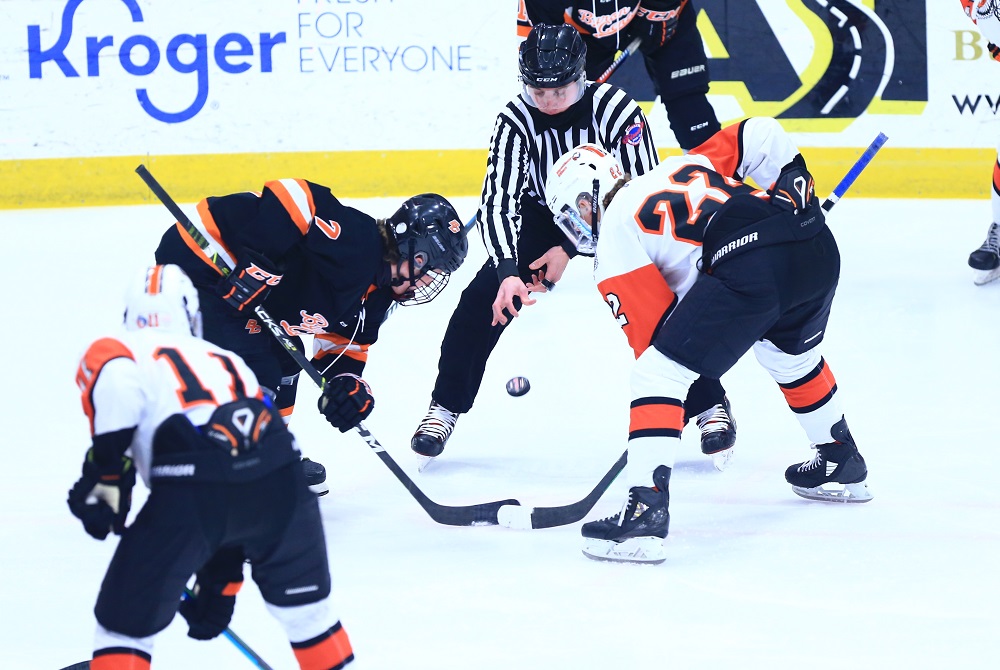
Bundle up because we are on the ice today with a delayed offside situation in hockey.
During the delayed offsides, the puck is shot directly on goal. Should the official:
► Whistle the play dead and restart with a faceoff from the offending team zone?
► Whistle the play dead and restart with a faceoff from the closest dot from where the shot was taken?
► Whistle the play dead and restart with a faceoff from the neutral zone?
► Or – let the play continue.
If you said let the play continue, you are correct. In this situation, the play should be allowed to continue until all offensive players clear the offensive zone.
The next time there’s a delayed offsides call with a shot on goal, you’ll know what to do.
Previous editions
Feb. 10: Basketball Timeout - Listen
Feb. 3: Basketball Video Review - Listen
Jan. 27: Wrestling Inspections - Listen
Dec. 16: Ball Over Backboard - Listen
Dec. 9: Winter Officials Mechanics - Listen
Nov. 26: Instant Replay - Listen
Nov. 11: Tourney Selection - Listen
Nov. 4: Receiver Carried Out of End Zone – Listen
Oct. 28: Volleyball Back-Row Block – Listen
Oct. 21: Soccer Disallowed Goal – Listen
Sept 30: Field Goal Falls Short – Listen
Sept. 23: Volleyball Obstruction – Listen
Sept. 16: Catch or No Catch – Listen
Sept. 9: Intentional Grounding – Listen
Sept. 2: Pass Interference – Listen
Aug. 26: Protocols and Mechanics – Listen
NFHS Network Touts Hockey Powers
January 21, 2015
By John Gillis
Courtesy of NFHS Huddle Up
This Friday, two talented Michigan Interscholastic Hockey League (MIHL) teams will take to the ice in what promises to be a highly competitive contest that will be broadcast live on the NFHS Network and is being featured this week on the NFHS website.
Bloomfield Hills Cranbrook Kingswood (11-1-1-1), ranked No. 1 in Division 3, will host Division 2 No. 3 Detroit U-D Jesuit (11-3) at Wallace Ice Arena. (Click here to watch the broadcast.)
Last season, Cranbrook Kingswood went 26-2 overall, placed first in the MIHL North Division at 12-1, and advanced to the MHSAA Quarterfinals where it fell to the eventual champion.
According to longtime Cranes coach Andy Weidenbach, his team and U-D Jesuit's Cubs likely will engage in a spirited game.
“This will be another tough battle in the MIHL – you can’t take a game off and be competitive in this league,” Weidenbach said. “U of D Jesuit and Cranbrook enjoy a friendly rivalry, and each game between them is generally highlighted by close checking, tough defense and low scoring.
“Experience has to be one of our stronger points. There are 13 seniors on the roster, including two senior goalies and four senior defensemen.
“Among our top players is 6-foot, 165-pound senior forward Austin Alger, who centers the No. 1 line, is our “go-to” player, and is committed to Miami (Ohio) University. Five-nine, 165-pound senior defenseman Cooper Stahl plays his position well, handles the puck well, and has great awareness on the ice. Both are team captains who have made significant contributions to the success of the program during their four years at Cranbrook.
“Spencer Applebaum – who is a senior goalie – has an outstanding record in MIHL play, was in net for the state championship game as a sophomore, and the team has confidence with him in the nets.
“As a high school hockey program, Cranbrook is honored that the game with U of D-Jesuit was selected to be highlighted by the NFHS Network. Our school, our students, our fans and the MIHL share in this honor.”
U-D Jesuit coach Rick Bennetts fosters great respect for Cranbrook and concurs with Weidenbach regarding the upcoming game.
“Cranbrook is always one of the best teams in the state, if not the best team in the state each year, and this year is no different,” Bennetts said “They are such a well-coached team that they rarely beat themselves. We have been able to beat them only three times in our 20-year history, so we will have to bring our ‘A Game.’
“We really don’t have top players – we have 10 forwards, seven defensemen and two goaltenders who all work to get the job done. Our leading scorers are Christian Wirth-Karbler and Teddy Apap with 13 points each, followed closely by Sam Knoblauch at 11 points. Our goalies – Jack Deines and Jake Robinson – are also top players for us. As they go, we go.
“We are truly humbled and honored to be a part of this webcast – it’s something we have never had the opportunity to do as a featured game in our 20-year history. We are the only high school in the city of Detroit to have high school hockey ,and our school has stayed in the city of Detroit for almost 140 years educating young men for the Greater Glory of God. One hundred percent of our students go on to college every year, and we currently have 10 former hockey players playing junior and/or college hockey, as well as one playing professionally.”
Huddle Up is published on the National Federation of State High School Associations website and covers everything from legends of the past to the inspiring stories of the present and the record breakers of the future. Click to read more.
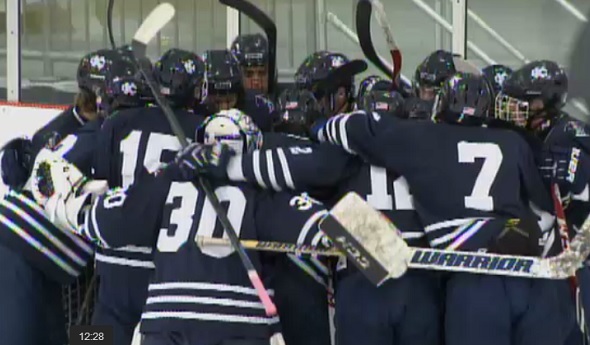
PHOTO: Bloomfield Hills Cranbrook Kingswood players huddle up before last week's game against Orchard Lake St. Mary's.