

Brighton Coach's Impact 'Immeasurable'
By
Tim Robinson
Special for MHSAA.com
October 7, 2020
By Tim Robinson
Special for Second Half
Paul Moggach has never been much for looking back.
 And as he begins his first season away from the Brighton hockey program in more than three decades, he’s still looking ahead.
“I’m thinking about what I’m going to miss more than the mark I left,” he said in a phone conversation last week. “I guess I enjoyed so much of the time I had, the opportunity to coach at Brighton, I’m thinking more how I fill the time and the things I'll miss.”
Moggach (pronounced MUG-uth) retired as Brighton’s coach this past summer after 25 seasons and having led five teams to MHSAA Division 1 championships. He compiled a record of 466-172-47 during that period.
But that’s not what he remembers most, nor why he wants people to remember him.
“I would like them to remember the teams and players who played for me and my assistants, more than me,” Moggach said. “We have so many blessings and opportunities in our lives, and hockey was one for me and hopefully for the players and assistants I worked with.”
One of those assistants was Kurt Kivisto, who joined the Bulldogs originally as a team manager more than 20 years ago and was a player at Brighton. He eventually won a national championship at Michigan State before rejoining the program as an assistant coach a decade ago.
“The No. 1 thing I’ll take from him is sticking by your beliefs and not sacrificing those beliefs for the team,” said Kivisto, who was named Moggach’s successor in September. “He sticks by those beliefs and ... he’s not willing to sacrifice that even if it could hurt the team. The character and integrity he has, how he treats people with fairness and what he believes is right is the biggest thing I’ll take.”
A stepson, Damon Whitten, played for Moggach at Brighton and at MSU before becoming an assistant coach and eventually the head coach at Lake Superior State, where he is in his eighth season.
Asked about Moggach’s impact at Brighton, Whitten said, “I’m not sure you can measure it. Your mind goes to the hockey players who have come to Brighton, and that’s a big part. But I think it goes beyond that. The money they’ve raised over the years for different families in need, for example. He’s had a big impact, and the players he had were a big part of that, but it goes well beyond that, and he did it the right way. Thirty-plus years (in the program), and I’m not sure you can count more than a handful of times where he made a bad decision or handled things poorly. He did things the right way, every day, all of the time, and I think it’s why he was so successful for so long.”
 The team’s charitable works were mostly kept under the radar – Moggach’s reasoning being his players had been given much, it was their turn to give back, and he didn’t want people thinking they did those things for publicity.
Moggach joined Rick Bourbonais as an assistant at Brighton in the mid-1980s, then switched roles with him for the 1996-97 season.
He realized Brighton’s potential in the 1992-93 season, when the Bulldogs upset perennial state power Trenton in the Class A Quarterfinals before losing to Detroit Catholic Central in a Semifinal.
“That, to me, said, at least in my mind, that we can do this,” Moggach said. “It’s not impossible.”
He slowly began to build the program, getting good players and a schedule that would challenge them.
“You get the players by building a good culture,” he said. “Back in the day, when I started, we weren’t very disciplined and our league wasn’t very disciplined. So I think we realized we had to build that, and I could have an influence on building that in Brighton.”
Along with the culture, Moggach looked for an edge whenever he could find it. He was talked into making a trip to the Keweenaw Peninsula by one of his player’s parents, and found enormous benefits for his team, both competitively and in team bonding.
“It’s a lot about the little things we do,” he said, “that we find joy in, and create those opportunities. Creating the little moments really can build to bigger moments. We played capture the flag one day in about two feet of snow.
“Almost killed them,” he added, chuckling. The exhausted players didn’t have much left for the game that night, but spending time together for four days in a bus and hotel room always brought the team closer on and off the ice.
That first UP expedition also led to more teams making the trip, for team bonding and a glimpse of a part of the state, and themselves, they might never have seen otherwise.
“We didn’t do that for long,” he said. “But we always came back saying we were better together because of that experience.”
Bob Nelson had three sons play for Moggach, and Nelson’s wife, Kris, was president of the team’s booster club during their involvement over nearly a decade in Brighton hockey. Nelson also coached the program’s younger players for five seasons.
“We got to know the Moggachs really well,” he said. “It was a good experience, both as a coach and as a parent as well.”
Moggach introduced other things, including an emphasis on nutrition and off-ice training, that players resisted at first until they saw the benefits.
 He savored conversations with referees and opposing coaches before the games and even the occasional reporter after games.
But his first priority was the players. At times he would erupt in practice at a player or, more commonly, the team, and the boys soon learned to hear the message, not the volume. But for a couple of seasons, they also wrote some of his wilder statements down in a notebook after practice.
One year, they read some of them at the banquet, and after each one, Moggach’s wife, Sharon, would look at him and ask, “Did you really say that?”
Moggach would laugh and confess to remembering he had actually done so, then laughing.
“He knew part of what made the program good was his relationship to the players,” Nelson said. “If it was a good time, he wanted to enjoy it, even at his own expense at times.”
Moggach has staying in the background this offseason, letting Kivisto shape the team.
Asked if he were willing to fully switch coaching roles, as he and Bourbonais did a quarter-century ago, Moggach laughed.
“No,” he said emphatically. “Rick wasn’t in his 70s when we made the switch. Kurt needs his time. I’ll be there if he needs me.”
Moggach, who is 74, still works fulltime as the University of Michigan’s director of risk management.
He plans to spend more time with his wife and watch his grandsons play hockey, as well as catching some Lake Superior State games.
“I was really blessed to have Rick and Brownie (longtime assistant Mike Brown) along for the ride, and then to get Kurt involved,” Moggach said. “They weren’t the only ones, but they were the kids for me.
“The other thing is the support from the Brighton (High School) administration, the teachers, and our community. There are more people to thank than I could ever bring up. I do think that, all together, it was a great run. It couldn’t have been any better.”
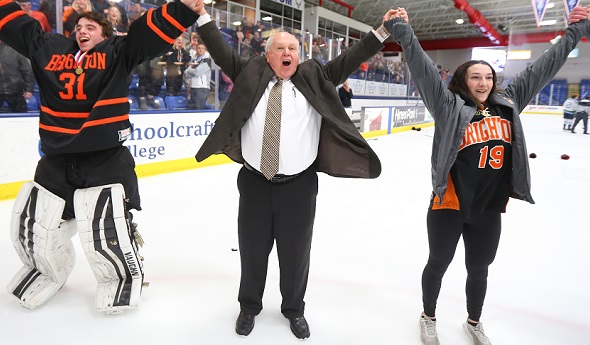
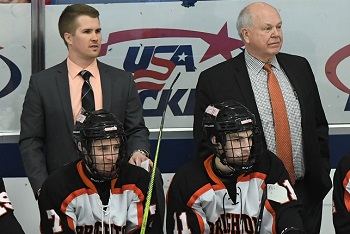
PHOTOS: (Top) Recently-retired Brighton hockey coach Paul Moggach celebrates the 2018 Division 1 championship game win over Saginaw Heritage at USA Hockey Arena. (Middle) Former player Kurt Kivisto, left of Moggach during the 2018 Semifinal win over Detroit Catholic Central, served as an assistant before assuming the head coaching job in September. (Below) Brighton's 2018 championship was its fifth under Moggach. (Photos by Hockey Weekly Action Photos.)
Grandville Seniors Striving to Finish Time Together with Another Memorable Run
By
Dean Holzwarth
Special for MHSAA.com
December 19, 2025
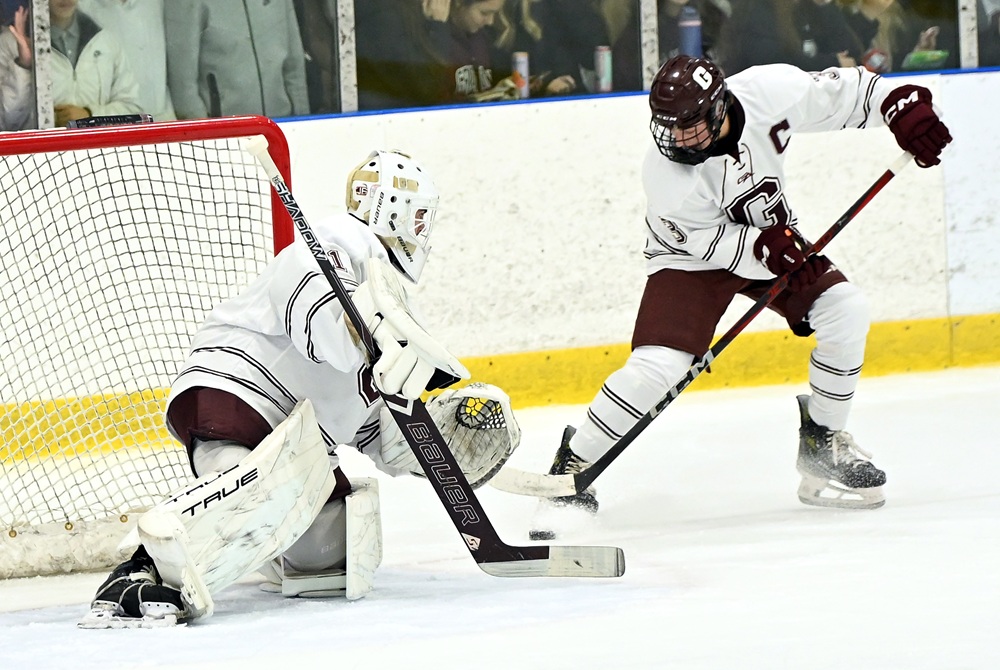
GRANDVILLE – A talented group of nine seniors on the Grandville hockey team have been playing together since they first learned to skate.
 Now, in their final season on the ice, they have sights fixed on ending their careers with another successful campaign.
“It's been really nice to play one last time with some of the guys you’ve been playing with since the youth hockey years and then playing together all four years in high school,” senior goalie Ayden Karas said. “ The chemistry and bond we’ve had all together really makes it one big family.”
Grandville senior Braden Vander Veen sees it as one last opportunity to make a lasting impact on the program.
“It’s been awesome to play with all these guys, and we have a ton of chemistry,” Vander Veen said. “We know we only have a certain amount of time left with each other, so we are just trying to leave it all out there.”
The Bulldogs, who lost in last year’s Division 2 Semifinal to eventual champion Flint Powers Catholic, have picked up where they left off en route to a solid 7-1-1 start to this season.
Longtime Bulldogs coach Joel Breazeale, who last month was recognized as the Michigan High School Coaches Association (MHSCA) Coach of the Year, said expectations remained lofty this winter with the return of several experienced players.
“Very happy with how we have played and I think the players would say they are pleased, but I don’t think they are surprised,” he said. “I think that’s the standard they’ve come to expect over the past two seasons, especially with this senior class that have been together with me since they were 4 or 5 years old. This is their opportunity to see it all the way through.”
 Grandville, currently ranked No. 4 in Division 2, dropped its first game to second-ranked Trenton at the West Michigan Showcase, but bounced back the next day to defeat one of the top teams in Division 3.
The Bulldogs rallied to knock off Houghton 4-3.
“We’ve had some good and solid close games with them, but we never had an opportunity to play them at a neutral site,” Breazeale said. “For our guys, especially with the returning boys, this was an opportunity that we don’t get too often and they just dug a little deeper.
“I thought we played wonderfully the night before against Trenton but the game got away from us, and I felt like the kids came out in the second period (against Houghton) and just picked up where they left off and their coach said that they just couldn't keep up with our guys. We were remarkably consistent with our energy and our ability to stay on top of the puck, constant pressure.”
It was the first time the seniors had beaten Houghton.
“That was huge,” Vander Veen said. “Obviously the night before we played Trenton, which was our first real test, and then beating Houghton, who is one of the best teams in the state, felt great. It really gave us a lot of confidence.”
Six of Grandville’s wins have been shutouts as an aggressive defense and stout goaltending have been complemented by timely goal scoring from a balanced line-up.
“I feel like the season has been going pretty well, we’ve had some good games the past couple weeks,” Karas said. “The defense has been a really big reason why I've performed so well, and they've always been really helpful in front.
 “Expectations were really high this year, especially coming off a final four run last year, but it's a new team and a new year.”
A promising group of younger players also have blended in well to provide depth.
“We have a ton of experience, and we took in a lot of young guys this year,” Vander Veen said. “It’s huge being able to mentor those guys and carry on with the success that we had last year. We have a lot of guys coming back who are hungry for more.
“We have definitely put in a ton of work in the offseason and with what we did last year, we were expecting to be up there this year. We are working toward that final four run again.”
Breazeale is looking for continued growth from his team as the season progresses.
“Marginal gains is what we’re focused on with the returning players, and then really hoping to see a jump from the new sophomores and juniors on the team,” he said. “The larger gains from our newest members will really determine how competitive we are with our depth because for any team to be successful it’s going to take more than just the leading cast members.”
The Bulldogs host Hudsonville on Friday before another road test Saturday against Rockford.
 Dean Holzwarth has covered primarily high school sports for Grand Rapids-based WOOD-TV for five years after serving at the Grand Rapids Press and MLive for 16 years along with shorter stints at the Ionia Sentinel and WZZM. Contact him at [email protected] with story ideas for Allegan, Kent and Ottawa counties.
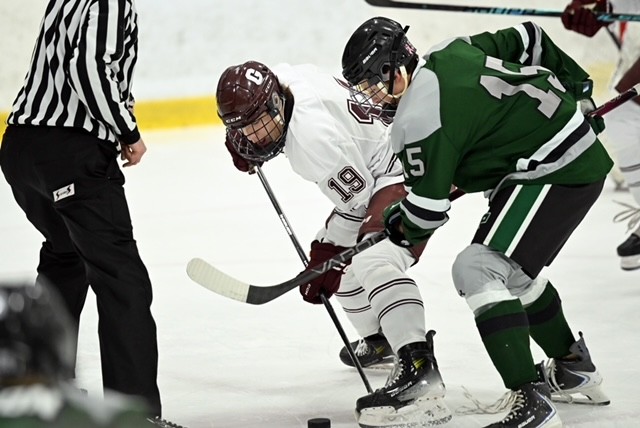
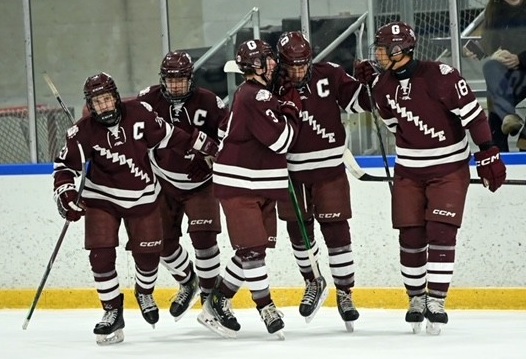
PHOTOS (Top) Grandville’s Braden Vander Veen (3) gets his stick on the puck as goalie Ayden Karas walls off that side of the net during a game this season. (Middle) Luke DeBoer (19) takes a faceoff against Jenison. (Below) A group of Bulldogs skate side by side, including Vander Veen and Lewis Gardine (18). (Photos by Jenn Bellgraph Photography.)