

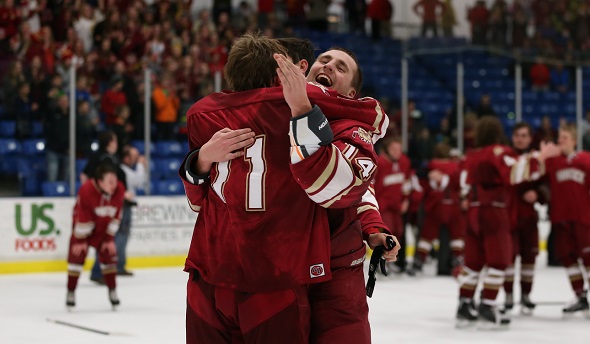
Hancock Finishes Long Trip as Champion
April 14, 2016
By Geoff Kimmerly
Second Half editor
As the Hancock hockey team bus rolled into town to end last month’s Division 3 championship run, coach Dan Rouleau warned his players that the celebration was just getting started.
 “I told these kids on the bus coming home, they were going to be rock stars over the next month,” he recalled Thursday. “And they certainly are.”
That’ll happen when a hockey-crazed community earns its first MHSAA title since 1999, along the way beating 17-time champion Bloomfield Hills Cranbrook Kingswood 2-1 in overtime in the Semifinal and four-time finalist Grand Rapids Catholic Central 4-2 in the championship game.
And despite the Bulldogs’ No. 2 ranking heading into the postseason, the run was made all the more incredible considering Hancock, with 262 students, had the lowest enrollment of among hockey schools in Michigan this winter and was paced by two underclassmen leading scorers and a sophomore goaltender.
“I told the guys before the season started that we’ve got a chance to do something special. I really felt like we had the chance to do this,” said Rouleau, who was an assistant for the 1999 team that won the Class B-C-D title. “When we were looking at who was coming back for the other teams, when we got to the Quarterfinals we told (our team) there are seven teams that could beat you guys, and seven that you could beat. It was that close.”
The Bulldogs are the Applebee’s Team of the Month for March after finishing the run as the best of that final eight, but also with a school-record 24 wins to go with only six losses – four decided in overtime and the other two by only one goal apiece.
Seniors Jack Fenton and Dylan Paavola made the Division 3 all-state first and seconds teams, respectively, bringing a veteran presence to the group of blueliners. But behind them, all-state goalie Dawson Kero was only a sophomore. Sophomore right wing Teddy Rendell was the team’s leading scorer with 24 goals and 36 assists, making the all-state first team, and freshman left wing Alex Nordstrom made the second team with 33 goals and 26 assists. (They were centered by senior Danny Hill, who joined Fenton and Paavola as captains.)
But on-ice dominance was only part of what made Hancock’s run so memorable. Here’s some of the rest:
Hancock, just over the Portage Lake Bridge on the Upper Peninsula’s Keweenaw Peninsula, is one of Michigan’s northernmost towns – and located 540 miles from USA Hockey Arena in Plymouth, home of the MHSAA Finals. Hancock also is 100 miles from Marquette, where it faced Sault Ste. Marie in a Quarterfinal on March 9, two days before it would take on the Cranes in their Semifinal.
First-year athletic director Steve Aho knew if his team won Tuesday in Marquette, it wouldn’t return home but would keep going all the way to Plymouth – so he was charged with planning for a potential five days of hotels, transportation, meals and more. He also started on plans for a fan bus that would bring students to the championship game if Hancock won the Semifinal that Thursday.
Neither trip would come cheap, of course. But that’s where Hancock’s wide-reaching web of supporters stepped in.
Teams making the long trip downstate frequently fund-raise to offset costs, Aho said. In this case the Bulldogs decided to try a GoFundMe crowd-funding web page, asking for $6,000 to combine with what the MHSAA gives teams for travel.
Aho had the team’s seniors write their story before the Quarterfinal, so the request would be in their voice and from their perspective. He published it immediately after the Bulldogs beat Sault Ste. Marie – and by Wednesday, $3,000 had been raised with funds coming in from alumni spread all over the Midwest and beyond. Within two days, the $6,000 was raised, which when combined with funds from the MHSAA paid for the trip.
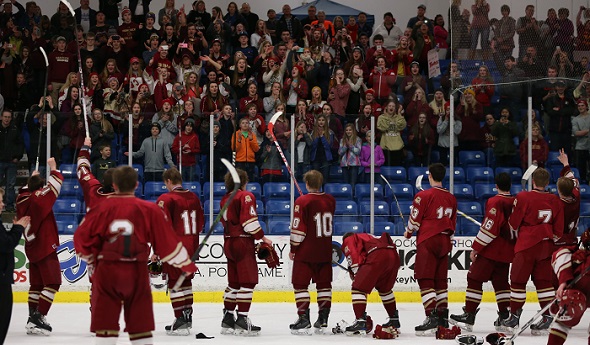 Rouleau said as the bus traveled south, his players watched the donations come in on their phones – and also the inspirational messages left by alums, including the Chicago Blackhawks’ Tanner Kero. “These guys knew they were involved in something special at that point,” Rouleau said.
Meanwhile, the school’s athletic boosters paid for most of a fan bus that was filled with 51 (for 53 seats) who made the trip to root on the Bulldogs – then got right back on the bus for the long trip home.
But what a trip back it was for the team. A Marquette County Sheriff’s deputy escorted the bus through that county, then passing the Bulldogs off to a Baraga County deputy. From Munising homeward (about 150 miles) the parade continued to grow until it swelled to roughly 40 rescue vehicles followed by fan vehicles for another mile (see the long line arriving in town on the video below).
It was a trip none of the players or coaches will forget. Rouleau had enjoyed the 1999 championship with his son and nephew on the team, but this run certainly rivals if not surpasses the first – not only is Rouleau now the head coach, but he also was diagnosed with Parkinson’s Disease six years ago and was hoping he’d have another opportunity to take a team downstate before his health would make him step down.
With the players Hancock should bring back next season, his team's next trip to Plymouth might come after a much shorter wait.
Past Teams of the Month, 2015-16:
February: Petoskey boys skiing – Report
January: Spring Lake boys swimming & diving – Report
December: Saginaw Heritage girls basketball – Report
November: Ann Arbor Gabriel Richard volleyball – Report
October: Benton Harbor football – Report
September: Mason and Okemos boys soccer – Report
PHOTOS: (Top) Hancock players celebrate after their Division 3 Final win over Grand Rapids Catholic Central last month. (Middle) The Bulldogs turn to salute fans who also made the 500-mile trip to USA Hockey Arena.
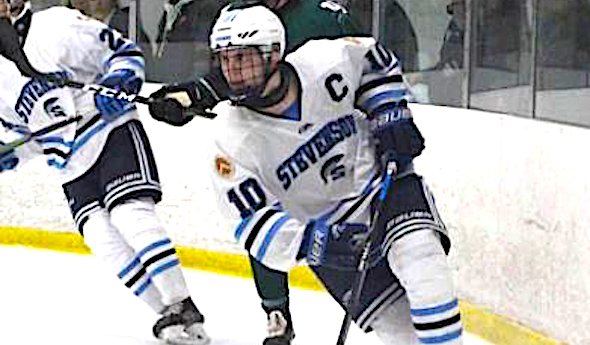
Performance: Stevenson's Seth Lause
January 9, 2020
 Seth Lause
Livonia Stevenson senior – Hockey
The four-year varsity center accomplished one of the rarest of hockey feats Saturday against No. 3 Hartland, scoring three short-handed goals in No. 2 Stevenson’s 5-2 win to earn the MHSAA “Performance of the Week.” Although the National Federation of State High School Associations does not keep a record for short-handed goals in one game, it is possible that Lause was only the second player nationally to score three at the high school level, following Lucas DeBenedet of International Falls, Minn., in 2011.
Lause is tied for the team lead in goals this winter with eight and ranks second with 12 assists as Stevenson is off to a 9-1-1 start. He made the Division 2 all-state second team last season with five goals and 12 assists over 19 games. The MHSAA also has not previously tracked a record for short-handed goals in one game – but for added perspective, the feat has been achieved only once in NHL history. Lause’s first goal came in the second period, and his second and third scores came during the same power play over 1 minute, 29 seconds, during the third period.
Stevenson has had one of the state’s strongest programs over the last decade, making at least the Quarterfinals five straight seasons, finishing Division 2 runner-up twice and winning the championship in 2013. After helping his team to another title pursuit, Lause hopes to continue playing at the junior level after graduation in the spring. Whether he begins college later or right away, he’s interested in the medical field and particularly psychology – and carries a 4.4 GPA at Stevenson.
Coach David Mitchell said: "Seth is a tireless worker ... both on the ice and in the classroom. He is an extremely high-character student-athlete that works tirelessly on his craft. It's been a real honor and pleasure to watch him grow as a player, as a person and as a leader. The sky's the limit for Seth with regards to his future. He is for sure leaving his mark on Livonia Stevenson hockey."
Performance Point: “The first goal was just a fortunate bounce. I think one of their guys missed a pass, and I ended up being on a line rush 2-on-1 with my teammate Noah (Turner). I was just looking for a shot on the first one, just trying to go low stick, since he had the low stick kinda showing me a little bit of that, and the rebound just came out to me when I shot it there, and I ended up burying it,” Lause said, describing his three goals. “The second one was (Ian) Kimble had a good play with his stick. He poke-checked it around one of their defensemen, came in, and created space for himself in the zone and saw my flying into the net. And so he threw it down into the corner and I picked it up down low, and I came around the net on my backhand side and I was looking around to see where everyone was at. I kinda looked off the goalie, and the goalie I saw was low and he had the high short side open, and so I flipped it up over and went up on the high far side. And then the third one was just a good play by Adam Heard. I was calling for it. I got behind their D at the far blue and he found me and gave me a great pass on my tape, and I just came in and shot it high glove. Honestly I didn’t even know we were still short-handed on my third goal, but everyone told me after the game that it was still short-handed and I’d scored three shorties, and I thought it was pretty cool. At first … I didn’t realize to scale how big of a deal it was.”
 Fueled by fun: “It’s just been fun. Last year, I was more focused on just doing as much as I could to win. I still do now, but I don’t put as much pressure on myself now. It’s just a great thing, since it is my last year, just kinda taking a different approach to it this year and just letting everything go and going out and having a blast. This may or may not be my last moments playing; with my friends and for my high school, obviously this is the last year. It’s just been a lot of fun playing with these guys. I think that’s just been the big difference – me letting go mentally and just having a blast doing it. … I’ve always known there’s been something special (with this team), just every year we’ve been here. But this year especially, it’s been just a lot of guys bought in earlier. It just happens quicker with some teams than others. The approach that we’ve had has just been a lot more relaxed, a lot more fun. This group has really connected with one another, and everything’s just clicking right now.”
Play hard, cheer hard: “We usually go to all the other events that we have (at school). So basketball, swimming, volleyball, other sports – we always attend their games. We try to show support that way by going and trying to create a small student section if you will, the whole hockey team. We go to every sport that we can, even tennis we go to. …. Our coach really takes pride in that too, because for everyone who comes to our games, all the peers who come to our games, he likes to give back to them and say thanks, honestly, just for a support they give us. Without them, it’s totally a different environment.”
Stevenson strong: “We just work hard. Our effort is our floor here. We’ve always prided ourselves on being one of the hardest-working teams, both on and off the ice, also involving ourselves in the community (and) we reach out to a lot of teams. We go to a lot of other team events here at our school. We just put a lot of pride in ourselves and the extra stuff we do. It’s just what makes us, us. We’re very involved in development and trusting the process of development and just being a team that works hard. We really just pride ourselves on that.”
The doctor is in: “Anything medical, I’m really interested in. … I’m mostly focused on the brain. I just love how the brain works. There are other organs like the heart that everyone knows about – we know every single little detail about the heart. But the brain is just something that’s so mysterious that a lot of people haven’t figured out yet. So that’s a thing that intrigues me – what is really going on, and something to just figure out because it’s a developing thing right now.”
– Geoff Kimmerly, Second Half editor
Past honorees
Dec. 5: Mareyohn Hrabowski, River Rouge football - Report
Nov. 28: Kathryn Ackerman, Grand Haven swimming - Report
Nov. 21: Emily Van Dyke, Southfield Christian volleyball - Report
Nov. 14: Taylor Wegener, Ida volleyball - Report
Nov. 7: Carter Solomon, Plymouth cross country - Report
Oct. 31: Jameson Goorman, Muskegon Western Michigan Christian soccer - Report
Oct. 24: Austin Plotkin, Brimley cross country - Report
Oct. 17: Jack Spamer, Brighton cross country - Report
Oct. 10: Kaylee Maat, Hudsonville volleyball - Report
Oct. 3: Emily Paupore, Negaunee cross country - Report
Sept. 26: Josh Mason, South Lyon soccer - Report
Sept. 19: Ariel Chang, Utica Eisenhower golf - Report
Sept. 12: Jordyn Shipps, DeWitt swimming - Report
PHOTOS: (Top) Livonia Stevenson's Seth Lause is a four-year contributor to one of the state's top programs. (Middle) Lause also is serving as a captain this winter. (Photos courtesy of the Livonia Stevenson hockey program.)