

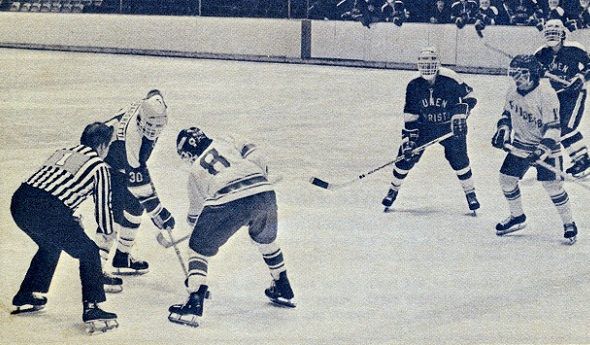
Hockey Owns Long History in Michigan HS Lore
By
Ron Pesch
MHSAA historian
March 2, 2019
By the fall of 1974, there were 80 “bona-fide high school teams” playing hockey in Michigan.
Growth since 1972 had been spectacular. During the 1972-73 school year, according to Michigan High School Athletic Association assistant director Warren McKenzie, there were 32 high school teams playing varsity schedules. In 1973-74, there were 56.
With increased popularity came the desire for championship competition. By late 1972, several school administrators were clamoring for the MHSAA to consider adding a postseason hockey tournament to its sports menu.
In May, October, and November 1973, the MHSAA Hockey Study Committee gathered in Lansing to explore that possibility, and examined the pros and cons of a tournament, the need for a standard set of rules, for limits on number of games in a season and to establish a uniform time of season.
“We see that hockey has come a long way, and due to recent growth, we wish to provide a state tournament,” said McKenzie later that school year. “Before we can provide a state tournament, there must be uniform rules.”
With things in order, in November 1974 the MHSAA announced plans for the first championship tournament, sketching out details for a two-tiered postseason, scheduled for March 1975.
To little surprise, high school hockey has a rich history in Michigan. In self-christened “Hockeytown,” the sport dates back to the late 1920s in the Detroit Public Schools.
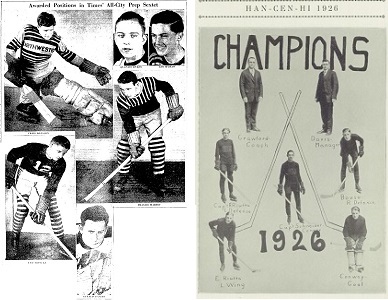 With the largest enrollments in the state, Detroit schools offered a wide array of athletic options to students. The Greater Detroit Prep Hockey Loop in these early days played games outdoors, on public rinks at Kronk and Bradley Parks in Detroit, Redford Park in Redford, at Playfair Park in Hamtramck and in Highland Park. Of course, this being Michigan where winter weather is far from predictable, Mother Nature could play havoc with a season.
Schedules were mapped by week of play, but the actual days and times of the games weren’t announced until weather conditions dictated if and when actual play could occur.
Hockey arrived at Detroit Catholic Central in 1934, started by Father Robert Lowrey. Also dependent upon outdoor rinks in those early years, games were played with Country Day School, Cranbrook School and area club teams. During the 1940s and 1950s, if outdoor conditions were poor for ice, the varsity Shamrocks would sometimes travel to Canada for practice and games at Windsor Arena. Built in 1924 as the Border Cities Arena, the wood-constructed stadium sat 6,000 and for a season served as the original home of the NHL expansion Detroit Cougars, later renamed the Falcons, then finally the Red Wings. Equipment costs, as well as this need to rent indoor ice time, meant the sport was expensive. Still, hockey was among Catholic Central’s most popular athletic offerings.
Hockey was also a fixture during the 1920s in the section of the Upper Peninsula known as Copper Country. There were only four indoor rinks in the Upper Peninsula at the time: the Palestra in Marquette, Gouin Street Arena in Sault Ste. Marie and two of the oldest continually operating rinks in the nation, the Calumet Colosseum in Calumet and the Amphidrome (later renamed Dee Stadium) in Houghton. But the popularity of basketball in the U.P. led to the disappearance of high school hockey by the 1940s.
Hockey vanished in the Detroit Public Schools in the late 1930s, but still remained strong in the Detroit Catholic schools.
Poking around newspaper archives and old yearbooks, one will inevitably unearth the name James O’Reilly Enright. Sports fans in the metro Detroit area knew him best as Father Enright, C.S.B., head coach of the varsity team for 21 years at Detroit Catholic Central and a longtime assistant with the school’s baseball teams.
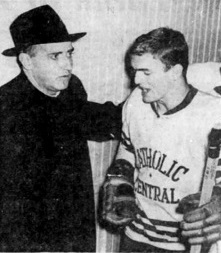 Born in Detroit, but raised in Toronto, Enright earned a bachelor’s degree from the University of Western Ontario, then joined the staff of Detroit Catholic Central in 1948 as an algebra teacher and head coach of the hockey team. In 1949, he went to Texas, working as a history and English teacher at Houston St. Thomas. While at St. Thomas, Enright revived a dormant hockey program and served as the school’s coach during his two years there. After completing his theological studies and entering the priesthood in June of 1951, he rejoined the staff of Detroit Catholic, where he again became the school’s hockey coach.
“We had been playing hockey at Catholic Central for several years, but we were forced to play only exhibitions inasmuch as no league was in operation,” Enright told the Detroit Times in 1960. “We would play some of the high schools in Windsor and Chatham, Ontario, where hockey is a varsity sport. Or anyone who would play us.”
In the fall of 1958, with the help of Fr. John Lee, the two worked to create a proper high school league. In its initial state, the International High School Hockey League was comprised of eight charter members: Catholic Central, Detroit Catholic schools St. Gregory, St. Ambrose, and Benedictine, Harper Woods Notre Dame, the Cranbrook School in Bloomfield Hills (with its own rink, opened in January 1957), and Ontario schools Windsor Riverside and North Essex.
Catholic Central won the league that first season finishing play with a 13-1 record while topping Notre Dame in the standings. The coming years saw entrances and exits by schools. North Essex departed after the first year. St. Anne of Tecumseh, Ontario, was briefly added to the mix.
The International League was split into two divisions, first and second, and in later years, North and South. Each February beginning in 1962, teams would compete in the annual Mayor’s Cup tournament, hosted at Cobo Arena near the Detroit riverfront or at Olympia, the old red barn, that served as home for the Red Wings. Without an MHSAA postseason hockey tournament in place, an IHSHL playoff was hosted each March. Winners often would lay claim to state championships. Catholic Central annexed state titles in 1959, 1961 and 1968.
Ann Arbor High School joined the league in 1962-63. A season-opening crowd of 3,500 was on hand at Michigan Hockey Arena on a Saturday in late November for the team’s debut. The Pioneers wore varsity football jerseys in that opener against Detroit Catholic Central (and for the early part of the season), as they didn’t yet have regular hockey uniforms. George Wolski posted a hat trick, scoring three goals for the Shamrocks, as Fr. Enright’s squad defeated Ann Arbor, 5-3.
Detroit Cathedral Catholic also joined the league beginning with the 1962-63 season. A strong team, the Wildcats fell to the Windsor Riverside Rebels, 2-1 and 3-2, in the league’s best-of-three championship series at Windsor Stadium in the 1963 playoffs. It was the second consecutive IHSHL title for Riverside.
By the mid-to-late 1960s the teams from Canada had departed, but continued growth of hockey programs in the Metro area led to additional expansion.
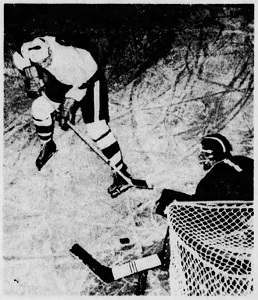 Headed by Hockey Magazine prep All-American Phil Wittliff’s 37 goals during the 1964-65 regular season, Port Huron Catholic posted an 11-2-1 regular season mark in its first season of varsity play in the IHSHL. Finishing second in its division, the team then rolled past leader Ann Arbor, with 4-3 and 7-6 wins in a best-of-three series, to advance to the league championship game. Before a crowd of nearly 700 at McMorran Sports Arena in Port Huron, the Warriors topped Cathedral Catholic, 7-4, to claim league and state championships in a contest that was ended early because of several fights. Wittliff, a junior, finished the year with 47 goals including three goals and three assists in the season finale. Following graduation, he played hockey at Notre Dame and in hockey’s minor leagues, then became head coach and team executive with the Milwaukee Admirals of the old International Hockey League.
“There are more than 200 amateur hockey teams in the Detroit area and the figure could easily double if there were enough playing rinks to go around,” stated the Detroit Free Press in March 1965. “The organized leagues begin with the Squirt Division for boys under 10. The Pee Wee under 12 group follows and then the Bantams. The Juvenile and Junior Division cover the high school age group.”
Ann Arbor (winner of IHSHL tournament titles in 1966, 1967 and 1971), Detroit Benedictine (champion in 1969 and 1970), Detroit Cathedral Catholic, St. Clair Shores Lakeview, Ecorse, Fraser and others emerged as strong opponents during the seasons and showcased their skills in tournaments hosted at Olympia Stadium, Cobo and various suburban rinks sprouting up during that span.
“High school hockey was abandoned in the Upper Peninsula some 25 years ago,” noted The Associated Press in an article from November 1969 announcing that Calumet, Hancock, Marquette and Houghton were prepared to sponsor the sport. That winter, the schools joined Eagle River, Wis., to form the Lake Superior Hockey League.
Sault Ste. Marie began play in the winter of 1972-73. Too far from Copper Country for competition to be practical, it joined the Schoolboy High School League “with seven Canadian teams across the (St. Marys) river.” Beginning in 1972, Alpena operated the V.F.W. Allstar Midgets hockey team, playing older teams, with the goal of adding hockey as a varsity sport with the 1973-74 season.
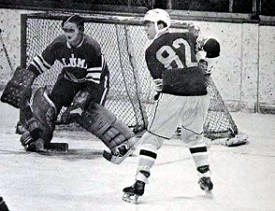 In Flint, Ainsworth, Bentley, Carman, Kearsley and Powers Catholic high schools joined Grand Blanc and Mt. Morris to launch teams and form the Genessee County High School Hockey League during the 1972-73 school year. Games were played at the Flint IMA Sports Arena and strongly supported by fans. Attendance averaged 1,500 per contest, with 3,500 packing the arena for the league championship between Powers and Grand Blanc. Flint Northern and others followed with programs the next winter, bringing league membership to 20 schools spread across two divisions.
“In February of 1973, there was no indoor ice in Grand Rapids. A year later… there are two indoor rinks, 18 youth teams, 18 men’s teams and close to 500 participants.” wrote United Press International reporter Richard Gosselin while covering the rapid growth of amateur hockey in Michigan in early 1973. “Saginaw was much the same way…From zero hockey last year, Saginaw now has a program of 17 teams with over 300 players.”
According to a series of articles written by Howard Hoffman for the Port Huron Times Herald in 1974, four high school hockey leagues existed in Michigan, each operating with its own set of rules.
Besides the Lake Superior Conference in the U.P., and the Genessee County League, high school-sponsored teams played in the Suburban Hockey League and the Michigan Metro League. The SHL began in 1972-73 and included “four Livonia schools, two from Southfield and Wyandotte Roosevelt.” The Metro League was the former International High School Hockey League. It had been rechristened following the departure of the Canadian schools and, according to Hoffman, now included 21 teams, “mostly private schools in Detroit and suburban schools in affluent cities such as St. Clair Shores, Grosse Pointe and Bloomfield Hills.”
Four additional club leagues, each without high school sponsorship, operated in Saginaw (six teams), Kalamazoo (six teams), Lansing (eight teams) and Grand Rapids (10 teams). In Lansing, the club teams were sponsored by the Metro Ice Arena, which paid coaches and officials, and supplied the equipment to the teams. In the Kalamazoo and Saginaw areas, the squads depended on families and/or friends of players to fund operations. Grand Rapids teams operated with funding from the local Amateur Hockey Association and the Grand Rapids Ice Arena.
In January 1975, the MHSAA finalized the field for that first postseason. Director Allen Bush stated that club teams, not officially representing a high school, would not be eligible for the playoffs.
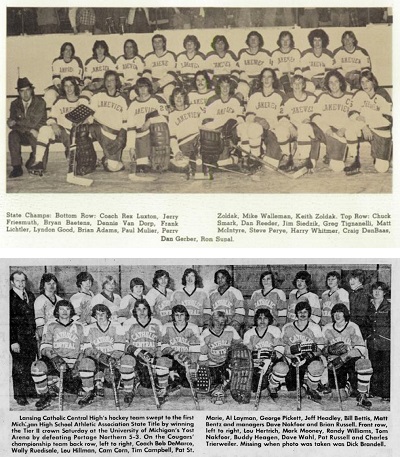 In this first year, all teams immediately advanced to regional action. Eligible teams were grouped into two classifications, based on hockey experience, size of the school and type of feeder programs in the area. Tier I, featuring 47 more experienced teams, would play semifinals and finals rounds at University of Michigan’s Yost Arena. In Tier II, 33 teams would battle it out for the right to compete in the semis and finals to be played at Veteran’s Arena in Ann Arbor.
“It was the best way we could figure out to get started and it seems to have worked out well,” said McKenzie. “At least there haven’t been too many complaints.”
St. Clair Shores Lakeview downed Calumet 5-1 behind a hat trick by Keith Zoldak in the Tier I championship, to finish the season with a perfect 31-0 record. Calumet ended the year at 25-3. Greg Tignanelli and Dan Reeder also scored for the Huskies, while Duane Nordstrom scored the lone goal for Calumet. In a time when most college hockey players came from Canada, Zoldak would later star at Ferris State and Tignanelli excelled at Northern Michigan, then was drafted by the Montreal Canadiens.
In only its second year of existence, Lansing Catholic topped previously unbeaten Portage Northern for the Tier II title, 5-3 before a crowd of 1,200. The Cougars ended the year 28-2-1, while Northern, which had beaten Catholic earlier in the year, finished 20-1. Junior goalie Buddy Heagen stopped 44 shots as the Huskies outshot Lansing Catholic, 47 to 27. Randy Williams, who finished the year with 52 goals, scored in both the first and second periods to lead the Cougars. Trailing 4-2, Northern cut the lead to a goal with 3:49 remaining on a Doug Eckert goal, but winger Cam Corn sealed the victory “when he backhanded a rebound past goalie John Wright” with just over a minute to play.
“It was a success, a real success, said McKenzie to the Lansing State Journal on Monday following the tournament. “The entire tournament went through without one major problem. We had no major altercation on the ice. I think we proved you can play hockey without fighting, without violence. We had the true hockey fans. They got excited, they cheered…their fans were perfect ladies and gentlemen. They paid the respect due to a winner. They applauded…it was a great example of sportsmanship by the players, coaches and fans alike.”
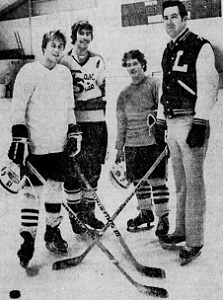
“The (roughness and fighting) was a big concern in those early days,” said Rex Luxton, hockey coach at St. Clair Shores Lakeview for 19 years. “There was always concern about that. For one year at Lakeview we had a kid fresh out of college coaching the hockey team. He was too close in age to the kids playing to (control it). I had been the football coach, so the athletic director came to me and said if we don’t clean it up the school will shut us down. I didn’t know anything about hockey, although I had a young son playing recreation, but I was a disciplinarian. I recruited a Canadian from my neighborhood, and he helped me to run things for two years.”
The MHSAA Tournament returned in 1976, with a few minor tweaks. This time 94 schools sponsored teams and Michigan State University played host to the final rounds. Again, competition was split into two classifications based on experience, with 45 teams placed in Tier I and 49 in Tier II. Eight regionals were held in each tier, with winners in Tier I scheduled to play the semifinals and finals at Munn Arena, and Tier II victors booked for games at MSU’s Demonstration Hall.
Trenton downed Lakeview, the reigning titlists in Tier I, 4-2. It was Trenton’s third victory over Luxton’s Huskies on the season, and avenged a 7-6 loss to Lakeview in the tournament’s semifinals in 1975. A crowd of 2,107 attended the championship contest. Matt Dubois finished with a goal and two assists for the winners, who ended the year with a 28-2-1 mark.
Lansing Catholic Central repeated as Tier II champ, downing Flushing, 4-1, to finish the season undefeated with 29 wins and two ties. The Cougars’ last defeat dated back to January 1975.
The tier format was also used for both the 1977 and 1978 tournaments. In 1977, the Tier I final rounds were again hosted at Yost in Ann Arbor, while Tier II played out at the IMA Sports Arena in Flint.
Marquette, behind a pair of third-period goals by Ted Sharkey and top-notch goaltending by Dale Carrier, earned Tier I honors, downing the reigning champs from Trenton 3-2. Marquette finished with a 21-4-1 record, while Trenton ended the year at 23-5-2. Jackson Lumen Christi blasted Flint Ainsworth 10-2 in Tier II. Tim Comperchio and Chris Dykstal each finished with two goals and two assists for the winners.
 Travel, ice time and equipment expense inherent to the sport continued to mean fluctuations in the schools competing during those days, as some dropped hockey while others added it to their athletic offerings. For the 1977-78 season, the MHSAA moved the Tier I semis and finals to Michigan Tech at Houghton. This time just 38 schools were assigned to the state’s top class.
John Manzella scored two short-handed goals and notched a third for the hat trick as St. Clair Shores Lakeview seized its second title in three visits to the Tier I championship game with a 9-2 victory over Sault Ste. Marie.
“That was an interesting trip,” recalled Lakeview coach Luxton. “Those were the days when the quarterfinals were played on Wednesday. Our athletic director was on top of things, so we headed north to the U.P. on Thursday. That was a long trip. We played the semis on Friday and the finals on Saturday night and then left for home. The bus driver never turned off the bus the entire trip – the engine ran the whole time.
“We had hockey cheerleaders then. The wind was blowing strong when we started heading across the bridge – the Big Mac – about two in the morning. When the bus started to list with the wind, the girls were on the bottom of the bus with their coats over their heads. Then by the time we got close to home, the bus engine started missing. ‘I guess we need fuel,’ the bus driver said. Fortunately, he found a place. We almost had run out of diesel by the time we got back on Sunday.”
The final rounds of Tier II remained at the Flint IMA. Robert Thomas scored a Finals record four goals as Lumen Christi topped Ecorse, 6-4, to repeat as Tier II champion. Tom Mourgut scored twice for Ecorse, which finished with a 17-10-0 mark. A total of 59 schools had been assigned to Tier II action.
With the sport still growing, and with four years of existence under its belt, the MHSAA’s Ice Hockey committee chose to use enrollment numbers to break the tournament into Classes for the 1978-79 season. A total of 53 of the 102 schools that indicated sponsorship of the sport fell in Class A. The remaining 49 were grouped into a second Class B-C-D grouping. The format would serve the sport for the next 21 years.
Enright had retired following the 1973 season. In 1974, Detroit Catholic Central claimed the last of the state’s pre-MHSAA titles and in 1983 the Shamrocks made their first appearance in an MHSAA championship game. In 1994, they won their first MHSAA postseason hockey title.
Just after the completion of the 25th annual tournament, the MHSAA announced that tournament play would be reclassified into “three nearly equal divisions of approximately 43 schools each” starting with the 1999-2000 school year.
“The rapid growth of ice hockey as an interscholastic sport in recent years, particularly in Class A, has necessitated the addition of a district level to that tournament,” said the State Association. “The reclassification will return the ice hockey tournament to a regional-final round format, with most regionals consisting of five teams.”
Twenty years later, that postseason format remains strong and nearly 150 teams – many co-operative programs with students from multiple schools – filled the MHSAA Tournament field as playoffs began last week. This season’s championships will be decided Saturday at USA Hockey Arena in Plymouth.
 Ron Pesch has taken an active role in researching the history of MHSAA events since 1985 and began writing for MHSAA Finals programs in 1986, adding additional features and "flashbacks" in 1992. He inherited the title of MHSAA historian from the late Dick Kishpaugh following the 1993-94 school year, and resides in Muskegon. Contact him at [email protected] with ideas for historical articles.
PHOTOS: (Top) Jackson Lumen Christi takes on Ecorse in the 1978 MHSAA Tier II Final. (2) The Detroit Times named its all-city team in 1936, left, while Hancock celebrated its winning team in 1926. (3) James O’Reilly Enright, left, played a major role in growing Detroit Catholic Central’s hockey program. (4) Port Huron Catholic’s Phil Wittliff scored against Detroit Cathedral during a 1965 league final. (5) Houghton and Calumet square off during the 1969-70 season. (6) St. Clair Shores Lakeview, top, and Lansing Catholic Central earned the first MHSAA hockey championships in 1975. (8) Rex Luxton, far right, let St. Clair Shores Lakeview for 19 seasons. (Photos collected by Ron Pesch.)
D3 Preview: Rush of Past Contenders Seek to Become Next Champ
By
Geoff Kimmerly
MHSAA.com senior editor
March 10, 2022
Reigning Division 3 runner-up Calumet will return to USA Hockey Arena this weekend seeking to take the next step and claim its first Finals championship since 2008 – while joined by three more semifinalists making the trip again after a few years away.
Midland Dow will take the ice for its first Semifinal since 2000, Orchard Lake St. Mary’s for its first in 10 years and Warren De La Salle Collegiate its first since winning Division 3 in 2017.
SEMIFINALS – Friday, March 11
Warren De La Salle Collegiate vs. Orchard Lake St. Mary’s, 11 a.m.
Calumet vs. Midland Dow, 1:30 p.m.
FINAL – Saturday, March 11 – 3 p.m.
Tickets cost $13 for both Semifinals (per session) and Finals and are available exclusively from GoFan. All Semifinals and Finals will be streamed live on MHSAA.tv and viewable with subscription, with free audio broadcasts via the MHSAA Radio Network.
Below is a glance at all four Division 3 contenders taking the ice this weekend. Click for the full program.
CALUMET
Record/rank: 19-9, No. 7
Championship history: Six MHSAA titles (most recent 2008), six runner-up finishes.
Coach: Dan Giachino, seventh season (129-50-8)
League finish: Tied for first in Great Lakes Hockey Conference
Best wins: 3-2 (Regional Final), 2-1, 3-2 and 5-3 over No. 4 Houghton, 3-1 over Division 1 No. 3 Salem, 6-2 over Division 1 No. 2 Brighton, 5-2 over Division 2 No. 4 Bloomfield Hills Brother Rice, 2-0 over Division 2 No. 2 Marquette.
Players to watch: Jackson Rilei, sr. F (19 goals, 35 assists); Paul Sturos, sr. F (29 goals, 19 assists); Tom Erkkila, sr. D (7 goals, 17 assists); Aksel Loukus, jr. G (2.60 goals-against average, 4 shutouts).
Outlook: The Copper Kings were runners-up last season, reaching the championship game for the first time since 2017. Rilei, Erkkila and Loukus all made the all-state first team last season, and senior defenseman Cliff Jurmu (4 goals/8 assists) made the second. Loukus has stopped 92 percent of shots he’s faced, and Calumet has allowed more than three goals only five times this season. Ayden Williams (13 goals/10 assists) is another goal scorer, and Nolan Sturos (2/11) was among the team’s points leaders last season and is moving up the list again despite playing only 17 games.
MIDLAND DOW
Record/rank: 18-5-3, No. 8
Championship history: Has never played in an MHSAA Final.
Coach: Dick Blasy, 19th season (record N/A)
League finish: Tied for second in Saginaw Valley League
Best wins: 3-2 (3 OT) over No. 1 Flint Powers Catholic in Regional Final, 4-3 over No. 9 Grosse Pointe Woods University Liggett, 4-1 over Division 1 No. 6 Howell, 8-1 over Division 1 No. 9 Traverse Bay Reps, 3-1 over Division 1 No. 5 Saginaw Heritage, 3-2 over Division 1 No. 4 Grandville, 3-0 over Division 2 No. 10 Byron Center, 4-2 over Division 2 No. 9 Traverse City Central.
Players to watch: Billy VanSumeren, sr. F (40 goals, 28 assists), Ryan Pomranky, sr. F (22 goals, 25 assists), Isaac Skinner, jr. F (11 goals, 22 assists); Collin Lemanski, sr. G (1.28 goals-against average, 6 shutouts).
Outlook: Dow was set in 2020 to make its first Semifinals appearance in 20 years, but COVID-19 ended the season. The Chargers were only delayed in making the trip. Most impressively, they followed up a regular-season tie with top-ranked Powers Catholic by winning their Regional meeting. Dow is especially impressive defensively with 16 games giving up one or no goals, including eight of its last nine. The 6-foot-5, 225-pound VanSumeren has scored 37 percent of the team’s goals, but 10 Chargers total have at least 10 assists. Senior Nolan Sanders is another of four double-digit scorers with 10 goals.
ORCHARD LAKE ST. MARY’S
Record/rank: 19-8, No. 3
Championship history: Three MHSAA titles (most recent 2008), one runner-up finish.
Coach: Brian Klanow, 23rd season (338-191-33)
League finish: Third in MIHL North
Best wins: 3-1 (Regional Final), 4-1 and 2-0 over No. 6 Bloomfield Hills Cranbrook Kingswood, 5-0 over No. 10 Grosse Pointe South, 2-0 over Division 1 No. 2 Brighton, 6-1 over Division 2 No. 6 Trenton, 8-5 over Division 2 No. 7 Canton, 5-1 and 2-0 over Division 2 No. 4 Bloomfield Hills Brother Rice.
Players to watch: Brendan Dell, sr. D (3 goals, 7 assists); Bryce Agne, sr. D (5 assists); Jack Brunell, sr. F (12 goals, 10 assists), Dylan Magdich, sr. D (9 goals, 10 assists).
Outlook: St. Mary’s will be playing in its first Semifinal since 2012 and first in Division 3 since 2005 after advancing this far several times in Division 1 and playing in Division 1 last season. Despite facing many of the state’s best, the Eaglets have been among the strongest defensively giving up more than three goals only five times and with senior goalies Aidan Klingbeil (1.41 goals-against average) and Kely Kane (1.65) both with save percentages above .910 and eight shutouts combined. Dell made the Division 1 all-state second team last season, and Agne earned an honorable mention.
WARREN DE LA SALLE COLLEGIATE
Record/rank: 23-4-1, No. 2
Championship history: Division 3 champion 2017.
Coach: Sean Clark, fourth season (56-33-6)
League finish: First in MIHL South
Best wins: 7-2 over No. 5 Riverview Gabriel Richard in Quarterfinal, 5-2 over No. 9 Grosse Pointe Woods University Liggett in Regional Final, 3-2 and 3-1 over No. 6 Bloomfield Hills Cranbrook Kingswood, 5-1 over No. 10 Grosse Pointe South, 4-2 over Division 1 No. 1 Detroit Catholic Central, 6-2 over Division 2 No. 6 Trenton, 4-0 over Division 2 No. 4 Bloomfield Hills Brother Rice, 4-3 over Division 2 No. 10 Byron Center.
Players to watch: Seaton Heilman, sr. C (13 goals, 19 assists); Brady Des Madryl, jr. C (18 goals, 18 assists); Robert VanderDonck, sr. LW (21 goals, 19 assists); Branden Stabnick, sr. RW (9 goals, 33 assists).
Outlook: The Pilots are riding an impressive seven-game winning streak that included the win over the Shamrocks in the regular-season finale – the second of two early losses De La Salle avenged over the last six weeks. Heilman earned an all-state honorable mention last season. Senior left wing Jacob Lawrence also is among leading scorers with 10 goals, with nine assists, and senior Jake Gangola has six goals and 22 assists from his defenseman spot. Junior Benjamin VanderDonck (1.16 GAA) and senior Andrew Parmentier (1.56) both have save percentages better than .930 and a combined seven shutouts.
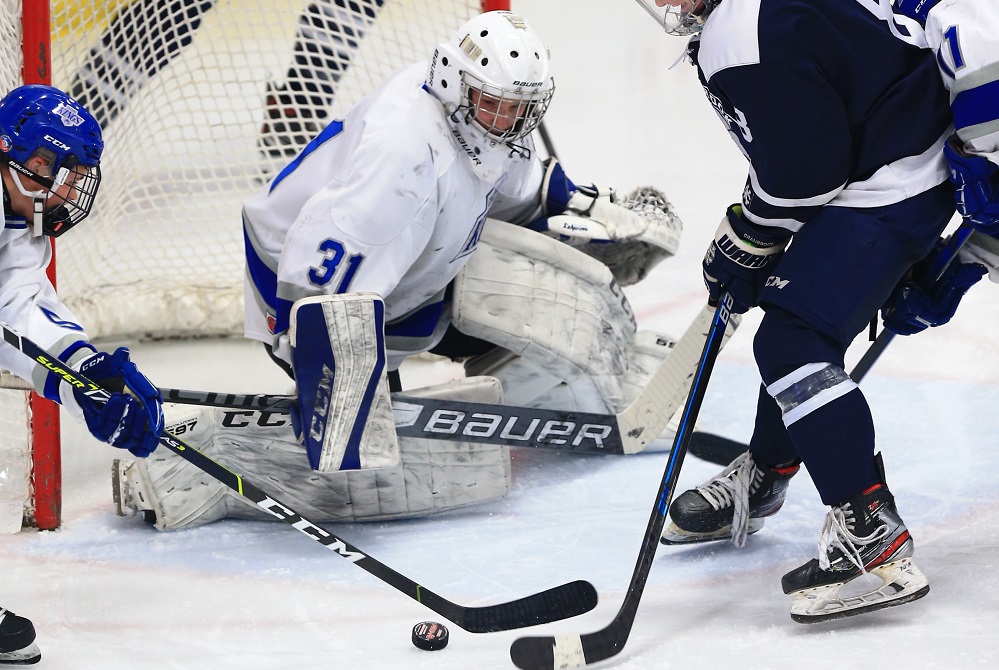
PHOTO Calumet goalie Aksel Loukus sets up to make a stop during last season’s Division 3 Final against Bloomfield Hills Cranbrook Kingswood.