

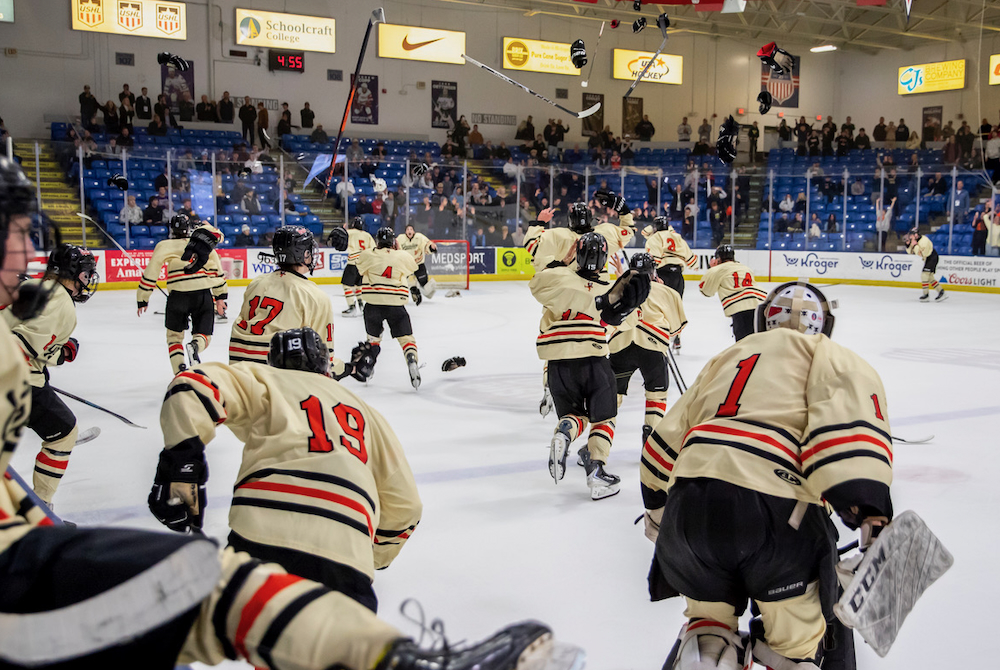
Houghton Never Stops Believing, Rallies Late to Claim 1st Finals Title Since 1982
By
Keith Dunlap
Special for MHSAA.com
March 7, 2026
PLYMOUTH — When entering the town of Houghton in recent years, there is one sign that seems to stick out more than others – at least to the Houghton High School hockey program.
“When you came into town, it said for years and years ‘State champs 1982,’” Houghton head coach Micah Stipech said, referring to the year Houghton last won an MHSAA Finals championship in ice hockey. “Now we can put a new one up.”
Indeed, as the Gremlins can finally once again call themselves Finals champions following a 5-2 triumph over Orchard Lake St. Mary’s in Saturday’s Division 3 championship game at USA Hockey Arena.
It’s difficult to fathom that one of the state’s premier programs had gone 44 years without a title, with its last championship the Class B-C-D crown in 1982.
Getting to the Final in recent years certainly wasn’t a problem for Houghton (25-6-1), as it was a runner-up in 2012, 2015 and 2019.
There just always was a downstate powerhouse it couldn’t overcome. But that wasn’t the case this time, thanks in large part to senior forward Jack Sayen.
Entering the game with 15 goals on the season, Sayen accounted for more than 25 percent of that total in the championship game, scoring four times for the Gremlins.
“I guess I was kind of in the right spot at the right time for some of them,” Sayen said. “I don’t care that I scored. I’m just happy our team won.”
Stipech said it was a slow start to the season, with his team breaking in a huge influx of underclassmen and losing six out of its first 10 games.
 “We were supposed to be down,” Stipech said. “We had 10 underclassmen. It wasn’t going to be our year. We only won four out of our first 10. We’re on a three-game skid and this group right here are like ‘We got this. We just need some time, and we’re going to be all right. They still believed.”
That self-belief really came to the forefront after St. Mary’s took a 2-1 lead with 14:27 remaining on a goal by senior Dominic Pizzo, who fired a shot from between the face-off circles into the net.
Houghton got only stronger at that point, blitzing St. Mary’s with a four-goal surge over the next 10:54.
Sayen started the rally, tying the game at 2-2 when he stationed himself in front of the St. Mary’s goal, took a pass sent behind the net from senior Noah Maillette and buried the chance under the crossbar.
Sayen then gave Houghton a 3-2 lead with 11:16 remaining, charging the net and jamming the puck past the pads of the St. Mary’s goalie.
Just 1:23 later, Houghton took a 4-2 lead when senior Connor Arko took a neat pass from Maillette, skated in on the St. Mary’s goal and lifted a backhand below the cross bar.
Houghton kept the pressure on and added to its lead, going up 5-2 with 3:33 remaining when Sayen pounced on a rebound and fired the puck in.
From there, the final minutes were a happy skate for Houghton.
St. Mary’s was attempting to repeat as champion, but had to settle for a runner-up finish and a 25-5 record to close the season.
“We just got a little lax down low in front of our net,” St. Mary’s head coach Brian Klanow said. “They took advantage of some not-so-good positioning and they were able to get some shots off the line.”
Houghton opened the scoring on a power play with 12:53 remaining in the first period when Sayen charged toward a loose puck in front of the St. Mary’s goal and buried the chance underneath the crossbar to make it 1-0 Gremlins.
St. Mary’s tied the game with 1:59 remaining in the second period on a goal by junior Thaddeus Raynish, who found a loose puck to the left of the Houghton goal and placed a shot into a half-open net to make it 1-1.
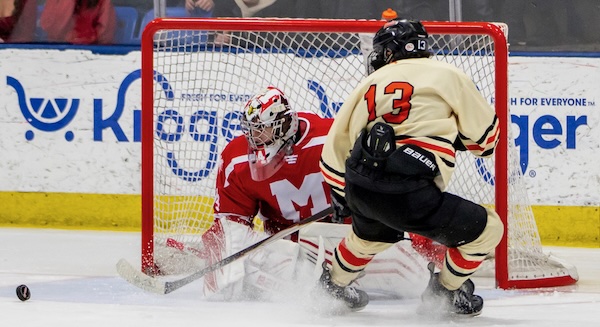
PHOTOS (Top) Houghton players celebrate at the end of the Division 3 Final at USA Hockey Arena. (Middle) The Gremlins’ Noah Maillette (13) moves toward a loose puck in front of the St. Mary’s net and goalie Thomas Reeber. (Photos by Adam Sheehan/Hockey Weekly Action Photos.)
#TBT: 2002 Ends with Lights-Out Finals
July 12, 2019
By Rob Kaminski
MHSAA benchmarks editor
The Flint IMA had been to the MHSAA Ice Hockey Finals what Joe Louis Arena was to the Detroit Red Wings since it began hosting high school championships in the state in 1977.
For parts of four decades, the facility set the scene for many memorable moments on ice for scholastic skaters.
So it would have been fitting as the curtain was closing on an era March 9, 2002, if there’d been an overtime championship game or two to commemorate the last MHSAA Finals at the building.
In 2003, the MHSAA Semifinals and Finals would move to Compuware Arena in Plymouth – now USA Hockey Arena – where the event has been played ever since.
There would be no overtimes during the IMA’s swan song, but the arena wasn’t about to let go without a fight. Following the morning’s Division 2 Final, won by Grosse Pointe North over local qualifier Davison, things got strange.
As if by divine intervention, a significant power outage hit the Flint area between the first and second periods of the Division 3 Final, necessitating a return to the building for an encore performance that Monday.
Following is an account from then-MHSAA Assistant Director Randy Allen, administrator of the sport at that time.
 “East Grand Rapids and (Dearborn) Divine Child were between the first and second periods when the power went out at what must’ve been around three in the afternoon. Some of the house lights went on, but there was no huge generator. The power company told us it could be quite a while before the power came back, so the decision was made pretty quickly to come back Monday. (Editor’s Note: MHSAA regulations at that time prohibited Sunday competition, thus play would resume Monday)
“Finishing the game in progress Monday was really a no-brainer, but now there were a couple of immediate challenges. First, how were we going to let people know, and second, what was going to happen to the (Detroit) Catholic Central-Marquette Division 1 game coming up later in the day?
“Well, knowing what I knew about the TV business (Allen’s background in Wisconsin included sportscasting), I grabbed one of the television reporters there, probably from Grand Rapids, and asked him to come down to the ice with me. It was totally dark; I figured once he put his camera lights on, it would get the attention of the crowd, which it did. So there’s about 2 or 3 thousand people in the arena – in the dark – and I’m standing in front of a light from a TV camera, and at the top of my voice I explain the situation and let them know we’re coming back Monday.
“Anyone wanting to come back, admission was free of charge, and we’d trust they were at the game. If they wanted a refund, they could mail their ticket stub to MHSAA and we'd send a refund. We obviously couldn’t use the box office without power. I don’t recall more than a couple dozen refund requests coming to our office later.
“Now the real challenge is the Division 1 game. Marquette very, very much wanted to go home and come back a week later. They’d been on the road all week (Marquette won a Quarterfinal in Traverse City that Wednesday). Jack (Roberts, former MHSAA executive director) was there, and he and Marquette’s AD (Scott Koski) and their superintendent debated a bit. In the end, the regulations of the day were upheld, and the game would be Monday.
“As it turned out, someone in the Marquette entourage had a contact in the Detroit Pistons front office, so the team was entertained in a suite at The Palace of Auburn Hills on Sunday night, so that was quite a happy ending from their standpoint.
“Many of the Marquette people were either in the arena or at a single hotel or two in the area, so alerting them to the change was not difficult.
“But then we started to think, ‘What about the Detroit CC people who would be driving up for their game later? Remember, social media was not as prevalent as it is today, or even the dependence on the internet.
“So, Saturday night, I sat there at the entrance to the IMA with my car running and lights on to inform the CC fans and anyone else who pulled up that the game had changed ... ‘Power’s out; game’s on Monday.’ They'd say thanks, and out they'd go. No one really got angry; there wasn’t anything anyone could do. I sat there an hour and a half with a steady stream, and shortly after the scheduled game time I called it a night.”
And, the IMA called it the end of an era, but not before hanging on for one more night, when Divine Child and Detroit CC would raise the last trophies in that building ... under the lights.
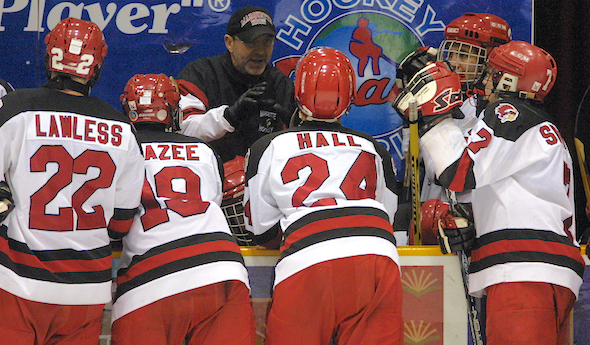
PHOTOS: (Top) Marquette was among teams that needed to stick around Flint two more days to play in the 2002 MHSAA Ice Hockey Finals. (Middle) Flint’s IMA arena.