

Officials Eager for New Hockey Format
July 12, 2019
By Rob Kaminski
MHSAA benchmarks editor
Tuesday, Feb. 26, was a particularly busy day on the ice as the 2019 MHSAA Ice Hockey Tournament reached just its second day around the state.
On the slate that night were 27 Regional games, bringing the two-day total to 48 on the heels of Monday’s busy calendar.
As teams were busy setting their sights on the ultimate goal, so, too, was another group of accomplished skaters who toil with much less fanfare. Nonetheless, the games can’t start without them – the folks in the striped shirts who call the games.
Just as players and coaches will welcome the expanded playoff format in 2020, the officials are looking forward to the change as well.
“When we got to the first week of the tournament, it seemed like we were going every day,” said Jim Gagleard, who assigns officials for the Livonia Ice Hockey Officials Association. “There are only so many officials to go around in any sport. By allowing us as officials a day or two to catch our breath, it’s good. Good for us, and good for players more than anything.”
If it seemed like every day, well, it was. A total of 66 games were played over the first three days, and 89 over the first four. Considering each game at the Regional level has three officials, that computes to 267 officials needed during that span. On the busiest day, 81 had to take to the ice.
Given that there were a total of 302 playoff-eligible officials in 2019, filling those slots can be a logistical nightmare for assigners at times.
“Regional week will see a huge burden alleviated for officials and especially assigners. There will be so much more flexibility under the new format,” said Dan DiCristofaro, President of the Northeast Hockey Referees Association. “Last year, we were faced with so many doubleheaders at single sites, and the first games needed an early start so that the second games would not last late into the evening on school nights.
“At times, the most important factor for the assigner was scheduling those officials who could get to the arena for the early start times. Merit and ability sometimes had to take a back seat.”
Gagleard agrees, saying, “Assigning-wise, early games are the toughest to fill. Everyone has a job, and in order to work a game they have to tell the boss they’re leaving at 2:30 for a 5 o’clock game. You start to look for officials who are retired, or can get out of work, instead of the most qualified. That’s not fair to the teams playing.”
In the northern reaches of the Upper Peninsula, the problem is more acute.
Sean Jacques is the athletic director at Calumet, and also an experienced official, having skated the Division 2 Final in Plymouth in 2016.
“Not enough,” Jacques said, in reference to the number of playoff officials in the UP. “Not enough. When I get the list of eligible officials that is sent to tournament managers, I have to search and scramble to find three people within an 80-mile radius.”
Moving the Quarterfinals to the weekend will definitely help matters, and eliminating Regional doubleheaders should ease the scheduling anxiety as well.
 “With Regionals spread out more, without doubleheaders, officials potentially could work more days,” Jacques said. “And there should be more availability for the Quarterfinals. The last few years, it was in the Sault, and getting four guys to the Sault on a weeknight, whether from Escanaba or northern lower Michigan, was difficult. There were times I’d turn down a Quarterfinal because I just couldn’t get there and back and make it to work the next day. Saturday makes it easier.”
On the west side of the Lower Peninsula, assigner Randy Sheahan uses a mathematical approach to illustrate his challenges, even for the regular season. Sheahan calculates that 98.88 percent of all West Michigan games are scheduled for Wednesday, Friday, or Saturday. Breaking it down further, 84.39 percent skip Wednesday and schedule only Friday or Saturday.
With the shortened regular season coming in 2019-20 to allow for a three-week tournament window, Sheahan took a proactive approach.
“When the MHSAA announced the change to a three-week tournament, I emailed all West Michigan coaches, plus a handful of athletic directors and booster leaders who may be involved in team scheduling,” Sheahan said. “I encouraged them if they are having difficulty squeezing all their games into a window which is now one week shorter, to give further consideration to playing on Mondays, Tuesdays, or Thursdays to greatly alleviate some of the stresses we place on the West Michigan officiating staff.”
As for the MHSAA Tournament, Sheahan agrees with his brethren across the state in metro Detroit that the expansion will benefit assigners, officials, and teams.
“I only see positives,” Sheahan said. “This gives me tremendous flexibility with our staff to maneuver around their professional and personal schedules to keep our best officials on the ice every round, which is an expectation teams have for playoffs. It also provides (at times) much needed rest for officials and teams, especially if they are involved in overtime affairs. This could help with the quality of overall game play.”
That’s the goal for everyone. Fresher legs for players and officials alike will provide a better experience for all involved.
“This allows for physical recovery for everyone on the ice,” said DiCristofaro. “It also allows for better time management for student-athletes, officials and coaches. Even at the Quarterfinal offerings with four officials for each game, we’d run into issues as far as which people could get to places, or wanted to travel and skate late on a work night. Saturday give us much more flexibility and should create more interest in the state tournament.”
The Quarterfinals, Semifinals and Finals have employed a four-official system in recent years, affording an extra position each game for deserving officials while adding to the quality of the game for participants at the highest level.
Sheahan plans to utilize the new format to continue to reward those among his troops who have earned their stripes for such contests.
“In theory, I may have opportunities to increase game counts for some of our perennial playoff officials, but I have no plans to do that,” Sheahan said. “We have other officials every season who are good enough to skate playoffs and have earned it, but simply couldn’t quite break the playoff bubble. Now the opportunity presents itself to reward some of those officials. It would be counterproductive to officiating development if fewer officials are getting opportunities for important games.”
Similarly, DiCristofaro is hoping the time will come when four officials will be assigned to skate Regional Finals, and perhaps the new length of the postseason will open the door.
“Some of most important games are the Regional Finals. Maybe this new schedule can help,” DiCristofaro said. “Four officials offer teams the best possible ice coverage, and they deserve that.”
Finals Preview: Power Teams, Power Play
March 5, 2014
By Geoff Kimmerly
Second Half editor
This weekend's MHSAA Ice Hockey Finals at Plymouth's Compuware Arena feature a two-time reigning champion in Division 1 and the winningest hockey coach in MHSAA history.
And fans also could see some lesser-known but similarly incredible stories continue to unfold.
In Division 3 alone, Sault Ste. Marie is going for its first title since 1989, while Farmington is going for its first after shocking the state with an upset of reigning champion Bloomfield Hills Cranbrook-Kingswood in the Quarterfinal. Grand Rapids Catholic Central advanced after surviving six overtimes in its quarter, while in Division 2 Muskegon Reeths-Puffer will play in a Semifinal for the first time.
This weekend's pairings are as follows:
Division 2 Semifinals - Thursday
Muskegon Reeths-Puffer (19-8-1) vs. Hartland (19-9-1), 5 p.m.
Trenton (24-4-1) vs. Warren DeLaSalle (13-14), 7:30 p.m.
Division 3 Semifinals - Friday
Sault Ste. Marie (24-2-2) vs. Monroe St. Mary CC (19-8-2), 11 a.m.
Farmington (19-10) vs Grand Rapids Catholic Central (18-4-6), 1:30 p.m.
Division 1 Semifinals - Friday
Detroit U-D Jesuit (21-7) vs Brighton (22-6-1), 5 p.m.
Detroit Catholic Central (22-7) vs Grandville (16-10-3), 7:30 p.m.
FINALS - Saturday
Division 2 – 10 a.m.
Division 3 – 2 p.m.
Division 1 – 6 p.m.
All Semifinals and Finals will be streamed live per subscriptiion basis on MHSAA.tv, with live audio available on MHSAANetwork.com.
Click for a full schedule of this weekend's games plus full results as they come in. Players statistics below are through the Regional round and were submitted by participating schools, except for Muskegon Reeths-Puffer and Farmington stats, which are through Quarterfinals.
Division 1
BRIGHTON
Record/rank: 22-6-1, No. 4
Championship history: Three MHSAA titles (most recent 2013).
Coach: Paul Moggach, 19th season (352-118-38)
League finish: First in Kensington Lakes Activities Association (Central and overall)
Best wins: 8-0 over No. 6 Bay City Central in Quarterfinal, 2-0 over No. 10 Plymouth, 6-5 over No. 9 Northville, 5-3 and 7-1 over Division 2 No. 3 Hartland, 6-5 over Division 2 No. 1 Livonia Stevenson, 4-2 over Division 2 No. 4 Novi, 5-2 over Division 3 No. 10 Hancock.
Players to watch: Danny Bosio, senior forward (32 goals, 26 assists); Brian Dowd, senior forward (17 goals, 20 assists); Jimmy Milletics, junior goaltender (18-6-1, 2.50 GAA, .867 save %); Brett Pietila, senior defenseman (six goals, 16 assists).
Outlook: Brighton is the back-to-back Division 1 champion and returns to Compuware with most of the top contributors from last season’s run. Milletics remains a standout in net after making the all-state first team last season; total, the Bulldogs have 10 shutouts this winter. Pietila also made the all-state first team last season, with Bosio on the second and Dowd earning an honorable mention. Brighton opened with a 4-3 loss to DCC in a rematch of last season’s Final, and started 3-4 before going 19-2-1 heading into Friday.
DETROIT CATHOLIC CENTRAL
Record/rank: 22-7, No. 2
Championship history: 10 MHSAA titles (most recent 2010), four runner-up finishes.
Coach: Doug Itami, first season (22-7)
League finish: Second in Michigan Interscholastic Hockey League North
Best wins: 2-0 and 5-2 (Quarterfinal) over No. 10 Plymouth, 5-0, 7-4 and 5-2 (Regional Final) over No. 1 Orchard Lake St. Mary’s, 4-3 over No. 4 Brighton, 7-0 over No. 9 Northville in Regional Semifinal, 8-0 and 4-1 over No. 3 Birmingham Brother Rice, 8-0 over No. 7 Detroit U-D Jesuit, 5-2 over Division 2 No. 1 Livonia Stevenson, 4-3 over Division 2 No. 2 Trenton.
Players to watch: Ryan Burnett, junior forward (16 goals, 18 assists); Mitch Ossowski, junior forward (13 goals, 20 assists); Carter Cerretani, senior defenseman (10 goals, 22 assists); Jim Considine, senior forward (11 goals, 11 assists).
Outlook: Itami took over this season for former coach Todd Johnson (who now is an assistant), and the Shamrocks haven’t missed a beat. They have to be favorites this weekend after beating the best of the rest of Division 1 during the regular season; those seven losses came from Division 3 Bloomfield Hills Cranbrook-Kingswood, Division 2 Trenton and Indiana’s Culver Academy. DCC lost four all-state first teamers from last season, but a balanced lineup has shined with seven players posting at least 10 assists and six at least eight goals entering the week.
DETROIT U-D JESUIT
Record/rank: 21-7, No. 7
Championship history: Has not appeared in an MHSAA Final.
Coach: Rick Bennetts, 19th season (234-224-32)
League finish: Second in MIHL South.
Best wins: 4-2 and 4-3 over No. 3 Birmingham Brother Rice, 5-3 over No. 8 Lake Orion in Quarterfinal, 4-2 over Division 3 No. 1 Bloomfield Hills Cranbrook-Kingswood, 5-3 over Division 3 No. 9 Flint Powers Catholic, 6-2 over Divsiion 3 No. 5 Dearborn Divine Child.
Players to watch: Tommy Apap, junior right wing (12 goals, 45 assists); Brian Hubbard, senior forward (24 goals, 28 assists); Sam Knoblauch, sophomore forward (20 goals, 15 assists); Christian Wirth-Karbler, junior forward (17 goals, 12 assists).
Outlook: This is the fourth time Jesuit has made at least the Semifinals over the last decade, and it’s seeking its first championship game berth after falling to eventual champion Brighton last season. The Cubs have outscored their four postseason opponents by a combined score of 29-4, keyed in part by first-line center Apap, a second-team all-stater in 2012 and first-teamer a year ago.
GRANDVILLE
Record/rank: 16-10-3, unranked
Championship history: Has not appeared in an MHSAA Final.
Coach: Joel Breazeale, fourth season (64-43-4)
League finish: Third in O-K Tier II.
Best wins: 3-2 OT over Grand Rapids West Catholic in Quarterfinal, 6-2 over East Kentwood in Regional Final, 4-1 over Grand Rapids Catholic Central.
Players to watch: Brandon Rozema, junior forward (24 goals, 28 assists); Mitchell Parsons, junior forward (12 goals, 26 assists); Gianni Vitali, junior forward (14 goals, 20 assists); Max Houtman, senior forward (11 goals, 19 assists).
Outlook: Grandville played Tuesday in its fifth Quarterfinal over the last decade and finally broke through for its first Semifinal berth since 2001. The Bulldogs did so with an overtime win and have plenty of experience in extra periods this season – total they are 2-4 in games that go past regulation. Five players have scored at least 11 goals and eight have at least 11 assists including senior captains Ryan Fischer and Isaac Lippert, who center the top line and lead the defense, respectively.
Division 2
HARTLAND
Record/rank: 19-9-1, No. 3
Championship history: MHSAA Division 2 runner-up 2013.
Coach: Rick Gadwa, third season (53-28-5)
League finish: First in Kensington Lakes Activities Association Lakes Conference
Best wins: 5-4 over No. 4 Novi in Regional Final, 5-2 over Division 1 No. 9 Northville, 3-0 over Division 1 No. 8 Lake Orion, 3-2 over Division 3 No. 9 Flint Powers Catholic.
Players to watch: Austin Flores, senior forward, Chris McRae, senior forward, Brent Pietila, senior goaltender, Josh Ruthig, senior forward. (Statistics not submitted.)
Outlook: Hartland has run its string of Regional championships under Gadwa to three and just missed its first MHSAA title last season, falling 5-4 to Livonia Stevenson in the championship game. The Eagles again loaded the schedule this season and beat a solid handful of ranked teams, and also recovered from a tough stretch of eight losses in nine games to close the regular season.
MUSKEGON REETHS-PUFFER
Record/rank: 19-8-1, unranked
Championship history: Has not appeared in an MHSAA Final.
Coach: Eric Sikkenga, eighth season (120-107-8)
League finish: First in O-K Tier 1
Best wins: 5-3 over No. 7 Saginaw Heritage in Quarterfinal, 3-2 over No. 9 Traverse City Central in Pre-Regional, 5-3 over East Kentwood
Players to watch: Josh Smith, senior forward (34 goals 23 assists); Kyle Kendra, senior forward (27 goals, 35 assists), Riley Draper, junior forward (14 goals, 21 assists), Jacob Vanderlee, junior goaltender (8-1-1, 1.53 GAA, .934 save %).
Outlook: Reeths-Puffer just missed its first MHSAA Semifinals last season, falling in overtime to East Kentwood in a Division 1 Quarterfinal. The Rockets are in Division 2 this winter and stormed into Finals weekend led by a top line of Draper centering Kendra and Smith. Reeths-Puffer has won the close ones this tournament; the Rockets went 4-4 in one-goal games during the regular season, but opened the playoffs by edging both Traverse City Central and Muskegon Mona Shores by a goal apiece.
TRENTON
Record/rank: 24-4-1, No. 2
Championship history: 13 MHSAA titles (most recent 2010), six runner-up finishes.
Coach: Michael Turner, 28th season (627-126-52)
League finish: First in MIHL South
Best wins: 4-1 and 3-2 (Regional Final) over No. 1 Livonia Stevenson, 5-3 over No. 3 Hartland, 9-1 over No. 9 Traverse City Central, 3-2 and 3-2 over Warren DeLaSalle, 8-0 and 5-2 over Division 1 No. 7 Detroit U-D Jesuit, 5-3 over Division 1 No. 3 Birmingham Brother Rice.
Players to watch: Andrew Sawyer, senior forward (17 goals, 40 assists), Mitchell Galea, senior forward (35 goals, 31 assists), Justin Dunn, senior forward (33 goals, 34 assists), Philip Pugliese, junior forward (14 goals, 15 assists).
Outlook: Trenton will play to add another giant highlight to a season filled with them. Turner last month became the winningest hockey coach in MHSAA history and has led the Trojans to 10 of their titles during two tenures as coach. Trenton eliminated reigning champion Livonia Stevenson to advance on its longest run since winning that last championship, in 2010. Sawyer is a returning all-state first-teamer and Dunn made the second team in 2012-13.
WARREN DELASALLE
Record/rank: 13-14, unranked
Championship history: Has not appeared in an MHSAA Final.
Coach: Daniel Barry, 12th season (277-72-11)
League finish: Third in MIHL South
Best wins: 3-2 over Port Huron Northern in Quarterfinal, 7-6 over Division 3 No. 6 Detroit Country Day, 6-1 over Division 3 No. 7 Farmington
Players to watch: Mario Ruggeri, junior forward (13 goals, eight assists); Trevor Reno, senior forward (11 goals, 17 assists), Joey Mastej, junior forward (18 goals, 19 assists)
Outlook: DeLaSalle likely is the surprise of the tournament so far, entering the postseason with a sub-.500 record for the second season in a row but winning its first Regional title since 2010. The Pilots’ record is a little deceptive, however, considering six of those losses came to ranked teams in Division 1. They are on a 6-3 run, and the Quarterfinal win avenged a 4-2 loss to Northern earlier this season.
Division 3
FARMINGTON
Record/rank: 19-10, No. 7
Championship history: Has not appeared in an MHSAA Final.
Coach: Bill Newton, first season (19-10)
League finish: Sixth in Oakland Activities Association Red.
Best wins: 3-2 over No. 1 Cranbrook-Kingswood in Quarterfinal, 3-1 over No. 5 Dearborn Divine Child in Regional Final, 3-1 over No. 6 Detroit Country Day in Regional Semifinal, 2-1 over Division 2 No. 4 Novi, 2-1 over Division 2 No. 10 Rochester Hills Stoney Creek, 4-2 over Division 2 No. 8 Escanaba, 4-1 over Division 1 No. 9 Northville.
Players to watch: John Lethemon, senior goaltender (18-10, 2.05 GAA, .936 save %); Drake Cole, junior forward (21 goals, 16 assists); Nick Heffron, senior forward, (14 goals, 16 assists), Nick Kozoro, senior defenseman (nine goals, 22 assists).
Outlook: Farmington dominated the spotlight of Wednesday’s Quarterfinals after eliminating reigning champion Cranbrook-Kingswood, but the Falcons have fared well all season against strong teams including a large number from Divisions 1 and 2. Newton was a longtime assistant who returned this season to take over the program. Lethemon reportedly made 60 saves Tuesday and is a returning all-state second-teamer.
GRAND RAPIDS CATHOLIC CENTRAL
Record/rank: 18-4-6, unranked
Championship history: Division 3 champion 2011, two runner-up finishes.
Coach: Mike Slobodnik, fourth season (68-33-10)
League finish: First in O-K Tier I.
Best wins: 2-1, 6 OT over No. 9 Flint Powers Catholic in Quarterfinal; 3-0 over No. 8 Grand Rapids Kenowa Hills in Regional Semifinal, 5-3 over East Kentwood, 2-1 over Division 1 No. 8 Lake Orion.
Players to watch: Andrew Wallick, junior defenseman (11 goals, 14 assists); Brian Cain, senior defenseman (two goals, eight assists); Brendan Kane, senior forward (nine goals, 18 assists); Tommy Bailey, junior goaltender (1.45 GAA, .943 save %).
Outlook: Slobodnik, a former four-year varsity player at East Kentwood who went on to play at Wisconsin-Stevens Point, has led GRCC to the final week of the season three of the last four and has the Cougars back in the Semifinals after one of the longest games in MHSAA history. GRCC is on a 7-2 run and gave up one or fewer goals in 14 games this season – keyed in part by Bailey and top defensive pair Cain and senior Max Tierney. Cain made the all-state second team last season.
MONROE ST. MARY CATHOLIC CENTRAL
Record/rank: 19-8-2, unranked
Championship history: Has not appeared in an MHSAA Final.
Coach: Brian Hughes, second season (34-16-6)
League finish: First in Huron League and Southeastern Hockey League
Best wins: 6-5 over Chelsea in Regional Final, 4-2 over Riverview Gabriel Richard in Quarterfinal, 5-2 over Grosse Ile, 4-3 over Southgate Anderson.
Players to watch: Shane Hughes, senior forward (21 goals, 31 assists), Henry Mikesell, senior defenseman (17 goals, 27 assists), Anthony Cicero, sophomore forward (22 goals, 14 assists).
Outlook: St. Mary has improved four wins from last season and won its first Regional title since 2009; it’s going for its first Semifinal appearance since the year before in 2008. The Falcons have won eight of their last nine coming into this weekend. Mikesell earned an all-state honorable mention last season and is one of six who have scored double-digit goals and eight with 10 or more assists.
SAULT STE. MARIE
Record/rank: 24-2-2, No. 4
Championship history: Two MHSAA titles (most recent 1989), six runner-up finishes.
Coach: John Ferroni, third season (59-22-3)
League finish: Does not compete in a league.
Best wins: 2-1 over No. 2 Houghton in Quarterfinal, 4-2 and 7-1 over Division 2 No. 8 Escanaba, 6-3 over Division 2 No. 9 Traverse City Central, 3-2 over Division 1 No. 7 Detroit U-D Jesuit, 4-3 over Muskegon Reeths-Puffer.
Players to watch: Will Gauthier, senior center (21 goals, 35 assists), Blake Mastaw, senior forward (14 goals, 13 assists); Chase Gamelin, senior forward (28 goals, 20 assists); Nickolas McKenzie, senior goaltender (3.80 GAA).
Outlook: Sault Ste. Marie has come back even stronger after falling 4-3 to Cranbrook-Kingswood in last season’s Division 3 Final. Many of the standouts from that team are back, with Gathier an all-state first-team selection in 2013, McKenzie a second-teamer and Mastaw an honorable mention. The lone losses were to Houghton (avenged in the Quarterfinal) and No. 3 Grosse Pointe Woods University Liggett, and the Blue Devils also posted impressive ties against Division 1 No. 10 Plymouth and No. 3 Birmingham Brother Rice.
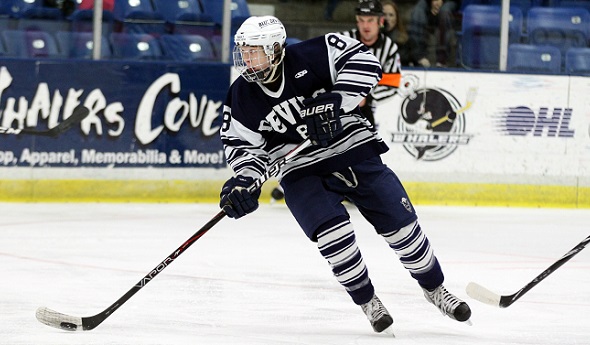
PHOTO: Sault Ste. Marie's Will Gauthier is among standouts back for Sault Ste. Marie as it pursues its first MHSAA hockey championship since 1989.