

Painesdale Jeffers Roster Filled with Jets Earns Historic Opportunity
By
John Vrancic
Special for MHSAA.com
February 25, 2025
HOUGHTON — Many talented hockey players have gone through the ranks at Painesdale Jeffers High School.
 The team, however, has often been low on numbers.
The situation has changed this winter, and the Jets have a 22-4 record to show for it.
“In the past, we could only skate two lines,” coach Aaron Helminen said. “Now our numbers are up. In the last few years we had 25-27 guys, which gives us some depth. You need numbers to have competition. It makes everybody better because the guys push each other. You have to work harder to keep your spot.”
Although Jeffers is a cooperative hockey program, allowing the Jets to roster players from Chassell, Ontonagon, Dollar Bay, Baraga, L’Anse and Ironwood as well, all 18 of this year’s players are Jeffers student-athletes – which is even more impressive as Jeffers’ enrollment total for classification this school year was just 218.
The Jets began their postseason journey with a 4-1 victory over Calumet in a Division 3 Regional opener last Wednesday. They return to the MacInnes Student Ice Arena at Michigan Tech at 7 p.m. today to face Houghton (18-8), which has won two straight Regional titles.
 “We got good shifts from our third line,” Helminen said. “We’re just excited to have an opportunity to play another game. Houghton can skate 3-4 lines. They have a very good team. That will be a revenge game for them.”
The Jets – ranked No. 6 in Division 3 entering the postseason – defeated the No. 2 Gremlins 6-2 in their lone regular-season meeting Jan. 22.
“They’re a very fast and physical team,” Jeffers senior Benton Rajala said. “We have to get guys on the puck and play the body. I don’t recall of Jeffers ever winning a Regional, but I have dreamed about it.”
The Jets, however, did capture a Regional title in 1977. A victory tonight would end their drought.
“It feels great to be moving on,” senior Brit Heinonen said after the Calumet win. “This gets the monkey off our back. Having larger numbers makes a big difference. We have a special group which plays well together. We have good chemistry.”
In last Wednesday’s game, Jeffers outshot Calumet 29-17 with junior goaltender Kasen Helminen stopping 16 shots.
“It feels good to win a playoff game, but I haven’t had much chance to think about it yet,” Helminen said after. “I’d rather have some shots taken at me. Clearing the puck helps me out. In practice, we have one or two drills in which shots are fired at me. I also practice a lot on my footwork.”
What kind of challenges are in store for the Jets tonight?
 “They (Houghton) try to beat you with the rushes,” the Jets’ goaltender said. “You have to be aware of their odd-man rushes.
”It would feel great to advance.”
Heinonen had similar thoughts about the Gremlins, who defeated Hancock 5-3 in their Regional opener.
“Houghton has been great for many years,” he said. “Teams around here will battle to the end. In playoffs, anything can happen. We have a good chance.”
The winner advances to the Saturday Quarterfinal contest at Lakeview Arena in Marquette to face the winner of another Regional Final tonight between Escanaba (16-10) and Sault Ste. Marie (11-13-1).
 John Vrancic has covered high school sports in the Upper Peninsula since joining the Escanaba Daily Press staff in 1985. He is known most prominently across the peninsula for his extensive coverage of cross country and track & field that frequently appears in newspapers from the Wisconsin border to Lake Huron. He received the James Trethewey Award for Distinguished Service in 2015 from the Upper Peninsula Sportswriters and Sportscasters Association.
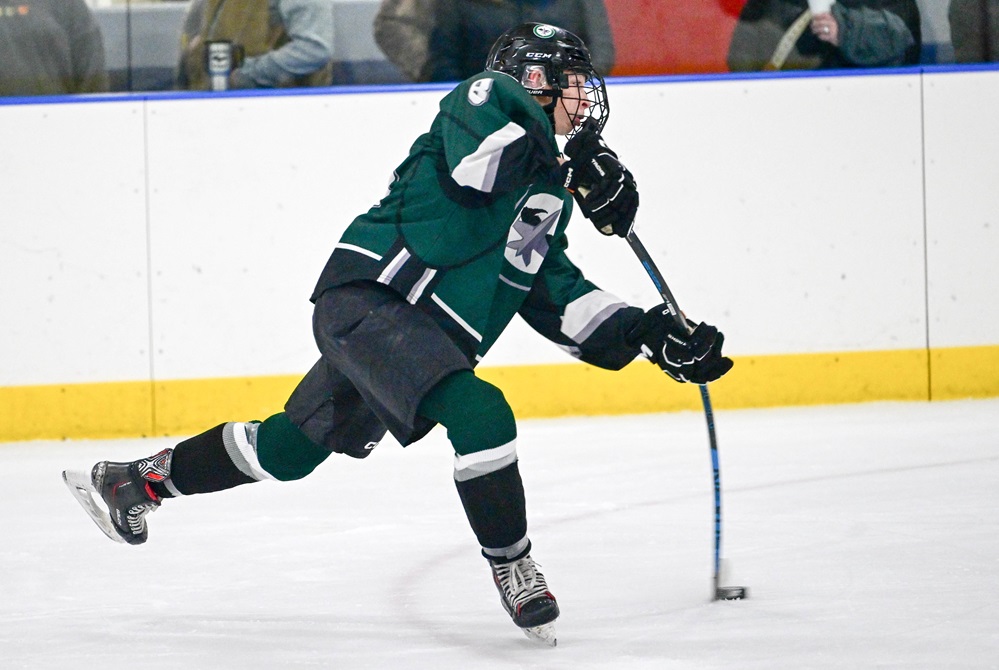
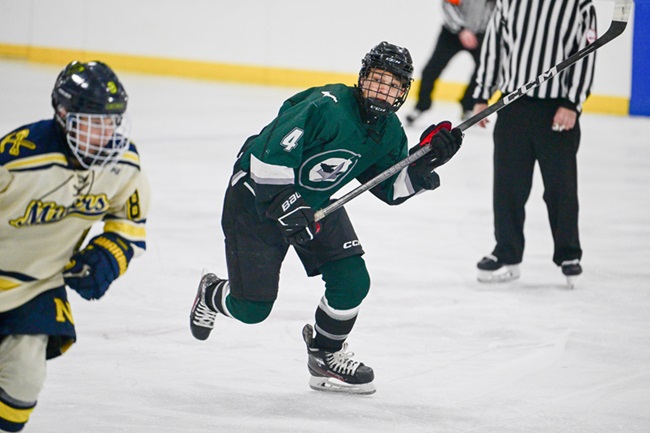
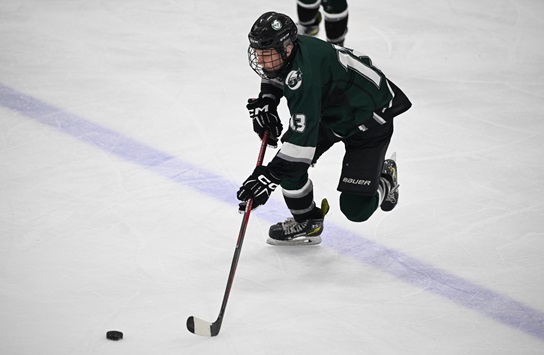
PHOTOS (Top) Painesdale Jeffers’ junior Brogan Turner rips a shot during a game this season. (Middle) The Jets’ Easton Therrian (4) makes his way up ice against Negaunee. (Below) Brit Heinonen advances past the blue line. (Photos by RR Photo.)
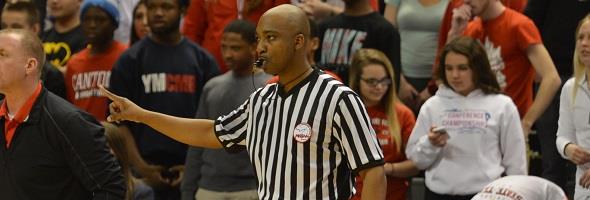
Be the Referee: Hockey Rules Chart
February 6, 2020
This week, MHSAA assistant director Brent Rice addresses some of the rules differences between high school and college hockey.
Be The Referee is a series of short messages designed to help educate people on the rules of different sports, to help them better understand the art of officiating, and to recruit officials.
Below is this week's segment - Hockey Rules Chart - Listen
Today we’d like to take a look at some of the differences between high school and college hockey.
• During pregame, the high school coach must meet with officials to verify that all players are properly equipped. There is no such rule in college hockey.
• Hand passes are permitted in the defensive zone in high school hockey, but not in college hockey.
• Goalies may play the puck with a high stick in college hockey, but not in high school hockey.
• A puck directed into the goal with a skate may be allowed in college hockey, but not in high school hockey.
Knowing the rules differences can help you better enjoy watching this sport. You can find the complete chart of rules differences on the Ice Hockey page of the MHSAA Website.
Past editions
Jan. 30: Cheer Safety - Listen
Jan. 23: Goaltending - Listen
Jan. 16: Wrestling Tie-Breaker - Listen
Jan. 9: Pregame Meeting - Listen
Dec. 19: Alternating Possession - Listen
Dec. 12: Ratings - Listen
Dec. 5: Video Review Success - Listen
Nov. 28: More Injury Time - Listen
Nov. 21: Football Review - Listen
Nov. 14: Sideline Safety - Listen
Nov. 7: Officials Playlist - Listen
Oct. 31: Most Important Line - Listen
Oct. 24: Automatic 1st Downs - Listen
Oct. 17: Catch Momentum - Listen
Oct. 10: Golf Rules Changes - Listen
Oct. 3: No Tackle Box - Listen
Sept. 26: You Make the Overtime Call - Listen
Sept. 19: Swimming Finishing Touch - Listen
Sept. 12: Curbing Gamesmanship By Substitution - Listen
Sept. 5: Football Safety Rules Changes - Listen
Aug. 29: 40-Second Play Clock - Listen