

Special Teams Set Powers Catholic Apart as Chargers Finish Repeat Title Run
By
Keith Dunlap
Special for MHSAA.com
March 7, 2026
PLYMOUTH — Before claiming its first MHSAA Finals title in 2023, in Division 3, Flint Powers Catholic was arguably the state’s most snakebitten ice hockey program.
Up to that point, Powers had lost all seven of its previous trips to the state championship game and hadn’t won a title despite 35 Regional championships.
Now, Finals championships are becoming a rite of March for the Chargers.
They captured their second straight and third over the last four years Saturday, repeating as Division 2 champions with a 4-1 win over Livonia Stevenson at USA Hockey Arena.
It was the second-straight Finals meeting between the teams, with Powers prevailing 3-2 in overtime in 2025.
“I think our program has changed dramatically the last five years,” Powers head coach Travis Perry said. “When I say that, it’s not about the wins and the losses. It’s about the mentality. Our mentality coming down here used to be, ‘We just hope to compete with Cranbrook, Calumet or whoever we are playing.’ Now, we know we can compete. We have players and a great coaching staff.”
The difference for Powers this time was special teams.
Perry said his power-play unit entered the title game scoring at a 37-percent clip and had been “carrying us most of the year,” so it was fitting that unit played a major role again.
Powers scored the first two goals of the game on the power play, which provided a cushion it ultimately didn’t relinquish.
On the other side, the Chargers killed off all six Stevenson power-play chances.
 “Our PK was really the backbone of the team today,” Perry said. “You’re trying to stay out of the box, but sometimes it happens.”
Stevenson first-year head coach Jay Thompson said his team’s special teams had also been good throughout the year, but championship games can be a different challenge.
“In these games, things tighten up,” he said. “We just fell short a little bit.”
Powers (27-5) opened the scoring with 14.1 seconds remaining in the first period by scoring on a two-man advantage.
Sophomore Owen Perry skated from behind the goal, pounced on a loose puck and placed a shot underneath the crossbar to give Powers a 1-0 lead.
The Chargers scored on another power play in the second period, going up 2-0 with 11:12 left when senior Gavin Vorwerk pounced on a loose puck in front of the Stevenson goal and chipped a shot into the net.
Stevenson (20-10-1) got on the board with 13:45 remaining in the game on an ordinary-looking play that turned into a goal.
Senior defenseman Dawson Wells fired a shot from the point that somehow got through a horde of bodies and went into the goal to make it 2-1 Powers.
Stevenson continued to pressure and created two golden opportunities on breakaways, but Powers senior goalie Hunter Clark stopped them both to preserve the lead. Clark ended up giving up just one goal throughout the entire MHSAA Tournament.
Trying to get the equalizer, Stevenson pulled goalie Drew Allen with just over two minutes remaining and off a face-off dumped the puck into the Powers zone.
That’s where Chargers junior defenseman Ethan Haley took a gamble that paid off, firing a shot from behind his own net that cleared the zone and went all the way down perfectly into the empty net to give Powers a 3-1 lead.
Powers then made it 4-1 with 1:02 remaining in the game on a wraparound goal by senior forward Ayden Cook after Stevenson put Allen back in net.
“They played very well today and structured hockey,” Thompson said. “I thought our guys did everything they could and gave our team an opportunity to win that hockey game. It just didn’t go our way.”
Powers is filled with players who have competed and won at the travel level, but to a man they say winning championships in high school is much better.
“Seeing everyone at school, you’re always saying, ‘Hey what’s up? What do you have for your next class? What do you want to do after school?’” Powers senior forward Parker Bendall said. “You’re just with them 24/7, five days a week at minimum. It’s just great being around every guy.”
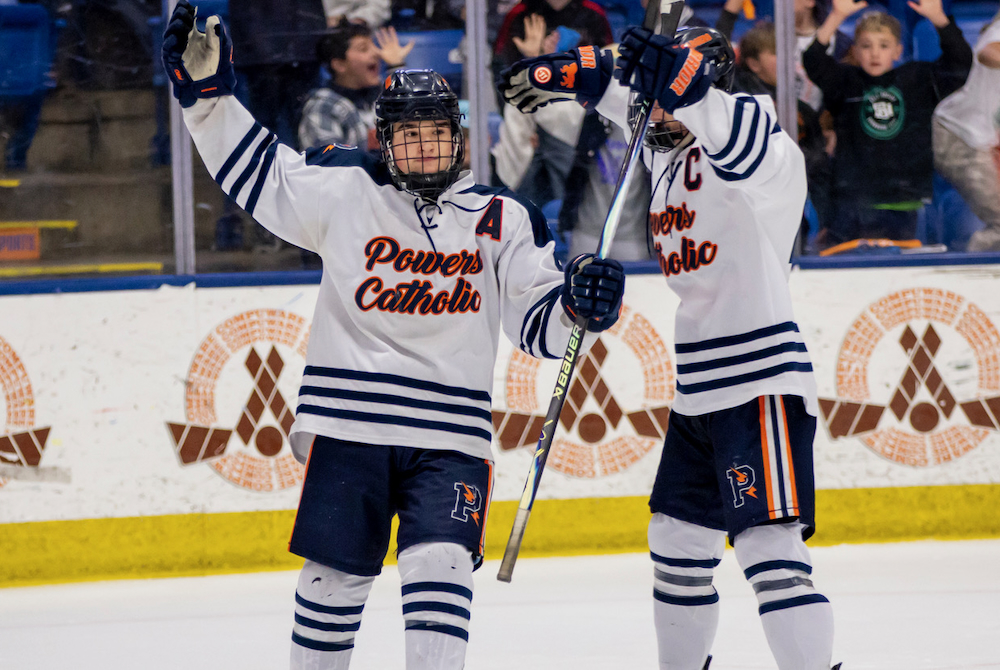
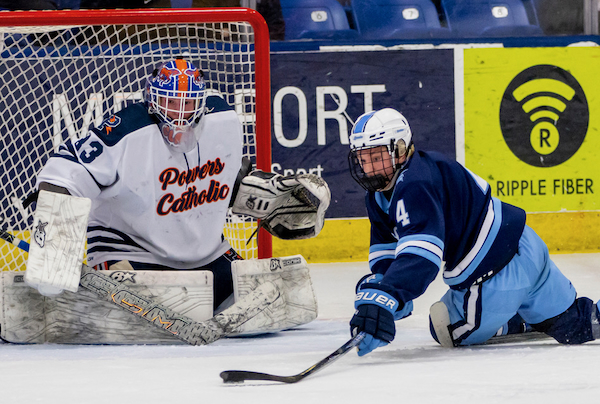
PHOTOS (Top) Flint Powers Catholic players celebrate during their Division 2 championship win Saturday at USA Hockey Arena. (Middle) Stevenson’s Tyler Breitbach (4) gets a stick on the puck in front of the Powers net and goalie Hunter Clark. (Photos by Adam Sheehan/Hockey Weekly Action Photos.)
Finals Preview: The Puck Starts Here
March 6, 2013
By Geoff Kimmerly
Second Half editor
Two things are sure to occur at this weekend's MHSAA Ice Hockey Finals.
At least one Division 2 finalist will play in a title game for the first time. And no matter which wins Saturday, that team will take leave Plymouth's Compuware Arena with its first MHSAA Finals championship trophy.
None of this weekend's Division 2 Semifinalists have won the biggest prize, adding another layer of intrigue to a tournament that traditionally draws contenders from all corners of the state.
Divisions 1 and 3, meanwhile, feature two of the most successful programs in MHSAA history. Although both missed Finals weekend in 2012, Detroit Catholic Central is back in Division 1 going for its 11th title, and Bloomfield Hills Cranbrook-Kingswood is back in Division 3 going for its 16th championship.
The pairings are as follows:
Division 2 Semifinals - Thursday
Port Huron Northern (15-13-1) vs. Hartland (18-8-2), 5 p.m.
Saginaw Heritage (24-5) vs. Livonia Stevenson (21-7-1), 7:30 p.m.
Division 3 Semifinals - Friday
Bloomfield Hills Cranbrook-Kingswood (26-2-1) vs. Riverview (20-7-1), noon
Sault Ste. Marie (21-8) vs. Flint Powers Catholic (22-5-1), 2:30 p.m.
Division 1 Semifinals - Friday
East Kentwood (15-12-2) vs. Detroit Catholic Central (21-7), 6 p.m.
Brighton (26-2-1) vs. Detroit U-D Jesuit (19-8-2), 8:30 p.m.
FINALS - Saturday
Division 2 – 10 a.m.
Division 3 – 2 p.m.
Division 1 – 6 p.m.
All Semifinals and Finals will be streamed live on MHSAA.tv, with live audio available on MHSAANetwork.com. The Finals also will appear later this month on Comcast channel 900. Division 1 will be broadcast at noon March 18, 9:30 p.m. March 19 and 10:30 a.m. March 20; Division 2 at 8 a.m. March 16 and 6 p.m. March 17, and Divsion 3 at 3 p.m. March 16, 9 a.m. March 17, 7 p.m. March 19 and 8 a.m. March 20.
Click for a full schedule of this weekend's games plus full results as they come in. Players statistics below are through the Regional round and were submitted by participating schools. And check back on Second Half this Saturday night for coverage from all three Finals.
Division 1
BRIGHTON
Record/rank: 26-2-1, No. 3
Championship history: Two MHSAA titles (most recently 2012).
Coach: Paul Moggach, 18th season (328-112-37)
League finish: First in Kensington Lakes Activities Association (Central and overall)
Best wins: 5-1 over No. 5 Plymouth, 4-3 over Division 3 No. 2 Houghton,4-1 over Division 3 No. 3 Calumet, 6-0 over Division 3 No. 5 Grosse Pointe Woods University Liggett, 6-2 and 8-1 over Division 2 No. 8 Novi, 5-3 over Division 2 No. 6 Livonia Churchill, 6-1 over Division 2 No. 9 Hartland, 4-2 over Division 3 No. 8 Farmington.
Players to watch: Michael Yuhasz, senior right wing (34 goals, 26 assists); Danny Bosio, junior left wing (26 goals, 27 assists); Jimmy Milletics, sophomore goaltender (1.60 GAA, 0.91 save %, eight shutouts).
Outlook: Brighton rode a sturdy defense to last season’s championship, and is strong stopping the puck again with Milletics providing quite an obstacle in net. The Bulldogs had given up one or no goals in eight straight games before allowing three to Bay City Central in the Quarterfinal. This team can score too, with seven who have netted at least 10 goals this season and 13 with at least 10 assists. Another result that could become important depending on how Friday shakes out – Brighton closed the regular season with an 8-0 win over East Kentwood, a Semifinalist on the other side of the bracket.
DETROIT CATHOLIC CENTRAL
Record/rank: 21-7, No. 1
Championship history: 10 MHSAA titles (most recently 2010), three runner-up finishes.
Coach: Todd Johnson, 13th season (277-58-23)
League finish: Second in Michigan Interscholastic Hockey League North
Best wins: 5-0 and 3-0 over No. 6 Grosse Pointe North, 6-1 and 3-1 over No. 4 Orchard Lake St. Mary’s, 2-1 over No. 7 Detroit U-D Jesuit, 3-1 and 3-1 (Regional) over No. 2 Birmingham Brother Rice, 5-1 over No. 5 Plymouth (Quarterfinal), 4-1 and 5-1 over Division 2 No. 5 Port Huron Northern, 8-0 and 5-1 over Division 2 No. 3 Trenton, 5-2 over Division 2 No. 6 Livonia Churchill, 4-2 over Division 3 No. 1 Bloomfield Hills Cranbrook-Kingswood, 6-0 over Division 3 No. 7 Dearborn Divine Child, 8-0 over Division 3 No. 5 University Liggett.
Players to watch: Michael Babcock, senior center (14 goals, 22 assists); Carson Gatt, junior defenseman (three goals, 17 assists), Charlie Green, senior right wing (16 goals, 18 assists).
Outlook: It’s fair to say DCC played the state’s toughest schedule this winter. On top of the 16 wins over ranked opponents, the Shamrocks’ losses came twice to Cranbrook-Kingswood, once to Brother Rice, once to Division 2 No. 1 Livonia Stevenson, twice to Indiana power Culver Academy and once to Canada’s Hill Academy. Babcock and Green made the all-state first team and Gatt made the second team in 2012.
DETROIT U-D JESUIT
Record/rank: 19-8-2, No. 7
Championship history: Has not appeared in an MHSAA Final.
Coach: Rick Bennetts, 18th season (215-217-32)
League finish: Second in MIHL South.
Best wins: 5-2 over No. 6 Grosse Pointe North (Regional), 5-2 over Division 2 No. 1 Livonia Stevenson, 4-3 and 5-4 over Division 2 No. 3 Trenton, 5-4 over Division 2 No. 5 Port Huron Northern, 4-0 over Division 2 No. 7 Grosse Pointe South, 5-2 over Division 3 No. 3 Calumet, 5-1 over Division 3 No. 4 Sault Ste. Marie.
Players to watch: Tommy Apap, junior right wing (14 goals, 23 assists); Craig Pefley, senior center (26 goals, 32 assists); Pete McMahon, senior left wing (14 goals, 19 assists).
Outlook: Jesuit fell just one point shy of winning its league title, and then beat MIHL South champion Grosse Pointe North during the Regional. Five of the Cubs’ losses came to ranked Division 1 teams, with two more against Division 3 teams that will play for that title this weekend. Pefley and Apap both made the all-state second team in 2012.
EAST KENTWOOD
Record/rank: 15-12-2, unranked
Championship history: One MHSAA title (1993), three runner-up finishes.
Coach: Shawn Jensen, first season (15-12-2)
League finish: Third in O-K Red
Best wins: 3-2 over Division 2 No. 10 Grand Haven, 4-1 over Rockford, 6-5 (OT) over Muskegon Reeths-Puffer (Quarterfinal).
Players to watch: Tyler Layle, senior defenseman (eight goals, 11 assists); Trent Bravata, senior center (20 goals, 18 assists), Austin Adams, senior left wing (10 goals, 13 assists).
Outlook: East Kentwood is back at the Semifinals for the third straight season and this time under first-year coach Jensen, an all-state defenseman for the Falcons in 1997 and later an assistant coach for the team. East Kentwood advanced in part with overtime wins in the Regional final and Quarterfinal. Layle made the all-state second team last season and Bravata earned an honorable mention.
Division 2
HARTLAND
Record/rank: 18-8-2, No. 9
Championship history: Has not appeared in an MHSAA Final.
Coach: Rick Gadwa, second season (33-18-4)
League finish: First in Kensington Lakes Activities Association Lakes Conference
Best wins: 2-1 over No. 8 Novi, 7-4 and 5-4 over Howell, 7-2 over Walled Lake Central.
Players to watch: Nick Pleshakov, senior defenseman; Brett Bandyk, senior forward; Chris McRae, junior forward. (Statistics not submitted.)
Outlook: Hartland has won its Regional both times under Gadwa, and this season took the next step. Although the games ended in losses, the Eagles saw some of the state’s best competition this winter including Division 1 top-five teams Brighton and Plymouth and Division 3 No. 5 Grosse Pointe Woods University Liggett. Pleshakov made the all-state second team as a junior.
LIVONIA STEVENSON
Record/rank: 21-7-1, No. 1
Championship history: Has not appeared in an MHSAA Final.
Coach: David Mitchell, fifth season (89-33-11)
League finish: Second in KLAA Kensington Central
Best wins: 9-2, 7-3 and 3-1 (Regional final) over No. 6 Livonia Churchill, 6-1 over No. 7 Grosse Pointe South, 6-1 over No. 8 Novi, 1-0 over Division 1 No. 1 Detroit Catholic Central, 4-0 over Division 1 No. 9 Macomb Dakota, 7-6 over Division 3 No. 5 Grosse Pointe Woods University Liggett.
Players to watch: Dominic Lutz, junior left wing (39 goals, 31 assists); Tyler Irvine, junior right wing (15 goals, 29 assists); Devin Kelly, junior center (14 goals, 35 assists).
Outlook: Stevenson survived a scare in the Quarterfinal before beating Ann Arbor Pioneer 3-2 in double overtime, but has won big against some of the best teams from all three divisions. Senior defenseman Trent Harvey has added 14 goals and 14 assists this season in front of senior goaltender Connor Humitz, who has five shutouts.
PORT HURON NORTHERN
Record/rank: 15-13-1, No. 5
Championship history: Division 1 runner-up in 2001.
Coach: Daryel McCarrel, 21st season (373-213-47)
League finish: Fifth in Michigan Interscholastic Hockey League North
Best wins: 5-2 over No. 3 Trenton, 4-3 over No. 7 Grosse Pointe South (Quarterfinal), 6-1 over Division 3 No. 6 Flint Powers Catholic
Players to watch: Bryce VanHorn, junior left wing (18 goals, 25 assists); Tyler Hughes, senior defenseman (four goals, 12 assists); Matt Fernandez, senior goaltender (2.78 GAA, four shutouts).
Outlook: The Huskies’ MIHL league finish again is deceptive, as it shares the league with Division 1 No. 1 Detroit Catholic Central, No. 2 Birmingham Brother Rice and No. 4 Orchard Lake St. Mary’s, and Division 3 No. 1 Bloomfield Hills Cranbrook-Kingswood. After facing that group, Northern no doubt is ready for anything this weekend. VanHorn earned an all-state honorable mention last season and is one of five Huskies with at least 10 goals and one of eight with at least 10 assists. Fernandez made the all-state second team last season and Hughes made the first team.
SAGINAW HERITAGE
Record/rank: 24-5, unranked
Championship history: Has not appeared in an MHSAA Final.
Coach: JJ Bamberger, fourth season (66-37)
League finish: Second in Saginaw Valley Association
Best wins: 4-3 over Howell, 4-1 and 3-2 (Regional) over Midland, 4-1 over No. 10 Grand Haven (Quarterfinal).
Players to watch: Tyler Angers, junior center (27 goals, 27 assists); Sami Abdelaziz, senior left wing (25 goals, 22 assists); Jacob Tweedle, senior center (13 goals, 12 assists).
Outlook: The Hawks are Regional champs for the second time in four seasons and after down finishes of 7-16-2 and 12-12 the last two winters. Heritage was ranked most of this season and peaked at No. 5, and is riding a 10-game winning streak. Junior goalie Kevin Cressey also has been outstanding, with a 2.40 goals-against average and .916 save percentage.
Division 3
BLOOMFIELD HILLS CRANBROOK-KINGSWOOD
Record/rank: 26-2-1, No. 1
Championship history: 15 MHSAA titles (most recently 2010), two runner-up finishes.
Coach: Andy Weidenbach, 20th season (387-145-34)
League finish: First in MIHL North.
Best wins: 5-2 and 5-1 over Division 1 No. 1 Detroit Catholic Central, 2-0 and 5-2 over Division 1 No. 4 Orchard Lake St. Mary’s, 9-3 over Division 1 No. 2 Birmingham Brother Rice, 7-4 over Division 1 No. 5 Plymouth, 3-2 and 4-3 over Division No. 6 Grosse Pointe North, 5-3 over Division 1 No. 7 Detroit U-D Jesuit., 7-0 over Division 2 No. 1 Livonia Stevenson.
Players to watch: Christopher Brown, junior center (21 goals, 24 assists); Alex Alger, junior right wing (29 goals, 24 assists); Austin Alger, junior center (20 goals, 27 assists); Michael Romund, senior left wing (20 goals, 27 assists).
Outlook: Cranbrook-Kingswood likely would be considered the favorite to win any of the three divisions this weekend, despite playing among the smallest schools. The Cranes beat six of the top 10 in Division 1 this season, and 18 of 23 games played against in-state opponents were against ranked teams. They didn't give up a goal in the postseason until beating No. 5 University Liggett 7-2 in the Quarterfinal. Brown made the all-state first team last season, and Alex Alger made the second team.
FLINT POWERS CATHOLIC
Record/rank: 22-5-1, No. 6
Championship history: Seven MHSAA runner-up finishes (most recently 2010).
Coach: Travis Perry, seventh season (144-41-11)
League finish: First in Saginaw Valley Association.
Best wins: 5-1 over Division 1 No. 7 Detroit U-D Jesuit, 2-1 over Division 2 No. 10 Grand Haven, 2-0 over Saginaw Heritage, 2-1 (2 OT) over East Grand Rapids (Quarterfinal).
Players to watch: Garrett Gormley, junior right wing (21 goals, 15 assists); Casey Korhonen, senior goaltender (1.27 GAA, 0.93 save %); Mike Forman, sophomore center (12 goals, 16 assists).
Outlook: Powers has won six straight Regional championships and is back in the Semifinals for the first time since 2010. Its defense has been staggering. The Chargers have given up one or zero goals in 16 games this season, and Korhonen has nine of the team’s 10 shutouts. He and Gormley both earned all-state honorable mentions last season.
RIVERVIEW
Record/rank: 20-7-1, No. 10
Championship history: Has not appeared in an MHSAA Final.
Coach: Al Taurence, third season (38-39-1)
League finish: Huron League, finish unavailable.
Best wins: 4-3 and 4-3 (Regional) over Monroe St. Mary Catholic Central, 5-3 over Chelsea (Quarterfinal).
Players to watch: Brian Bachnak, senior left wing (52 goals, 42 assists); Timothy Lyons, senior center (21 goals, 46 assists); Alex Testy, senior right wing (16 goals, 18 assists).
Outlook: Bachnak made the all-state second team last season and has put up incredible numbers in leading Riverview to the Finals after it finished 4-20 only two seasons ago. He’s one of a number of veterans, with 11 seniors among team’s 21 players. The Quarterfinal win over Chelsea avenged a 4-2 loss midway through the season.
SAULT STE. MARIE
Record/rank: 21-8, No. 4
Championship history: Two MHSAA titles (most recently 1989), five runner-up finishes.
Coach: John Ferroni, second season (33-19-2)
League finish: Does not compete in a league.
Best wins: 8-2 over No. 9 Hancock, 6-3 and 4-1 (Quarterfinal) over No. 2 Houghton, 1-0 over No. 7 Dearborn Divine Child, 5-2 over No. 5 University Liggett, 2-1 over Division 2 No. 5 Port Huron Northern, 5-4 over Division 2 No. 7 Grosse Pointe South
Players to watch: William Gauthier, junior center (17 goals, 18 assists), Blake Mastaw, junior left wing (15 goals, 22 assists); Eric Hillock, senior left wing (21 goals, 14 assists); Chase Gamelin, junior right wing (15 goals, 20 assists).
Outlook: Sault Ste. Marie has done exceptionally well against a tough slate after finished 12-11-2 in 2011-12. Four of its losses are to ranked Division 1 or 2 teams – including 5-4 in overtime to Division 1 No. 2 Birmingham Brother Rice. While there is obvious scoring punch, the defense has been impressive as well – the Blue Devils didn't allow a goal in the playoffs until Houghton got one Wednesday. Senior defenseman C.J. Wilkins earned an all-state honorable mention as a forward last season.
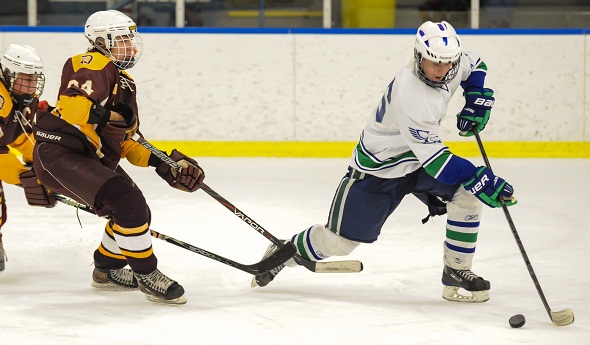
PHOTO: Saginaw Heritage (right) will attempt to advance to its first MHSAA championship game by defeating top-ranked Livonia Churchill in one of today's Division 2 Semifinals. (Click to see more at HighSchoolSportsScene.com.)