

Story in Photos: 2025 Ice Hockey Semifinals
By
Geoff Kimmerly
MHSAA.com senior editor
March 7, 2025
PLYMOUTH – The 2024-25 hockey season will conclude Saturday with all three No. 1-ranked teams at the end of the regular season playing to finish the MHSAA Tournament also on top at Plymouth's USA Hockey Arena.
Division 2 will start Saturday’s MHSAA Finals at 11 a.m. with top-ranked Flint Powers Catholic (24-4) facing No. 4 Livonia Stevenson (18-8-2). Bloomfield Hills Cranbrook Kingswood will play for a repeat in Division 3; the No. 5 Cranes (19-8-1) will face top-ranked Orchard Lake St. Mary's (22-5-2) at 3 p.m. The Division 1 Final will feature top-ranked Detroit Catholic Central (27-2) playing for a sixth-straight title, vs. No. 3 Howell (24-3-2), with the puck dropping at 7 p.m. to finish the day.
Hockey Weekly Action Photos captured plenty of action from the Semifinals – all photos below are by John Castine.

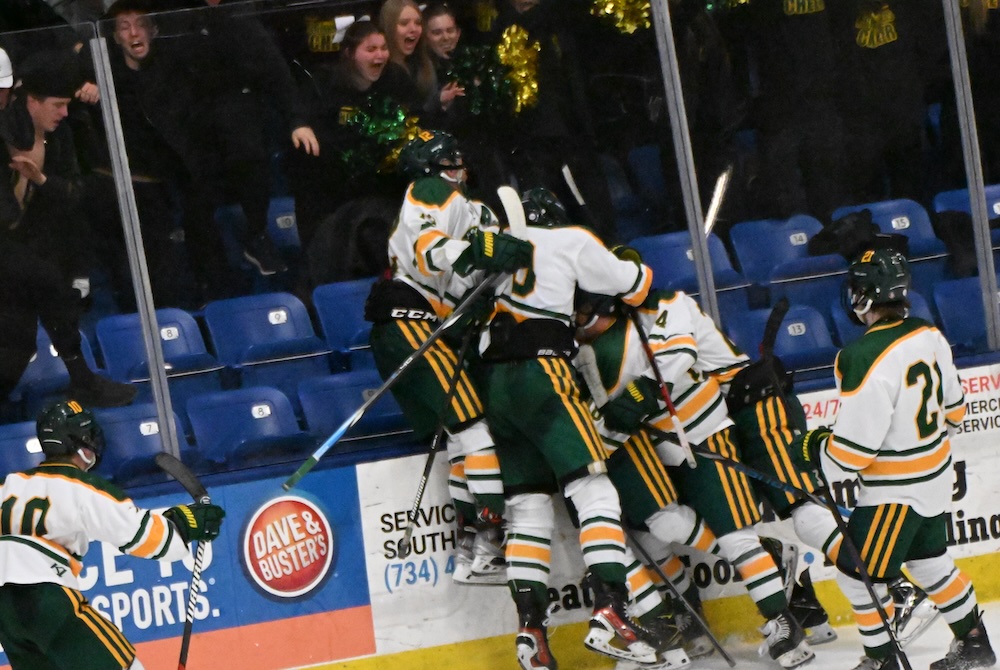
A Howell player works to maintain possession during Friday's 5-4 Division 1 Semifinal overtime win over Salem with Abel Dubanik (84) applying pressure.
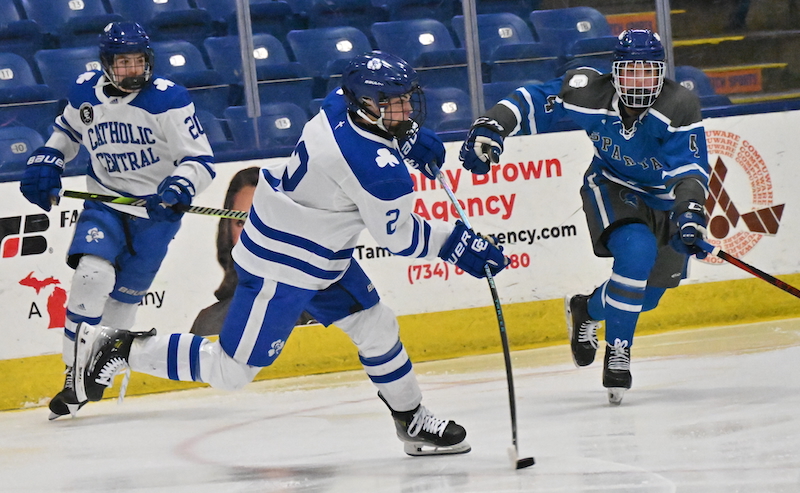
Detroit Catholic Central's Nino Suhy (2) rips a shot during his team's 8-0 Division 1 win over Sparta on Friday. He had two goals and an assist.
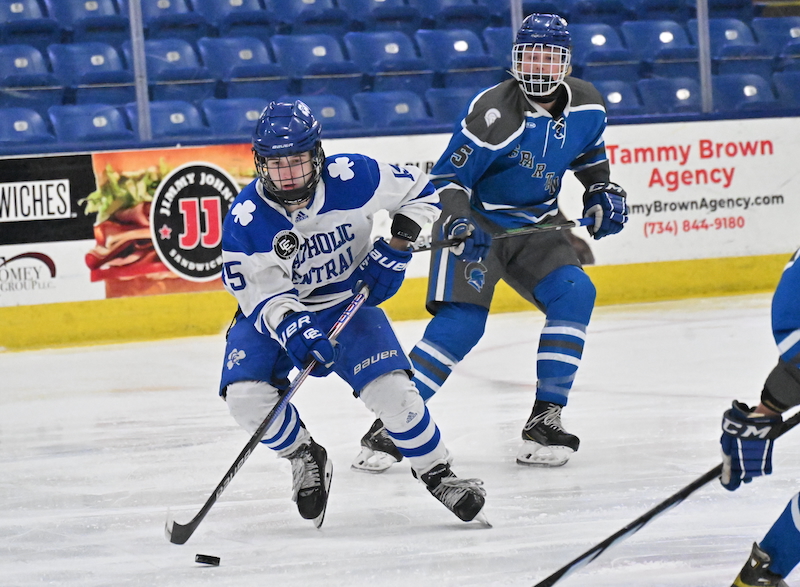
The Shamrocks' Connor Laird (15) moves the puck up ice as Sparta's Jameson Meendering (5) trails. Laird finished with a goal and an assist.
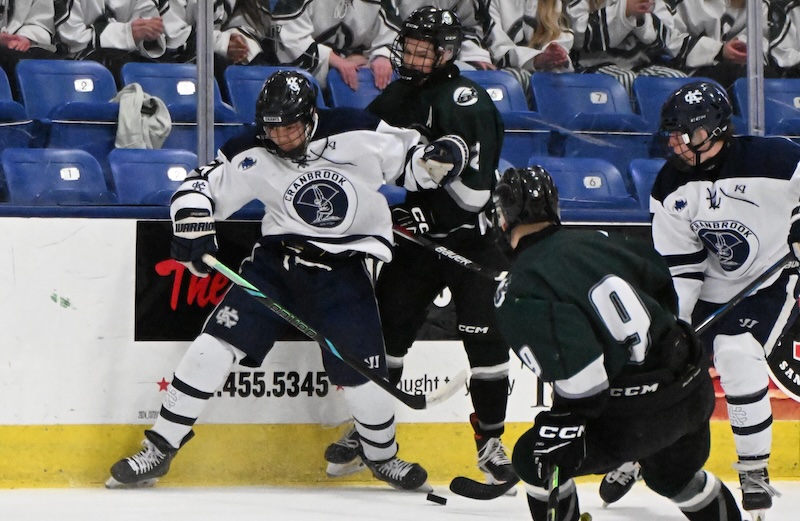
Bloomfield Hills Cranbrook Kingswood and Painesdale Jeffers players work to gain possession of the puck during the Cranes' 2-1 win in Division 3 on Friday.
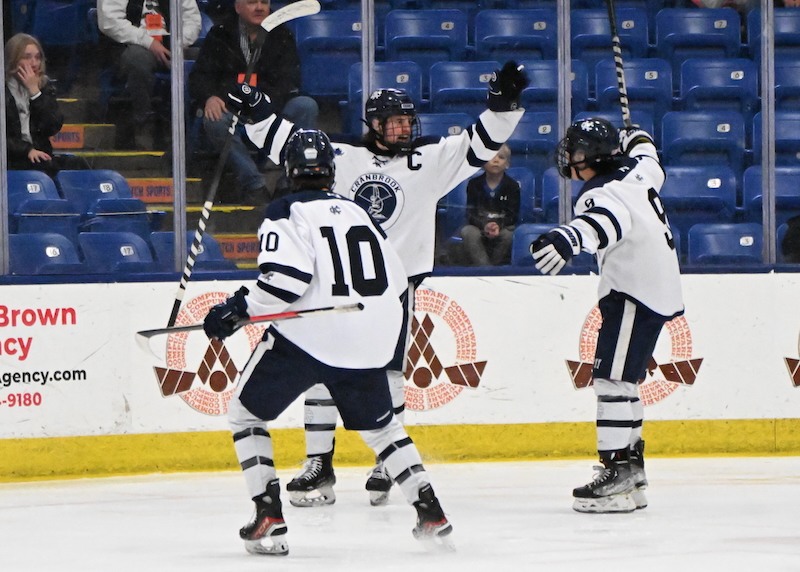
Cranbrook's Nick Timko celebrates one of his two goals with teammates GianLuca DiSalvo (9) and Cam Rocchini (10).
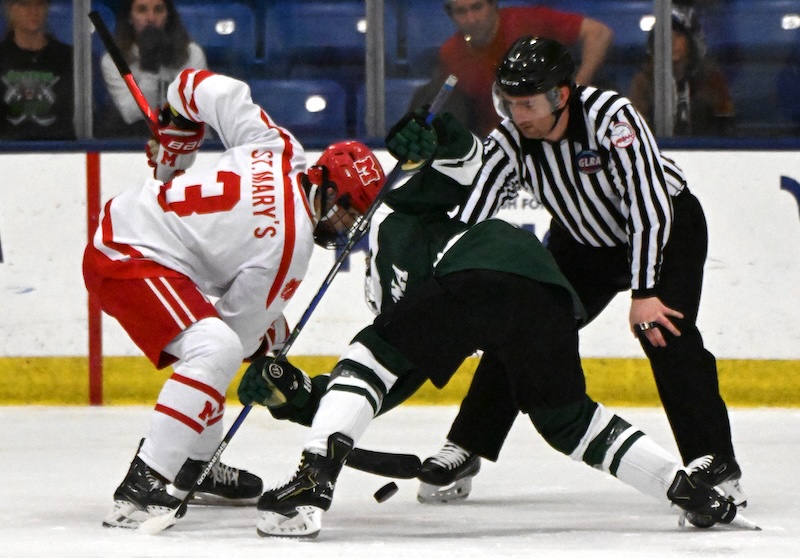
Orchard Lake St. Mary's and Alpena face off during the Eaglets' 9-1 Friday win in Division 3.
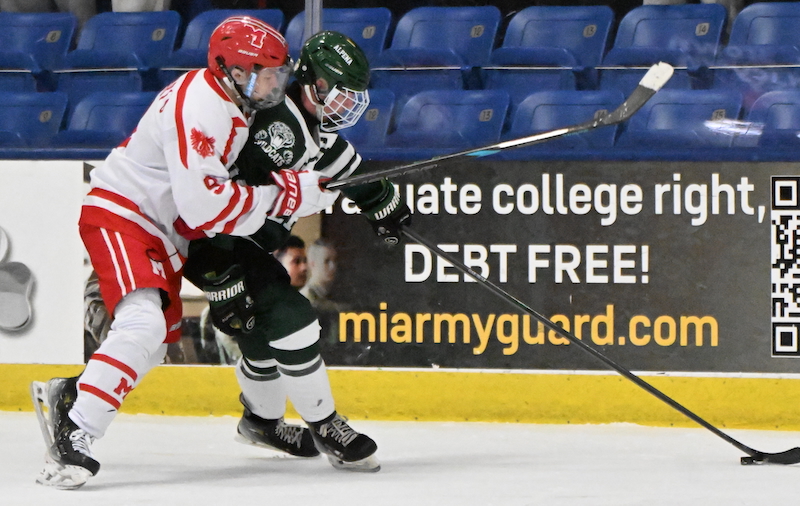
The Eaglets' Julian Johnston (9) and an Alpena player battle for possession. Johnston finished the victory with two goals and three assists.
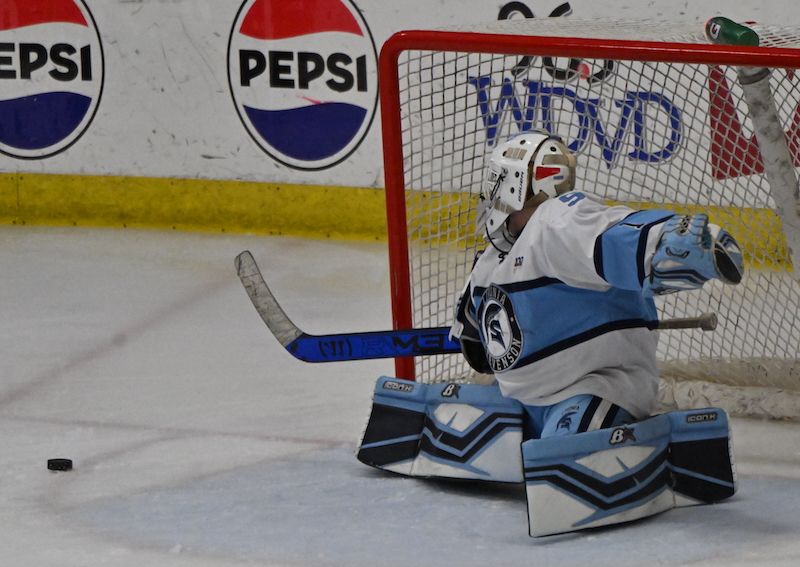
Livonia Stevenson goalie Mark Besedin deflects a shot during his team's 6-2 win over Bloomfield Hills Brother Rice in Division 2 on Thursday.
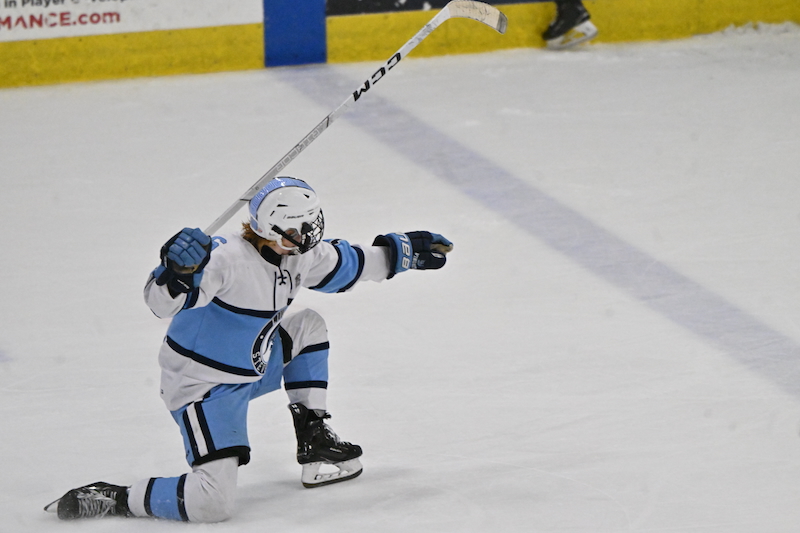
Stevenson's Tanner Champoux (6) celebrates during his team's win to reach the Division 2 Final for the first time since 2016.
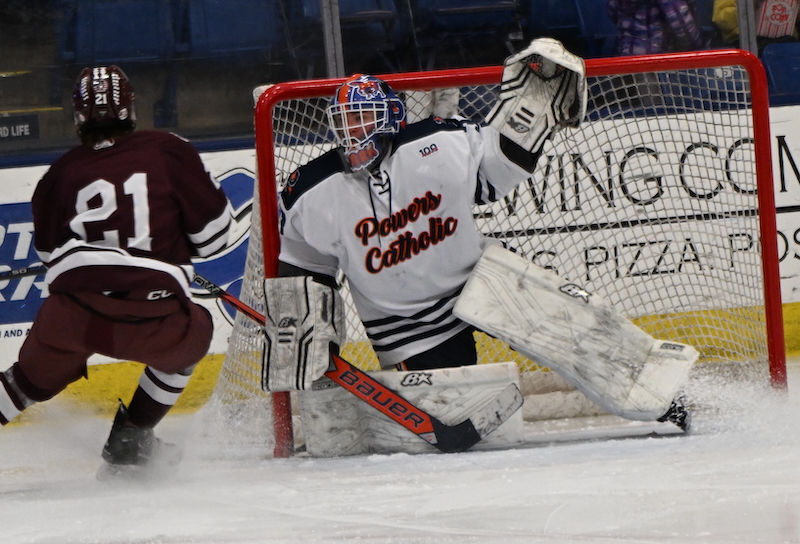
Flint Powers Catholic goalie Hunter Clark walls off a side of the goal as Grandville's Bennett Eisma (21) makes a run toward the crease during the Chargers' 4-3 Division 2 win Thursday.
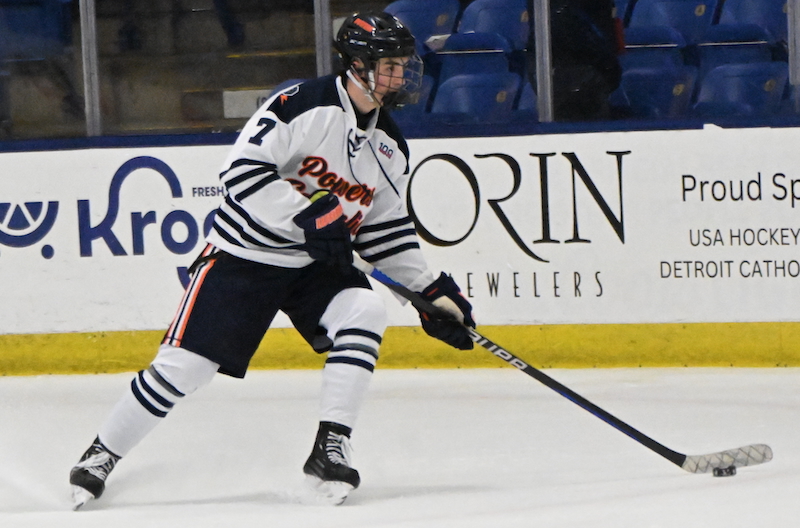
Powers' Blake Dawson controls the puck as his team advanced to play for a potential second title over the last three seasons.
TOP PHOTO Howell players and fans celebrate their team's 5-4 overtime win over Salem on Friday at USA Hockey Arena.
#TBT: 2002 Ends with Lights-Out Finals
July 12, 2019
By Rob Kaminski
MHSAA benchmarks editor
The Flint IMA had been to the MHSAA Ice Hockey Finals what Joe Louis Arena was to the Detroit Red Wings since it began hosting high school championships in the state in 1977.
For parts of four decades, the facility set the scene for many memorable moments on ice for scholastic skaters.
So it would have been fitting as the curtain was closing on an era March 9, 2002, if there’d been an overtime championship game or two to commemorate the last MHSAA Finals at the building.
In 2003, the MHSAA Semifinals and Finals would move to Compuware Arena in Plymouth – now USA Hockey Arena – where the event has been played ever since.
There would be no overtimes during the IMA’s swan song, but the arena wasn’t about to let go without a fight. Following the morning’s Division 2 Final, won by Grosse Pointe North over local qualifier Davison, things got strange.
As if by divine intervention, a significant power outage hit the Flint area between the first and second periods of the Division 3 Final, necessitating a return to the building for an encore performance that Monday.
Following is an account from then-MHSAA Assistant Director Randy Allen, administrator of the sport at that time.
 “East Grand Rapids and (Dearborn) Divine Child were between the first and second periods when the power went out at what must’ve been around three in the afternoon. Some of the house lights went on, but there was no huge generator. The power company told us it could be quite a while before the power came back, so the decision was made pretty quickly to come back Monday. (Editor’s Note: MHSAA regulations at that time prohibited Sunday competition, thus play would resume Monday)
“Finishing the game in progress Monday was really a no-brainer, but now there were a couple of immediate challenges. First, how were we going to let people know, and second, what was going to happen to the (Detroit) Catholic Central-Marquette Division 1 game coming up later in the day?
“Well, knowing what I knew about the TV business (Allen’s background in Wisconsin included sportscasting), I grabbed one of the television reporters there, probably from Grand Rapids, and asked him to come down to the ice with me. It was totally dark; I figured once he put his camera lights on, it would get the attention of the crowd, which it did. So there’s about 2 or 3 thousand people in the arena – in the dark – and I’m standing in front of a light from a TV camera, and at the top of my voice I explain the situation and let them know we’re coming back Monday.
“Anyone wanting to come back, admission was free of charge, and we’d trust they were at the game. If they wanted a refund, they could mail their ticket stub to MHSAA and we'd send a refund. We obviously couldn’t use the box office without power. I don’t recall more than a couple dozen refund requests coming to our office later.
“Now the real challenge is the Division 1 game. Marquette very, very much wanted to go home and come back a week later. They’d been on the road all week (Marquette won a Quarterfinal in Traverse City that Wednesday). Jack (Roberts, former MHSAA executive director) was there, and he and Marquette’s AD (Scott Koski) and their superintendent debated a bit. In the end, the regulations of the day were upheld, and the game would be Monday.
“As it turned out, someone in the Marquette entourage had a contact in the Detroit Pistons front office, so the team was entertained in a suite at The Palace of Auburn Hills on Sunday night, so that was quite a happy ending from their standpoint.
“Many of the Marquette people were either in the arena or at a single hotel or two in the area, so alerting them to the change was not difficult.
“But then we started to think, ‘What about the Detroit CC people who would be driving up for their game later? Remember, social media was not as prevalent as it is today, or even the dependence on the internet.
“So, Saturday night, I sat there at the entrance to the IMA with my car running and lights on to inform the CC fans and anyone else who pulled up that the game had changed ... ‘Power’s out; game’s on Monday.’ They'd say thanks, and out they'd go. No one really got angry; there wasn’t anything anyone could do. I sat there an hour and a half with a steady stream, and shortly after the scheduled game time I called it a night.”
And, the IMA called it the end of an era, but not before hanging on for one more night, when Divine Child and Detroit CC would raise the last trophies in that building ... under the lights.
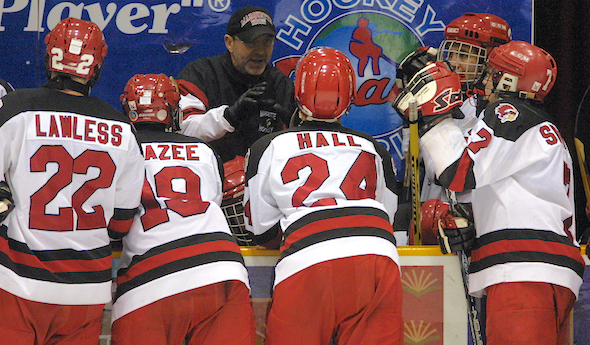
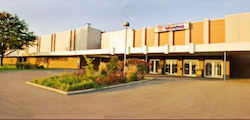
PHOTOS: (Top) Marquette was among teams that needed to stick around Flint two more days to play in the 2002 MHSAA Ice Hockey Finals. (Middle) Flint’s IMA arena.