

Be the Referee: Lodged Ball
May 15, 2019
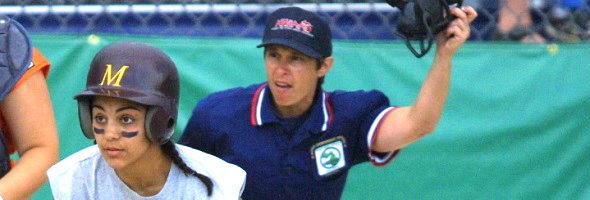
This week, assistant director Brent Rice offers a baseball/softball "You Make the Call" regarding a batted ball that becomes lodged in the fence.
Be The Referee is a series of short messages designed to help educate people on the rules of different sports, to help them better understand the art of officiating, and to recruit officials.
Below is this week's segment – Lodged Ball - Listen
Let’s test your rules knowledge with a “You Make The Call” on this baseball-softball situation.
The batter hits a line drive – and the ball caroms directly off first base into foul territory and wedges itself into a gate near a dugout without ever touching the ground. What’s the call?
First, the batted ball is a fair ball because it struck a base. At this point, it’s still a live ball. Then, when the ball became wedged in the dugout gate, it became a dead ball. By rule, the batter would be awarded second base, and any other runners on base would be awarded two bases at the time of the pitch.
Past editions
May 9: Bounced Pitch - Listen
May 2: Boys Lacrosse Safety - Listen
April 25: Softball Illegal Pitch - Listen
March 21: Instant Replay in Basketball - Listen
March 14: Basket Interference - Listen
March 7: Primary Areas - Listen
February 28: Under the Bus - Listen
February 21: You Make the Call - Listen
February 14: Because They Love It - Listen
February 7: Coach/Official Communication - Listen
January 31: Backcourt Violation? - Listen
January 24: Required Hockey Equipment - Listen
January 17: You Make the Call: 10-Second Clock - Listen
January 10: Tripping in Hockey - Listen
January 3: Sliding in Basketball - Listen
December 27: Stalling in Wrestling - Listen
December 20: Basketball: You Make the Call - Listen
December 13: Basketball Uniform Safety - Listen
December 6: Coaching Box Expansion - Listen
November 29: Video Review, Part 2 - Listen
November 22: Video Review, Part 1 - Listen
November 15: You Make the Call - Sleeper Play - Listen
November 8: 7-Person Football Crews - Listen
November 1: Overtime Differences - Listen
October 25: Trickery & Communication - Listen
October 18: Punts & Missed Field Goals - Listen
October 11: What Officials Don't Do - Listen
October 4: Always 1st-and-Goal - Listen
September 27: Unique Kickoff Option - Listen
September 20: Uncatchable Pass - Listen
September 13: Soccer Rules Change - Listen
September 6: You Make the Call: Face Guarding - Listen
August 30: 40-Second Play Clock - Listen
August 23: Football Rules Changes - Listen
Preview: Pair of Reigning Champs Return, 14 More Seeking to End Season Celebrating
By
Geoff Kimmerly
MHSAA.com senior editor
June 10, 2026
Two reigning champions are returning to MHSAA Softball Finals weekend beginning Thursday at Michigan State's Secchia Stadium, and one of them is hoping for a double-repeat performance after finishing 2025 on top.
Grass Lake in Division 3 and Mendon in Division 4 are seeking to extend their reigns. And for the second-straight season, the Hornets will play Hillman in a Semifinal, this time ranked Nos. 1 and 2, respectively, in the final coaches association poll.
Hillman also is one of nine teams traveling to East Lansing this weekend seeking a first Final championship.
This weekend's schedule is as follows:
Division 1 – Thursday
Macomb Dakota vs. Grand Haven, 10 a.m.
Walled Lake Northern vs. Northville, 12:30 p.m.
Division 2 – Thursday
Stevensville Lakeshore vs. Armada, 3 p.m.
Ogemaw Heights vs. Farmington Hills Mercy, 5:30 p.m.
Division 3 – Friday
Evart vs. Grass Lake, 10 a.m.
Ravenna vs. New Lothrop, 12:30 p.m.
Division 4 – Friday
Hilman vs. Mendon, 3 p.m.
Brown City vs. Fowler, 5:30 p.m.
FINALS – Saturday
Division 1 – 10 a.m.
Division 2 – 12:30 p.m.
Division 3 – 3 p.m.
Division 4 – 5:30 p.m.
Tickets cost $11 and may be purchased online only at GoFan. One ticket is good for all baseball, softball and girls soccer games at MSU’s Old College Field that day. All Semifinals and Finals will be broadcast and available with subscription from MHSAA.tv.
Below is a glance at all 16 teams taking the field (with statistics through Regional Finals):
Division 1
GRAND HAVEN
Record/rank: 33-7-1, No. 6
Coach: John Hall, 10th season (222-125-3)
League finish: Tied for second in Ottawa-Kent Conference Red
Championship history: Has never played in an MHSAA Final.
Players to watch: Bella Korf, sr. C/IF (.444, 50 R, 16 2B, 10 HR, 41 RBI); Lorelei Chciuk, sr. P/IF (.371, 35 RBI, 18-5 pitching, 0.93 ERA, 340 K/157 1/3 IP); Bri Borgman, sr. IF/P (.487, 40 R, 14 2B, 8 HR, 39 RBI, 14-2 pitching, 2.23 ERA, 136 K/88 IP); MaKenna VandenBrink, jr. OF (.400, 36 R, 20 SB).
Outlook: A group of eight seniors – including seven who start – have brought Grand Haven to the Semifinals for the first time, and memorably with wins over top-ranked Hudsonville in the Regional Final (after the Eagles won two of their three games during the regular season) and No. 5 Traverse City Central in the Quarterfinal. A Regional Semifinal win over Rockford also avenged a late loss. Chciuk and Borgman made the all-state first team last season and are catalysts to the effort, but several more are making big contributions including sophomore Ryley Jeltema (.360) and senior Natalie Waite (.293, 32 R, 16 SB).
MACOMB DAKOTA
Record/rank: 31-12, unranked
Coach: Shelby Weeks, third season (83-32)
League finish: Second in Macomb Area Conference Red
Championship history: Division 1 champion 2017, runner-up 2016 and 2022.
Players to watch: Nadeline Tcruz, fr. OF (.416, 64 R, 14 2B, 35 SB); Maddie Kruk, jr. OF (.423, 44 R, 14 2B, 35 RBI): Kiley Phelan, sr. IF (.524, 38 RBI); Nola Mae Tcruz, jr. IF (.423, 34 R, 30 RBI, 21 SB).
Outlook: Dakota finished second in the MAC Red to No. 2 New Baltimore Anchor Bay but defeated the Tars in their District Final and continued on to their first Semifinals since that 2022 runner-up season. Phelan made the all-state first team last spring and tops a team list that has 10 hitters batting .333 or better. Brooke Cahill (10-5, 2.56 ERA) and Alivia Reardon (13-3, 3.12) have shared the majority of pitching duties, and senior Chloe Dunn (.395, 43 RBI) and freshman Ella Goike (.383, 40 R, 43 RBI, 36 SB) are also among the biggest contributors offensively.
NORTHVILLE
Record/rank: 35-4-1, No. 4
Coach: Scott DeBoer, ninth season (235-110-6)
League finish: First in Kensington Lakes Activities Association West
Championship history: Has never played in an MHSAA Final.
Players to watch: Jocelyn Burns, soph. C (.450, 46 RBI); Kennedi Adams, jr. CF (.411, 32 R, 10 2B, 23 SB); Mary Gugala, sr. P (.321, 27-2 pitching, 1.04 ERA, 285 K/180 2/3 IP); Kendall Heron, sr. SS (.407, 12 SB).
Outlook: Northville’s first Regional title since 2012 has turned into its first trip to the Semifinals, as the Mustangs got past No. 9 Salem in their District Semifinal and Saline in their Regional championship game while allowing a total of four runs over five postseason contests. The Salem and Saline wins avenged regular-season losses, and the other two came against No. 2 Anchor Bay and No. 8 Grand Blanc with the tie against No. 6 Grand Haven. A total of 10 hitters are batting .300 or higher, with senior Alyssa Spencer (.353), freshman Mia Petrovski (.343) and junior Olivia Smith (.329) next highest on the list.
WALLED LAKE NORTHERN
Record/rank: 37-3, No. 7
Coach: Kristen Woodard, 15th season (376-150-4)
League finish: First in Lakes Valley Conference
Championship history: Has never played in an MHSAA Final.
Players to watch: Makenna Kresbaugh, jr. CF (.433, 49 R, 65 RBI); Lyla Turmell, sr. P (.561, 54 R, 11 HR, 52 RBI, 26-2 pitching, 0.95 ERA, 228 K/155 1/3 IP); Shaela Byrnes, jr. 2B (.477, 35 R, 34 RBI); Aubrey Kresbaugh, soph. SS (.436, 49 R).
Outlook: Northern has seemed on the cusp of making this first trip to the Semifinals, winning Regional titles as well last spring, in 2022 and 2017. Turmell made the all-state first team last season, and Makenna Kresbaugh and Byrnes earned honorable mentions. They with junior catcher Anna Doyle (.327, 33 R) give the team a talented group up the middle. Junior Olivia Frellick (.324, 34 RBI) and freshman Alex Dziak (.329) also bolster the lineup. Northern’s postseason run has included a pair of wins over honorable mentions Livonia Stevenson and league rival White Lake Lakeland.
Division 2
ARMADA
Record/rank: 35-8, honorable mention
Coach: Rob Girvin, fourth season (97-54)
League finish: First in Blue Water Area Conference
Championship history: Class C runner-up 1979
Players to watch: Helena Fettue, jr. SS (.427, 37 R, 19 SB); Grace Girvin, soph. 1B/P/C (.384, 50 R, 34 RBI, 19 SB, 10-2 pitching, 2.08 ERA); Lilyana Piconke, soph. OF (.447, 59 R, 56 RBI, 31 SB); Megan Cox, fr. P/1B (.362, 31 RBI, 15-2 pitching, 1.60 ERA, 174 K/109 1/3 IP).
Outlook: Armada is making its first trip back to the Semifinals since 2010 after opening the tournament with a win over league rival and reigning champ Richmond, adding victories over honorable mentions St. Clair and Orchard Lake St. Mary’s along the way, and then also downing No. 6 Frankenmuth in their Quarterfinal. Cox, Grace Girvin and Taylor Capozzo (9-4, 3.25 ERA) have split starts in the circle, and Capozzo also bats fourth and entered the week hitting .377 with 36 runs scored and 56 driven in. Sophomore Justine Lint (.336, 31 RBI) also has been a top run producer.
FARMINGTON HILLS MERCY
Record/rank: 20-17, unranked
Co-coaches: Alec Lesko & Sara McGavin, fifth seasons (146-39)
League finish: Fifth in Catholic High School League Central
Championship history: Division 1 champion 2016, runner-up 2002.
Players to watch: Taylor Selimi, jr. 3B (.404, 36 R, 35 RBI); Sophia Chaput, sr. CF (.509, 48 R, 31 SB); Maeve Weiss, fr. C (.323, 30 RBI); Anna McGavin, jr. P/OF (.286, 30 R, 17-10 pitching, 2.53 ERA, 277 K/170 1/3 IP).
Outlook: After eight seasons away, Lesko and McGavin returned to lead the program again this school year have brought Mercy to the Division 2 Semifinals after years playing among the elite in Division 1. The Marlins made the Division 1 Semifinals most recently in 2024 and 2021, and advanced to this weekend with a Quarterfinal win over No. 5 Carleton Airport, and have made this surge with only two senior starters but seven underclassmen on the roster.
OGEMAW HEIGHTS
Record/rank: 28-9, unranked
Coach: Ryan Nicholson, first season (28-9)
League finish: Second in Jack Pine Conference
Championship history: Class B runner-up 1982.
Players to watch: Kylee England, soph. P (.481, 16 2B, 38 RBI, 18-8 pitching); Aubrey Evans, jr. SS (.500, 54 R, 14 HR, 72 RBI); Averie Weiler, soph. 2B (.422, 39 R, 30 RBI); Addison Wenkel, fr. CF (.453, 62 R, 44 SB).
Outlook: Nicholson took over the program this year after five as an assistant coach and has brought Ogemaw Heights to the Semifinals for the first time since 1982 (and with its first Regional title since 1994). The Falcons have scored double-digit runs in 18 games, and all nine starters were hitting at least .328 entering the week. Sophomore Mackenzie Benjamin (.387, 44 R, 40 RBI) and junior Laila Ireland (.383) are two more big bats on the 11-player roster that has only two seniors.
STEVENSVILLE LAKESHORE
Record/rank: 34-4, No. 1
Coach: Denny Dock, 37th season (1,171-268-2)
League finish: First in Southwestern Michigan Athletic Conference
Championship history: Eight MHSAA titles (most recent 2022), two runner-up finishes.
Players to watch: Lily Dustin, sr. 1B/P (.566, 28 2B, 58 RBI, 13-1 pitching, 2.32 ERA); Shaunna Roberts, fr. 3B (.504, 17 2B, 45 RBI); Adelle Prosser, fr. C (.468, 15 2B, 44 RBI); Ashley Ramirez, jr. P (17-3, 1.68 ERA, 191 K/125 IP, .324).
Outlook: The winningest coach in MHSAA softball history (at 1,359-361-2 and counting over a total of 47 seasons) is bringing his top-ranked team back to MSU for the first time since the 2022 championship season – and Lakeshore might be making a few more trips over the next few years. The Lancers start their lone senior, Dustin, and she bats fourth, but the three hitters in front of her are all freshmen and part of a group of five total on the roster. Sophomore Payten Strefling (.430, 45 RBI), freshman Madi Ettinger (.417) and junior Belle Forrester (.404) also are among the top hitters for a lineup that carries a .408 average.
Division 3
EVART
Record/rank: 42-0, No. 1
Coach: Shaun Gray, third season (109-9)
League finish: First in Highland Conference
Championship history: Division 3 champion 2024, runner-up 2022.
Players to watch: Kyrah Gray, sr. P (.600, 83 R, 26 2B, 14 HR, 53 RBI, 29-0 pitching, 0.84 ERA, 345 K/175 1/3 IP); Mattisen Tiedt, sr. 1B (.616, 60 R, 20 2B, 12 HR, 78 RBI, 7-0 pitching, 1.91 ERA); Keira Elder, sr. C (.417, 50 R, 41 RBI); Jillian Decker, sr. SS (.463, 48 R, 18 2B, 42 RBI).
Outlook: After falling in its District opener last year to eventual Division 3 runner-up Clare, Evart has not lost again – while playing a schedule that’s included a nice collection of ranked and larger opponents. The Wildcats have won 18 games by shutout, with Kyrah Gray a returning all-state first teamer writing her name all over the record book again offensively and in the circle. Tiedt also made the all-state first team last season and is posting huge numbers, and sophomore Quyncee Gray (.471, 46 R, 36 RBI) is adding plenty of pop to the middle of the lineup.
GRASS LAKE
Record/rank: 35-5, No. 4
Coach: Roger Cook, 25th season (625-225)
League finish: Second in Cascades Conference
Championship history: Division 3 champion 2025.
Players to watch: Morgan Conrad, sr. P/1B (.378, 24-1 pitching, 2.04 ERA, 144 K/127 IP); Leilah Smith, sr. 2B (.395, 38 R, 48 RBI); Makenzie Hilberer, jr. SS (.480, 53 R, 50 RBI, 16 SB); Lily McVicker, fr. CF (.509, 64 R, 24 SB).
Outlook: Grass Lake is returning to MSU with five starters from last season’s championship game win, including all-state first-teamers Conrad, Smith and Hilberer. The Warriors finished second in the Cascades to No. 2 Brooklyn Columbia Central but then defeated the Golden Eagles in a District Semifinal, and Grass Lake also downed No. 6 Clinton in its Regional Final and honorable mention Ottawa Lake Whiteford on Tuesday. Sophomore third baseman Kennedy Collins (.446, 39 R, 45 RBI) and senior left fielder Addalynn Hensen (.395, 38 R) also started a year ago and rank among the team’s top hitters.
NEW LOTHROP
Record/rank: 33-10, unranked
Coach: Chad Henige, first season (33-10)
League finish: First in Mid-Michigan Activities Conference
Championship history: Class C champion 1982, runner-up 1978.
Players to watch: Mallory Heroux, sr. P (.477, 19 2B, 52 RBI, 27-4 pitching, 0.62 ERA, 308 K/170 1/3 IP); Savannah Knieper, soph. 2B (.403, 34 R, 41 RBI); Leigha Eagan, fr. 3B (.368, 38 R); Alexandra Knieper, sr. C/3B (.427).
Outlook: New Lothrop is making its first Semifinal appearance since its championship season after avenging last year’s Regional loss with a 3-2, 10-inning Quarterfinal victory over honorable mention Millington. Heroux earned an all-state honorable mention last spring and tops a team hitting leaderboard that also includes freshmen Sydney Knieper (.358, 54 R, 49 SB) and Raegan Heroux (.357, 31 RBI) among main run producers. Henige took over the program after previously serving as junior high coach and then varsity assistant over the last nine seasons.
RAVENNA
Record/rank: 38-1, No. 3
Coach: Dave Sherman, 10th season (246-83)
League finish: First in West Michigan Conference Rivers
Championship history: Has never played in an MHSAA Final.
Players to watch: Riley Homoly, sr. 2B (.417, 51 R, 47 RBI, 21 SB); Emily Postema, sr. C (.588, 70 R, 14 3B, 71 RBI, 43 SB); Natalie Rosel, jr. P (.555, 75 R, 53 RBI, 43 SB, 24-0 pitching, 0.60 ERA, 240 K/129 1/3 IP); Reese Herremans, jr. SS (.454, 66 R, 20 2B, 56 RBI, 20 SB).
Outlook: Ravenna is continuing to move closer to a possible first championship, with this repeat trip to MSU the team’s third in four seasons and following up last year’s one-run loss in the Semifinals. A 6-0 win over No. 5 Morley Stanwood in the Regional Final was a defining moment and avenged the team’s only defeat this spring. The Bulldogs opened the postseason with four straight shutouts, and Rosel earned an all-state honorable mention last season as did Postema and Homoly. Junior third baseman Sydney Morrissey (.438, 40 R, 39 RBI) also is among dangerous bats for a team that’s averaging 12 runs per game.
Division 4
BROWN CITY
Record/rank: 25-11, No. 9
Coach: Scott Parr, fifth season (88-81)
League finish: First in Big Thumb Conference Black
Championship history: Has never played in an MHSAA Final.
Players to watch: Sydnee Mabee, jr. SS (.441, 51 R, 28 SB); Maddie Hohne, sr. P (.467, 36 R, 30 RBI, 17-7 pitching, 3.38 ERA, 199 K/145. IP); Sami Hayes, soph. UTY/P (.409, 30 R, 7-3 pitching); Chloe Hayes, sr. CF (.393, 41 R).
Outlook: Brown City has been building to this first trip to the Semifinals, with four straight District and three consecutive league championships under Parr and now a first Regional title and Quarterfinal victory. The stunner came in the Regional Semifinal as the Green Hornets guaranteed an end to No. 3 Unionville-Sebewaing’s six-season streak of making Division 3 Finals with a 10-8 win. Senior Linzee Mathews (.393, 31 R), junior Alaina Roberts (.376, 36 R and 38 RBI) and senior Callie Morse (.349) also bolster the lineup.
FOWLER
Record/rank: 28-8, No. 8
Coach: Brian Miller, first season (28-8)
League finish: First in Central Michigan Athletic Conference
Championship history: Has never played in an MHSAA Final.
Players to watch: Saige Miller, sr. SS (.594, 70 R, 10 HR, 48 RBI, 23 SB); Selena Stump, sr. P/OF (.492, 48 R, 37 RBI, 20 SB, 17-4 pitching, 3.51 ERA, 107 K/123 1/3 IP); Kerigan Pung, jr. C (.461, 32 R, 30 RBI); Addison Spicer, sr. 3B (.504, 37 R, 17 2B, 57 RBI).
Outlook: The Eagles are back at the Semifinals for the first time since 2014, building on a postseason run that’s included wins over No. 5 Bellaire, No. 6 St. Louis and No. 7 Beal City. Maryland recruit Miller is capping an all-state career; she made the first team last season, while Stump earned an honorable mention. Senior Rachel Wirth (.456, 44 R) and freshman Bristol Miller (,423, 43 R, 36 RBI) also bolster an offense averaging nearly 11 runs per game. Brian Miller took over the program after previously serving as an assistant at Fowler and Pewamo-Westphalia.
HILLMAN
Record/rank: 33-9, No. 2
Coach: Jason Weiland, third season (105-21)
League finish: First in North Star League Little Dipper
Championship history: Class D runner-up 1996.
Players to watch: Aubrey Weiland, jr. SS (.411, 60 R, 33 RBI); Gretchen Weiland, sr. P (.560, 58 R, 56 RBI, 19-5 pitching, 2.15 ERA, 214 K/107 2/3 IP); Abigail Oswald, fr. P/2B (.431, 59 R, 34 RBI, 21 SB, 9-4 pitching); Madelyn Oswald, jr. C (.567, 59 R, 20 2B, 65 RBI, 27 SB).
Outlook: Six starters including ace pitcher Gretchen Weiland are back from last season’s Semifinal lineup, and she made the all-state first team last year while Aubrey Weiland earned an honorable mention. Juniors Rylee Lis (.384, 43 R, 43 RBI) and Brook Linseman (.387) and sophomore Peyton Szlag also started last season, and Gretchen Weiland and Peyton Banks are the only seniors on this roster. The Tigers won a District two weeks ago that also included No. 10 (tie) Johannesburg-Lewiston and honorable mention Rogers City.
MENDON
Record/rank: 30-3, No. 1
Co-coaches: Steve Butler & Mike Smith, ninth seasons
League finish: First in Southern Central Athletic Association
Championship history: Division 4 championship 2025, runner-up 2023, Class D runner-up 1992.
Players to watch: Cienna Nightingale, sr. C/1B (.622, 68 RBI, 22 SB); Jadyn Samson, sr. SS/P (.640, 77 R, 18 2B, 30 RBI, 33 SB, 8-2 pitching); Rowan Allen, sr. P/SS (.638, 63 R, 42 SB, 18-1 pitching, 2.47 ERA, 161 K/96 IP); Taya Bingaman, sr. CF (.641, 58 R, 18 2B, 60 RBI, 29 SB).
Outlook: Mendon returns just four players from last season’s championship game lineup – but all four are hitting over .600 and the group includes top pitcher Allen, who gave up a combined two earned runs during last season’s Semifinal and Final. Samson, Nightingale and Allen all made the all-state first team last season as well. Freshman Sabrina Monroy (.383, 30 R, 30 RBI) is another major contributor on the offensive side. The losses came twice to Division 3 Bronson and once to Division 2 Three Rivers, and this tournament run has included a Regional Final win over No. 10 (tie) Gobles.
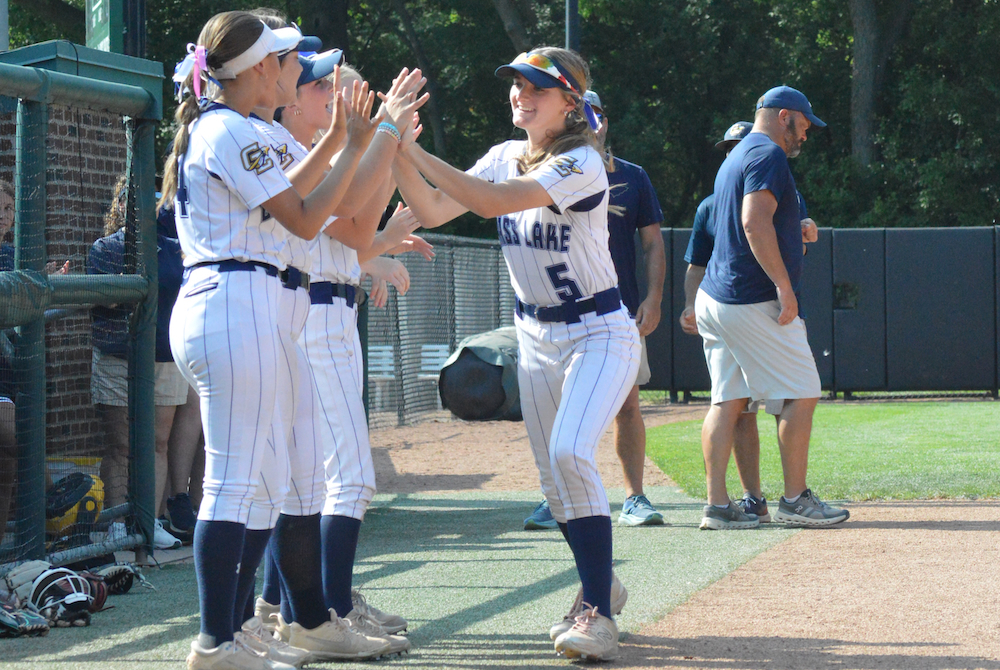
PHOTO Grass Lake’s Leilah Smith (5) is introduced before the start of last season’s Division 3 Final at Secchia Stadium.