

Be the Referee: Lodged Ball
May 15, 2019
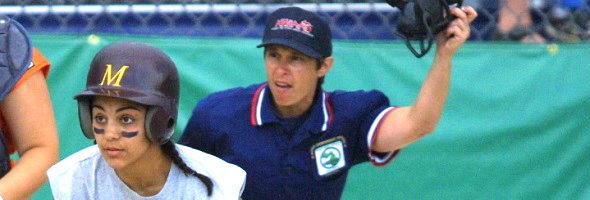
This week, assistant director Brent Rice offers a baseball/softball "You Make the Call" regarding a batted ball that becomes lodged in the fence.
Be The Referee is a series of short messages designed to help educate people on the rules of different sports, to help them better understand the art of officiating, and to recruit officials.
Below is this week's segment – Lodged Ball - Listen
Let’s test your rules knowledge with a “You Make The Call” on this baseball-softball situation.
The batter hits a line drive – and the ball caroms directly off first base into foul territory and wedges itself into a gate near a dugout without ever touching the ground. What’s the call?
First, the batted ball is a fair ball because it struck a base. At this point, it’s still a live ball. Then, when the ball became wedged in the dugout gate, it became a dead ball. By rule, the batter would be awarded second base, and any other runners on base would be awarded two bases at the time of the pitch.
Past editions
May 9: Bounced Pitch - Listen
May 2: Boys Lacrosse Safety - Listen
April 25: Softball Illegal Pitch - Listen
March 21: Instant Replay in Basketball - Listen
March 14: Basket Interference - Listen
March 7: Primary Areas - Listen
February 28: Under the Bus - Listen
February 21: You Make the Call - Listen
February 14: Because They Love It - Listen
February 7: Coach/Official Communication - Listen
January 31: Backcourt Violation? - Listen
January 24: Required Hockey Equipment - Listen
January 17: You Make the Call: 10-Second Clock - Listen
January 10: Tripping in Hockey - Listen
January 3: Sliding in Basketball - Listen
December 27: Stalling in Wrestling - Listen
December 20: Basketball: You Make the Call - Listen
December 13: Basketball Uniform Safety - Listen
December 6: Coaching Box Expansion - Listen
November 29: Video Review, Part 2 - Listen
November 22: Video Review, Part 1 - Listen
November 15: You Make the Call - Sleeper Play - Listen
November 8: 7-Person Football Crews - Listen
November 1: Overtime Differences - Listen
October 25: Trickery & Communication - Listen
October 18: Punts & Missed Field Goals - Listen
October 11: What Officials Don't Do - Listen
October 4: Always 1st-and-Goal - Listen
September 27: Unique Kickoff Option - Listen
September 20: Uncatchable Pass - Listen
September 13: Soccer Rules Change - Listen
September 6: You Make the Call: Face Guarding - Listen
August 30: 40-Second Play Clock - Listen
August 23: Football Rules Changes - Listen
St. Mary's Sinks Reigning Champ in D2
June 13, 2015
By Andy Sneddon
Special for Second Half
EAST LANSING – None of the players on the Orchard Lake St. Mary’s roster had ever been on a Regional championship baseball team.
Most every starter returned this spring for Mount Pleasant, the defending Division 2 champion.
Greg Loukinen, one of just two senior starters for St. Mary’s, tossed a five-hit gem Saturday as the Eaglets unseated the Oilers, 4-1, in the Division 2 title game at Michigan State University’s McLane Baseball Stadium.
It was the first MHSAA baseball title for St. Mary’s (32-13) since 2003 and came against an Oilers team (27-13) that was not only defending its crown, but had outscored its opponents, 69-2, in seven MHSAA tournament games and recorded shutouts in eight of its previous nine starts.
“Our guys have competed at this stage in other sports – they haven’t been here in baseball, but they’ve competed in football and in the summer they’ve played in a lot of big games in front of a lot of people,” St. Mary’s coach Matt Petry said. “They didn’t show that it bothered them too much today.”
 The Eaglets overcame three errors, two of which came in the top of the first inning when Mount Pleasant seized a 1-0 lead. St. Mary’s answered with the tying run in the bottom of the first on the legs of Mason Vaughn, who walked, stole second, took third on a wild pitch and scored on another wild pitch.
“That was huge. I think that set the tone for us that we were going to be around all game. If we didn’t get that run back things might have gone a different way.”
The Eaglets went ahead for good in the second inning, getting an RBI double from Joe Carlini and a run-scoring single from Drake Titus as Mount Pleasant starter Hunter Buczkowski struggled to find his control.
Buczkowski walked five, struck out five and surrendered three hits over four innings in taking the loss. Three of his walks, plus a wild pitch, came during the Eaglets’ two-run second inning.
That’s all Loukinen needed as the left-hander struck out seven and walked just one.
“He battled through some adversity there in the top of the first and he did a great job of settling down after that inning and not letting it bother him after we kicked the ball around behind him a little bit,” Petry said. “He doesn’t let too much bother him. He doesn’t walk guys. If you’re going to beat him, you’re going to have to earn it and he did a great job of keeping their guys off base via the walk. And we made some plays behind him when we needed to.”
Hunter Buczkowski led off the Oilers’ half of the seventh inning with a single and Obie Ricumstrict drew a two-out walk to bring the tying run to the plate. Loukinen struck out Zach Heeke, Mount Pleasant’s leading hitter, to end the game.
“I was just paying attention to the fact that there was another batter that I had to get out, that’s how I look at it,” Loukinen said. “I take after my teammate Drake Titus. He doesn’t let anything affect him. Regardless of the run they scored (in the first inning) I knew what I needed to do, and I had the defense to back me up.
“The past few years have been a struggle. Two years ago we made it to regionals, last year we got cut off early. There’s a lot of brotherhood on the team; everybody feels it. It was 100 percent a team win. It wasn’t just me; it was the defense, the bats, everyone on the bench.”
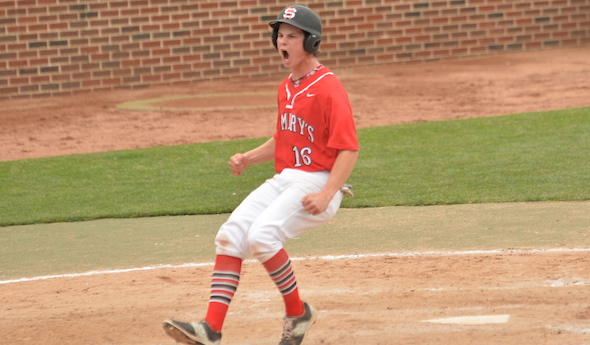
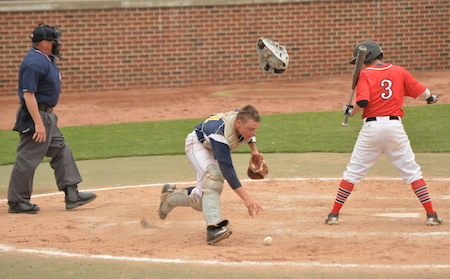
PHOTOS: (Top) Orchard Lake St. Mary’s Joe Carlini yells in celebration after scoring a run Saturday. (Middle) Mount Pleaant catcher Daniel Keller picks up the ball as St. Mary’s Campbell Kinch signals to a teammate not to advance.