

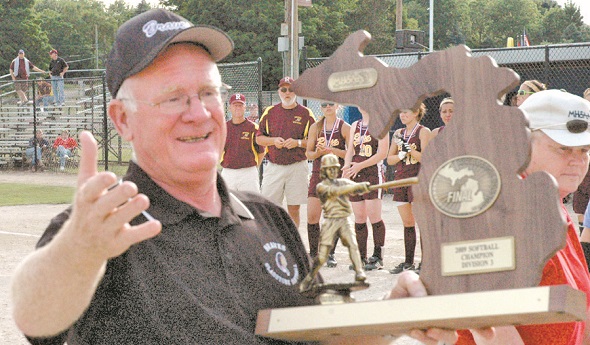
Gladstone Coach Smith Built Champions

October 24, 2016

By Dennis Grall
Special for Second Half

ESCANABA — Gerry Smith put his life into helping area youngsters get a foot into the athletic doorway, and in the process touched the lives of so many people.

“Smitty” died Oct. 15 following a lengthy illness.

“God got a great softball coach,” said retired Gladstone athletic director Matt Houle. “He was unique and old school, but his love for kids and the game always showed clearly. He had such a passion for the game of softball and just loved working with kids.”

Smith, 70, worked at Mead Paper Co. for more than 30 years and was IBEW 979’s business agent for 21 years. But he will perhaps be most remembered for his 43 years on softball and baseball fields throughout the area. He spent 11 years as Gladstone High School’s head softball coach, directing the Braves to MHSAA titles in 2004 and 2009. He was 290-77-1, but missed much of the 2008 season because of shoulder surgery. The Braves were 31-10 under interim manager John Malloch, which would give Smith an overall 321-87-1 record.

“He put a lot of trust into people he asked to help him out,” said Ashley Hughes, who succeeded Smith in 2014 and guided the Braves to the MHSAA Division 3 title that year.

Hughes, who joined Smith on the softball staff when she became a teacher at her alma mater in 2009, also pitched for Smith and the Braves before getting a softball scholarship to Lake Superior State University.

She recalled Smith sought her services when she returned to Gladstone. “Hey kiddo, how about helping us out this year,” is how Hughes remembers that conversation.

He then told her, “I’m going to teach you everything I know and in a few years this will all be yours,” Hughes related.

“For me to come as head coach after Smitty, there was so much pressure. I wanted to live up to everything he had provided for this program,” Hughes said. “I didn’t want to disappoint him. He put a lot of faith in me.”

She said Smith also had an impact when she was a player. “He was so in your face in such a positive light. He wanted you to be successful, whether you had never touched a ball or had the ability to go on to play college ball. He was a spit-fire. He was so intense.

“He just exuded passion, at practice, at games. He had so much love for the game. That is something I’ve held onto because I too loved that game. To have someone like Smitty be so passionate and intense helped me become passionate and gave me the drive to be like that.”

Bill Buchmiller and Smith were partners for 40 years and he became godfather to Buchmiller’s children. In addition to guiding the Braves’ high school varsity, they served as American Legion coaches in the early stages of Gladstone’s program, worked together as Little League coaches and were softball teammates.

“He took a program from nothing to two state championships,” said Buchmiller. “He always encouraged the group. He may have broke them down a little bit but he always built them back up. He was a hard guy to get to know, but once you got to know him, he was a great guy.”

Smith used the knowledge he had gleaned from many years as a player and infused that into his players. “He just dwelled on the basics of softball. If you had to play small ball to win, that is what he played,” said Buchmiller.
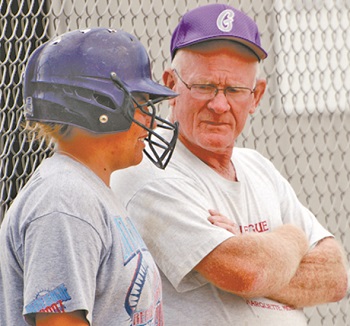
“He covered all the different bases of softball. He stressed defense. He told (hitting coach) Al Verbrigghe, ‘You give me one run Al and we’ll win the ball game with my defense. Give me a run and we’ll manage somehow.’”

Theresa Shepeck, who joined Smith on the GHS staff in 2003, agreed with that assessment.

“Smitty always thought the short game was the way to go,” she said. “It was about bunting, not the long ball. You get a runner on one, you bunt her to two. You get somebody on three, then you suicide (bunt) her home.”

Shepeck said his players thrived on his various idiosyncrasies, such as finding tourney lodging in rather inexpensive motels and using a wad of cash to pay for the team’s rooms. “The kids just yukked it up,” she said with a laugh.

“He always put the kids first. If somebody made a mistake, it was never their fault; it is my (Smith’s) fault, the coaching staff’s fault. If one of us coaches made a mistake, he took that blame. It was always his fault, his responsibility,” said Shepeck.

The players appreciated how he used them in games and practices. “His philosophy was to put the best nine on the field, period,” she said. “He walked on a lot of toes, he had a lot of hurt feelings (of parents), but I think the kids respected that. Nobody ever doubted how they fit in. He was there to win.

“He was a little man (about 5-foot-6) but had a huge heart. He was all about the kids and the coaching staff. It was an honor to learn from him, to be in his presence, to be a mentor to the kids.”

Hughes agreed, noting “he had a way of figuring out what the team needs are and re-arranging the players (duties). He knew the players’ strengths and was always looking out for the entire team.”

Smith’s career record likely could have included more wins if he didn’t use the season’s first month to shuffle personnel while building for the postseason. It paid off when it counted the most as the Braves reached at least the Quarterfinal level each of his 11 seasons.

“He was definitely not afraid to experiment,” said Hughes. “He knew the rules of the game and he was always looking for more (from his players). He was an aggressive coach, and the girls who love the sport really grasped at that. He utilized every player on his roster.

“He didn’t have to say too much, but you always wanted to answer him and make him proud and prove to him that you can come through.”

Houle summed up Smith’s legacy when he said, “He was the person that put Gladstone High School on the map in high school activities. He will be dearly missed by so many. He touched so many lives.”

Denny Grall retired in 2012 after 39 years at the Escanaba Daily Press and four at the Green Bay Press-Gazette, plus 15 months for WLST radio in Escanaba; he served as the Daily Press sports editor from 1970-80 and again from 1984-2012. Grall was inducted into the Upper Peninsula Sports Hall of Fame in 2002 and serves as its executive secretary. E-mail him at [email protected] with story ideas for the Upper Peninsula.

PHOTOS: (Top) Gladstone High School softball manager Gerry Smith holds the Division 3 championship trophy after the Braves won the 2009 title in Battle Creek. Smith, who also led the Braves to the 2004 crown, died Oct. 15. (Middle) Smith talks with catcher Jordan Kowalski at a practice prior to the 2011 Division 3 Semifinals. (Photos courtesy of Escanaba Daily Press.)

Serving a Balanced School Sports Diet

May 1, 2018

By John E. “Jack” Roberts
MHSAA Executive Director

If you really want to know what a person thinks is important, look at that person’s calendar and checkbook or credit card receipts. How a person spends his/her time and money tells you more than anything that person says.

The same can be said for organizations. How they spend their time and money identifies what they value.

So, an observer of the Michigan High School Athletic Association might notice that the only standing committee that meets more than once each year is the MHSAA’s Junior High/Middle School Committee, and the MHSAA’s longest-standing work group is the Task Force on Multi-Sport Participation, which has had six formal meetings during 2016 and 2017.

Promoting multi-sport participation, and doing so before students reach high school, is a documented MHSAA priority. We believe it’s good for students, schools and society.

By encouraging participation but not specialization, balanced multi-sport participation provides the sweet spot between two unhealthy extremes – on the one hand, inactivity that contributes to a childhood obesity epidemic or, on the other hand, year-round specialization that is too early, intense and prolonged, leading to an epidemic of overuse injuries in youth sports.

Within the pages of this issue of benchmarks are descriptions of initiatives to elevate the profile of school-sponsored sports programs for junior high/middle school age youth and to under-gird multi-sport participation as the means to maximize benefits for students and schools today, and for society in the future.

***

The MHSAA is tailoring efforts to put the multi-sport athlete back in style. Among the initiatives is bolstering participation at the junior high/middle school ages.

By Rob Kaminski
MHSAA benchmarks editor

Saugatuck’s high school football season had just come to an end with a 21-0 loss to Pewamo-Westphalia in the MHSAA Division 7 Final last November when three key players were being led up the tunnel to represent the school for postgame media interviews.

When asked how many on the team would have a one-day break before joining the basketball team for practice on that Monday, one of the players replied, “We have about seven of us who begin basketball Monday.”

The response was comforting to hear in an age that has seen specialization and year-round, single-sport focus render the multi-sport student-athlete to minority status in many hallways across the nation’s high schools.

Granted, participation in multiple sports is necessary for programs to exist in smaller schools such as Saugatuck, but even those communities can benefit from a renewed emphasis and earlier introduction to school-based athletics.

As MHSAA Executive Director Jack Roberts points out above, there are just two groups that meet more than once each year at the offices in East Lansing: the Junior High/Middle School Committee, and – during the past two years – the Task Force on Multi-Sport Participation.

Each will continue to play pivotal roles in promoting increased participation, one by examining early introduction to school sports at the junior high/middle school level, and the other by evaluating education, cooperation and recognition of multi-sport numbers at the high school age.

“One of the challenges we currently face is that in some cases students enter high school never having experienced school sports,” said MHSAA Assistant Director Cody Inglis, who oversees the Junior High/Middle School Committee. “Now they go cold-turkey into high school sports and we have to introduce them to rules and regulations that aren’t a fabric of non-school sports which they may play. The earlier we can expose them to our programs, the better off we’ll be at the high school level.”

Inglis outlined three main topics in front of the Junior High/Middle School Committee currently: 1) how to introduce school sports to students earlier; 2) the effect more games – not length of season – would have on JH/MS participation, and 3) whether the MHSAA should sponsor Regional tournaments in select sports prior to high school age.

The Task Force on Multi-Sport Participation, meanwhile, has turned its focus on the following: 1) educating groups on the benefits of variety in participation and the perils inherent in specialization, 2) preparing tools for administrators, and 3) creating recognition programs for multi-sport student-athletes.

The following are results from a fall 2017 survey on junior high/middle school programs and explanations of tools created by the multi-sport task force to encourage participation for all seasons.

Start in the middle ... or even before

The prevailing sentiment among athletic administrators, coaches and student-athletes themselves is that early introduction to a variety of sports will foster a culture of future participation and the tendency to continue in more than one sport.

“Students at the JH/MS level need to experience sports sampling so that they can be physically literate; to gain competence and confidence to move their bodies in a variety of movements so that they can achieve lifelong health and wellness and stay injury-free,” said Scott Przystas, teacher and coach at Grand Haven Area Public Schools and member of the MHSAA Task Force on Multi-Sport Participation.

The overriding question is how to strike a delicate balance between opportunity and excess at the target age group.

The good news is that MHSAA JH/MS membership has increased by more than 100 schools during the last two years, bringing the total to nearly 800. The MHSAA is exploring means to ensure the trend continues, surveying the schools last fall on matters such as modifying the Limited Team Membership rule to allow student- athletes at the JH/MS to compete in up to two outside events in the same sport in the same season, having the MHSAA sponsor regional or even state competitions in certain sports and expanding the number of JH/MS games and contests allowed during the 13-week season.

“The survey attempted to answer several questions,” Inglis said. “Would opening up options to participate in a couple non-school events during the same season draw athletes to our JH/MS programs or keep them in non-school sports? Would statewide or regional tournaments be attractive?”

Survey results reveal the current climate pertaining to several topics.

Of the 616 completing the survey, 436 were athletic directors and 166 were principals, with the remainder consisting of other positions within the schools, ranging from coaches to superintendents. The grades served by the schools were 6th-8th, with about 36 percent indicating that 5th-graders were also in their buildings.

“The survey response has shown there’s a definite hesitation for state tournaments at the JH/MS level, but there is some favorable feeling toward regional tournaments,” Inglis said.

For example, when asked about the possibility of regional tournaments in track & field and/or cross country, the results were about 50/50 for and against.

Yet, when it comes to the idea of statewide tournaments in those sports, the attitude changes significantly, with roughly 30 percent in favor. Further, when the question of JH/MS state championships for any other sports is posed, the response is an overwhelming “No,” from 84 percent of those surveyed.

Following is a sampling of comments regarding postseason tournaments at the JH/MS level:

• “Middle school athletics should be a time to expose students to the sport and develop their skills. Increasing the competitiveness of it would change the focus.”

• “Logistically, it would create more challenges to have regional and state tournaments at the middle school level. However, we are at the point where we are in a struggle competing with club sports such as basketball and soccer, to name two. At a minimum, a regional championship would create additional buzz and competitive atmosphere at the school setting. A state championship is not as critical. However, if we do this for one sport, we will have to consider doing this for all sports.”

• “I think we are headed down a dangerous path of too much too quick for junior high kids. They can play for championships in high school and beyond if they are good enough. More games mean less practice, more expense and less of a focus on the things that are important.”

• “I think middle school sports is a great opportunity to expose students to sports. We need to keep it pure with learning each day without the pressure of trying to win trophies and medals.”

• “State championships at a younger age will just start the clock earlier of recruiting and illegal transfers. Add more games to be competitive with the non-school sports.”

That last sentence hits a couple hot buttons. Can more games be added while maintaining an appropriate amount of competition? Can an environment be created to pull students from, or co-exist, with non-school options at the JH/MS level?

“Overall, our JH/MS constituents do not want to lengthen athletic seasons, but there is some opinion to increase the number of contests within the current seasons, particularly on days not followed by school days,” Inglis said.

For example, respondents indicated just 45 percent were in favor of increasing the number of basketball games in a season from 12 to 15, while only 39 percent would support the same increase in soccer schedules.

However, support resonated with the notion of allowing multi-contest events on days not followed by school days.

The group in favor of the above scenario was also 83 percent in favor of limiting such doubleheader dates to four per season.

In soccer, a similar scenario also was approached in the survey.

Basketball and soccer are two sports in which non-school entities offer plenty of competition for participants, even at ages prior to JH/MS.

For youth already involved in such programs prior to reaching local junior highs and middle schools, the challenge is to display the benefits of school-based sports.

Justin DiSanti is a doctoral student and research assistant at Michigan State University with a concentration in sport psychology who also serves on the multi-sport task force for the MHSAA. His research interests include talent development and sport specialization, particularly in youth and high school sports.

DiSanti points to a model that is frequently used in the world of youth sport, the Developmental Model of Sport Participation (DMSP).

“This model has three stages providing approximate age guidelines and associated recommendations for shaping youth athletes’ schedules,” DiSanti said. “I believe that this model is highly-applicable to today’s world of youth sport, but the proper interpretation of the model is critical. When looking at specialization through the lens of the DMSP, we can begin to answer the question, ‘Is an athlete specializing too early?’”

The first stage, “The Sampling Years,” affects children from 6 to 12 years old, during which time participation in a wide range of athletic endeavors is encouraged. By this model, many youngsters are already thinking about specializing, or at least narrowing their focus by the time they arrive at junior highs and middle schools.

Przystas, the 2016 Michigan Physical Education Teacher of the Year by the state’s chapter of Society of Health and Physical Educators, concurs that this is a key time for future student-athletes.

“I think the multi-sport message needs to start from the ground up, with elementary physical education teachers, continuing to middle school PE and middle school sports and then into high school,” Przystas said.

In an effort to ease the transition from community and club teams, or to introduce students to sports in a school setting, JH/MS programs are critical. Leaders were asked whether allowing some non-school participation in the same sport during the same season would create a viable bridge leading to school sports participation.

The vote was nearly split when considering the allowance of two non-school events for team and individual sports per season for current MHSAA JH/MS student-athletes, with 54 percent of respondents in favor.

Yet, 63 percent believe that scenario would create conflict between the two options, and the feeling was again split as to whether such an allowance would increase or decrease participation in either the school or non-school setting.

With the degree of uncertainty as to the effect of non-school allowances, some think it best to focus on the many unique benefits offered through school sports which are lacking in alternative settings.

“I think it is important for student-athletes at this level to understand what having school pride means,” Przystas said. “When they are playing with their school logo on the front of their jersey they are representing something bigger than themselves. It is important for the coach/teacher/administrator to emphasize the importance of history and tradition not only in sports, but in other endeavors such as Science Olympiad or Spelling Bee.”

Following is a sampling of comments regarding non-school relationships at the JH/MS level:

• “Junior high is a great time for kids to increase their skill, and for many kids who don't have parents to tote them to clubs and travel teams to try the sport.”

• “It is understood that in many areas, getting kids back from travel teams is important, but in our area finding gym time, etc., is very tough.”

• “I'm uncomfortable with allowing just two non-school sporting events; I have no idea how that will be monitored. I would rather allow it or not.”

• “My biggest concern for a middle school student to play on multiple teams during the season is safety. Their bodies are still growing and I see injury being the biggest concern.”

• “School-sponsored, MHSAA sports being offered by any particular school, should take precedent over any non-school sponsored sport being offered at the same time.

• “We have a lot of football players choose to play with area little league teams instead of our school team. The non-school teams have the opportunity to play more games than our school team and they also have the opportunity for playoffs. We are limited to six games and we have academic requirements that non-school teams don't have.”

• “In my opinion, kids are going to play for either the school or play outside. Many parents are of the mindset that their child is a star and playing travel sports will get them noticed. MS sports can't compete with this mindset and I believe we should not compete with it. Those who stay and play for schools are the ones we should be focusing on. Let's make it (a) better situation for them.”

The MHSAA also carries with it something else that other organizations lack: a brand. That much came through in the spring of 2017 when a pilot program on “Presenting Sponsorship of JH/MS events” was completed.

MHSAA staff visited five areas of the state and joined in presenting pre-existing track & field league or conference meets with branding presence and financial support.

“One of the big takeaways was the power of the MHSAA brand,” Inglis said. “Student-athletes flocked to get pictures with the MHSAA banner behind them and with their trophies or medals won. The power and positivity of the MHSAA brand is something that will be used to get additional JH/MS programs into school membership.”

Future plans include sponsorship at conference events that already exist in numerous other sports.

Multiple choice is the best answer

The meeting room where the MHSAA Task Force on Multi-Sport Participation gathered for its sixth meeting over a two-year span last November was plenty big enough for the group.

But, it would never contain all of those involved in school sports to whom the task force wishes to convey its message.

Therein lies the purpose and challenge of this most important group of individuals: how to get the attention of the desired audiences, and how to best deliver the virtues and benefits of multi-sport participation.

One task force member equated it to so many parent-teacher conferences; the parents that need to attend, do not. While it is universally accepted that specialization leads to burnout and detracts from the full school sports experience, all too often the two groups with the most influence – parents and coaches – are fine with that notion as long as it’s someone else’s kid, or someone else’s player.

“One obstacle to multi-sport participation are parents. They need to understand that by having their student-athlete play one sport year-round does not guarantee a full athletic scholarship,” Przystas said. “The benefits of exposing their student athlete to a variety of sports needs to be reiterated by coaches and ADs.”

Athletic directors can further assist in the movement by coordinating coaches within their schools.

“The high school coaches need to be on board with encouraging their athletes to play multiple sports and must understand the benefits they will receive from it in the long run; athletes will not be burned out, will still have another level to at which to compete, will be willing to learn, healthy and uninjured,” Przystas said. “I think the message should be advertised in middle school events that the MHSAA sponsors as well as throughout communities and at youth level leagues.”

And, the younger the better in terms of sampling a wide variety of activities, thus preparing students for the opportunities that await them as they move through the school system.

“I believe the message needs to be heard at the elementary and middle school levels,” St. Joseph athletic director and task force member Kevin Guzzo said. “Any type of informative flyers or public service announcements touting the benefits of multi-sport participation would help educate parents on this message.”

That is the task of the group, which is currently considering numerous methods to apply the force.

Prior to the November meeting, a brochure entitled “Coaching Our Coaches” was produced and disseminated statewide, and posted to the Multi-Sport Participation page of MHSAA.com.

An accompanying PowerPoint presentation was presented by Przystas at a state conference for physical education professionals in October. Feedback from the presentation led to modifications in the PowerPoint. Among the modifications were slides less directed at the audience and more toward what the audience can do to help promote the initiative.

“The feedback from that first presentation showed us that we need to acknowledge the very many aspects of the problem, establish a positive tone, set realistic expectations and goals for the session, and identify target audiences – perhaps parents and coaches,” said MHSAA Executive Director Jack Roberts. “We might ask audiences how they can put the right people in place and what methods they use to promote the multi-sport experience to athletes, parents and coaches.”

Further educational tools and settings also have been discussed. Any time gatherings of MHSAA constituents take place, the time is ripe for delivering the message – including sportsmanship summits and coaches association meetings.

The medium for delivery must reach far beyond print and personal interaction. Social media will play a key role in advancing multi-sport participation initiatives with great frequency,

Ultimately, the task force concluded that the best way to influence and shape the culture of school sports moving forward is to recognize those schools and individuals who are living the multi-sport life and reaping the benefits.

"Recognizing Our Best" has been created and will be fluid in its content, periodically updated and delivered electronically to recognize exemplary efforts.

Some discussion took place regarding the creation of MHSAA or MIAAA awards to recognize efforts in promoting multi-sport participation, but the consensus was that local efforts and existing success stories will get greater results.

“We have implemented a program called the Iron Bear Club at our school that rewards those who are three-sport athletes,” Guzzo said. “Numbers have slightly increased over the last few years and we are hoping to continue to see an increase. Students who are three-sport athletes receive an ‘Iron Bear’ shirt, and we celebrate them on social media.”

Local efforts serve to strengthen relationships within school buildings and school systems.

“Coaches – both of in-house school-sponsored sports and private club coaches – need to be on the same page as to what is best for the athlete long-term and what advice they are giving their athletes once their season is over,” Przystas said. “This is a big obstacle that needs attention because some coaches are selfish and want what’s best for themselves and will do whatever they can do to win. 

"Coaches – especially middle school and subvarsity coaches – need to understand that no one cares what their record is, but rather whether the student-athletes are having fun and continuing with school-sponsored athletics after their season is over.”

PHOTOS: (Top and top middle) Letter jackets from Owosso and Fenton, respectively, display recognition for high school athletic careers with plenty of variety. (Middle) Davison athletes pose with an MHSAA banner at a junior high event. (Below) East Grand Rapids lacrosse players high five before a game.