

Neighbors, Friends & Coaching Legends
April 26, 2018
By Doug Donnelly
Special for Second Half
When Kris Hubbard was asked to coach the fledgling Ottawa Lake Whiteford softball team in the late 1970s, the first person she went to for advice was her neighbor, Kay Johnson.
 Johnson, who already had been coaching the Morenci softball team for about five years, wrote down a couple of pages worth of tips, from offensive situations for practice to drills for outfielders. Those golden rules given from one friend to another helped build the foundation for Hubbard’s career that has spanned 40 years, more than 800 wins and three MHSAA Finals championships.
“I wanted to start a softball program and I said to her, ‘Okay, what do I need to do?’” Hubbard recalls. “I think I still have it. It was a pretty good list.”
“I got her started,” Johnson said. “I don’t know that I taught her a lot.”
Johnson graduated from Whitmer High School in Toledo in 1968 and Adrian College in 1972. She lived in Sylvania, Ohio, only a couple of miles from Whiteford High School, and accepted a teaching and coaching job at Morenci. She coached volleyball, basketball, softball and track. Her 1976 Bulldogs track & field team won the Lower Peninsula Class D championship.
Hubbard grew up in Blissfield and played college basketball at Western Michigan University, graduating in 1973. After college she accepted a teaching job at Whiteford and early on was coaching track, volleyball and basketball for the Bobcats. After the 1978 track season, Hubbard stepped down as head coach for that team. It was then that some of the Whiteford girls came to her and asked if she would be interested in coaching them in a new sport at the school – softball.
“I had played fast-pitch softball, but I didn’t know all of the little things kids needed to know,” Hubbard said. “That’s why I went to her.”
Johnson and Hubbard had met a few years earlier when Johnson was playing on a Toledo city league recreation basketball team. Her team needed more players and her uncle told her about Hubbard, who, come to find out, was a distant relative. The two didn’t know each other, but they lived about a long fly ball from each other at the Michigan-Ohio border.
“My mom’s brother was married to her grandma’s sister,” Johnson said. “We didn’t know each other. I was at Thanksgiving and my uncle said I should call her for the basketball team.”
“So, I talked with her and I thought maybe we could ride together,” Hubbard recalls. “I asked where she lived. Turns out, she lived on the first street into Ohio (across the state line) and I lived on the first street in Michigan. … We have a lot in common. Both of us like sports and have similar interests. We’ve been friends ever since.”
They’ve been more than just rivals in different dugouts. When Hubbard was getting married in the 1980s, she moved in with Johnson after her house sold. For years they have traveled to softball coaching clinics together, even making a presentation on softball drills at least once. This past winter they vacationed together.
“She’s been a good friend,” Hubbard said.
Hubbard had never coached softball but was a fast learner. Her first three Bobcats teams won Tri-County Conference championships from 1979-81. In 1984, the Bobcats won their first of three Class D championships over the next four years.
Ironically, only one of those state title teams won a league championship. That’s because Tri-County Conference opponent Summerfield won the Class C title in 1984 and Johnson’s Morenci team won Class C titles in 1985 and 1986.
The league has been a softball powerhouse from the start. Since 1984, Summerfield and Whiteford have three MHSAA Finals titles each and Morenci and Clinton two apiece. Numerous TCC teams have reached the Semifinals or played in championship games. Whiteford, for example, played in the 2017 Division 4 Final and Morenci in the 2016 Semifinals.
“There have been some good coaches in the TCC, and I’m not talking about us,” Hubbard said.
Hubbard has 11 TCC titles to her credit, including the 2017 win. Robert Taylor (Summerfield) has eight league titles, Johnson seven and Al Roberts (Clinton) five.
The league has also been home to some tremendous talent. Summerfield’s Michelle Bolster played at Indiana University. Whiteford’s Leigh Ross was an All-American at the University of Toledo, later coached at Syracuse and is now a softball analyst for ESPN and the Big Ten Network. Morenci pitcher Renae Merillat was an All-American at Hillsdale College. Summerfield’s Melissa Taylor claimed the statewide Miss Softball Award as the top position player in 1997.
 Johnson entered 2018 with 889 career victories, Hubbard with 813, putting them both near the top of the MHSAA softball coaching wins list. Johnson has more than any softball coach in Lenawee County history, while Hubbard passed Monroe’s Vince Rossi last year to become the winningest softball coach in Monroe County history. This year, both teams are in a loaded Division 4 District that includes Britton Deerfield, Summerfield and Sand Creek.
“There have been times where the District is tougher than Regional,” Hubbard said.
Johnson said both she and Hubbard have the same philosophy when it comes to the regular season – throw out the records and build a team that can contend for an MHSAA championship.
“Our league prepares us for the District tournament,” she said. “We both put teams on our schedule that are going to challenge us. I’d rather lose 3-1 then win 15-0. Winning 15-0 does nothing. It doesn’t teach anything.”
Morenci was a member of the Lenawee County Athletic Association before joining the TCC in the early 1980s. That meant the two friends would be coaching against each other at least twice a year.
“We’ve done it enough now that it’s just another league game,” Johnson said.
It’s no accident the two have similar coaching styles and strategy when it comes to developing pitchers, bunting at key situations in a game and advancing runners.
“We talk about softball a lot, just not about playing each other. That’s not exactly fun,” Hubbard said. “I think we are both pretty laid back. To coach as long as we have, you have to be.”
The game has changed over the years – the ball itself is much different than it was in the 1970s and 1980s. The home run was rare 20 years ago but is now part of the game, something Johnson isn’t thrilled about.
“I hate the home run in fast-pitch,” she said. “I want doubles, triples and relays from the outfield. I want action. You work your defense. I want them to be able to show off. The bats have really livened up the game.”
Hubbard wants to coach the Bobcats at least one more year after this season. This spring her team has seven players back, including its top pitcher, from last year’s runner-up finish. Most are only juniors. She smiles easily when talking about ex-players and their after-school successes.
“I love Facebook for one reason – you get to follow a lot of your former athletes,” she said. “There’s a whole lot of them who are really successful in life. That’s what it is all about. It’s a game. Softball is just a game. It’s (a small part) of your life. If you turn out all right, that’s what it is about.”
Johnson used to identify pitching prospects while teaching physical education at Morenci. She was later a principal and now is athletic director at Morenci along with softball coach.
“It’s sustained over the years,” Johnson said of the program. “We’ve had our low years. One year we only won five games. But, program-wise, year-in and year-out, we bring out the quality kids. They know the expectations. They have a high grade-point average. When you are getting those quality kids out, you know they are going to give you a good effort.”
Johnson and Hubbard will square off this season May 22 in a doubleheader at Whiteford. Before the game, which will be the 106th and 107th meetings between the two all-time, Hubbard will put a Snapple in the dugout for Johnson. Neither coach is interested in knowing who has the upper hand when it comes to the head-to-head series.
“You don’t get real fired up about it,” Hubbard said. “For those two hours I want to kick her butt and she wants to kick mine. We are going to be friends no matter what.”
 Doug Donnelly has served as a sports and news reporter and city editor over 25 years, writing for the Daily Chief-Union in Upper Sandusky, Ohio from 1992-1995, the Monroe Evening News from 1995-2012 and the Adrian Daily Telegram since 2013. He's also written a book on high school basketball in Monroe County and compiles record books for various schools in southeast Michigan. E-mail him at [email protected] with story ideas for Jackson, Washtenaw, Hillsdale, Lenawee and Monroe counties.
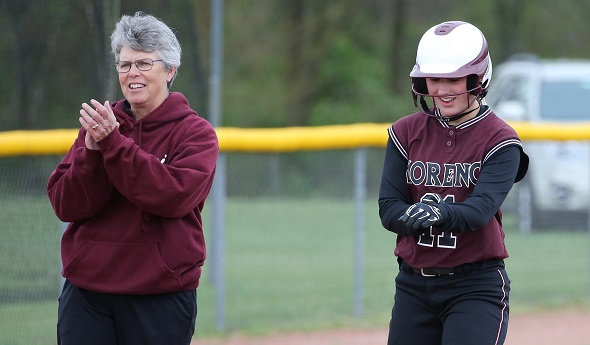
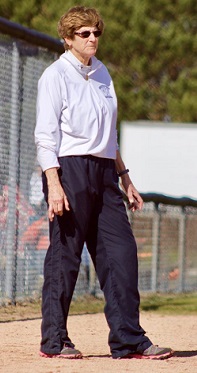
PHOTOS: (Top) Morenci’s Kay Johnson encourages her next hitter as a runner reaches third base. (Middle) Ottawa Lake Whiteford’s Kris Hubbard surveys the field during Wednesday’s sweep of Petersburg Summerfield. (Photos by Mike Dickie and Angela Link, respectively.)

Turnaround Coaches: Study their Steps
April 27, 2016
 By Scott Westfall
MSU Institute for the Study of Youth Sports
Turnaround leadership is often a popular topic within sports conversations, as many coaches are revered for their ability to transform a struggling team into a “winner.”
Turnarounds often are discussed in platitudes such as, “That coach has what it takes to turn this program around.”
While often talked about during the offseason, especially in the face of coaching vacancies, turnarounds are difficult to achieve. After all, if transforming a failing team into a successful one were an easy task, there would not be such an abundance of teams that struggle year-in and year-out.
As much as turnaround coaches are celebrated for their abilities to turn a losing program into a winner, very little scientific research has been devoted to analyzing coaches who have proven themselves as turnaround specialists. The steps and intangibles necessary for achieving a coaching turnaround have remained undetermined as this topic had never been examined from a scientific perspective – until now.
For the past year and a half, I have devoted the majority of my time to researching turnaround leadership in high school coaching, undertaking this study as the topic of my doctoral dissertation project. Research participants in this study included 11 high school football coaches from the state of Michigan who led dramatic turnarounds at their high schools within the last decade. The criteria for participant selection were:
• Prior to the coach’s arrival or appointment as head coach, the team finished (at least) three of the previous four seasons with a losing record (below .500 winning percentage), including a losing season immediately before the coach’s arrival or appointment.
• Within five seasons of the coach’s arrival, the team enjoyed (at least) three winning seasons (above .500 winning percentage).
Before their turnarounds occurred, these high schools had not experienced a winning season (on average) in 7.2 years, while five of the 11 schools had never qualified for the MHSAA Playoffs. However, upon being hired, the average time it took the coaches to achieve a winning record was 1.73 seasons. Moreover, the average time it took the coaches to qualify for the MHSAA Playoffs was 1.82 years. On top of this, each of the 11 teams qualified for the playoffs within three years of hiring their new coach.
The circumstances these coaches faced when they arrived were challenging to say the least, as all of the coaches entered a negative situation with poor team culture. These situations were characterized by losing streaks, cancelled seasons, dilapidated facilities, poor role models on the previous coaching staffs and a significant amount of parental pushback. Players and community members often were embarrassed by their football program. One coach described the situation by recounting, “During that time they were a doormat; everybody’s homecoming, a laughing stock. They were like the Bad News Bears.” Additional problems included low numbers, very little player development, and a low amount of commitment to the overall program.
One coach that I interviewed compared entering a turnaround situation to building a well. He stated, “You may not have success on the surface initially, but if you dig nice and deep and build the well right, there is water down there. It’s going to be some work and it might not come up right away – it takes some pumping. But if you build it right, it will happen.” In this article I will attempt to encapsulate 16 months of research, 191 pages of interview transcriptions, 2,278 miles driven across the state of Michigan, and countless hours spent with 11 turnaround coaches, in order to present to you the nucleus of what it takes to turn around a failing high school program.
The coaching philosophies of the majority of the coaches were characterized as “educational athletics.” This involved coaches striving to do things the right way, viewing their job as an extension of the classroom, implementing a character development program, and using football as a vehicle to teach life skills to players. Furthermore, their greatest strengths were revealed to be coaching/leadership skills, along with the ability to develop strong relationships with their players.
Coaches unanimously agreed that upon their arrival immediate changes needed to be made to the team’s culture. These changes included prioritizing team workouts, altering visible elements like the organization of practices, offensive and defensive schematics, team logos, along with placing positive role models in front of the players. Other changes to team culture happened through improved coach-athlete relationships, giving players a better football experience, and purging the program of negative people. One coach used the term, “Weeding the roses,” which means getting rid of the negative people in the program in order to let the better parts grow and prosper.
All of the coaches developed some type of vision for their program. The most common visions involved transforming their team into a top-level program, and for their players to conduct themselves as quality human beings. Winning games, competing with the best teams in their division, and playing for MHSAA championships marked becoming a top program. While winning was a major component of the coaches’ visions, developing quality human beings was revealed to be just as essential. This was evident as several coaches remarked that their most well-behaved kids were also their most productive players, and that doing things right in school and in the community often equates to wins on the football field.
To build upon their visions, each of the coaches formulated some type of plan or “blueprint” to execute their turnarounds. The majority of the coaches’ plans were constructed around developing positive coach-athlete relationships and employing off-season strength and conditioning programs. While all of the coaches’ plans eventually yielded a great amount of success, not all parties bought into them initially. Some of the players needed to see proof that the team could win games before they were completely sold. In order to create buy-in, the coaches used various approaches to connect with players and sell their plan. These methods included team activities, cultivating relationships with players, continuously selling their vision, hiring/retaining quality assistant coaches, and entering the situation with some sort of previous expertise. Although it may take time, the coaches stressed the importance of the players buying into their vision. As one of them decreed to his team, “The quicker you buy in, the quicker we win.”
Early indicators that a turnaround was commencing included winning games or making significant strides off of the field through positive coach-athlete relationships. Sources of sustained changes included a win streak or an increased level of commitment from the players. Clear indicators that the program had undergone a turnaround included the players adopting a new mentality filled with trust and confidence, along with the program reaching unprecedented levels of success, such as competing with the best teams, completing an undefeated season, and/or making the playoffs consistently.
Character development emerged as a strong component of this study, as 100 percent of the coaches reported that it played a significant role in fostering turnarounds. The coaches also indicated that they deliberately teach character in practice and use coaching as a platform for character development.
In hindsight, an outside observer may assume that these coaches were destined to succeed and their plans were met with little resistance. However, after examining their roads to turnaround success, most of them met several barriers along the way. Early obstacles included widespread mental challenges among players such as a lack of confidence and/or trust. Other early barriers included parental pushback and some cases of overt interference. After the turnarounds were complete, the coaches’ problems did not disappear; they simply changed form, as complacency became the new problem on the team. A potential root of this complacency was the addition of younger players who thought that success would happen automatically simply because of the program’s prior achievements.
The coaches were quick to acknowledge that the turnarounds would not have been possible without the excellent support they received. Their greatest source of help came from their assistant coaches who contributed both tangible and psychosocial support. Tangible support was seen through the assistants performing administrative duties and overseeing strength and conditioning sessions. Meanwhile, psychosocial support came in simple ways, such as listening, giving advice, and showing belief in the head coach. As one coach stated, “You’re only as good as the people you have around you.”
Team turnarounds are not officially complete until a team maintains the success it has built. In order to avoid complacency and sustain momentum, the coaches recommended that coaches and players find ways to keep reaching higher. In order to do this, coaches recommended talking to players about their team goals and what they want their legacies to be. To help sustain momentum, coaches stressed that it is often the little things that matter the most, such as effort, team discipline, player accountability, and positive attitudes.
The strongest theme that emerged from this study was the importance of coach-athlete relationships. All of the coaches believed that relationships are imperative to fostering turnarounds. It was also emphasized that relationships are crucial for sustaining long-term success. In essence, coaches may experience some momentary success by taking shortcuts with superior talent, however, strong relationships are the “X-factor” that will sustain the program over the long run. While the approaches of building relationships were diverse, what mattered most was coaches spending time with players in both structured and unstructured team activities, and simply showing players that they cared about them as people as much as they did as football players.
Steps of a Turnaround
(When turnarounds happen, they usually happen in this order)
1. Establish new leadership
2. Assemble a staff of positive role models
3. Gather information about the program
4. Create the vision
5. Make a plan and communicate it
6. Create buy-in from players and other key people
7. Change behavior – This is the impetus of the turnaround
8. Create and celebrate early wins
9. Don’t let up – Keep setting new goals and reaching higher
10. Complacency is the enemy: Make sure change sticks!
Intangibles Checklist
(These are the little things that people cannot see or do not talk about, yet they often matter the most)
1. Positive relationships between coaches and players. Build these by spending time with players and showing them you care about them as a person.
2. Establishment of a strength and conditioning program. All successful turnarounds were led by coaches who implemented a respectable offseason training program.
3. Display an undeniable belief that your vision and the plan will produce successful results. Continuously sell your plan and give players the reasons behind why you do what you do. Be prepared to stand tall and adhere to your vision when adversity strikes.
4. Generate player buy-in through team activities. Remember that sports are supposed to be FUN. Plan structured and non-structured activities to generate fun, excitement and team cohesion!
5. Demand excellence of your players off the field. Promote educational athletics and use your platform as a coach to teach character and life lessons to your players.
6. Outwork your opponents in everything you do. Arrive earlier. Stay later. Go above and beyond what your competitors are doing. Set the tempo that hard work is the new norm and it starts with you.
7. Remember that the little things matter. Take the time to ensure that your team always has the right effort, attitude and discipline, as well as accountability to the program and each other.
Scott Westfall spent 10 years as a teacher, coach, and athletic director in Fort Collins, Colo. He is currently finishing his Doctorate at Michigan State University, with an emphasis in Sport Psychology and Athletic Administration, and assisting the MHSAA with its student leadership programs. Westfall is a former athlete who participated in football, wrestling, tennis and cross country at the high school level, and rugby at the collegiate level. Please feel free to contact Scott if you would like a copy of his full dissertation. Scott also performs speaking engagements at conferences on various topics within educational athletics. He can be reached at [email protected]