

Neighbors, Friends & Coaching Legends
April 26, 2018
By Doug Donnelly
Special for Second Half
When Kris Hubbard was asked to coach the fledgling Ottawa Lake Whiteford softball team in the late 1970s, the first person she went to for advice was her neighbor, Kay Johnson.
 Johnson, who already had been coaching the Morenci softball team for about five years, wrote down a couple of pages worth of tips, from offensive situations for practice to drills for outfielders. Those golden rules given from one friend to another helped build the foundation for Hubbard’s career that has spanned 40 years, more than 800 wins and three MHSAA Finals championships.
“I wanted to start a softball program and I said to her, ‘Okay, what do I need to do?’” Hubbard recalls. “I think I still have it. It was a pretty good list.”
“I got her started,” Johnson said. “I don’t know that I taught her a lot.”
Johnson graduated from Whitmer High School in Toledo in 1968 and Adrian College in 1972. She lived in Sylvania, Ohio, only a couple of miles from Whiteford High School, and accepted a teaching and coaching job at Morenci. She coached volleyball, basketball, softball and track. Her 1976 Bulldogs track & field team won the Lower Peninsula Class D championship.
Hubbard grew up in Blissfield and played college basketball at Western Michigan University, graduating in 1973. After college she accepted a teaching job at Whiteford and early on was coaching track, volleyball and basketball for the Bobcats. After the 1978 track season, Hubbard stepped down as head coach for that team. It was then that some of the Whiteford girls came to her and asked if she would be interested in coaching them in a new sport at the school – softball.
“I had played fast-pitch softball, but I didn’t know all of the little things kids needed to know,” Hubbard said. “That’s why I went to her.”
Johnson and Hubbard had met a few years earlier when Johnson was playing on a Toledo city league recreation basketball team. Her team needed more players and her uncle told her about Hubbard, who, come to find out, was a distant relative. The two didn’t know each other, but they lived about a long fly ball from each other at the Michigan-Ohio border.
“My mom’s brother was married to her grandma’s sister,” Johnson said. “We didn’t know each other. I was at Thanksgiving and my uncle said I should call her for the basketball team.”
“So, I talked with her and I thought maybe we could ride together,” Hubbard recalls. “I asked where she lived. Turns out, she lived on the first street into Ohio (across the state line) and I lived on the first street in Michigan. … We have a lot in common. Both of us like sports and have similar interests. We’ve been friends ever since.”
They’ve been more than just rivals in different dugouts. When Hubbard was getting married in the 1980s, she moved in with Johnson after her house sold. For years they have traveled to softball coaching clinics together, even making a presentation on softball drills at least once. This past winter they vacationed together.
“She’s been a good friend,” Hubbard said.
Hubbard had never coached softball but was a fast learner. Her first three Bobcats teams won Tri-County Conference championships from 1979-81. In 1984, the Bobcats won their first of three Class D championships over the next four years.
Ironically, only one of those state title teams won a league championship. That’s because Tri-County Conference opponent Summerfield won the Class C title in 1984 and Johnson’s Morenci team won Class C titles in 1985 and 1986.
The league has been a softball powerhouse from the start. Since 1984, Summerfield and Whiteford have three MHSAA Finals titles each and Morenci and Clinton two apiece. Numerous TCC teams have reached the Semifinals or played in championship games. Whiteford, for example, played in the 2017 Division 4 Final and Morenci in the 2016 Semifinals.
“There have been some good coaches in the TCC, and I’m not talking about us,” Hubbard said.
Hubbard has 11 TCC titles to her credit, including the 2017 win. Robert Taylor (Summerfield) has eight league titles, Johnson seven and Al Roberts (Clinton) five.
The league has also been home to some tremendous talent. Summerfield’s Michelle Bolster played at Indiana University. Whiteford’s Leigh Ross was an All-American at the University of Toledo, later coached at Syracuse and is now a softball analyst for ESPN and the Big Ten Network. Morenci pitcher Renae Merillat was an All-American at Hillsdale College. Summerfield’s Melissa Taylor claimed the statewide Miss Softball Award as the top position player in 1997.
 Johnson entered 2018 with 889 career victories, Hubbard with 813, putting them both near the top of the MHSAA softball coaching wins list. Johnson has more than any softball coach in Lenawee County history, while Hubbard passed Monroe’s Vince Rossi last year to become the winningest softball coach in Monroe County history. This year, both teams are in a loaded Division 4 District that includes Britton Deerfield, Summerfield and Sand Creek.
“There have been times where the District is tougher than Regional,” Hubbard said.
Johnson said both she and Hubbard have the same philosophy when it comes to the regular season – throw out the records and build a team that can contend for an MHSAA championship.
“Our league prepares us for the District tournament,” she said. “We both put teams on our schedule that are going to challenge us. I’d rather lose 3-1 then win 15-0. Winning 15-0 does nothing. It doesn’t teach anything.”
Morenci was a member of the Lenawee County Athletic Association before joining the TCC in the early 1980s. That meant the two friends would be coaching against each other at least twice a year.
“We’ve done it enough now that it’s just another league game,” Johnson said.
It’s no accident the two have similar coaching styles and strategy when it comes to developing pitchers, bunting at key situations in a game and advancing runners.
“We talk about softball a lot, just not about playing each other. That’s not exactly fun,” Hubbard said. “I think we are both pretty laid back. To coach as long as we have, you have to be.”
The game has changed over the years – the ball itself is much different than it was in the 1970s and 1980s. The home run was rare 20 years ago but is now part of the game, something Johnson isn’t thrilled about.
“I hate the home run in fast-pitch,” she said. “I want doubles, triples and relays from the outfield. I want action. You work your defense. I want them to be able to show off. The bats have really livened up the game.”
Hubbard wants to coach the Bobcats at least one more year after this season. This spring her team has seven players back, including its top pitcher, from last year’s runner-up finish. Most are only juniors. She smiles easily when talking about ex-players and their after-school successes.
“I love Facebook for one reason – you get to follow a lot of your former athletes,” she said. “There’s a whole lot of them who are really successful in life. That’s what it is all about. It’s a game. Softball is just a game. It’s (a small part) of your life. If you turn out all right, that’s what it is about.”
Johnson used to identify pitching prospects while teaching physical education at Morenci. She was later a principal and now is athletic director at Morenci along with softball coach.
“It’s sustained over the years,” Johnson said of the program. “We’ve had our low years. One year we only won five games. But, program-wise, year-in and year-out, we bring out the quality kids. They know the expectations. They have a high grade-point average. When you are getting those quality kids out, you know they are going to give you a good effort.”
Johnson and Hubbard will square off this season May 22 in a doubleheader at Whiteford. Before the game, which will be the 106th and 107th meetings between the two all-time, Hubbard will put a Snapple in the dugout for Johnson. Neither coach is interested in knowing who has the upper hand when it comes to the head-to-head series.
“You don’t get real fired up about it,” Hubbard said. “For those two hours I want to kick her butt and she wants to kick mine. We are going to be friends no matter what.”
 Doug Donnelly has served as a sports and news reporter and city editor over 25 years, writing for the Daily Chief-Union in Upper Sandusky, Ohio from 1992-1995, the Monroe Evening News from 1995-2012 and the Adrian Daily Telegram since 2013. He's also written a book on high school basketball in Monroe County and compiles record books for various schools in southeast Michigan. E-mail him at [email protected] with story ideas for Jackson, Washtenaw, Hillsdale, Lenawee and Monroe counties.
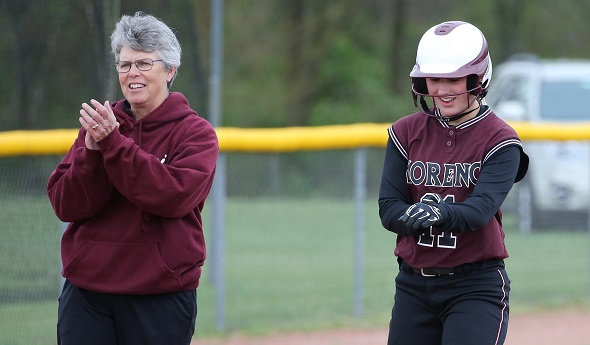
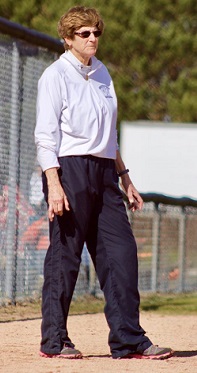
PHOTOS: (Top) Morenci’s Kay Johnson encourages her next hitter as a runner reaches third base. (Middle) Ottawa Lake Whiteford’s Kris Hubbard surveys the field during Wednesday’s sweep of Petersburg Summerfield. (Photos by Mike Dickie and Angela Link, respectively.)
Regulars Return to D4 Softball Finale
June 12, 2015
By Butch Harmon
Special for Second Half
EAST LANSING – With many of the players having graduated that helped lead Kalamazoo Christian to MHSAA Finals the past two seasons, Comets coach Terry Reynolds never expected his young Comets to be back this spring.
That’s exactly where the Comets have arrived, however, earning their third straight trip to the Division 4 Final by defeating Hillman 13-2 in five innings at Secchia Stadium on the campus of Michigan State University.
“At the end of the basketball season, I was wondering what we were going to do this season,” Reynolds said. “This is surreal. I never expected it. On March 9 when the season started, I was not sure of what we had. Now, I’m very proud of these girls.”
Kalamazoo Christian (29-14) will face Unionville-Sebewaing (37-3) in the Final at 3 p.m. Saturday. The Final will be Christian's 11th; it has played in the most championship games in MHSAA softball history.
The Comets didn’t just earn a trip to the title game; they slugged their way to the Final scoring in all four innings, highlighted by a seven-run fourth that blew the game open.
Up 6-0 going into the bottom of the inning, their already-hot bats turned blistering. Kalamazoo Christian reeled off eight straight hits during the inning in putting seven runs on the scoreboard.
The inning began quietly enough when junior Brooklyn Block led off with a bunt single. After a sacrifice bunt by junior McKena Razenberg, the floodgates began to open. Sophomore Monica Locker, one of eight sophomores on the Comets’ roster, doubled to plate Block. Junior shortstop Kara Gjeltema then followed with a RBI single.
One of few veterans who returned this season, Gjeltema has been a hitting standout the past two seasons, and this year entered the Semifinals with a .541 batting average and 66 RBI. Gjeltema added to that total with two hits and three RBI.
“We’ve come together this year as a family,” Gjeltema said. “We work as a family and have all come together.”
A catcher last season, Gjeltema moved to shortstop this spring.
“We had four shortstops in the spring,” Reynolds said. “Kara has a rifle for an arm, and I wanted someone who is fearless and Kara would run through a wall for you.”
Sophomore Aliyah Lemmer followed Gjeltema in the batting order and added a single to keep the fourth inning going. Lemmer also drove in the first two runs of the game for the Comets with a two-run double in the bottom of the first inning.
Along with supplying offense, Lemmer was also Christian’s starting pitcher and in charge of silencing the Hillman bats. Lemmer did just that, as she allowed one base runner during the first four innings before giving up a pair of runs in the fifth.
Lemmer backed up last year’s staff ace Rebekah VanDam and took over the mantle of top thrower for a program long known for producing quality pitchers.
“The first inning I was pretty nervous,” Lemmer said. “Seeing all the fans and everything, I was nervous but then I settled down after getting the first three outs.”
Lemmer allowed three hits and no walks while striking out two over five innings.
Eight of the nine hitters in the Comets starting lineup collected at least one hit, and all but one of the nine scored a run.
I was up until four in the morning watching tape on Hillman,” Reynolds said. “I told the girls to stay off the high pitch and make her come down. The girls were patient and did that. We had some opportunities, and the girls took advantage of it.
“Nothing will surprise me at this point,” Reynolds added. “The girls say that we are a family and they will keep battling and keep pushing no matter who we play.”
Hillman finished 30-4.
Unionville-Sebewaing 4, Holton 1
Unionville-Sebewaing softball coach Steve Bohn saw Michigan State men’s basketball coach Tom Izzo on the Michigan State campus Friday morning and was going to ask him what his secret is for winning titles.
With the way USA junior pitcher Nicole Bauer performed, and the way his hitters performed in the clutch, any advice from Izzo wasn’t needed this time as the Patriots handed Holton (37-1) its first and only loss.
 Bohn, in his fourth season at Unionville-Sebewaing, has brought the Patriots to the Semifinals the past three years, getting his team into the Division 3 title game the past two years. This spring, playing in Division 4, the Patriots will play on the final day again.
“We’ve been down here for the fourth time now,” Bohn said. “I saw Tom Izzo earlier and I wanted to ask him how he does it.”
Having a pitcher like Bauer helps. Bauer gave the Patriots an outstanding pitching performance as she scattered four hits and allowed one walk over seven innings. Bauer also struck out 11 Holton hitters.
The Patriots also had some timely hitting. With two outs in the bottom of the fourth inning, Bauer helped her own cause when she reached on a double. Senior Erica Treiber followed with a single that plated pinch runner Lauren Adam with the first run. Senior Madison Zimmer then gave the Patriots some breathing room with an RBI single that scored Treiber.
“We like to score with two outs,” Bauer said. “We go up there thinking we have nothing to lose when we have two outs.”
The Patriots added another two-out run in the fifth inning when Kayla Gremel hit a two-out double that plated Sara Reinhardt. Unionville-Sebewaing added an insurance run in the sixth inning on an RBI single by Katie Engelhardt.
“We just hope to execute and get it done tomorrow,” Bohn said.
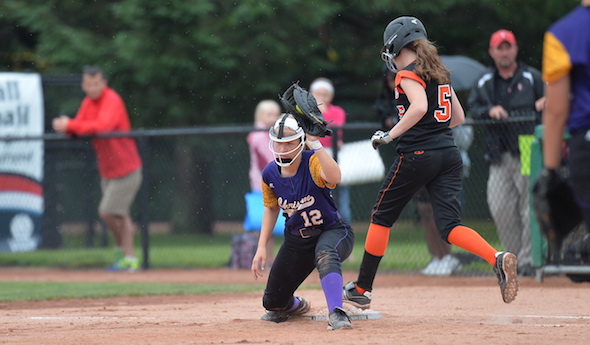
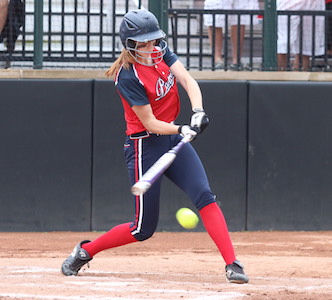
PHOTOS: (Top) Kalamazoo Christian first baseman Monica Locker secures a throw just before a Hillman runner crosses the bag Friday. (Middle) A Unionville-Sebewaing hitter drives a pitch during the Patriots' win.