

One Week, Multiple Milestones
By
Geoff Kimmerly
MHSAA.com senior editor
May 23, 2012
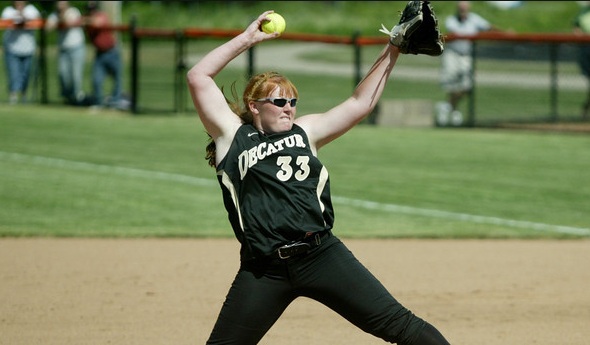
Sunglasses on whether it’s sunny or not, fastballs blazing and drop-balls dipping, Decatur senior Erika Southworth is an intimidating foe for those who dare step into the batters box.
But that’s just her on-field persona. When games are done, she talks with opposing players and has become friends with many.
And last week, she couldn’t help but get a little teary-eyed under her trademark shades.
On Thursday, Southworth won the 100th game of her career, at home against Gobles. On Saturday, at Climax-Scotts, Southworth recorded her 1,000th strikeout.
“None of my teammates knew until practice the day before. I think it motivated them more,” Southworth said of the 100th win. “At the end of that game, they came over and gave me a hug, and they said, ‘That win was for you. We worked hard for you.’ I got a little emotional.
“Both were a big deal to me. … But the wins mean more, I guess. Striking out a lot of people doesn’t matter if you didn’t win any games. I guess it means I had a pretty good career.”
A three-time all-state selection likely heading for her fourth, Southworth – a Second Half High 5 recipient this week – was going to be remembered regardless of those career milestones. But both cement her name in the MHSAA record book – she’s the 26th pitcher to win 100 games and 34th to strike out 1,000 batters, according to those lists.
This season, she’s 24-3 with a 0.83 ERA and 199 strikeouts in 157 innings pitched – with only eight walks. She’s also leading No. 7-ranked Decatur with a .448 batting average and 34 RBI.
Her career so far has included a Division 4 championship game appearance as a freshman (a 4-0 loss to Unionville-Sebewaing) and two more trips to Quarterfinals. It’s included the increase of pitching distance from 40 to 43 feet, a major adjustment for some that she used to become a better pitcher.
“In the early part of her career, she pitched kind of like a machine. I called the pitch and location, and she would just throw the pitch to the location,” Decatur coach Matt McLouth said. “After the mound went back to 43 feet, the pitches that she would strike out opposing hitters from 40 feet weren’t always striking out hitters from 43 feet. She really learned the art of getting hitters out. She learned that getting her opponent to hit a weak ground ball was just as good as getting a strikeout."
Southworth will take a “refined” repertoire with her this fall to the University of Michigan-Dearborn. The drop-ball is her favorite pitch. But McLouth said her change-up also has improved significantly over the last few seasons, and she’s added a rise ball to match.
The Wolves also will get a sports lifer who understands the value of dedication. Southworth has been part of Decatur’s softball program since joining as a team manager in sixth grade. She spent the first decade of her life running around the wrestling mat at the practices of her father Brian Southworth, who has won 567 matches over 28 seasons as Decatur’s coach in that sport, and also coaches the girls track and field team.
But before Erika leaves town and starts a degree in business, there's some to finish with the Raiders.
Decatur’s 2011 season ended with an 11-0 loss to Breckenridge. The team was relatively young and learned a lot that day about playing in pressure situations. Southworth is ready to pop on the sunglasses and lead her teammates on one more run – and earn a first championship to go with those other milestone numbers.
She’s learned, both on the diamond and the mat, what it will take to make that happen.
“I learned you have to work hard for what you earn. It’s not just given to you,” Southworth said. “Never give up. If you want something, you have to go and get it.”
Click to read more about Southworth's future plans and family ties.
PHOTO: Decatur's Krista Southworth prepares to fire a pitch during last season's Division 4 Quarterfinal against Breckenridge. (Photo couresty of High School Sports Scene.)
Constantine Follows Slugger on Fast Start
By
Wes Morgan
Special for MHSAA.com
May 11, 2017
By Wes Morgan
Special for Second Half
Kim Maddox has an incredible feel for the game of softball. Growing up with significantly impaired hearing, that’s been a necessity.
 Maddox, a junior slugger at Constantine High School who set her school’s season home run record in 2016 with 11 bombs, has already blasted 12 through 23 games this spring in playing a major role in the Falcons’ 22-1 record.
With the aid of cochlear implants she’s had since she was a small child, Maddox can hear, but she has to concentrate more than anyone else on the field. That is just one of many traits Constantine coach Marge Caid said sets her third baseman apart.
“She misses some things, but she does pay attention more than the others,” Caid said.
“I just look at the coach all the time,” Maddox said.
Precision and power are what’s obvious about Maddox, not any kind of disability.
“She is physically probably the strongest player I have ever coached. She has great bat speed, and her technique and her form are textbook. She works very, very hard and she is very dedicated to making sure that swing is perfect.”
Maddox fully expected to have this kind of year individually and as a team.
“We have good hitting, and this is a good team together,” she said. “I love my team. I have hitting lessons and I’ve been practicing and practicing. The biggest thing for me is to relax and then attack the ball.”
Like any good squad, success has been predicated on more than just individual talent. Constantine graduated some extremely skilled and productive players at the end of a 2016 campaign that set a record for wins in a season with a 32-6 record. The Falcons went 12-0 in Southwestern Athletic Conference Valley division play.
The loss of starting catcher Dylan King and hurler Bailey Potter to graduation didn’t slow the Falcons down. They have won 10 straight games since their lone loss of the year to a solid Three Rivers team.
Constantine has outscored opponents 247-29 and won by shutout nine times. In all, Constantine boasts five players hitting over .350, while its pitching has been effective and reliable.
Emily Mallo is 9-0 in the circle with a 0.56 ERA, and Mercedes Cole is 13-1 with a 0.66 ERA. The two combined have allowed 75 hits and 11 earned runs.
 “We hit the ball well, which is our biggest strong point,” Caid said, “besides having a bunch of players who have been on the varsity team for quite a while.”
Caid hasn’t submitted information to the Michigan High School Softball Coaches Association for ranking purposes because she wants to see what her team is really made of down the stretch — which includes the toughest opponents of the year.
“We did play Paw Paw and Three Rivers, but other than that, I can’t justify tooting our horn that much,” she said. “We want to make less base-running mistakes, and a couple fielding things we need to work out.
The Falcons have a critical showdown with rival Schoolcraft today, which will likely determine the divisional championship. Schoolcraft is undefeated in Valley play after Monday’s pivotal sweep of Kalamazoo Christian. Both Schoolcraft and Constantine are 8-0.
“The rest of our season is going to be tough,” Caid said. “If we can’t play with these guys, then we’re going to be up a creek when it comes to Districts. We have to play ball and choke it out like we did last year.”
Constantine’s tremendous season in 2016 fizzled out with a Division 3 District Semifinal loss to Bridgman (9-1). This year, the District tournament includes familiar opponents in Galesburg-Augusta, Comstock, Kalamazoo Hackett, Schoolcraft and Parchment.
It certainly has taken a team effort to come back strong again this year and duplicate last year’s regular-season success.
Still, Maddox’s staggering numbers stand out in the crowd, especially considering she has another year of prep ball remaining. Maddox is hitting .589, which isn’t even the best average on the team. Kallie Sears, with 42 hits on the year, is operating at a .592 clip. Maddox was hovering around .700 before struggling at the plate this past weekend.
In 86 plate appearances, she has registered 43 total hits to lead the team. Of those, seven were doubles and three went for triples. She has 53 runs batted in so far and 38 runs scored. She also had a .640 on-base percentage and a 1.260 slugging percentage. Surprisingly, Maddox has been walked just 10 times.
“I hate being walked,” she said.
 Wes Morgan has reported for the Kalamazoo Gazette, ESPN and ESPNChicago.com, 247Sports and Blue & Gold Illustrated over the last 12 years and is the publisher of JoeInsider.com. He can be reached at [email protected] with story ideas for Berrien, Cass, St. Joseph and Branch counties.
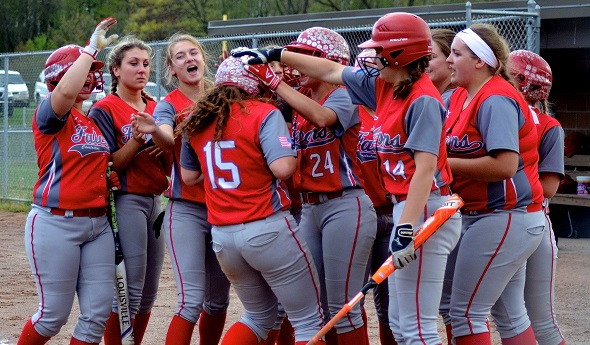
PHOTOS: (Top) Constantine players celebrate as Kim Maddox (15) crosses the plate to score a run. (Middle) Maddox eyes an approaching pitch during a game this spring. (Photos courtesy of JoeInsider.com.)