


MHSA(Q&)A: Beal City volleyball coach Kelly David
October 6, 2012
By Geoff Kimmerly
Second Half editor
 When people in Michigan’s volleyball community hear the name Kelly David, they might think first of the standout from just a few seasons ago. A four-sport standout for the Aggies, she set the volleyball team into the 2009 Class D Semifinals before going on to play at St. Clair Community College.
David, 20, graduated from high school a little more than two years ago, but is continuing to have an impact on the volleyball court – although now from the sideline as coach of the No. 3-ranked team in Class D. She took over the Beal City program this fall from her former coach, Randy Gallagher and has the Aggies 26-5-1.
Coaching has come naturally for the former floor leader, who already has gained valuable experiences and knowledge to share with her players. She previously coached at the junior high and club levels, the former for her aunt Sue Frederiksen – who coaches Almont’s varsity and is a member of the Michigan Interscholastic Volleyball Coaches Association Hall of Fame.
David is majoring in elementary education at Central Michigan University and sees teaching and coaching in her future for many years to come.
Why did you decide to become a coach?
I played at St. Clair (Community College) for two years, and my aunt had always been into coaching. I ended up coaching her seventh grade volleyball team for two years, and I coached in the Skippers AAU program over there. I found out I liked coaching more than playing.
How have you approached coaching a team that includes players who were freshmen when you were a senior in high school?
Going into it, I knew I wasn’t their friend; I was their coach. I wasn’t close to any of the girls except my sister (Monica, a senior). The people who coached me or were my teachers, (who said) go to class, do this, and you knew they received ultimate respect. I had helped out in previous years, and I knew what I had to do to gain that respect. And (my players) have listened to me.
Did you anticipate questions about you taking over the program only a few years out of high school?
I knew in my head, but I didn’t think it would be a problem in people’s minds. "She’s young, her sister is on the team;" that’s the stuff people might second guess. But I knew how to control the team, and having my sister on it wasn’t a big teal. So far (issues) haven’t happened. I’ve coached teams in previous years, and I’d always been the leader when I did play. I think that helps.
What were your goals coming into the season?
I had a lot of goals. Obviously, I wanted us to go far, like in the past. The biggest thing I noticed playing college from high school, the players knew the game of volleyball. They were smart. They had the same athletic ability as those I played against in high school, but they were just smarter. Knowing how to position the ball on the court, knowing the game, and I wanted to teach (my players) the game of volleyball. It’s important to know the game, and then we can work around the obstacles.
What did you learn by watching your aunt coach?
Just how strong you have to be. When I watch her coach, she’s very enthusiastic. But when someone does something wrong, she lets them know. That’s an important thing.
When did you first know you were interested in coaching?
When I was in high school, when I played, I’d help the other players. I noticed that was something I liked to do. I’d watch someone and pick up things they could fix. I thought about it in high school, and once I actually did it with the seventh graders, it wasn’t a job for me. It’s fun. Coaching is something I want to do. They want to be playing volleyball – that’s why they’re on the team. Everyone wants to be there, and we’re trying to accomplish the same thing.
What has been the biggest challenge during your first season?
The biggest challenge is handling the pressure. I know the team can do well. We’re ranked third in the state right now. But it’s getting them to perform the way they can perform, getting them to come together at the right time.
I’d also like to mention that Beal City (already) had a great program, from (former coaches) Randy Gallagher and before I came, Kelly Knuth. I’m just happy to step in and try to continue what they did.
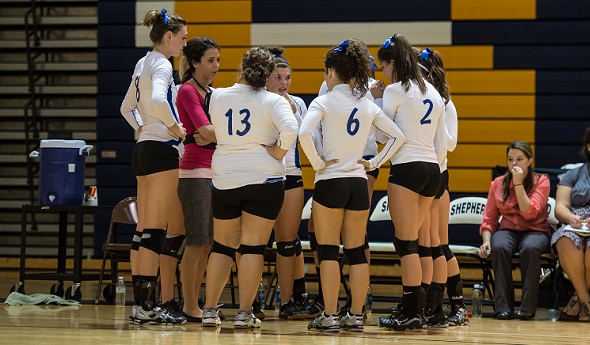
PHOTO: Beal City huddles during a break in its match against Shepherd this season. (Click to see more from HighSchoolSportsScene.com).
2-Time Champ as Player, Haut Putting Further Imprint on SMCC as Coach
By
Doug Donnelly
Special for MHSAA.com
August 16, 2022
MONROE – After leading the Monroe St. Mary Catholic Central volleyball team into the Division 3 championship match last season, coach Cassie Haut had to apply for the Kestrels coaching job.
 That’s because when SMCC reached the Finals in 2021, Haut was officially the co-head coach with Karen O’Brien.
“Oh, yeah, I had to go through the interview process and everything,” Haut said. “I met with the athletic director and other school officials. I was excited when I got the job.”
Haut certainly earned it.
SMCC officially billed Haut and O’Brien as co-head coaches when the 2021 season began. Haut was in charge of the team’s day-to-day activities and O’Brien – who led SMCC to Division 3 Finals titles in 2019 and 2020 – would help out as often as possible after being diagnosed with ovarian cancer for the fourth time.
O’Brien ended up being around the program often, including during the Kestrels’ postseason run.
When the season ended, however, O’Brien stepped aside, paving the way for a new coach to lead the ultra-successful SMCC program that has reached 10 Finals since 2003, and won seven of them.
Haut doesn’t feel added pressure as the next SMCC coach to maintain that level of success.
“I love it,” she said. “I’m honored to be able to be part of this legacy.”
Haut played basketball, softball and volleyball at SMCC and was part of two championship volleyball teams – in Class C in 2012 and 2014 – under head coach Diane Tuller. The 2015 SMCC grad also had an outstanding career at Eastern Michigan University, earning all-freshman team honors for the Mid-American Conference and twice being named first team all-MAC. In 2018 she was named the MAC Tournament MVP.
Soon after Haut’s college graduation, O’Brien – who was an SMCC assistant during Haut’s high school senior year – called her and asked if she wanted to be part of the program now as a coach.
“It was something that I always thought of doing,” Haut said. “After graduating, I remember thinking ‘What’s next?’ Coaching was something I felt I wanted to do. It helps keeps me part of the game that I love.”
SMCC graduated several seniors from the 2020 championship squad and had to do some rebuilding in 2021. O’Brien was there to put together some of the pieces, then helped mentor Haut as she guided the team through much of its 36-12 run. During the MHSAA Tournament run, O’Brien would funnel postgame questions to Haut, preferring to stay out of the limelight.
It was still, however, a dual coaching role until Haut took over the job.
“I was building up practice plans and ideas for the season just in case I was hired,” Haut said. “I had some things in my mind that I wanted to do. It’s nothing too crazy, but I just added my own touches.
 Last year, for example, it was O’Brien who organized summer practices and helped build the regular-season schedule.
“I missed out on those parts of it, so it was something I was looking forward to this year,” Haut said. “It was exciting. We’re still in the same great tournaments that SMCC loves to go to.”
Haut is meshing the experiences she had as a player and coach to form her own coaching style and program.
“All of the coaches I’ve played for and coached with have a slightly different idea of the game,” she said. “The game has evolved in different ways. As I have gone through high school and college as a player, I felt like I learned more depth to the game every year. Then, since I’ve been coaching, I feel like it’s gone to another level.”
Before this season started, Haut had her players write down their goals.
“I want to learn everything I can about the girls,” she said. “It’s not just about volleyball, but life. My college coach really believed that. I’m excited to be part of these girls’ lives.”
Haut comes from an athletic family and has been around sports all her life.
Her father Chris played baseball at the University of Toledo. Her sister Mikayla was a four-time all-state volleyball player and Miss Volleyball finalist, and is coming off a Metro Atlantic Athletic Conference (MAAC) Rookie of the Year award at Fairfield University in Connecticut. Sister Maddie earned all-conference honors and helped Ave Maria University win its conference title a year ago. Brother CJ was an outstanding basketball player for the Air Force Academy.
SMCC is primed for more success this year. Haut welcomes back a solid senior group that has already showed off its leadership skills. The Kestrels will be among favorites as they seek to make a fourth-straight trip to Battle Creek.
“From the time we got into the gym, they have been leaders,” Haut said.
Two freshmen played key roles a year ago, McKenna Payne and Jessica Costlow. Payne rang up 465 kills, 360 digs and 86 aces during her ninth-grade season while Costlow had 414 kills, 275 digs and 59 blocks.
Last year, SMCC lost in the Division 3 Final to Reese. After taking a 2-0 lead in the match, the Kestrels dropped the final three games 25-15, 25-21, 16-14.
“I like a lot of what I saw in the scrimmage. It was good to get some different lineups together, and we have a deep bench,” Haut said. “I see a ton of potential with this team.”
 Doug Donnelly has served as a sports and news reporter and city editor over 25 years, writing for the Daily Chief-Union in Upper Sandusky, Ohio from 1992-1995, the Monroe Evening News from 1995-2012 and the Adrian Daily Telegram since 2013. He's also written a book on high school basketball in Monroe County and compiles record books for various schools in southeast Michigan. E-mail him at [email protected] with story ideas for Jackson, Washtenaw, Hillsdale, Lenawee and Monroe counties.
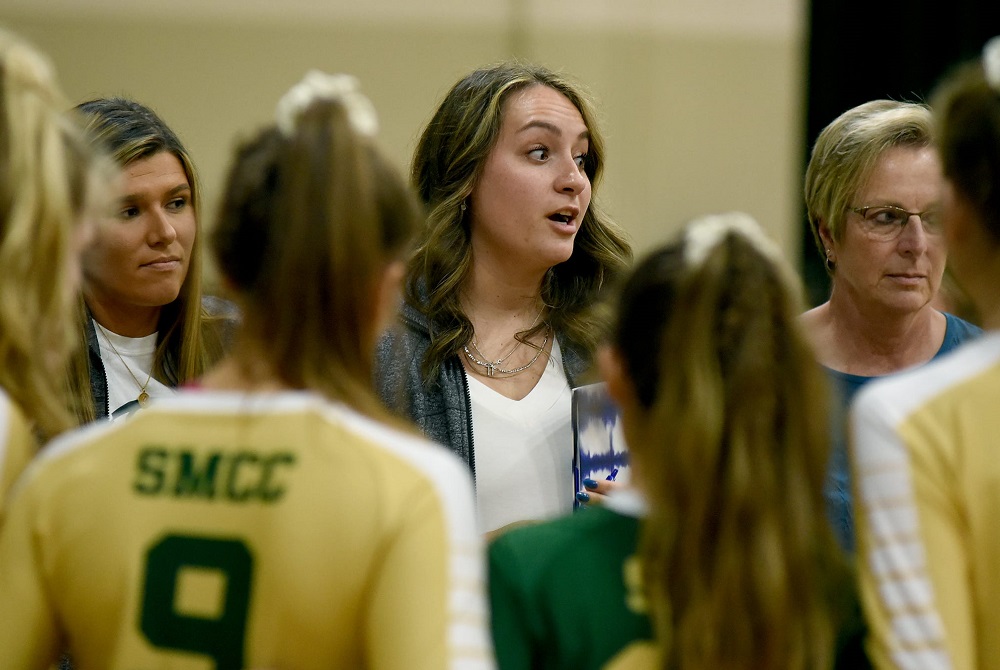
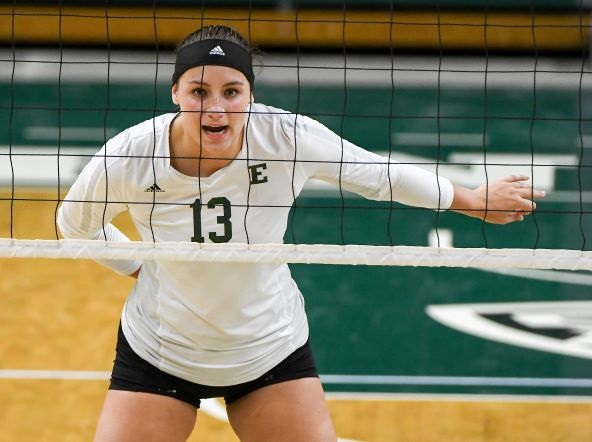
PHOTOS (Top) Cassie Haut, middle, talks with her Monroe St. Mary Catholic Central team last season as co-varsity coach with Karen O’Brien, right. (Middle) Haut signals to her teammates while starring at Eastern Michigan. (Top photo by Tom Hawley. Middle photo courtesy of the EMU athletic department.)