


MHSA(Q&)A: Beal City volleyball coach Kelly David
October 6, 2012
By Geoff Kimmerly
Second Half editor
 When people in Michigan’s volleyball community hear the name Kelly David, they might think first of the standout from just a few seasons ago. A four-sport standout for the Aggies, she set the volleyball team into the 2009 Class D Semifinals before going on to play at St. Clair Community College.
David, 20, graduated from high school a little more than two years ago, but is continuing to have an impact on the volleyball court – although now from the sideline as coach of the No. 3-ranked team in Class D. She took over the Beal City program this fall from her former coach, Randy Gallagher and has the Aggies 26-5-1.
Coaching has come naturally for the former floor leader, who already has gained valuable experiences and knowledge to share with her players. She previously coached at the junior high and club levels, the former for her aunt Sue Frederiksen – who coaches Almont’s varsity and is a member of the Michigan Interscholastic Volleyball Coaches Association Hall of Fame.
David is majoring in elementary education at Central Michigan University and sees teaching and coaching in her future for many years to come.
Why did you decide to become a coach?
I played at St. Clair (Community College) for two years, and my aunt had always been into coaching. I ended up coaching her seventh grade volleyball team for two years, and I coached in the Skippers AAU program over there. I found out I liked coaching more than playing.
How have you approached coaching a team that includes players who were freshmen when you were a senior in high school?
Going into it, I knew I wasn’t their friend; I was their coach. I wasn’t close to any of the girls except my sister (Monica, a senior). The people who coached me or were my teachers, (who said) go to class, do this, and you knew they received ultimate respect. I had helped out in previous years, and I knew what I had to do to gain that respect. And (my players) have listened to me.
Did you anticipate questions about you taking over the program only a few years out of high school?
I knew in my head, but I didn’t think it would be a problem in people’s minds. "She’s young, her sister is on the team;" that’s the stuff people might second guess. But I knew how to control the team, and having my sister on it wasn’t a big teal. So far (issues) haven’t happened. I’ve coached teams in previous years, and I’d always been the leader when I did play. I think that helps.
What were your goals coming into the season?
I had a lot of goals. Obviously, I wanted us to go far, like in the past. The biggest thing I noticed playing college from high school, the players knew the game of volleyball. They were smart. They had the same athletic ability as those I played against in high school, but they were just smarter. Knowing how to position the ball on the court, knowing the game, and I wanted to teach (my players) the game of volleyball. It’s important to know the game, and then we can work around the obstacles.
What did you learn by watching your aunt coach?
Just how strong you have to be. When I watch her coach, she’s very enthusiastic. But when someone does something wrong, she lets them know. That’s an important thing.
When did you first know you were interested in coaching?
When I was in high school, when I played, I’d help the other players. I noticed that was something I liked to do. I’d watch someone and pick up things they could fix. I thought about it in high school, and once I actually did it with the seventh graders, it wasn’t a job for me. It’s fun. Coaching is something I want to do. They want to be playing volleyball – that’s why they’re on the team. Everyone wants to be there, and we’re trying to accomplish the same thing.
What has been the biggest challenge during your first season?
The biggest challenge is handling the pressure. I know the team can do well. We’re ranked third in the state right now. But it’s getting them to perform the way they can perform, getting them to come together at the right time.
I’d also like to mention that Beal City (already) had a great program, from (former coaches) Randy Gallagher and before I came, Kelly Knuth. I’m just happy to step in and try to continue what they did.
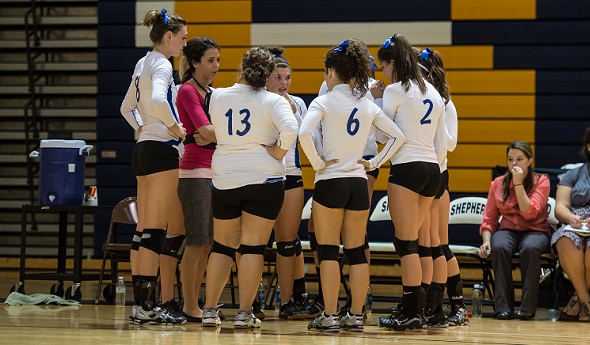
PHOTO: Beal City huddles during a break in its match against Shepherd this season. (Click to see more from HighSchoolSportsScene.com).
Weber Coming Up Big Again as Madison Eyes League, District Opportunities
By
Doug Donnelly
Special for MHSAA.com
October 12, 2021
ADRIAN – Abby Weber doesn’t stand out on the volleyball court during warm-ups or lineup introductions.
 At about 5-foot-6, Weber doesn’t look like a dominating volleyball player – until the game starts, that is. After that, opponents better know where she’s at and how to stop her.
The Adrian Madison senior captain has been the key cog in a Trojans volleyball team that won its 33rd match of the season Monday. She’s on the varsity for the fourth straight season and, with her on the team, Madison hasn’t lost a Tri-County Conference game. The Trojans have won 49 straight TCC matches – and picked up five straight league titles along the way. They are in great shape to capture a sixth straight as they are 7-0 in the league with five matches left.
In the win over Ottawa Lake Whiteford, Weber was more than dominating, standing out for her serving, hitting, and seemingly making every dig necessary.
“It’s just her drive,” Madison coach Heather Lanning said. “She is one of those kids who has a heart of gold and the drive and the ambition. She will not let a ball drop.”
Weber started playing volleyball when she was 6, at the YMCA in Adrian. She attended volleyball camps at Madison while growing up, then joined a travel team out of Toledo, located about 35 minutes from Madison, which is in Lenawee County. She played two years on the middle school team, then was brought straight to the Trojans varsity as a freshman.
She played her way into the lineup and has stayed there since. Last year she was the only underclassmen in an otherwise all-senior lineup. Despite not being a senior, she was a captain. It is a role she relishes.
“They all depend on me because I’m a captain,” she said. “I love to help them and give them energy. When someone gets a kill or something, I want to congratulate them because it’s a big deal. They love it.”
In the win over Whiteford, Weber recorded her 1,500th career kill. Earlier this year she went over 1,000 digs. It’s kind of like a basketball player having 1,000 points and 1,000 rebounds during a career.
 “It just goes to show her drive and her ability on the court,” Lanning said. “That’s just Abby.”
Lanning is the second coach Weber has played for during her four-year varsity career. Lanning previously coached the Trojans JV team, so she was familiar with most of the Madison varsity when she got the head coaching job. She didn’t now Weber, but it didn’t take her long to notice what a gem she had inherited.
“She already knew everyone else,” Weber said. “I was into the mix with them.”
Lanning was looking over some statistics from the last couple of seasons when she realized the milestone her returning all-conference and all-county player was nearing.
“She told me I was coming up to 1,500 digs,” Weber said. “I know it was a pretty great accomplishment to get it. I’m happy about it.”
Weber said she couldn’t do it alone. Through Monday she has 1,508 career digs and 1,104 career kills. She had 19 kills and 17 digs in Monday’s match alone.
“My team helps me,” Weber said. “I wouldn’t be able to get a dig if it wasn’t for people helping me and telling me where everyone is, and I wouldn’t have as many kills as I do if it wasn’t for my setters and back row making the pass. It’s because of everyone.”
Driven by a high energy level on the court, Weber often serves, then makes a move to get closer to the net, and, finally, will get to the front row before the ball is back on her team’s side.
“I like to go with the faster-pace tempo,” she said.
Lanning said wherever she puts Weber, she is impressed.
“She’s very effective on the attack from the back row,” Lanning said. “She can still kill it from the back row. It doesn’t matter where she is at.”
The moves Weber made impressed her opposing coach Monday. Whiteford’s Janie Bunge saw far too much of Weber.
“She was everywhere,” Bunge said. “As soon as her rotation came up, she’d serve six or seven points in a row. We couldn’t stop her.”
Weber is interested in playing college volleyball but isn’t sure where at the moment. She’s been looking at some schools at the NAIA level.
“I love being part of a team,” Weber said. “I have made a lot of friends from volleyball and competing against other teams. It’s really fun.”
Madison keeps getting stronger as the season goes on. They are getting contributions from multiple players, including sophomores Tatum Wilson and Jillian Kendrick, four juniors and five of Weber’s fellow seniors, such as Mallory Palpant and Hannah Kendrick. All four of those players had their moments in Monday’s win.
Madison has begun getting some votes in the weekly Michigan Interscholastic Volleyball Coaches Association rankings. The Trojans were among the honorable mention teams in the latest Division 3 poll. The top-ranked team – Monroe St. Mary Catholic Central – is in the District that Madison will host.
“We are thinking about Districts,” Weber said. “We’re just going to try and figure out where the other teams’ holes are and what we need to do.”
 Doug Donnelly has served as a sports and news reporter and city editor over 25 years, writing for the Daily Chief-Union in Upper Sandusky, Ohio from 1992-1995, the Monroe Evening News from 1995-2012 and the Adrian Daily Telegram since 2013. He's also written a book on high school basketball in Monroe County and compiles record books for various schools in southeast Michigan. E-mail him at [email protected] with story ideas for Jackson, Washtenaw, Hillsdale, Lenawee and Monroe counties.
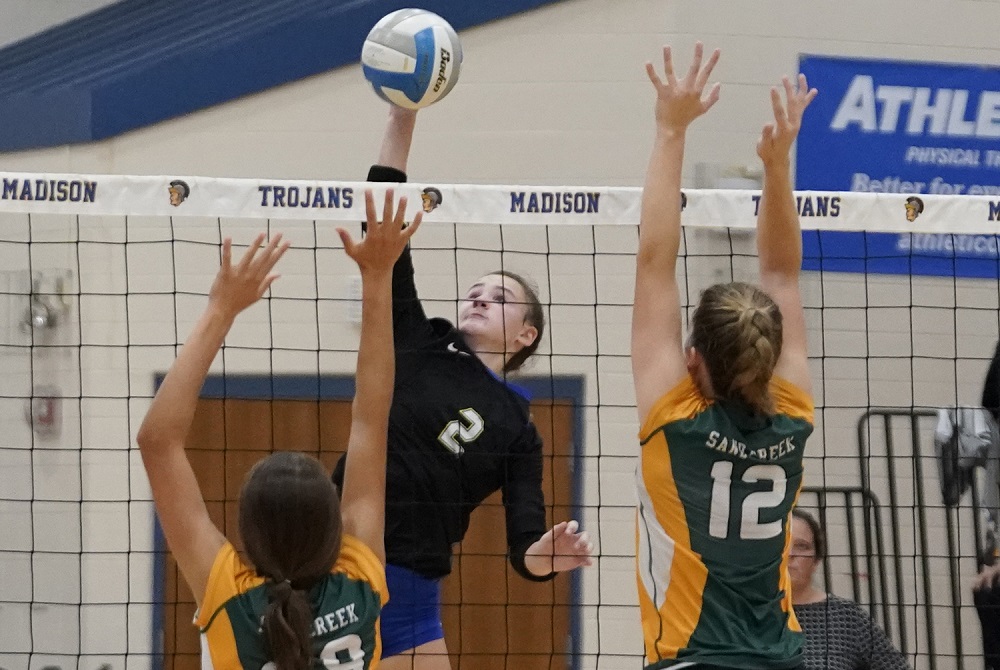
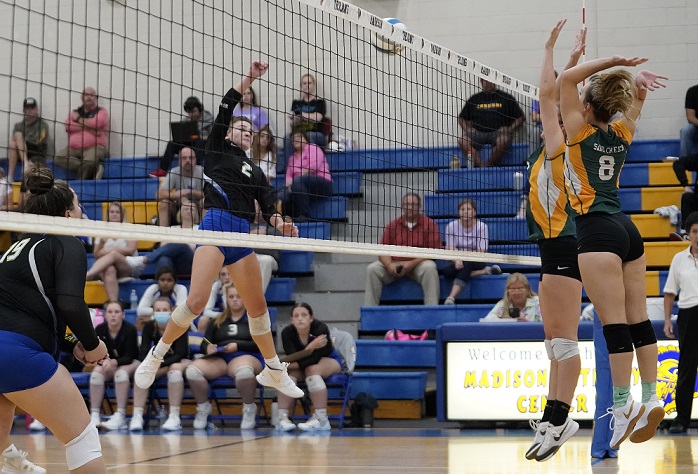
PHOTOS (Top) Adrian Madison’s Abby Weber gets high over the net on a kill attempt this season against Sand Creek. (Middle) Webber sends a volley back toward the Aggies’ side of the net. (Photos by Mike Dickie.)