


MHSA(Q&)A: Beal City volleyball coach Kelly David
October 6, 2012
By Geoff Kimmerly
Second Half editor
 When people in Michigan’s volleyball community hear the name Kelly David, they might think first of the standout from just a few seasons ago. A four-sport standout for the Aggies, she set the volleyball team into the 2009 Class D Semifinals before going on to play at St. Clair Community College.
David, 20, graduated from high school a little more than two years ago, but is continuing to have an impact on the volleyball court – although now from the sideline as coach of the No. 3-ranked team in Class D. She took over the Beal City program this fall from her former coach, Randy Gallagher and has the Aggies 26-5-1.
Coaching has come naturally for the former floor leader, who already has gained valuable experiences and knowledge to share with her players. She previously coached at the junior high and club levels, the former for her aunt Sue Frederiksen – who coaches Almont’s varsity and is a member of the Michigan Interscholastic Volleyball Coaches Association Hall of Fame.
David is majoring in elementary education at Central Michigan University and sees teaching and coaching in her future for many years to come.
Why did you decide to become a coach?
I played at St. Clair (Community College) for two years, and my aunt had always been into coaching. I ended up coaching her seventh grade volleyball team for two years, and I coached in the Skippers AAU program over there. I found out I liked coaching more than playing.
How have you approached coaching a team that includes players who were freshmen when you were a senior in high school?
Going into it, I knew I wasn’t their friend; I was their coach. I wasn’t close to any of the girls except my sister (Monica, a senior). The people who coached me or were my teachers, (who said) go to class, do this, and you knew they received ultimate respect. I had helped out in previous years, and I knew what I had to do to gain that respect. And (my players) have listened to me.
Did you anticipate questions about you taking over the program only a few years out of high school?
I knew in my head, but I didn’t think it would be a problem in people’s minds. "She’s young, her sister is on the team;" that’s the stuff people might second guess. But I knew how to control the team, and having my sister on it wasn’t a big teal. So far (issues) haven’t happened. I’ve coached teams in previous years, and I’d always been the leader when I did play. I think that helps.
What were your goals coming into the season?
I had a lot of goals. Obviously, I wanted us to go far, like in the past. The biggest thing I noticed playing college from high school, the players knew the game of volleyball. They were smart. They had the same athletic ability as those I played against in high school, but they were just smarter. Knowing how to position the ball on the court, knowing the game, and I wanted to teach (my players) the game of volleyball. It’s important to know the game, and then we can work around the obstacles.
What did you learn by watching your aunt coach?
Just how strong you have to be. When I watch her coach, she’s very enthusiastic. But when someone does something wrong, she lets them know. That’s an important thing.
When did you first know you were interested in coaching?
When I was in high school, when I played, I’d help the other players. I noticed that was something I liked to do. I’d watch someone and pick up things they could fix. I thought about it in high school, and once I actually did it with the seventh graders, it wasn’t a job for me. It’s fun. Coaching is something I want to do. They want to be playing volleyball – that’s why they’re on the team. Everyone wants to be there, and we’re trying to accomplish the same thing.
What has been the biggest challenge during your first season?
The biggest challenge is handling the pressure. I know the team can do well. We’re ranked third in the state right now. But it’s getting them to perform the way they can perform, getting them to come together at the right time.
I’d also like to mention that Beal City (already) had a great program, from (former coaches) Randy Gallagher and before I came, Kelly Knuth. I’m just happy to step in and try to continue what they did.
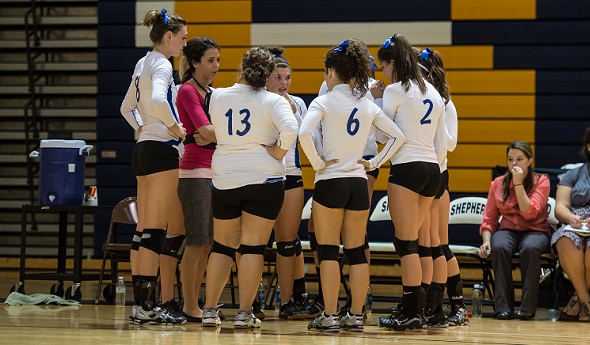
PHOTO: Beal City huddles during a break in its match against Shepherd this season. (Click to see more from HighSchoolSportsScene.com).
USA Standout Skilled for Every Season
By
Paul Costanzo
Special for MHSAA.com
December 28, 2018
Rylee Zimmer lightened her winter workload during her sophomore year, taking the basketball season off to focus more on volleyball.
 It turned out to be a short-term move.
“I could make it to some of the games still, because I wasn’t quite as busy,” the Unionville-Sebewaing senior said. “But when I watched them play, I missed it, so I came back to play.”
Zimmer has finished her high school volleyball career and signed to continue playing the sport at Saginaw Valley State University. But her days as a Patriot are not over, as she is currently playing basketball, and in the spring will come back to her familiar spot on the softball diamond, where she is a returning all-state selection as a shortstop.
“I actually think (playing three sports) does help me,” Zimmer said. “Like in basketball, we’re working on jumping and we run a lot. It keeps me more in shape.”
It’s no secret, however, that volleyball is No. 1 for Zimmer. She plays for the Five:1 club during the winter and spring, and is currently balancing school, the club and basketball season. Sub out softball for basketball, and you have her spring schedule.
“Actually, it works out pretty good, because for girls basketball, we play on Tuesdays and Thursdays, and I have practice on Monday and Wednesday,” she said. “After basketball and softball practices, I drive to Clio and practice until 9 at night. I don’t have much downtime.”
Zimmer was a four-year starter for the Patriots volleyball team, and this fall she led the team to its first MHSAA Finals appearance – where it fell to four-time reigning champion Bronson in the Division 3 title match.
“When we were in eighth grade, when Erica Treiber (a volleyball All-American at Tennessee) was on the team, we went to Battle Creek with my family (for the Semifinals), and I never thought I’d be able to make it there,” Zimmer said. “This year, my senior year, when we started playing I thought, ‘This team is pretty good and can make it pretty far.’ It was so exciting to be able to make it to the last game of the season.”
 On the season, Zimmer finished with 828 kills, 630 service receptions, 537 digs, 132 total blocks and 41 aces. It was her second straight season with more than 800 kills, and she finished her career with 2,332. Her career kill percentage was .374.
“Rylee is just an athletic player,” USA coach Teresa Rose said. “Last year, she was a captain, but this year she was a little more of a vocal captain. She never wanted to step on the seniors’ toes when she was only a junior. She’s very knowledgeable. She plays club at Five:1, she plays basketball, she plays softball – she's constantly doing something. Girls that only play one sport, they’re playing club, too, but they’re not using those other muscles you do while doing those other things. I think that really helps her be strong.”
Zimmer committed to Saginaw Valley late in her junior year, and signed during the early signing period in November. She said that playing at the next level was something she had dreamed of and thought could be a reality since she was moved up to varsity for volleyball as a freshman.
While playing three sports through high school has helped make her a better all-around athlete, she is looking forward to focusing on a single sport in college.
Rose also is excited to see what Zimmer can do at the next level.
“I’ve seen her play at this level, and she’s a standout,” Rose said. “To see her at the next level when she’s playing with everybody that’s that good, I can’t wait to watch her. Seeing her play with girls at the college level that are all volleyball players – that's all they’re doing – I think you’re going to see her be even more explosive than what she was this year.”
Before she moves on, however, Zimmer has more to do at USA. While the Patriots are 2-3 to start this season on the court, last winter Zimmer averaged 13.6 points and 9.8 rebounds per game to lead the team to the Class C Regional Final.
The USA softball team was a Division 4 semifinalist a year ago, with Zimmer playing a big part. She hit .445 in 38 games, with 27 extra-base hits (14 doubles, 11 triples, two home runs), 41 RBI and 53 runs scored. She has a career batting average of .429.
“I’m just excited to have fun and have one last year with the people I’ve always played with,” she said. “I’m excited to have one last season with them.”
 Paul Costanzo served as a sportswriter at The Port Huron Times Herald from 2006-15, including three years as lead sportswriter, and prior to that as sports editor at the Hillsdale Daily News from 2005-06. He can be reached at [email protected] with story ideas for Genesee, Lapeer, St. Clair, Sanilac, Huron, Tuscola, Saginaw, Bay, Arenac, Midland and Gladwin counties.
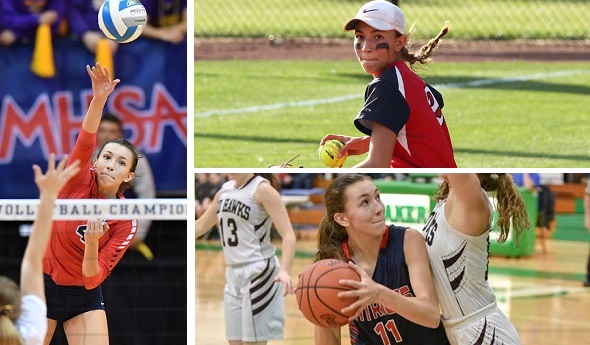
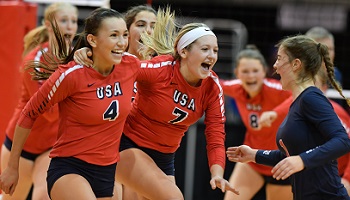
PHOTOS: (Top) Clockwise from left, USA’s Rylee Zimmer spikes during this fall’s Division 3 Volleyball Final, Zimmer throws to first during last spring’s Division 4 Softball Semifinals and works for position in the post during a Class C Basketball District game. (Middle) Zimmer (4) celebrates her team’s Volleyball Semifinal win with her teammates. (Volleyball and softball photos by Hockey Weekly Action Photos; basketball photo by Varsity Monthly.)