


MHSA(Q&)A: Beal City volleyball coach Kelly David
October 6, 2012
By Geoff Kimmerly
Second Half editor
 When people in Michigan’s volleyball community hear the name Kelly David, they might think first of the standout from just a few seasons ago. A four-sport standout for the Aggies, she set the volleyball team into the 2009 Class D Semifinals before going on to play at St. Clair Community College.
David, 20, graduated from high school a little more than two years ago, but is continuing to have an impact on the volleyball court – although now from the sideline as coach of the No. 3-ranked team in Class D. She took over the Beal City program this fall from her former coach, Randy Gallagher and has the Aggies 26-5-1.
Coaching has come naturally for the former floor leader, who already has gained valuable experiences and knowledge to share with her players. She previously coached at the junior high and club levels, the former for her aunt Sue Frederiksen – who coaches Almont’s varsity and is a member of the Michigan Interscholastic Volleyball Coaches Association Hall of Fame.
David is majoring in elementary education at Central Michigan University and sees teaching and coaching in her future for many years to come.
Why did you decide to become a coach?
I played at St. Clair (Community College) for two years, and my aunt had always been into coaching. I ended up coaching her seventh grade volleyball team for two years, and I coached in the Skippers AAU program over there. I found out I liked coaching more than playing.
How have you approached coaching a team that includes players who were freshmen when you were a senior in high school?
Going into it, I knew I wasn’t their friend; I was their coach. I wasn’t close to any of the girls except my sister (Monica, a senior). The people who coached me or were my teachers, (who said) go to class, do this, and you knew they received ultimate respect. I had helped out in previous years, and I knew what I had to do to gain that respect. And (my players) have listened to me.
Did you anticipate questions about you taking over the program only a few years out of high school?
I knew in my head, but I didn’t think it would be a problem in people’s minds. "She’s young, her sister is on the team;" that’s the stuff people might second guess. But I knew how to control the team, and having my sister on it wasn’t a big teal. So far (issues) haven’t happened. I’ve coached teams in previous years, and I’d always been the leader when I did play. I think that helps.
What were your goals coming into the season?
I had a lot of goals. Obviously, I wanted us to go far, like in the past. The biggest thing I noticed playing college from high school, the players knew the game of volleyball. They were smart. They had the same athletic ability as those I played against in high school, but they were just smarter. Knowing how to position the ball on the court, knowing the game, and I wanted to teach (my players) the game of volleyball. It’s important to know the game, and then we can work around the obstacles.
What did you learn by watching your aunt coach?
Just how strong you have to be. When I watch her coach, she’s very enthusiastic. But when someone does something wrong, she lets them know. That’s an important thing.
When did you first know you were interested in coaching?
When I was in high school, when I played, I’d help the other players. I noticed that was something I liked to do. I’d watch someone and pick up things they could fix. I thought about it in high school, and once I actually did it with the seventh graders, it wasn’t a job for me. It’s fun. Coaching is something I want to do. They want to be playing volleyball – that’s why they’re on the team. Everyone wants to be there, and we’re trying to accomplish the same thing.
What has been the biggest challenge during your first season?
The biggest challenge is handling the pressure. I know the team can do well. We’re ranked third in the state right now. But it’s getting them to perform the way they can perform, getting them to come together at the right time.
I’d also like to mention that Beal City (already) had a great program, from (former coaches) Randy Gallagher and before I came, Kelly Knuth. I’m just happy to step in and try to continue what they did.
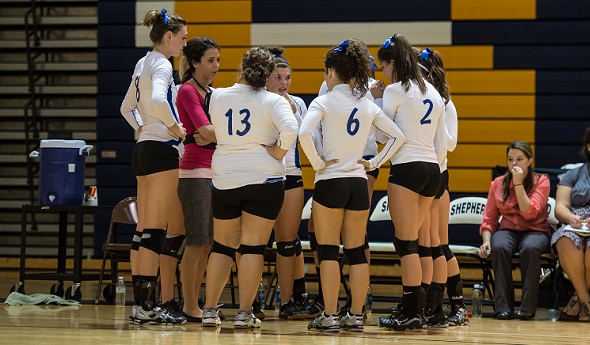
PHOTO: Beal City huddles during a break in its match against Shepherd this season. (Click to see more from HighSchoolSportsScene.com).
Undefeated Manistique Makes Banner Run
November 9, 2015
By Dennis Grall
Special for Second Half
MANISTIQUE – Finally, the time has arrived to put volleyball on the sports map at Manistique High School.
 The Emeralds will play in their first Regional tournament Tuesday when they face perennial power Calumet in Class C at Gladstone High School. They achieved that pinnacle by upending Gwinn 3-1 Thursday, in Ishpeming.
Under coach Amy Nixon, the Emeralds take an 18-0 record into the Regional. Their first District title came on the heels of their first Mid-Peninsula Conference championship, which means a volleyball banner finally will be hung in the high school gym and a couple of trophies will be displayed in the school's trophy case for the first time.
"The girls have become almost like rock stars," said Manistique athletic director Rob Ryan, noting the sport had very little success during the previous 20 years. "It's been a great journey. They now have crowds that are similar to boys and girls basketball, and the community is getting involved."
A fan bus of 50 students attended the District title game, which was a two-hour drive each way. Nixon was told by several people at Ishpeming that her student section was the loudest they had ever seen in Ishpeming. The team received a police escort back into Manistique late Thursday night.
"I'm proud of our students, family and friends," said Nixon. To which Ryan added, "everyone in the community is buzzing about it."
The success is a much-needed boost for the school and the community. The area is still reeling from the closure of its paper mill, its' biggest employer, earlier this year. And athletic success has been rare in most sports over the years as the Emeralds compete in the M-PC, regarded as one of the most competitive conferences in the state, in all sports.
Football was 1-8 in the fall, so volleyball has provided the important ingredient of success in Manistique. "Volleyball is something everybody is talking about," said Ryan.
"For 10 years volleyball has not been on the map at Manistique. We just were not competitive. It was very quiet in the gym. It was dark and depressing. Now we have raucous crowds. It has really done a 360. It is unbelievable."
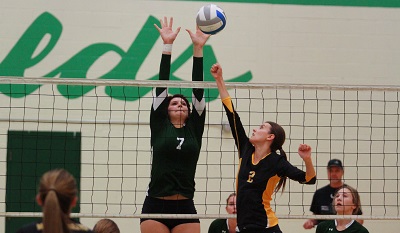 With seven seniors on the team, including three-year starters Lexi Carlson, Machaela Hinkson and Sydney Chartier, the Emeralds have been groomed to succeed this fall. Carlson, a first-team M-PC standout, had 13 kills and three blocks Thursday while Chartier had 20 assists and Brooke Whiskin had 23 of Manistique's 91 digs.
"Our defense has improved so much," said Nixon, indicating the Emeralds changed formations from a man-up defense to a rotation system this year. "We don't let a whole lot of balls drop to the floor," said Nixon.
While Carlson, who joined the varsity late in her freshman season, is the leader, Nixon said, "we are a complete team. We are so strong mentally and physically. They have each other's back. There is no girl drama. This is really a well-rounded team. We have five hitters who get kills on a consistent basis.
"We are a tough-attacking offensive power."
Nixon, in her eighth season at the helm, is a native of Kingsford and spent two years as volleyball coach at Gwinn before coming to Manistique. She was a student assistant on the Northern Michigan University volleyball team and has used her experience, along with attending clinics, to instill success in Manistique.
"It's been an amazing ride," said Nixon, indicating the journey began with a five-set loss to Gwinn in the Class C District a year ago. "The girls were heart-broken when they lost last year," she said.
With nine returnees from that team, Nixon got the girls together in April and discussed goals and what the future could look like if the players were willing to put in the time and effort.
With her husband Tim conducting strength and conditioning programs, the girls began to reach for this season's success with the help of open gyms and small-scale skill sessions during the four months prior to official practice starting in August, when they "hit the ground running," said Nixon.
"It has been grueling," said Nixon, noting team bonding has been a focus. "For six months, volleyball has been our life. Their hearts have been 100 percent in it every day. They have been so determined to make it happen. They focused on achieving something great this year."
 Changing the mind-set after so many years of struggling was vital. "I set high expectations for my team. I would not accept being mediocre," said Nixon, who strived to have the players give their best effort at all times. As the triumphs began building this season, Nixon said, "it proved to them what they were capable of doing."
The experienced core of the team has helped give the Emeralds an edge this season. "Their court vision is very cool for me to see," said Nixon. After being previously happy to just get the ball over the net, now the Emeralds set targets for their shots.
"They put it in specific spots. Their instincts are so good," said Nixon.
Ryan said this squad's success also occurs off the court, noting their team GPA is 3.7 or 3.8. "This is a great group of girls. They never have a discipline problem. They deserve everything they are getting,” he said.
"Getting that first volleyball banner on the gym wall will be very emotional. To finally clear this hurdle (District title) is really rewarding."
The Emeralds have not seen Calumet this season, but Manistique hosted the Copper Country power in the Class C Quarterfinal last year and received some insight into the team.
"The girls are really focused and will stay the course," said Nixon. "We had a motto (when practice began), Battle Creek or bust," she said of the MHSAA Finals site. "It started out as a joke, but as we have experienced success the motto is not so much a joke. It is reality."
 Denny Grall retired in 2012 after 39 years at the Escanaba Daily Press and four at the Green Bay Press-Gazette, plus 15 months for WLST radio in Escanaba; he served as the Daily Press sports editor from 1970-80 and again from 1984-2012. Grall was inducted into the Upper Peninsula Sports Hall of Fame in 2002 and serves as its executive secretary. E-mail him at [email protected] with story ideas for the Upper Peninsula.
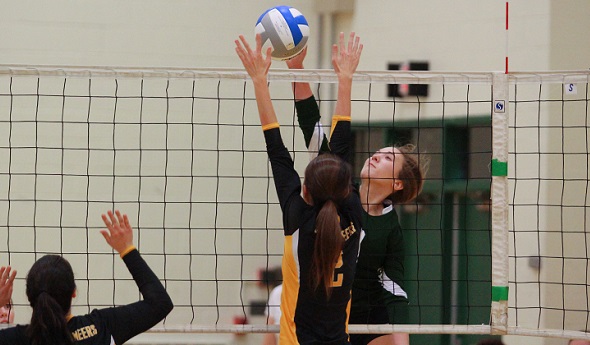
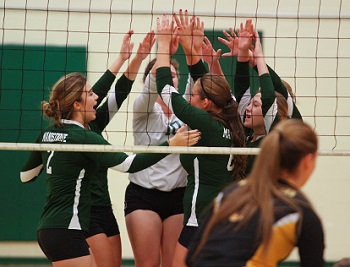
PHOTOS: (Top) Manistique senior Allie Nagy follows through on a kill attempt during a victory this season over Iron Mountain. (Middle) Lexi Carlson (7) goes high to set up a block. (Below) The Emeralds celebrate during their victory. (Photos courtesy of Manistique athletic department/Jeffrey Bolm.)