


MHSA(Q&)A: Beal City volleyball coach Kelly David
October 6, 2012
By Geoff Kimmerly
Second Half editor
 When people in Michigan’s volleyball community hear the name Kelly David, they might think first of the standout from just a few seasons ago. A four-sport standout for the Aggies, she set the volleyball team into the 2009 Class D Semifinals before going on to play at St. Clair Community College.
David, 20, graduated from high school a little more than two years ago, but is continuing to have an impact on the volleyball court – although now from the sideline as coach of the No. 3-ranked team in Class D. She took over the Beal City program this fall from her former coach, Randy Gallagher and has the Aggies 26-5-1.
Coaching has come naturally for the former floor leader, who already has gained valuable experiences and knowledge to share with her players. She previously coached at the junior high and club levels, the former for her aunt Sue Frederiksen – who coaches Almont’s varsity and is a member of the Michigan Interscholastic Volleyball Coaches Association Hall of Fame.
David is majoring in elementary education at Central Michigan University and sees teaching and coaching in her future for many years to come.
Why did you decide to become a coach?
I played at St. Clair (Community College) for two years, and my aunt had always been into coaching. I ended up coaching her seventh grade volleyball team for two years, and I coached in the Skippers AAU program over there. I found out I liked coaching more than playing.
How have you approached coaching a team that includes players who were freshmen when you were a senior in high school?
Going into it, I knew I wasn’t their friend; I was their coach. I wasn’t close to any of the girls except my sister (Monica, a senior). The people who coached me or were my teachers, (who said) go to class, do this, and you knew they received ultimate respect. I had helped out in previous years, and I knew what I had to do to gain that respect. And (my players) have listened to me.
Did you anticipate questions about you taking over the program only a few years out of high school?
I knew in my head, but I didn’t think it would be a problem in people’s minds. "She’s young, her sister is on the team;" that’s the stuff people might second guess. But I knew how to control the team, and having my sister on it wasn’t a big teal. So far (issues) haven’t happened. I’ve coached teams in previous years, and I’d always been the leader when I did play. I think that helps.
What were your goals coming into the season?
I had a lot of goals. Obviously, I wanted us to go far, like in the past. The biggest thing I noticed playing college from high school, the players knew the game of volleyball. They were smart. They had the same athletic ability as those I played against in high school, but they were just smarter. Knowing how to position the ball on the court, knowing the game, and I wanted to teach (my players) the game of volleyball. It’s important to know the game, and then we can work around the obstacles.
What did you learn by watching your aunt coach?
Just how strong you have to be. When I watch her coach, she’s very enthusiastic. But when someone does something wrong, she lets them know. That’s an important thing.
When did you first know you were interested in coaching?
When I was in high school, when I played, I’d help the other players. I noticed that was something I liked to do. I’d watch someone and pick up things they could fix. I thought about it in high school, and once I actually did it with the seventh graders, it wasn’t a job for me. It’s fun. Coaching is something I want to do. They want to be playing volleyball – that’s why they’re on the team. Everyone wants to be there, and we’re trying to accomplish the same thing.
What has been the biggest challenge during your first season?
The biggest challenge is handling the pressure. I know the team can do well. We’re ranked third in the state right now. But it’s getting them to perform the way they can perform, getting them to come together at the right time.
I’d also like to mention that Beal City (already) had a great program, from (former coaches) Randy Gallagher and before I came, Kelly Knuth. I’m just happy to step in and try to continue what they did.
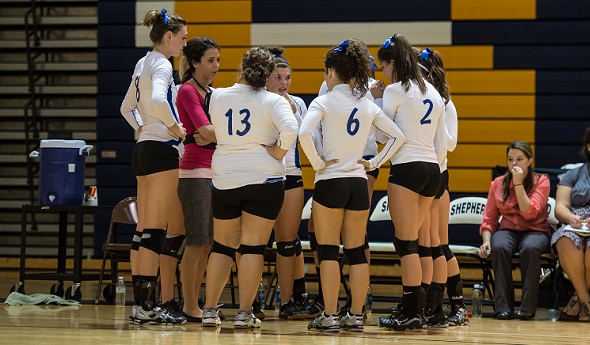
PHOTO: Beal City huddles during a break in its match against Shepherd this season. (Click to see more from HighSchoolSportsScene.com).
Roles Reverse as North Branch Wins Rematch
November 22, 2014
By Geoff Kimmerly
Second Half editor
BATTLE CREEK – Saturday’s final MHSAA Volleyball Final felt familiar – and not just because North Branch and Lake Odessa Lakewood wore nearly identical uniforms.
It wasn’t long ago that the Class B powers met to finish another season, and a Lakewood team filled with seniors swept the then-much younger Broncos to claim the 2012 title.
This championship rematch turned into a role reversal.
North Branch, with four major contributors who played on the losing side last time, swept Lakewood 25-19, 25-15, 25-23 to claim the program’s second MHSAA championship and first since 2009.
“We went in wanting revenge. Two years ago … we were devastated,” said North Branch senior Laura Willson, a key contributor on the 2012 team. “It feels great to do to them what they did to us.”
Willson was her team’s second-leading hitter with 10 kills in the 2012 Final. She took nearly half of her team’s attempts Saturday and connected on 22 kills.
Seniors Calla McNulty, Victoria Severance and Mady Ruhlman also saw time in the championship game two years ago and led the Broncos in a statistical category this time – McNulty with three aces, Ruhlman with 14 digs and Severance with four blocks.
There were lessons to be learned after the 2012 Final loss – Willson said the Broncos came to understand the importance of fighting for every point and also developed a closer bond than when she was a sophomore and teammates “picked at each other a bit.”
 “They had some heartbreak two years ago, and it’s all worth it with what happened today,” North Branch coach Jim Fish said. “I knew we were the better team today. Two years ago, we knew they were the better team. They had four four-year starters, and we were up against it.”
“We had more size, more experience and more power than they did two years ago,” Lakewood coach Kellie Rowland agreed. “And they had it on us today.”
Lakewood indeed had some of the look of North Branch 2012. Although three Vikings did also see time in that previous championship matchup, only two seniors were part of this season’s main playing group.
Those seniors, Vanessa Reynhout and Gracie Shellenbarger, led Lakewood with seven kills apiece, and Shellenbarger also had 10 digs.
The Vikings had an especially difficult time countering the 6-foot-1 Willson, which wasn’t helped by not having freshman middle Alivia Benedict, who left Thursday’s Semifinal with an injury.
Lakewood did open the first set by taking a 7-3 lead as North Branch piled up an uncharacteristic five errors early. But the Broncos came back to stay at 14-13 and led for good in the second set beginning at 4-3.
The Vikings led the third set 21-19 before North Branch rattled off three straight points on the way to finishing the match.
Sophomore Madee Miner had 39 assists for the Broncos (61-7-4), which entered the postseason ranked No. 2 and defeated No. 1 Pontiac Notre Dame in the Semifinal.
Sophomore Gabie Shellenbarger had 26 assists for the Vikings, who finished 51-9 after entering the playoffs ranked No. 5 and should return 10 of their 15 players for the next two seasons.
“Like I told them, they could’ve let the Regional slip through their hands, the Quarterfinal slip, the Semifinal slip. And they didn’t,” Rowland said. “I told the young ones, look at it, feel it, know how bad it feels so you want to get back and win it all.”
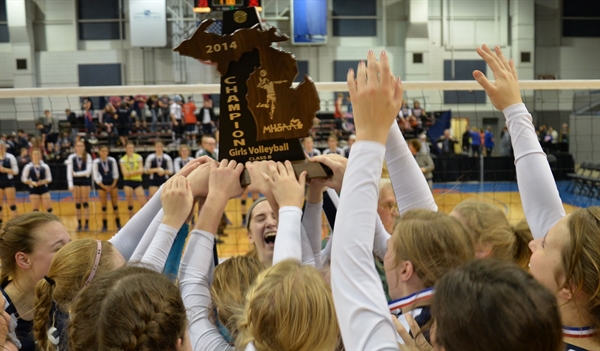
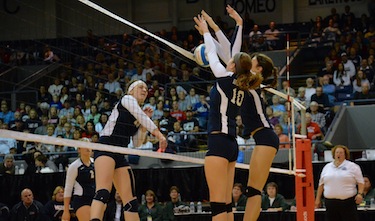
PHOTOS: (Top) North Branch players raise their championship trophy after Saturday’s Class B Final. (Middle) Lakewood’s Vanessa Reynhout drives a kill into a North Branch block including Laura Willson (10). (Click for action photos and team photos from Hockey Weekly Action Photos.)
VIDEO HIGHLIGHTS:
SHE'S A FRESHMAN! - Lake Odessa Lakewood's Lisa Hewitt comes up with the block in the first set against North Branch.
WILLSON FIRES DOWN THE MIDDLE - A key play at the end of the third set was this spike by Laura Willson which put North Branch at match point.
Watch the entire match and order DVDs by Clicking Here.