

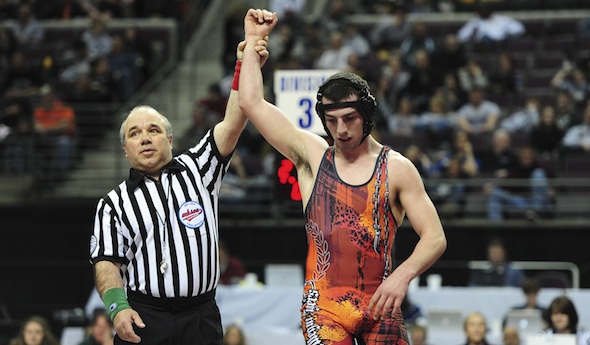
Allegan's Simaz Adds to Family Title Run
March 2, 2014
By Chris Phifer
Special to Second Half
AUBURN HILLS, MI – For the past decade, the name Simaz has rung through the walls of The Palace of Auburn Hills in early March.
And it's had a championship ring.
Four Simaz brothers – Eric, Cam, Taylor and Kyle – have won eight individual titles at the MHSAA Individual Wrestling Finals, starting with Eric and Cam in 2005, and ending with Kyle on Saturday in the 145-pound match in Division 3.
He beat Chad Decker of Grass Lake 27-12 for his second title.
Total family titles: one by Eric, three by Cam, two by Taylor and two by Kyle.
“I think that's awesome,” Simaz said. “Our family is very competitive. A jog around the Simaz house is a race. We have a very competitive family.”
Simaz says this title did not come without trepidation.
“This weekend is a very stressful weekend,” Simaz said. “I'm glad it's over, and I'm glad I came out on top.”
103
Champion: Tristan Serbus, Corunna, Soph. (46-1)
Decision, 10-6 over Brendan Abrigo, Manchester, Jr. (52-3)
Serbus had something to prove.
He lost to Abrigo earlier this season, but that would not stop him from achieving what he had been working for his whole season – beating Abrigo in the 103-pound championship match.
And he stayed on the offensive to do that, beating him 10-6 for the title.
“It feels awesome,” Serbus said. “I worked hard and attacked, attacked, attacked. I am so glad I have my coaches and teammates.”
112
Champion: Aaron Kilburn, Richmond, Soph. (40-5)
Decision, 4-1 over K.J. Suitor, Saginaw Swan Valley, Soph. (54-3)
Kilburn improved on last year's third-place finish by controlling Suitor for a 4-1 victory.
Kilburn cruised through his first match with a fall in the second period. He continued with a 9-2 victory over Nolan Saxton from Lakeview. In the Semifinal, he outlasted Arthur Paine from Montrose 3-0, setting up his final match with Suitor.
“I thought that I wrestled well the whole tournament,” Kilburn said. “It feels better taking first than third, I can tell you that.”
119
Champion: Devin Schroder, Grand Rapids Catholic Central, Soph. (40-4)
Decision, 5-2 over Kanen Storr, Leslie, Soph. (57-2)
Schroder won his second straight MHSAA title in what proved to be one of the most competitive weights in the Finals tournament, regardless of division.
His Semifinal match was a repeat of last year’s championship matchup, as Schroder worked his way to a 10-3 decision over Alex Martinez of Ida.
He continued to roll in the Final, defeating Leslie’s Storr, a champion himself in 2013.
It was sweet accomplishment for Schroder, who focused on this weekend to fuel his work ethic and dedication the last few weeks.
“You have down points during the season,” said Schroder, who lost four matches this year after going undefeated last year. “However, you look forward to the state tournament, because it pushes you to get better.”
125
Champion: Foster Karmon, Allegan, Soph. (58-2)
Decision, 2-1 over Jerry Fenner, Birch Run, Jr. (48-6)
Karmon had to endure two close matches to claim his first title. He used strategy and savvy wrestling to overcome Fenner in the Final.
This coming after he beat Matt Santos of Saginaw Swan Valley in the Semifinal 2-1.
“I had to keep my offense going (during the third period up 2-0),” Karmon said. “I knew if I backed up I would get called for stalling, so I had to stay on him like I did earlier in the match.”
130
Champion: Grant Turnmire, Almont, Jr. (47-4)
Fall, 0:38 over Zane Corey, Allegan, Sr. (45-4)
All it took was one big headlock, and support from his dad, to propel Turnmire to his first MHSAA title. Turnmire used an impressive headlock to pin Corey in 38 seconds.
After that he rushed to hug his father and coach, Bill Turnmire.
“It is special to win a state title,” Grant Turnmire said. “My dad has supported me throughout. This is very special.”
135
Champion: Nate Limmex, Grand Rapids Catholic Central, Jr. (23-0)
Technical Fall, 17-2 in 3:42 over Alex Young, Portland, Jr. (34-9)
Being injured in January did not stop Limmex from capturing his second MHSAA title in two years. Limmex had some tight matches on his path to the Final, but came away unscathed.
He dominated talented Young from Portland from the start, completing his 17-2 technical fall in the second period.
“I have been working on transitioning from leg attacks to turks because it will lead to more opportunities for back points,” Limmex said. “It is not boring winning two state titles. It feels good knowing that the hard work pays off.”
140
Champion: Zehlin Storr, Leslie, Sr. (61-0)
Decision, 3-1 over Doug Rojem, Dundee, Sr. (47-6)
Wrestling a returning champ at the same weight might seem intimidating to the average person.
However, when you are a person like Storr, it is not intimidating; it is motivating.
He used wrestling knowledge and craftiness on his way to a second MHSAA championship, beating a very talented Rojem, who also was attempting to win his second title.
“I wanted to beat his defense with my offense,” Storr said. “This year, I can say I had a blast. ”
152
Champion: Devin Skatzka, Richmond, Jr. (40-3)
Fall, 1:01 over Eric Coval, Manchester, Sr. (37-1)
“Pin to win” is a motto that many wrestlers and coaches use to motivate.
However, Skatzka takes this to heart.
He went through the entire Finals pinning every opponent in the first period, one in just 15 seconds.
That led to his third MHSAA title.
“I really did not expect it, especially against Coval (when talking about pinning every opponent in the first period),” Skatzka said. “I was really looking for that pin. I am very proud of myself.”
160
Champion: Tristen Zienkiewicz, Farwell, Sr. (49-2)
Decision, 4-3 over Jared Elliott, Birch Run, Sr. (48-6)
Many wrestlers have moves they try to execute during every match. The trick is to be able to utilize them in different positions.
Zienkiewicz did just that.
With only eight seconds left in is final match against Elliott, he executed a fantastic inside trip, dragging his feet in bounds for the two-point takedown to secure a 4-3 victory.
“(Hitting an inside trip with eight seconds to go), I thought my God, my God, my dream came true,” Zienkiewicz said. “Whatever is there, I take it.”
171
Champion: Andy Donoho, Lake Fenton, Sr. (52-7)
Decision, 4-2 over Tye Thompson, Dundee, Jr. (43-7)
Last weekend, Donoho did what was best for his team, bumping up a weight to wrestle Dundee's MHSAA runner-up Teddy Warren at 189 pounds.
This weekend he was able to avenge a loss his teammate Trent Hilger suffered last week at Team Finals, as he beat Thompson in the championship match at 171.
“Gratification, I got it here from great coaches and great workout partners,” Donoho said. “Everyday, we get after it. It was worth it.”
189
Champion: Jake McKiernan, Richmond, Sr. (37-5)
Decision, 5-0 over Teddy Warren, Dundee, Sr. (25-4)
Wrestling has three positions – neutral, top, and bottom.
McKiernan utilized strategy in the neutral position to come away with a 5-0 victory over Warren.
He knew Warren was good on his feet, so he had to be better than him there, because he knew he could take him on the mat.
“This feels incredible,” McKiernan said. “My coaches helped me mentally. I never really pictured myself in this situation. Getting better in the neutral position was the key, especially in this match.”
215
Champion: Danny Drummond, Grand Rapids Catholic Central, Sr. (33-9)
Decision, 7-4 TB3 over Colin Beebe, Allendale, Sr. (48-1)
Wrestling is a very physical sport. Sometimes matches last a very long time.
Drummond figured his final match with favored Beebe would go into overtime. In fact, it took three overtimes for Drummond to outlast Beebe.
Drummond was able to score an escape with time still remaining. He then was able to secure a late takedown to secure his first title.
“I wrestled him four or five times in two years, and he's beat me every time,” Drummond said. “He is one of the best wrestlers I have ever wrestled. I wanted to pound it on for three periods physically. This feels amazing.”
285
Champion: Eric Fader, Sandord-Meridian, Sr. (48-5)
Decision, 7-6 TB1 Glenn Geurink, Allendale, Sr. (46-1)
When you think of heavyweight wrestling, you think of a slow-paced chess match, especially when you are talking about title deciders.
Fader and Geurink would disagree.
That's because this match had non-stop action to the end. And in the end, it was Fader that came away with a 7-6 tie-breaker victory.
“I just went out there and did my best,” Fader said. “I had to grind it out, do some set ups, and hit my blast double.”
PHOTO: Allegan's Kyle Simaz has his hand raised in victory during the Division 3 Individual Finals. (Click to see more fromHigh School Sports Scene.)
Rep Council Wrap-Up: Spring 2021
By
Geoff Kimmerly
MHSAA.com senior editor
May 6, 2021
The addition of a girls division to the Individual Wrestling Tournament series and approval of a common start date for all Fall sports highlighted actions taken by the Representative Council of the Michigan High School Athletic Association during its annual Spring Meeting on May 3.
The Spring Meeting of the 19-member legislative body of the Association’s more than 1,500 member schools is generally the busiest of its sessions each year. The Council considered 19 committee proposals and dealt with a variety of eligibility rule, postseason tournament and operational issues.
Beginning with the 2021-22 school year, a championship division for female competitors who participate on MHSAA member school teams will be added to the Individual Wrestling Tournament series. There will be 14 champions awarded, based on weight classes established by the National Federation of State High School Associations. Qualifiers will be determined via a sectional format, and girls will continue to compete on boys teams during regular-season and team tournament competition; girls also may choose to compete in the boys individual tournament instead of the girls bracket. A total of 401 girls competed in wrestling for MHSAA member schools during the 2019-20 school year, up from 250 in 2017-18 and then 327 in 2018-19. The girls division proposal had been put forth by the MHSAA Wrestling Committee.
The Council also voted to move the start of all Fall sports practices to the same day. Those sports now may begin on the 16th Monday before Thanksgiving. Previously, football started on a Monday and all other sports began Wednesday. For the upcoming school year, the Fall sports start date is Aug. 9, 2021.
As it has during most meetings over the 2020-21 school year, the Council continued to discuss possible adjustments because of the COVID-19 pandemic and disruption it has caused to Michigan high school athletics. Notably, the Council approved an extension of the waiver of the previous academic record regulation for sports played in Fall 2021. This is the third extension of the waiver. The previous academic record regulation requires participants to have received credit for at least 66 percent of a full credit load during the previous semester. As COVID-19 has resulted in various academic scheduling adjustments, schools will continue to determine if athletes have met the credit level necessary to be eligible for athletics this fall.
The Council also made permanent the allowance for cooperative programs in nine sports among schools of the same public school district regardless of the 3,500-student enrollment maximum. Those co-op programs were first allowed as part of a two-year experiment beginning with the 2016-17 school year to increase possibilities for participation in those sports – baseball, bowling, girls competitive cheer, cross country, golf, soccer, softball, tennis and wrestling. Schools taking part in these co-op programs must continue to show a demonstrated history of inadequate numbers of participants and apply for renewal every two years.
Here is a summary of other notable actions taken by the Representative Council at the Spring Meeting, which will take effect during the 2021-22 school year:
Athletic Equity
• The Council approved an Athletic Equity Committee recommendation to publish the following statement to suggest to local schools that they review nicknames and school logos that are considered offensive or hurtful to minority groups or demonstrate an insensitive bias:
“The MHSAA recognizes the importance of equity in high school sports. Schools and mascots are rich in tradition and unique to each community. Although we understand the tradition of those individual communities, we also wish to support and foster an environment of inclusion. It is in this spirit that the MHSAA encourages member schools and communities to evaluate and reconsider names and mascots that may be offensive to groups of individuals.”
Officials
• The Council approved an Officials Review Committee recommendation to adjust the officials rating system with the hope of encouraging more ratings and providing a more specific understanding of an official’s overall body of work. Instead of the current overall 1-5 rating system, officials will receive specific feedback in four categories: judgment, presence and demeanor, attitude and effort, and administration and communication.
Sport Matters
• In bowling, the Council approved a Bowling Committee recommendation to adopt the Phantom oil pattern for the 2021-22 season.
• In competitive cheer, the Council approved a Girls Competitive Cheer Committee recommendation to study a new choreography chart that will award points based on a variety of skills while also awarding a range of points to benefit both small and large teams which have various skill levels.
• Also in cheer, the Council approved a pair of Committee technical recommendations; the first allows for a connected tumbling skill to be considered a new variety point for Round 3, and the second allows four difficulty points for a one-leg flair at the elevator level for middle school competition.
• In golf, the Council approved the Golf Committee recommendation to require the use of the iWanamaker scoring program and app during the regular season, beginning in Fall 2021. The program and app became required during Regional and Finals play during the Fall 2020 season.
• In softball, the Council approved a Girls Softball Committee recommendation to add a suspended game policy to MHSAA playing rule adoptions in the MHSAA Handbook. This policy – which mirrors that approved for baseball in 2020 – provides a game will be suspended any time it is called before it reaches regulation, or if called any time when the score is tied.
• In tennis, the Council approved a Tennis Committee recommendation regarding instances when a seeded player withdraws from Regional or Finals competition before the first match is played. In those instances, the players seeded lower in that flight than the player who withdrew will move up one seed and be placed on the previously-determined lines for those seeds within the flight bracket. However, non-seeded players already drawn into the bracket will not be moved.
• Also in wrestling, the Council approved a late-arrival skin check on days – especially during weekends – when teams may be competing in multiple regular-season duals. An athlete who misses the scheduled morning skin check may, with coach’s notification to the official beforehand, receive a skin check upon later arrival to the event but prior to the start of the dual in which the wrestler may compete. This will allow an individual the opportunity to participate if that wrestler missed the scheduled morning inspection due to educational reasons or unforeseen circumstances.
The Council also discussed possible topics for presentation during this fall’s Update Meeting statewide tour, and took action to clarify Handbook language regarding a variety of topics. The Association’s $11.5 million budget for the 2021-22 school year also was approved.
The Representative Council is the 19-member legislative body of the MHSAA. All but five are elected by member schools. Four members are appointed by the Council to facilitate representation of females and minorities, and the 19th position is occupied by the Superintendent of Public Instruction or designee.
The MHSAA is a private, not-for-profit corporation of voluntary membership by more than 1,500 public and private senior high schools and junior high/middle schools which exists to develop common rules for athletic eligibility and competition. No government funds or tax dollars support the MHSAA, which was the first such association nationally to not accept membership dues or tournament entry fees from schools. Member schools which enforce these rules are permitted to participate in MHSAA tournaments, which attract more than 1.4 million spectators each year.