

Back Home, Astrauskas Title Dreaming Again
January 16, 2019
By Jeff Chaney
Special for Second Half
HOWARD CITY – Tanner Astrauskas is back on track to achieve his goal of becoming an MHSAA Finals champion.
 Tragedy almost prevented him from realizing that dream.
Astrauskas is a senior 140-pound wrestler for Tri-County High School. He had a solid start to his career, winning 35 matches as a freshman and then as a sophomore going 44-7 and placing eighth at 125 pounds at the Division 3 Individual Finals.
But just before he stepped onto the mat to wrestle his first match that 2017 weekend at The Palace of Auburn Hills, Astrauskas received disheartening news that changed his world in an instant.
"Just before the finals of my sophomore year I found out my best friend killed himself, and I found that out just before I wrestled at state," Astrauskas said. "That whole tournament I was pretty broke, I didn't even want to wrestle. I got pinned in my first match by the kid who ended up winning it, and then I won my next two matches 4-2 and 5-0 to make it into the medal round. I was pretty happy I placed considering the circumstances."
Best friend Casey Eckert was only 15 when he died. The circumstances lingered for Astrauskas when he returned home to Howard City, and they sent him into a downward spiral.
"Two days after state we had his funeral, and that took me to a dark place," Astrauskas said. "I wasn't doing so well in school, and I ended up running away from home."
Astrauskas ran away to Tennessee to stay with friends, but it was another friend who helped bring him back to Michigan.
"My friend, Hunter Brimmer, was at Olivet (College) and he talked me into coming back and (being) with my parents,” Astrauskas said. “And they ended up picking me up from Olivet and taking me home."
But Astrauskas was still empty and searching for answers.
 "After coming home, I still needed to get away to find myself and I ended up moving to Shelby and got my own place and went to school at Shelby High School my junior year," Astrauskas said. "I just wanted to move away and get my head right, and learn what it took to be on my own."
Astrauskas lived on his own in Shelby under the watchful eye of close family friends and didn’t play any sports as a junior, and the experience seemed to help him grow. Then this year, he made another decision in that growth process. In November, after football season at Shelby, Astrauskas decided he was ready to come home and face those difficult memories.
Since he was moving back in with his parents, he was able to wrestle for Tri-County this winter. And with a clearer head, he has mat goals again.
"I just felt like I wanted to move back and finish my senior year with friends I grew up with," Astrauskas said. "And I felt I could achieve my goals and excel better at Tri-County. I want to win a state championship."
Astrauskas is off to a great start. He is 12-1, losing his first match of the year Saturday to Kent City's Evan Jones in overtime in the 140-pound final of the Sparta Invitational.
One of his biggest wins this winter was a 5-3 decision over Madison Heights Lamphere's Matt Tomsett – the Division 2 Finals runner-up at 130 pounds last year.
Astrauskas also is doing great in his school work, currently carrying a 3.45 GPA. And Tri-County coach Corey Renner has seen a different person in his wrestling room.
"I think this whole thing has helped him a lot," Renner said. "He's always been a good wrestler, but he was the kid that if you yelled at him to run faster in sprints, he would go slower and end up in last. But this year he is first, he seems to have more focus and is more confident. He has become a leader, he has been good with the young kids. He has come a long way."
Life can be cruel, and for Astrauskas, a lot of cruelty has happened at a young age. But he is taking everything as a positive now, fueling his focus on getting to Ford Field for March 1-2 and this season’s Individual Finals – where he’ll compete to reach the top of the podium.
"To anyone out there going through depression, it does get better," Astrauskas said. "There are other ways to deal with it. Get therapy, support from your friends. You don't need to turn to drugs or alcohol, or even worse. Things will get better."
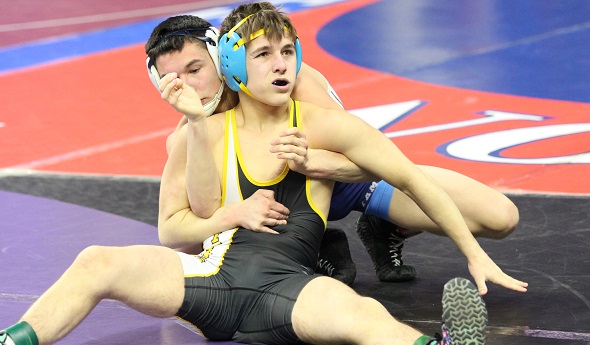
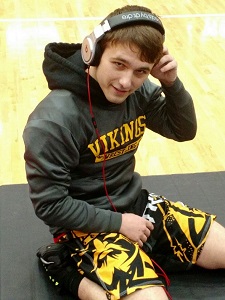
PHOTOS: (Top) Tanner Astrauskas wrestles Richmond’s Alec Ziza during a consolation first-round match at the 2017 MHSAA Individual Finals. (Middle) Astrauskas, back home at Tri-County, has become a team leader with title aspirations.
Rep Council Wrap-Up: Spring 2021
By
Geoff Kimmerly
MHSAA.com senior editor
May 6, 2021
The addition of a girls division to the Individual Wrestling Tournament series and approval of a common start date for all Fall sports highlighted actions taken by the Representative Council of the Michigan High School Athletic Association during its annual Spring Meeting on May 3.
The Spring Meeting of the 19-member legislative body of the Association’s more than 1,500 member schools is generally the busiest of its sessions each year. The Council considered 19 committee proposals and dealt with a variety of eligibility rule, postseason tournament and operational issues.
Beginning with the 2021-22 school year, a championship division for female competitors who participate on MHSAA member school teams will be added to the Individual Wrestling Tournament series. There will be 14 champions awarded, based on weight classes established by the National Federation of State High School Associations. Qualifiers will be determined via a sectional format, and girls will continue to compete on boys teams during regular-season and team tournament competition; girls also may choose to compete in the boys individual tournament instead of the girls bracket. A total of 401 girls competed in wrestling for MHSAA member schools during the 2019-20 school year, up from 250 in 2017-18 and then 327 in 2018-19. The girls division proposal had been put forth by the MHSAA Wrestling Committee.
The Council also voted to move the start of all Fall sports practices to the same day. Those sports now may begin on the 16th Monday before Thanksgiving. Previously, football started on a Monday and all other sports began Wednesday. For the upcoming school year, the Fall sports start date is Aug. 9, 2021.
As it has during most meetings over the 2020-21 school year, the Council continued to discuss possible adjustments because of the COVID-19 pandemic and disruption it has caused to Michigan high school athletics. Notably, the Council approved an extension of the waiver of the previous academic record regulation for sports played in Fall 2021. This is the third extension of the waiver. The previous academic record regulation requires participants to have received credit for at least 66 percent of a full credit load during the previous semester. As COVID-19 has resulted in various academic scheduling adjustments, schools will continue to determine if athletes have met the credit level necessary to be eligible for athletics this fall.
The Council also made permanent the allowance for cooperative programs in nine sports among schools of the same public school district regardless of the 3,500-student enrollment maximum. Those co-op programs were first allowed as part of a two-year experiment beginning with the 2016-17 school year to increase possibilities for participation in those sports – baseball, bowling, girls competitive cheer, cross country, golf, soccer, softball, tennis and wrestling. Schools taking part in these co-op programs must continue to show a demonstrated history of inadequate numbers of participants and apply for renewal every two years.
Here is a summary of other notable actions taken by the Representative Council at the Spring Meeting, which will take effect during the 2021-22 school year:
Athletic Equity
• The Council approved an Athletic Equity Committee recommendation to publish the following statement to suggest to local schools that they review nicknames and school logos that are considered offensive or hurtful to minority groups or demonstrate an insensitive bias:
“The MHSAA recognizes the importance of equity in high school sports. Schools and mascots are rich in tradition and unique to each community. Although we understand the tradition of those individual communities, we also wish to support and foster an environment of inclusion. It is in this spirit that the MHSAA encourages member schools and communities to evaluate and reconsider names and mascots that may be offensive to groups of individuals.”
Officials
• The Council approved an Officials Review Committee recommendation to adjust the officials rating system with the hope of encouraging more ratings and providing a more specific understanding of an official’s overall body of work. Instead of the current overall 1-5 rating system, officials will receive specific feedback in four categories: judgment, presence and demeanor, attitude and effort, and administration and communication.
Sport Matters
• In bowling, the Council approved a Bowling Committee recommendation to adopt the Phantom oil pattern for the 2021-22 season.
• In competitive cheer, the Council approved a Girls Competitive Cheer Committee recommendation to study a new choreography chart that will award points based on a variety of skills while also awarding a range of points to benefit both small and large teams which have various skill levels.
• Also in cheer, the Council approved a pair of Committee technical recommendations; the first allows for a connected tumbling skill to be considered a new variety point for Round 3, and the second allows four difficulty points for a one-leg flair at the elevator level for middle school competition.
• In golf, the Council approved the Golf Committee recommendation to require the use of the iWanamaker scoring program and app during the regular season, beginning in Fall 2021. The program and app became required during Regional and Finals play during the Fall 2020 season.
• In softball, the Council approved a Girls Softball Committee recommendation to add a suspended game policy to MHSAA playing rule adoptions in the MHSAA Handbook. This policy – which mirrors that approved for baseball in 2020 – provides a game will be suspended any time it is called before it reaches regulation, or if called any time when the score is tied.
• In tennis, the Council approved a Tennis Committee recommendation regarding instances when a seeded player withdraws from Regional or Finals competition before the first match is played. In those instances, the players seeded lower in that flight than the player who withdrew will move up one seed and be placed on the previously-determined lines for those seeds within the flight bracket. However, non-seeded players already drawn into the bracket will not be moved.
• Also in wrestling, the Council approved a late-arrival skin check on days – especially during weekends – when teams may be competing in multiple regular-season duals. An athlete who misses the scheduled morning skin check may, with coach’s notification to the official beforehand, receive a skin check upon later arrival to the event but prior to the start of the dual in which the wrestler may compete. This will allow an individual the opportunity to participate if that wrestler missed the scheduled morning inspection due to educational reasons or unforeseen circumstances.
The Council also discussed possible topics for presentation during this fall’s Update Meeting statewide tour, and took action to clarify Handbook language regarding a variety of topics. The Association’s $11.5 million budget for the 2021-22 school year also was approved.
The Representative Council is the 19-member legislative body of the MHSAA. All but five are elected by member schools. Four members are appointed by the Council to facilitate representation of females and minorities, and the 19th position is occupied by the Superintendent of Public Instruction or designee.
The MHSAA is a private, not-for-profit corporation of voluntary membership by more than 1,500 public and private senior high schools and junior high/middle schools which exists to develop common rules for athletic eligibility and competition. No government funds or tax dollars support the MHSAA, which was the first such association nationally to not accept membership dues or tournament entry fees from schools. Member schools which enforce these rules are permitted to participate in MHSAA tournaments, which attract more than 1.4 million spectators each year.