

Baranoski Continues Pioneering as Official
February 28, 2019
By Jeff Chaney
Special for Second Half
It took two decades, but Casey Baranoski is on the brink once again of reaching wrestling's highest stage in the state of Michigan.
As a wrestler for Comstock Park High School during the late 1990s, Baranoski was a pioneer in the sport, becoming the first female in the state to record more than 100 wins while wrestling in the 103 and 112-pound weight classes.
She finished with a highly respectable 123-38 record for the Panthers, and was a two-time Regional qualifier.
But she could never take that final step to make it to the MHSAA Individual Finals.
"I got to Regionals, and I kind of choked," said Baranoski, a 1998 graduate.
Now Baranoski is a pioneer in the sport once more, as two weeks ago she officiated the Division 1 Individual Regional at Grand Haven High School, one step away from state.
"This is a fun sport to be part of, and it never quite gets out of your blood," Baranoski said. "(Me getting into officiating) is my brother Tom's fault. He got me to ref for the first time. And I work for a credit union, so I have banker's hours, so it was perfect for my schedule. It just worked out."
That start was five years ago, and slowly Baranoski has been working on her craft in stripes, earning the much needed experience it takes to earn an MHSAA Tournament assignment.
 Unlike as a competitor, an official’s quest to make the Finals is not entirely in her or his hands. Officials are graded each match and tournament they work during the season by the coaches, and grades are tabulated. With high enough scores, an official might just get an invitation to ref the sport's best athletes.
Steve Shutich, who has been officiating high school wrestling in Michigan for 29 years, was the head official at the Grand Haven Regional two weeks ago, and he believes Baranoski is close to getting her ticket stamped for the trip to the Finals at Ford Field.
And he should know – he has officiated 16 individual and four team Finals.
"She did well," said Shutich, who is on the board of the West Michigan Wrestling Officials Association. "It proved that she is for better matches. She held her own that day."
Baranoski believes she is up to the task as well.
"I thought I did pretty well that day. It was nice to be accepted by the coaches," Baranoski said. "Wrestling and effort go hand in hand, and you have to rely on effort, not only as a wrestler, but also as a ref. I didn't get booed out of the gym, so I think I did pretty well."
Baranoski did get some experience officiating state finals matches this year. She was an official at the first girls state finals hosted Feb. 3 by the Michigan Wrestling Association.
"That was pretty cool," Baranoski said. "There were 165 girls at Adrian College, and it was a good experience."
Experience that Shutich says Baranoski needs to take one more step for the MHSAA Finals.
"She just needs a little more seasoning," Shutich said. "She'll be ready. She has what it takes to be the best. She knows the sport."
But Baranoski wants no favors.
"I want to earn it down there. I don't want it gifted," Baranoski said. "If my ratings are there, great. If it happens that way, outstanding."
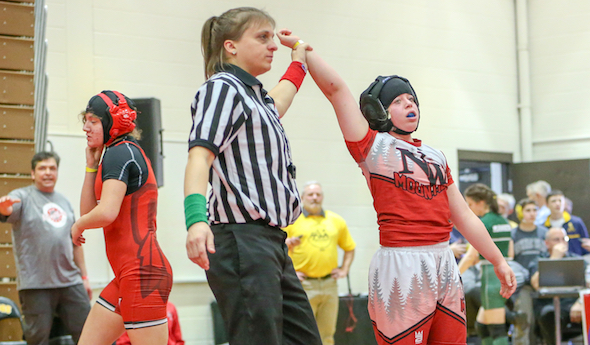
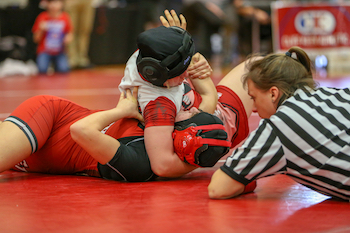
PHOTOS: (Top) Casey Baranoski raises the arm of a winner during the Girls Wrestling Finals on Feb. 3 at Adrian College. (Middle) Baranoski watches for a pin. (Photos by GRW Action Photography.)
Be the Referee: Automatic 1st Downs
October 24, 2019
This week, MHSAA officials coordinator Sam Davis explains differences in high school football rules regarding automatic first downs from similar rules at the college and pro levels.
Be The Referee is a series of short messages designed to help educate people on the rules of different sports, to help them better understand the art of officiating, and to recruit officials.
Below is this week's segment - Automatic 1st Downs - Listen
Today we are going to talk about one of the biggest rule difference areas in high school football from those rules used in college and pro games – automatic first downs.
When watching that college game on Saturday or the pro game on Sunday, all of us know there are several defensive fouls that give the offense an automatic first down. However, under high school rules, the opposite is true most of the time.
The only high school fouls that result in an automatic first down for the offense are the roughing fouls – roughing the passer, the kicker, the holder and the long snapper. Fouls such as defensive pass interference or any other personal foul do not bring an automatic first down under high school rules.
Past editions
Oct. 17: Catch Momentum - Listen
Oct. 10: Golf Rules Changes - Listen
Oct. 3: No Tackle Box - Listen
Sept. 26: You Make the Overtime Call - Listen
Sept. 19: Swimming Finishing Touch - Listen
Sept. 12: Curbing Gamesmanship By Substitution - Listen
Sept. 5: Football Safety Rules Changes - Listen
Aug. 29: 40-Second Play Clock - Listen