

Baranoski Continues Pioneering as Official
February 28, 2019
By Jeff Chaney
Special for Second Half
It took two decades, but Casey Baranoski is on the brink once again of reaching wrestling's highest stage in the state of Michigan.
As a wrestler for Comstock Park High School during the late 1990s, Baranoski was a pioneer in the sport, becoming the first female in the state to record more than 100 wins while wrestling in the 103 and 112-pound weight classes.
She finished with a highly respectable 123-38 record for the Panthers, and was a two-time Regional qualifier.
But she could never take that final step to make it to the MHSAA Individual Finals.
"I got to Regionals, and I kind of choked," said Baranoski, a 1998 graduate.
Now Baranoski is a pioneer in the sport once more, as two weeks ago she officiated the Division 1 Individual Regional at Grand Haven High School, one step away from state.
"This is a fun sport to be part of, and it never quite gets out of your blood," Baranoski said. "(Me getting into officiating) is my brother Tom's fault. He got me to ref for the first time. And I work for a credit union, so I have banker's hours, so it was perfect for my schedule. It just worked out."
That start was five years ago, and slowly Baranoski has been working on her craft in stripes, earning the much needed experience it takes to earn an MHSAA Tournament assignment.
 Unlike as a competitor, an official’s quest to make the Finals is not entirely in her or his hands. Officials are graded each match and tournament they work during the season by the coaches, and grades are tabulated. With high enough scores, an official might just get an invitation to ref the sport's best athletes.
Steve Shutich, who has been officiating high school wrestling in Michigan for 29 years, was the head official at the Grand Haven Regional two weeks ago, and he believes Baranoski is close to getting her ticket stamped for the trip to the Finals at Ford Field.
And he should know – he has officiated 16 individual and four team Finals.
"She did well," said Shutich, who is on the board of the West Michigan Wrestling Officials Association. "It proved that she is for better matches. She held her own that day."
Baranoski believes she is up to the task as well.
"I thought I did pretty well that day. It was nice to be accepted by the coaches," Baranoski said. "Wrestling and effort go hand in hand, and you have to rely on effort, not only as a wrestler, but also as a ref. I didn't get booed out of the gym, so I think I did pretty well."
Baranoski did get some experience officiating state finals matches this year. She was an official at the first girls state finals hosted Feb. 3 by the Michigan Wrestling Association.
"That was pretty cool," Baranoski said. "There were 165 girls at Adrian College, and it was a good experience."
Experience that Shutich says Baranoski needs to take one more step for the MHSAA Finals.
"She just needs a little more seasoning," Shutich said. "She'll be ready. She has what it takes to be the best. She knows the sport."
But Baranoski wants no favors.
"I want to earn it down there. I don't want it gifted," Baranoski said. "If my ratings are there, great. If it happens that way, outstanding."
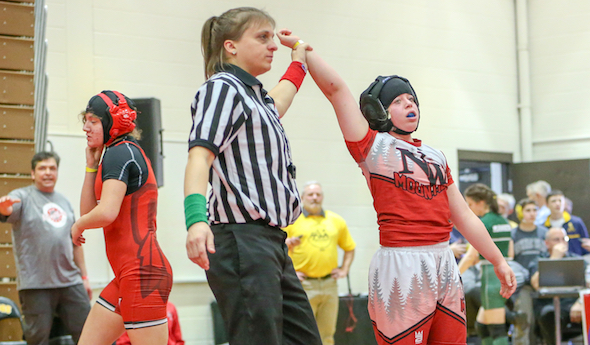
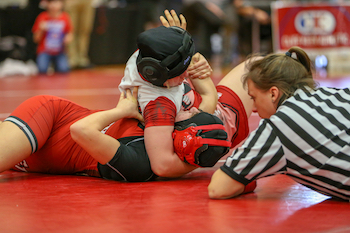
PHOTOS: (Top) Casey Baranoski raises the arm of a winner during the Girls Wrestling Finals on Feb. 3 at Adrian College. (Middle) Baranoski watches for a pin. (Photos by GRW Action Photography.)
Spidle Sets Up 2020 Run for 4-Title Glory
By
Paul Costanzo
Special for MHSAA.com
March 2, 2019
DETROIT – A change in divisions couldn’t slow Sean Spidle down.
The Flint Powers Catholic junior claimed his third straight MHSAA individual wrestling championship Saturday, defeating Tecumseh’s Joshua Hilton 9-6 in the Division 2 112-pound final. Spidle won titles in Division 3 the previous two years, at 103 in 2017 and 112 in 2018.
“It feels amazing,” Spidle said. “This is what I train for. I thought about this every single night. I have to give a lot of credit to my parents and coaches; they pushed me to be better every single day.”
Spidle took a 6-2 lead in the match and held off a late charge from Hilton, who scored a pair of takedowns in the final period. Spidle ran into the stands following his win, celebrating with family and friends as he has now given himself a chance to join the ranks of four-time champions.
“It’s time to train and get ready for it,” he said. “It’s awesome. It makes it even better that my friends and parents came to support. This is everything I wanted.”
285
Champion: Donovan King, Farmington, Sr. (51-2)
Fall, 4:39, over Jaren Johnson, Warren Lincoln, Sr. (37-2)
After missing his entire junior season with a torn knee ligament, King made up for lost time and rolled to his first Finals title.
He racked up three pins in his four matches, including in the final, to become Farmington’s first MHSAA champion since 1995.
“It feels great to come back to win this and be the third person to win states from Farmington High School,” King said. “It was very hard. I had to overcome a lot of pain during the season, my knee shifting out of place during a match. It’s just a mindset. I’m just glad I got through that this whole season.”
103
Champion: Jacob Brya, St. Johns, Fr. (42-2)
Decision, 9-2, over Jamison Zimmerman, Niles, Jr. (37-7)
In his first high school season, Brya showed that his youth success was no fluke.
The former MYWAY state champion’s run to an MHSAA championship included two pins and a four-takedown performance in the title match.
“I just kind of wanted to be conservative so I could win the match,” Brya said. “I didn’t want to do anything dumb so I could blow a lead, so I just kind of wrestled conservative and beat him off my feet.”
119
Champion: Vincent Perez, Tecumseh, Sr. (53-0)
Major Decision, 18-8, over Joe Haynes, Warren Woods-Tower, Soph. (34-8)
After finishing second his junior season, Perez wasn’t going to leave anything to chance Saturday night.
He scored nine points in the third period to turn a close match into a major decision and put an exclamation point on a perfect season.
“I didn’t come here just to win, I came here to dominate,” Perez said. “Third period, it was still a decision, and I wasn’t content with that. I wanted to dominate. I’ve been working all year to control, be aggressive and dominate. Last year, it didn’t work out so well, came up a little short. But this year, it’s a better taste leaving.”
125
Champion: Chaise Mayer, Warren Woods-Tower, Sr. (44-3)
Decision, 3-2, over Chayse Lajoie, Gaylord, Jr. (48-2)
After finishing as a Division 2 runner-up in 2016 and 2017, Mayer made it to the top of the podium, knocking off a two-time returning champion in Lajoie.
The two wrestlers traded a takedown and a reversal in the first period, and a Mayer escape in the second proved to be the difference as he rode Lajoie out for the entirety of the third period.
“It’s much deserved and well-earned,” Mayer said. “I’ve worked my whole life for this. To come so close so many times and not get it, I couldn’t let that happen again. It was just about being gritty and knowing I could do it. Knowing how to win.”
130
Champion: Kaleob Whitford, St. Johns, Sr. (42-2)
Decision, 6-0, over Nate Young, Holly, Jr. (51-7)
A dominant display in the top position capped a dominant overall tournament for Whitford, who had racked up a pair of pins and a major decision prior to the final.
He scored a takedown late in the first period of his match against Young, and rode him out through the end of the second.
“I feel accomplished,” Whitford said. “My dad was a state champion his senior year, my brother was a four-time state champ, so I had to keep the generation going. I didn’t really think about it. I tried to keep my mind clear. I don’t think about anything when I’m about to wrestle.”
135
Champion: Christopher Lilly, Croswell-Lexington, Jr. (52-7)
Decision, 6-3, over Matthew Tomsett, Madison Heights Lamphere, Sr. (52-3)
After watching his dad coach a pair of Finals champions in previous years, Lilly was determined to create a father-son moment at Ford Field.
Thanks to a three-takedown performance against Tomsett, he was able to do just that. Lilly was a Regional runner-up, and won each of his matches by three points or fewer, not making it easy on his dad, Cros-Lex coach Joe Lilly, and fans. But in the end, it was well worth it.
“It’s pretty crazy,” Christopher Lilly said. “I wanted to do that since I was little when I watched Donnie Corby win a state title and then I watched Collin Lieber win a state title. I wanted him to be in my corner, then (watch) me win a state title.”
140
Champion: Avry Mutschler, Lowell, Sr. (37-2)
Decision, 5-2, over Nick Matusko, Chelsea, Jr. (45-1)
Mutschler felt that at previous MHSAA Finals he hadn’t wrestled at his best through the end of matches. This time, he finished the job.
The Lowell senior capped off a career that already included four team Finals championships with his first individual title, securing a takedown with nine seconds left to seal the match.
“Those last 30 seconds, every year that I’m here I tend to quit wrestling and I start hanging on and that’s when bad things happen,” Mutschler said. “I kept trying to remind myself, ‘You have to keep going forward, you have to keep moving your feet, you have to keep hand fighting when you’re trying to score, 0-0 in the first.’ That’s what I did, I got a takedown and I iced it.”
145
Champion: Caleb Fish, Eaton Rapids, Jr. (44-1)
Major Decision, 17-5, over Nick Gates, Marysville, Sr. (40-4)
Fish closed out a dominant tournament performance, earning his third major decision of the weekend and first championship.
A year ago, Fish was the runner-up at 135 pounds, and this year he wasn’t going to let anything get in his way.
“I felt pretty great,” Fish said. “I felt that I had control in my hands. He was not shooting his shot and I shot mine.
“It feels pretty darn great. I’ve worked hard. I took second last year and that really hurt, so I went even a step further and worked harder and finally got my success that I was working for.”
152
Champion: Austin Boone, Lowell, Jr. (31-4)
Fall, 2:57, over Devin Spears, Melvindale, Sr. (47-6)
Nobody bothered to send out a wrestler against Boone a week ago at the Team Finals as Lowell picked up its sixth straight championship. This is why.
The Lowell junior earned his third individual title in three tries, putting an exclamation point on his season with a second-period pin against Spears.
“It was a fun season,” Boone said. “I definitely think we had more fun in the room than we have in the past. Obviously it’s still working. It’s a great feeling to know that the team can celebrate along with you.”
160
Champion: Omari Embree, Warren Woods-Tower, Fr. (37-5)
Decision, 5-2, over Nelson Poet, New Boston Huron, Jr. (35-10)
Embree was tired after winning his first championship. But he found one more burst of energy to pull off a flawless backflip.
“At the time I was really tired, so it was hard,” he said. “But it just played out well. Everybody was yelling.”
Embree took an early lead in the match, and led 3-2 late in the third before another takedown sealed it.
“I felt in control,” Embree said. “I knew it was going to be close because obviously it’s the state finals, and we wrestled before in the Regional Semifinal, so he knew what I was going to do. I just knew I had to manage the match, and I managed the match really well.”
171
Champion: Ryan Ringler, Cedar Springs, Sr. (48-0)
Decision, 4-2, over James Penfold, Goodrich, Sr. (46-4)
Penfold was one of the few wrestlers to push Ringler this season, as this was a rematch of Ringler’s 3-2 win at the Goodrich Tournament of Champions.
Ringler was again able to come out on top Saturday, getting a takedown with 11 seconds remaining to claim his second straight title.
“I had a plan coming into it,” Ringler said. “I knew he was going to be a little more defensive. ... I just had to push the pace and get to my stuff.
“I love wrestling the great guys. It only makes you better, too. It’s great to have that rivalry between two guys.”
189
Champion: Sage Serbenta, Cedar Springs, Jr. (46-1)
Decision, 3-2, over John Shelton, East Grand Rapids, Jr. (46-2)
Neither wrestler had to go a full six minutes to get to the final, but it took every second to decide this Regional Final rematch.
Like he did in that Regional, Serbenta came out on top, getting in on a leg late and holding on to keep Shelton off the board.
“I knew what he was going to do. I knew he was going to switch his style up on me,” Serbenta said. “Last time, he didn’t take a single shot, so I knew he was going to start coming in, and he did. I knew he liked those underhooks, so I was trying to avoid those. I feel like I deserve (the title) with how much I work. … You realize that those last 30 minutes of practice when you don’t feel like practicing, those are when you practice.”
215
Champion: Taye Ghadiali, Warren Fitzgerald, Sr. (45-0)
Decision, 11-4, over Honour Kline, Goodrich, Sr. (52-2)
A dominant weekend for Ghadiali ended with a championship and an unbeaten season.
Ghadiali won by first-period pin in each of his first three matches, and used a pair of first-period takedowns to take control of his match with Kline.
“All the work that I’ve been doing through MYWAY – I wasn’t always good in MYWAY – I just kept working and working, I always wanted to be a state champ, and now today I am,” Ghadiali said. “My mindset was, after that semifinal match (a year ago), I just felt like I wasn’t setting up my shots, I was just shooting to shoot. I was always wrestling just to win and now my wrestling style, I wanted to dominate. I wrestled to score the most points I can.”
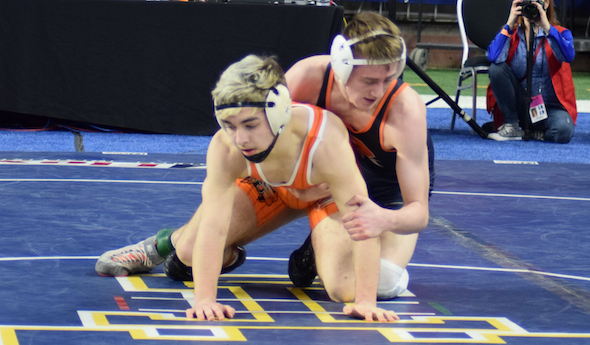
PHOTO: Flint Powers Catholic’s Sean Spidle works to gain control during his Division 2 championship match at 112 pounds. (Click for more from HighSchoolSportsScene.com.)