

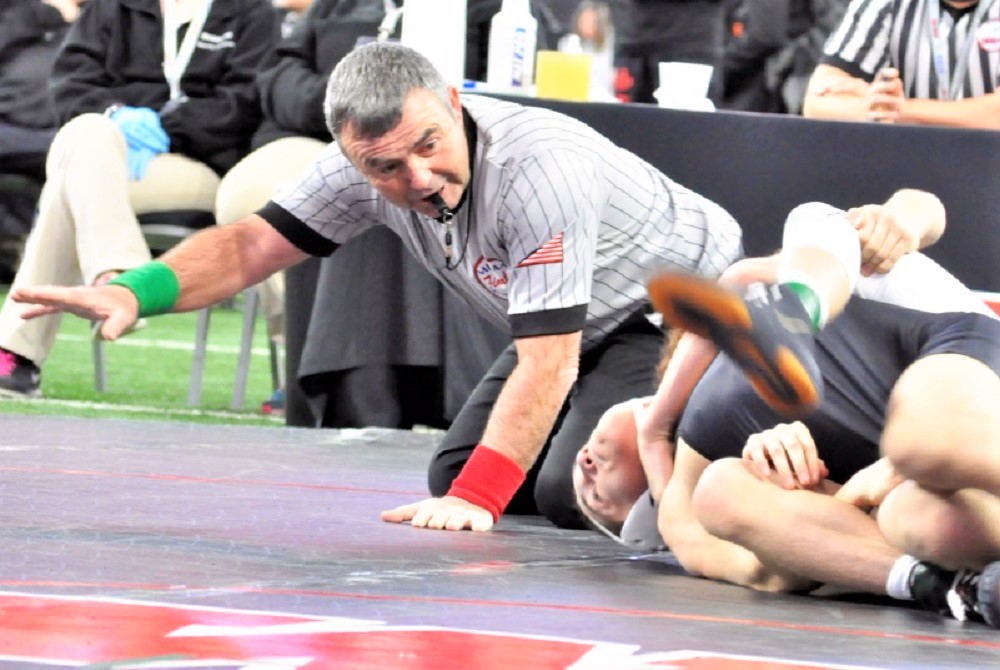
Be the Referee: Wrestling Inspections
By
Sam Davis
MHSAA Director of Officials
January 27, 2022
Be The Referee is a series of short messages designed to help educate people on the rules of different sports, to help them better understand the art of officiating, and to recruit officials.
Below is this week's segment – Wrestling Inspections - Listen
Before every individual or team wrestling event, each participant must be inspected by the referee or other authorized personnel. They are looking for any skin infections or evidence of a communicable disease.
A typical inspection will check a wrestler’s mouth for braces, fingernails, hairlines, underarms, back/shoulder area, behind the knee and more.
All inspections are done in the same manner for all wrestlers at a tournament site, both male and female wrestlers. Inspections generally should take place in an area not readily visible by the public because of modesty concerns for the wrestlers.
No wrestler is allowed to compete until they have gone through and passed the inspection.
Skin inspections are done with the goal of keeping all participants as safe as possible and preventing the spread of contagious skin conditions.
Previous editions
Dec. 16: Ball Over Backboard - Listen
Dec. 9: Winter Officials Mechanics - Listen
Nov. 26: Instant Replay - Listen
Nov. 11: Tourney Selection - Listen
Nov. 4: Receiver Carried Out of End Zone – Listen
Oct. 28: Volleyball Back-Row Block – Listen
Oct. 21: Soccer Disallowed Goal – Listen
Sept 30: Field Goal Falls Short – Listen
Sept. 23: Volleyball Obstruction – Listen
Sept. 16: Catch or No Catch – Listen
Sept. 9: Intentional Grounding – Listen
Sept. 2: Pass Interference – Listen
Aug. 26: Protocols and Mechanics – Listen
Be the Referee: Registration - Part 2
December 18, 2014
This week, MHSAA assistant director Mark Uyl continues last week's explanation of the steps to becoming an MHSAA registered official.
"Be the Referee" is designed to help educate people on the rules of different sports, to help them better understand the art of officiating and to recruit officials. The segment can be heard on Mondays, Wednesdays and Fridays during the school year on The Drive With Jack Ebling on WVFN-AM, East Lansing.
Below is this week's segment - Registration Part 2 - Listen
Today we are going to build on last week’s segment which dealt with how a person becomes an MHSAA Registered Official.
Once a person completes the first step in the process – passing the basic Officiating Exam through the MHSAA Office, the next step is to get that person connected with a local officials association that specializes in that sport across our state.
These local associations are the ones that do the training – whether it’s on the court, on the field or video training – to get, for example, that person interested in basketball completely immersed in the rules, mechanics and coverages of what it takes to become a good basketball official.
Past editions
Dec. 10 - Registration Part 1 - Listen
Dec. 3 - Legacy Program - Listen
Nov. 26 - Sideline Management - Listen
Nov. 19 - 7-Person Mechanics - Listen
Nov. 12 - Blocking Below the Waist - Listen
Nov. 5 - Tournament Selection - Listen
Oct. 29 - Uncatchable Pass - Listen
Oct. 22 - Preparation for Officials - Listen
Oct. 15 - Automatic First Downs - Listen
Oct. 8 - Officials & Injuries - Listen
Oct. 1 - Overtime - Listen
Sept. 25 - Field Goals - Listen
Sept. 18 - Tackle Box - Listen
Sept. 11 - Pass Interference - Listen
Aug. 25 - Targeting - Listen