

Division 4: Chasing Hudson
February 21, 2013
By Geoff Kimmerly
Second Half editor
With a fifth-straight MHSAA Division 4 championship Saturday, Hudson would join Davison as the only two schools to accomplish that feat since the Team Finals began in 1988.
But seven other teams at Battle Creek's Kellogg Arena will do their best to make their own history instead this weekend.
Below is a look at all eight teams competing in Division 4, listed by seed. Their Quarterfinal matches begin at 5:30 p.m. Friday, with Semifinals at 11:45 Saturday morning and the championship match at 4 p.m. All matches this weekend will be streamed live on MHSAA.tv. For results throughout, check the MHSAA Wrestling page. Rankings below are from MichiganGrappler.com.
#1 HUDSON
Record/rank: 27-6, No. 1
League finish: Second in Lenawee County Athletic Association
Coach: Scott Marry, 25th season (654-141)
Championship history: Four MHSAA championships (most recently 2012).
Individual Finals qualifiers: 285 Zach Rieger (48-1) sr., 103 Roddy Hamdan (42-5) soph., 112 Tyler Roberts (36-16) soph., Isaac Dusseau (44-6) jr., 125 Mason Lopinski (33-19) fr., 130 Cole Weaver (46-0) jr., 130 Carlos Randall (26-4) jr., 135 JD Waters (35-5) jr., 135 Wyatt Spangler (27-22) sr., 152 Kyle Johnson (41-15) fr., 215 Jake Morgan (37-12) jr.
Outlook: Only Hudson, Davison and Dundee have won at least four straight Team Finals championships. Last year’s run was led by a pair of seniors who went on to individual championships, but Hudson merely has reloaded led in part by Weaver, who claimed last season’s Division 4 title at 119. And only three of this weekend’s expected starters are seniors.
#2 HESPERIA
Record/rank: 33-2, No. 2
League finish: Tied for first in Central State Activities Association
Coach: Doug Baird, 12th season (399-41)
Championship history: MHSAA champion 2008, four runner-up finishes.
Individual Finals qualifiers: 285 Wyatt Conkle (39-13) soph., 103 Corey Agens (38-15) jr., 103 Davian Gowens (36-11) fr., 119 Zack Yates (46-1) jr., 130 David Jacobs (49-7) jr., 135 Chase Siersema (52-3) jr., 140 Mark Workman (37-13) fr., 145 Cash Bolles (37-7) sr., 160 Lee Siersema (49-7) sr., 189 Eldon Graham (42-8) jr., 215 Scott Rosencrans (25-13) fr.
Outlook: Last season was the only one over the last nine in which in the Panthers didn't make it to Battle Creek, and they've made the Semifinals six times during that span. Two of Hesperia’s runner-up finishes came against Hudson in 2011 and 2009 by a combined 14 points. Yates was an individual runner-up last season, to Hudson’s Weaver at 119, and Chase Siersema was an individual runner-up in 2011. Like Hudson again, only two of Hesperia’s expected starters this weekend are seniors.
#3 NEW LOTHROP
Record/rank: 31-4, No. 3
League finish: First in Genesee Area Conference
Coach: Jeff Campbell, 12th season (307-62)
Championship history: 12 MHSAA championships (most recently 2004), four runner-up finishes.
Individual Finals qualifiers: 112 Cole Hersch (43-11) fr., 119 Johnny Robinson (33-14) fr., 125 Gabe Bennett (40-11) soph., 130 Dalton Birchmeier (28-22) soph., 140 Jacob Perrin (55-2) sr., 145 Josh Wendling (41-5) jr., 152 Aaron Bauman (45-6) jr., 160 Taylor Krupp (46-3) jr., 171 Dakota Clark (26-23) jr., 189 Cody Symons (53-2) jr., 215 Owen Wilson (35-10) jr.
Outlook: New Lothrop has reached the Quarterfinals all 12 seasons under Campbell and eclipsed 30 wins two of the last three. His line-up has only one senior, but that senior – Jacob Perrin – is coming off an MHSAA individual championship at 130. Four others are ranked among the top four in their individual weight classes this winter.
#4 BRONSON
Record/rank: 21-0, No. 7
League finish: First in St. Joseph Valley Conference
Coach: Al Sosinski, 30th season (474-234)
Championship history: MHSAA runners-up in 2002 and 2003.
Individual Finals qualifiers: 119 Jake Littlefield (36-10) sr., 125 Hunter Machus (42-5) sr., 130 Kahle Scheenks (33-15) soph., 145 Brandon Losinski (42-9) sr., 160 Dan Erwin (25-7) sr., 171 Leo Mora (33-6) sr., 189 Brett Burtrum (25-7) soph.
Outlook: Bronson has won its District the last 12 seasons and is making its first trip to the Quarterfinals since 2009. The line-up features eight seniors including five who will also compete at the Individual Finals. Machus and Mora are ranked among the top four in their respective weight classes. Sosinski’s record qualifies for listing among the top 20 winningest wrestling coaches in MHSAA history.
#5 SAND CREEK
Record/rank: 25-9, unranked
League finish: First in Tri-County Conference
Coach: Marc Spicer, fifth season (106-64)
Championship history: Has never finished among the top two teams in Finals competition.
Individual Finals qualifiers: 285 Gabe Beaubien (40-17) sr., 103 Terry Burns (31-12) fr., 112 Michael Petee (37-19) soph., 145 Roger Fox (35-8) jr., 160 Nick Garza (45-7) sr., 189 Charlie Robertson (38-11) soph., 215 Garrett Miller (51-5) sr.
Outlook: Sand Creek has continued to build under Spicer with three straight District Titles and its first Regional championship under him this season. Garza finished individual Finals runner-up last season at 152 and leads a line-up with eight 30-match winners. All seven wrestlers between 145-285 have won at least 31 matches this season.
#6 CARSON CITY-CRYSTAL
Record/rank: 26-6, No. 9
League finish: First in Central Michigan Athletic Conference
Coach: Kacy Datema, third season (57-28)
Championship history: MHSAA runners-up in 2000 and 2001.
Individual Finals qualifiers: 103 Taylor Barkley (29-15) fr., 112 Kenneth Dittenber (49-4) sr., 119 Dallas O’Green (46-6) fr., 140 Garner Cusack (46-7) jr., 145 Dillan Decker (47-5) soph., 152 Darren Decker (50-2) soph., 160 Lincoln Burnham (14-9) soph.
Outlook: Datema, a former Carson City-Crystal wrestler himself, has guided the Eagles back to Battle Creek after steady improvement during his first two seasons as coach. They could be back for a few more with nine underclassmen expected to start this weekend. Dittenber is a two-time Individual Finals champion, and Dillan Decker also is considered a top contender next weekend.
#7 KENT CITY
Record/rank: 25-4, unranked
League finish: First in O-K Silver
Coach: Chad Kik, 13th season (255-138)
Championship history: Has never finished among the top two teams in Finals competition.
Individual Finals qualifiers: 285 Tom Devos (35-12) jr., 135 Brendon Rodenburg (44-9) fr., 140 Jayson Ellicott (44-12) jr., 152 KJ Herremans (39-12) jr., 171 Shane Rodenburg (52-2) soph., 215 Konner Wolter (53-1) sr.
Outlook: Kent City has increased its win total four straight seasons, won its District the last three years and will make its first Quarterfinal appearance under Kik – who won an individual championship for Sparta in 1992. Wolter is one of only two seniors, but with Rodenburg is expected to contend for an individual championship next weekend. Kent City beat No. 10 Bangor in a tie-breaker at the Regional.
#8 NORWAY
Record/rank: 21-2, unranked
League finish: First in Mid-Peninsula Athletic Conference
Coach: Nick Burklund, fourth season (43-26)
Championship history: Has never finished among the top two teams in Finals competition.
Individual Finals qualifiers: 125 Cayleb Winkler (29-13) sr., 152 Taylor Bonetti (37-16) soph., 171 Jacob Rehn (30-13) soph.
Outlook: Norway too has increased its win total each of the last four seasons and despite posting sub-.500 marks in Burklund’s first two. The Knights could continue to surge with only two seniors on the roster this winter. Norway won its District matches by a combined score of 129-15, and then got past tough competitors Rogers City and St. Ignace at the Regional.
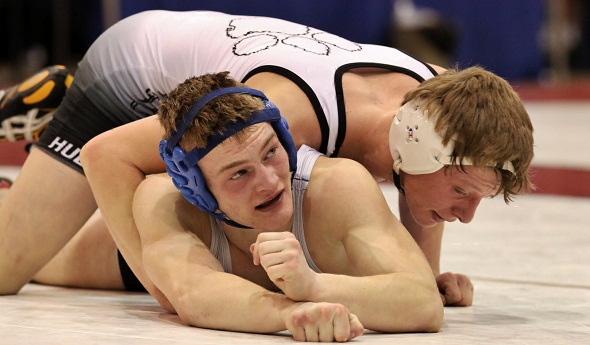
PHOTO: Hudson's Cole Weaver (top) battles to an 18-6 major decision in his match at 125 pounds during last seaon's Division 4 Final at Battle Creek's Kellogg Arena. Click to see more at HighSchoolSportsScene.com.)
Rep Council Wrap-Up: Spring 2021
By
Geoff Kimmerly
MHSAA.com senior editor
May 6, 2021
The addition of a girls division to the Individual Wrestling Tournament series and approval of a common start date for all Fall sports highlighted actions taken by the Representative Council of the Michigan High School Athletic Association during its annual Spring Meeting on May 3.
The Spring Meeting of the 19-member legislative body of the Association’s more than 1,500 member schools is generally the busiest of its sessions each year. The Council considered 19 committee proposals and dealt with a variety of eligibility rule, postseason tournament and operational issues.
Beginning with the 2021-22 school year, a championship division for female competitors who participate on MHSAA member school teams will be added to the Individual Wrestling Tournament series. There will be 14 champions awarded, based on weight classes established by the National Federation of State High School Associations. Qualifiers will be determined via a sectional format, and girls will continue to compete on boys teams during regular-season and team tournament competition; girls also may choose to compete in the boys individual tournament instead of the girls bracket. A total of 401 girls competed in wrestling for MHSAA member schools during the 2019-20 school year, up from 250 in 2017-18 and then 327 in 2018-19. The girls division proposal had been put forth by the MHSAA Wrestling Committee.
The Council also voted to move the start of all Fall sports practices to the same day. Those sports now may begin on the 16th Monday before Thanksgiving. Previously, football started on a Monday and all other sports began Wednesday. For the upcoming school year, the Fall sports start date is Aug. 9, 2021.
As it has during most meetings over the 2020-21 school year, the Council continued to discuss possible adjustments because of the COVID-19 pandemic and disruption it has caused to Michigan high school athletics. Notably, the Council approved an extension of the waiver of the previous academic record regulation for sports played in Fall 2021. This is the third extension of the waiver. The previous academic record regulation requires participants to have received credit for at least 66 percent of a full credit load during the previous semester. As COVID-19 has resulted in various academic scheduling adjustments, schools will continue to determine if athletes have met the credit level necessary to be eligible for athletics this fall.
The Council also made permanent the allowance for cooperative programs in nine sports among schools of the same public school district regardless of the 3,500-student enrollment maximum. Those co-op programs were first allowed as part of a two-year experiment beginning with the 2016-17 school year to increase possibilities for participation in those sports – baseball, bowling, girls competitive cheer, cross country, golf, soccer, softball, tennis and wrestling. Schools taking part in these co-op programs must continue to show a demonstrated history of inadequate numbers of participants and apply for renewal every two years.
Here is a summary of other notable actions taken by the Representative Council at the Spring Meeting, which will take effect during the 2021-22 school year:
Athletic Equity
• The Council approved an Athletic Equity Committee recommendation to publish the following statement to suggest to local schools that they review nicknames and school logos that are considered offensive or hurtful to minority groups or demonstrate an insensitive bias:
“The MHSAA recognizes the importance of equity in high school sports. Schools and mascots are rich in tradition and unique to each community. Although we understand the tradition of those individual communities, we also wish to support and foster an environment of inclusion. It is in this spirit that the MHSAA encourages member schools and communities to evaluate and reconsider names and mascots that may be offensive to groups of individuals.”
Officials
• The Council approved an Officials Review Committee recommendation to adjust the officials rating system with the hope of encouraging more ratings and providing a more specific understanding of an official’s overall body of work. Instead of the current overall 1-5 rating system, officials will receive specific feedback in four categories: judgment, presence and demeanor, attitude and effort, and administration and communication.
Sport Matters
• In bowling, the Council approved a Bowling Committee recommendation to adopt the Phantom oil pattern for the 2021-22 season.
• In competitive cheer, the Council approved a Girls Competitive Cheer Committee recommendation to study a new choreography chart that will award points based on a variety of skills while also awarding a range of points to benefit both small and large teams which have various skill levels.
• Also in cheer, the Council approved a pair of Committee technical recommendations; the first allows for a connected tumbling skill to be considered a new variety point for Round 3, and the second allows four difficulty points for a one-leg flair at the elevator level for middle school competition.
• In golf, the Council approved the Golf Committee recommendation to require the use of the iWanamaker scoring program and app during the regular season, beginning in Fall 2021. The program and app became required during Regional and Finals play during the Fall 2020 season.
• In softball, the Council approved a Girls Softball Committee recommendation to add a suspended game policy to MHSAA playing rule adoptions in the MHSAA Handbook. This policy – which mirrors that approved for baseball in 2020 – provides a game will be suspended any time it is called before it reaches regulation, or if called any time when the score is tied.
• In tennis, the Council approved a Tennis Committee recommendation regarding instances when a seeded player withdraws from Regional or Finals competition before the first match is played. In those instances, the players seeded lower in that flight than the player who withdrew will move up one seed and be placed on the previously-determined lines for those seeds within the flight bracket. However, non-seeded players already drawn into the bracket will not be moved.
• Also in wrestling, the Council approved a late-arrival skin check on days – especially during weekends – when teams may be competing in multiple regular-season duals. An athlete who misses the scheduled morning skin check may, with coach’s notification to the official beforehand, receive a skin check upon later arrival to the event but prior to the start of the dual in which the wrestler may compete. This will allow an individual the opportunity to participate if that wrestler missed the scheduled morning inspection due to educational reasons or unforeseen circumstances.
The Council also discussed possible topics for presentation during this fall’s Update Meeting statewide tour, and took action to clarify Handbook language regarding a variety of topics. The Association’s $11.5 million budget for the 2021-22 school year also was approved.
The Representative Council is the 19-member legislative body of the MHSAA. All but five are elected by member schools. Four members are appointed by the Council to facilitate representation of females and minorities, and the 19th position is occupied by the Superintendent of Public Instruction or designee.
The MHSAA is a private, not-for-profit corporation of voluntary membership by more than 1,500 public and private senior high schools and junior high/middle schools which exists to develop common rules for athletic eligibility and competition. No government funds or tax dollars support the MHSAA, which was the first such association nationally to not accept membership dues or tournament entry fees from schools. Member schools which enforce these rules are permitted to participate in MHSAA tournaments, which attract more than 1.4 million spectators each year.