


MHSA(Q&)A: Hudson wrestling coach Scott Marry
February 26, 2012
Although updating the records remains a work in progress, it’s fair to say few have accomplished in Michigan high school wrestling what Hudson coach Scott Marry has over the last 24 seasons.
He’s one of just a handful of coaches who have won more than 600 matches – he’s 630-135 after this Finals weekend – and Hudson is one of only three programs to win four or more consecutive team championships since 1988, the first season MHSAA team titles were decided by dual matches instead of the Individual Finals results. The Tigers beat Shelby 33-22 in Saturday’s Division 4 Final at Battle Creek’s Kellogg Arena.
Marry is a Hudson alum, having graduated in 1983 before attending Adrian College. He also coached the junior varsity football team for 11 seasons.
Of roughly 270 students at Hudson High, 27 were on the wrestling team this season, including Marry’s son Devan – who has signed with Eastern Michigan for next season. We caught up with Scott Marry after Saturday’s championship match.
It’s four titles in a row.
I’m numb right now. I’m lost for words. I’m happy for these seniors. Most of these seniors were on that football team (in 2010) that was a state title also, so they’ve won five state titles. They have five championship rings. They were in another (football) Finals against Traverse City (St. Francis, in 2009). So they’ve been in seven Finals contests.
About 10 percent of your school’s enrollment is on the wrestling team. How were you able to create so much interest in the program?
They want to be part of something successful. The kids know that hard work pays off. They really do. This didn’t start this year. I’ve had these kids in the program for years. Every one of these seniors, I’ve known them seven or eight years. They’re my boy’s best friends. That’s a huge advantage.
And I don’t think that just because the senior class was so good that this is going to be the end of Hudson wrestling, by any means. But those seniors had a big part to do with what happened today.
Although you’ve won four straight titles, is this one more special because you know these seniors so well?
Definitely. We’ve been bawling all day. We’ve been hugging and crying and saying good-bye, and promising each other that no matter what – win, lose or draw – we were going to have these same feelings for each other when we were done. But this is a little bit sweeter. I get to say good-bye to six guys that I’ve shared a lot of time with. And in a good way – it’s a positive saying good-bye, not a negative one. I’m going to miss them all.
What keeps you coming back every year?
The student athletes. The community. … I think, to give these kids something to look forward to, something to work for, that’s the least I can do.
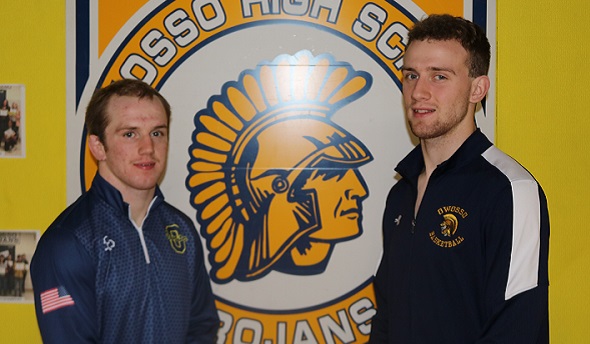
Blahas Building Lasting Owosso Legacy
February 5, 2020
By Tim Robinson
Special for Second Half
Owosso seniors Hunter and Colton Blaha, born 11 months apart, have been competing with each other nearly every day of their lives.
 “We’ve been competing forever,” said Colton, the younger of the brothers, with a laugh. “Sprinting down the road so you can get to the house first.”
Hunter agreed.
“We’re always competing, no matter what it is,” he said. “Board games, chores. It doesn’t matter.”
The Blaha brothers have channeled that competitiveness into a work ethic and sense of community that has helped lift the Owosso High School sports programs in which they’ve competed.
Both played football (Hunter at quarterback, Colton at running back), while Hunter plays basketball and runs track and Colton is an all-state wrestler who plays baseball in the spring.
Most of the programs they have played for have not had recent success. The brothers endured part of a 43-game losing streak in football, Hunter’s basketball team recently snapped a 30-game losing streak, and the Owosso baseball team has struggled in recent years.
And, to the Blahas, that doesn’t matter.
Competing does.
“I honestly don’t care what our record is,” Colton Blaha said. “We always had a close bond with the kids in our grade, and that means more than anything. It means more than any record we could have had in wins or losses.”
Trojans athletic director Dallas Lintner, who also is an assistant football coach, said what sets the Blahas apart is that selflessness – a willingness to help build a program despite an outward lack of success.
“What’s refreshing to see at the high school level is that they’re competitive, but they’re classy,” Lintner said. “They mean a lot to us at Owosso High School. They mean a lot to our community particularly with the relationships they’ve built with middle-school kids, with elementary school kids. They really do it all for us.”
Both Blahas have worked, assisting the coaches in their sports, with younger athletes at all levels to help them feel a part of the program.
“When we got here, the senior leadership was horrible,” Hunter Blaha said. “We got treated horribly by the upperclassmen, and that plays a big part in a program, having a bond and a relationship with the younger kids. We set that as a goal in the eighth grade, because we knew how important it was to our program if we got the youth program going at a young level and got them going at the same pace.”
And so Owosso football players at lower levels have seen the Blahas at their games or matches the last four years. Both attend youth level games and interact with future Owosso athletes as much as their schedules allow.
“They’re like rock stars to those kids,” football coach Devin Pringle said. “We do things at elementary schools like reading to kids, and we take the Blahas. They’re like NFL stars to those kids. They wrestle with them, give them high-fives, talk about grades.”
At one point during the football season, Hunter became involved with a troubled elementary school student as part of a class in social tolerance.
“I was chosen to help this kid,” he said. “My idea was to bring him to a game, come see a coin toss, maybe get him a signed football.”
Which he did. The youngster got to do all three and went home with a lasting memory.
“It was an awesome experience,” Hunter said. “I could tell he was really happy that he got the chance to do that.”
Another thing that makes the Blahas stand out, their coaches said, is their commitment to their hometown.
“A lot of kids transferred out of here to play on better sports teams,” Colton Blaha said. “My mom has always taught us to make a name for ourselves, and I feel that Hunter and I have both done that here. We’ve done the best we can to try to change the sports programs around, and we hope the kids under us have picked up on that.”
 Naturally, coaching and commitment by those younger players is critical, but there are signs of a turnaround in Owosso football. The Trojans varsity won two games last season and lost three more by a single point. The rest of the teams in the program all had winning records.
“We knew coming in it would take some time to get a new culture established,” Pringle said. “When it happens, it’s because these young men decided to stay.”
After his freshman year of football, Hunter Blaha was promoted to varsity. As a sophomore, he was a unanimous choice as a team captain and started at quarterback.
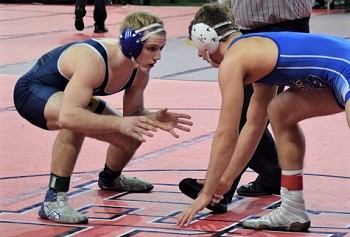
Colton finished third at 160 pounds at last year’s Division 2 Individual Wrestling Finals, a rise fueled by the competitive fires built during his youth.
“We used to have basement wrestling tournaments, and he used to kick my butt,” Colton said of Hunter. “I used to get so mad at him.”
The boys wrestled and sometimes fought at school, too.
“I always beat him,” Hunter said. “I remember one day I stopped and he came up to me and said, ‘I’m not going to let you whip my (butt) any more. It’s just not going to happen. That’s the day he started wrestling, and he’s been working his tail off ever since. It’s pushed me to work harder and get some goals in mind.”
As for the rivalry, “a year later, (Colton) started whipping my butt,” Hunter said, smiling. “It’s escalated from there.”
Both Blahas plan to compete in college, Hunter in football and Colton in wrestling. Both plan to become teachers, and Pringle has a not-so-subtle plan for Hunter.
“Colton is amazing in his own right,” Pringle said. “But Hunter, when he gets that degree, he’ll be head football coach at Owosso someday. We’re getting a new weight room, and I tell him, ‘I’ll have this ready for you when you take over.’ He’ll be a kid who impacts hundreds of kids before he’s done.”
But first, there’s a senior year to complete.
“It feels like it came up way too fast,” Hunter said. “It feels like yesterday I started at quarterback my sophomore year. I kind of get emotional about it. I don’t like talking about it. Most kids are ready to get out of here, to get their lives going. But I’ve been here since I was 6 years old, and it’s all I’ve ever known, playing with these kids.”
Colton Blaha is known as an athlete who’s the first to arrive at practice and the last to leave, almost to a fault.
“I have him in a fourth-hour class, and he always wants to get in a couple of extra sets,” Pringle said, chuckling. “He always leaves the room last, and sometimes I’m late for lunch because of it.”
A few lost minutes of lunch, though, has been a small price to pay.
“I know they’re going to do great things,” Lintner said. “They’re going to be great husbands. They’re going to be great fathers. They’re going to be great college athletes no matter what university they choose. We’re super proud of them, and as an educator, I’ve been fortunate to be with them the last four years of their journey.”
Asked what the most important thing is that they've gained through athletics, both brothers pause for several seconds before answering.
“Hard work can take you anywhere,” Colton said. “Always. Through hard work, you go through a lot of ups and downs, a lot of lefts and rights, but if you keep working hard, keep your head balanced, you can go anywhere.”
“Being a family, definitely,” Hunter said. “That’s what it’s all about. Life’s not always about football and athletics. You want to make your friendships and talk about these memories 20 years down the road.”
But the Blahas have done more than make memories. They’ve made an impact, one that will be felt ‘years down the road.’
PHOTOS: (Top) Colton, left, and brother Hunter Blaha. (Middle) Colton, left, begins his third-place match during last season’s Division 2 Individual Finals at Ford Field. (Middle photo by HighSchoolSportsScene.com.)