

Performance: Tri-County's Dakota Greer
March 9, 2018
 Dakota Greer
Howard City Tri-County wrestling - Senior
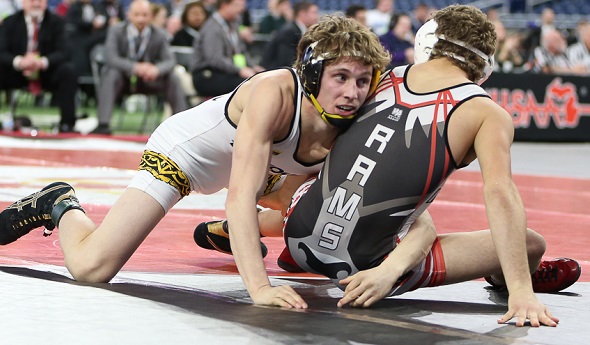
Greer capped his high school wrestling career Saturday at Ford Field with a third Division 3 championship, winning a 9-2 decision over Montrose’s Reese Wallis in the title match to finish this season 43-2 and earn the Michigan Army National Guard “Performance of the Week.”
The champion at 119 as a junior and 103 as a freshman, Greer finished 174-6 for his career with 86 pins, and despite missing the end of his sophomore season. He injured his thumb late that winter, and despite making the attempt at his Individual District tournament, was unable to continue competing. That ended up taking him out of the running for four individual titles, but still left him among the elite who have wrestled in this state.
 Greer followed the influence of cousins Dillen and Darren Decker into the sport – the 2015 Carson City-Crystal graduates both were MHSAA finalists for the Eagles, and Dillen was a champion as a senior before both went on to wrestle at Heidelberg University in Ohio. Greer also plays baseball – pitcher and centerfield – and is considering a variety of college options and opportunities to continue wrestling at that level. If he doesn’t wrestle, he’s leaning toward Ferris State University; regardless of where he’s headed next, Greer would like to study forestry, criminal justice to become a conservation officer, or heating and cooling.
Coach Corey Renner said: “Dakota told me about when he was a youth wrestler, getting beat by the same kids all the time, until one year he ‘decided not to lose anymore.’ So he started working harder, trying to learn more, etc., and his ability took off from there. Dakota has practiced so much that his moves just seem to happen without a lot of conscious thought, more like a reflex. He is also very good at reading his opponent and finding weaknesses in a short amount of time. … Dakota seems to be able to see things from a coach’s point of view, and he is good at helping get other kids to buy into what we are trying to do. Dakota doesn't ever expect anything; he knows that success is earned every day and that past success doesn't guarantee anything or allow you any "slack.” I think that when Dakota had the injury his sophomore year, he approached it with the same attitude as when he was a little kid – just work hard and do all the things that helped lead to success before to try to get back to where he was.”
Performance Point: “It was more of a relief than anything to finally get it done,” Greer said of winning the third title. “All the things leading up to it, all the work. Getting the two before, you’re kinda expected to win it, so it’s nice to get out there and get it done. … Coming into my freshman year, I wasn’t sure how good I would be or what I could become. What I’ve done is what I’ve dreamed of doing, but I didn’t know if I could or not. After I got the first one, I knew I was capable of it. It was just a matter of making it happen.”
On the attack: “I started to see a lot of cases where kids were coming at me with a bunch of weird, different techniques defending my offense. This year I was focusing on how to still attack and find out ways to get around that. If they’re going to block one thing, find another way to attack.”
 No regret: “(Missing the 2016 Finals) doesn’t bother me too much. I can’t worry about things like that. I’m not going to sit here and say I would’ve done something; you never know unless you do it. It was a very tough bracket that year – any of those kids could’ve beaten me. … (But) I think it was a huge part of me coming back as strong as I did. It drove me.”
Cousin connection: “The reason I started wrestling was because of my cousins. I always looked up to them and wanted to wrestle because of them. They used to live here right by us, and they wrestled when they were younger and I always looked up to them and wanted to do what they were doing. I started when I was 3, and from then on is history. They were down (at Ford Field) watching me wrestle; they’ve been huge support.”
Gotta get outside: “I just love everything about it. I love nature, being outside, all the great things and activities. (This fall) I got a couple deer. This whole winter, I run hunting dogs, beagles, so I raise and train them and hunt rabbits with those. I have my own fishing boat, and I do bow fishing and bass fishing and all that stuff during the summer. It’s basically my whole life besides wrestling and school.”
- Geoff Kimmerly, Second Half editor
Every week during the 2017-18 school year, Second Half and the Michigan Army National Guard will recognize a “Performance of the Week" from among the MHSAA's 750 member high schools.
The Michigan Army National Guard provides trained and ready forces in support of the National Military Strategy, and responds as needed to state, local, and regional emergencies to ensure peace, order, and public safety. The Guard adds value to our communities through continuous interaction. National Guard soldiers are part of the local community. Guardsmen typically train one weekend per month and two weeks in the summer. This training maintains readiness when needed, be it either to defend our nation's freedom or protect lives and property of Michigan citizens during a local natural disaster.
Previous 2017-18 honorees:
March 1: Camree' Clegg, Wayne Memorial basketball - Read
February 23: Aliah Robertson, Sault Ste. Marie swimming - Read
February 16: Austin O'Hearon, Eaton Rapids wrestling - Read
February 9: Sophia Wiard, Muskegon Oakridge basketball - Read
February 2: Brenden Tulpa, Hartland hockey - Read
January 25: Brandon Whitman, Dundee wrestling - Read
January 18: Derek Maas, Holland West Ottawa swimming - Read
January 11: Lexi Niepoth, Bellaire basketball - Read
November 30: La'Darius Jefferson, Muskegon football - Read
November 23: Ashley Turak, Farmington Hills Harrison swimming - Read
November 16: Bryce Veasley, West Bloomfield football - Read
November 9: Jose Penaloza, Holland soccer - Read
November 2: Karenna Duffey, Macomb L'Anse Creuse North cross country - Read
October 26: Anika Dy, Traverse City Central golf - Read
October 19: Andrew Zhang, Bloomfield Hills tennis - Read
October 12: Nolan Fugate, Grand Rapids Catholic Central football - Read
October 5: Marissa Ackerman, Munising tennis - Read
September 28: Minh Le, Portage Central soccer - Read
September 21: Olivia Theis, Lansing Catholic cross country - Read
September 14: Maddy Chinn, Pontiac Notre Dame Prep volleyball - Read
PHOTOS: (Top) Howard City Tri-County's Dakota Greer (left) works to gain control during his championship match Saturday. (Middle) Greer celebrates with the Ford Field crowd after clinching his third MHSAA individual wrestling title. (Click for more from HighSchoolSportsScene.com.)
Rematch of Champs Brings Classic Conclusion to D1 Finals
By
Drew Ellis
Special for MHSAA.com
March 5, 2022
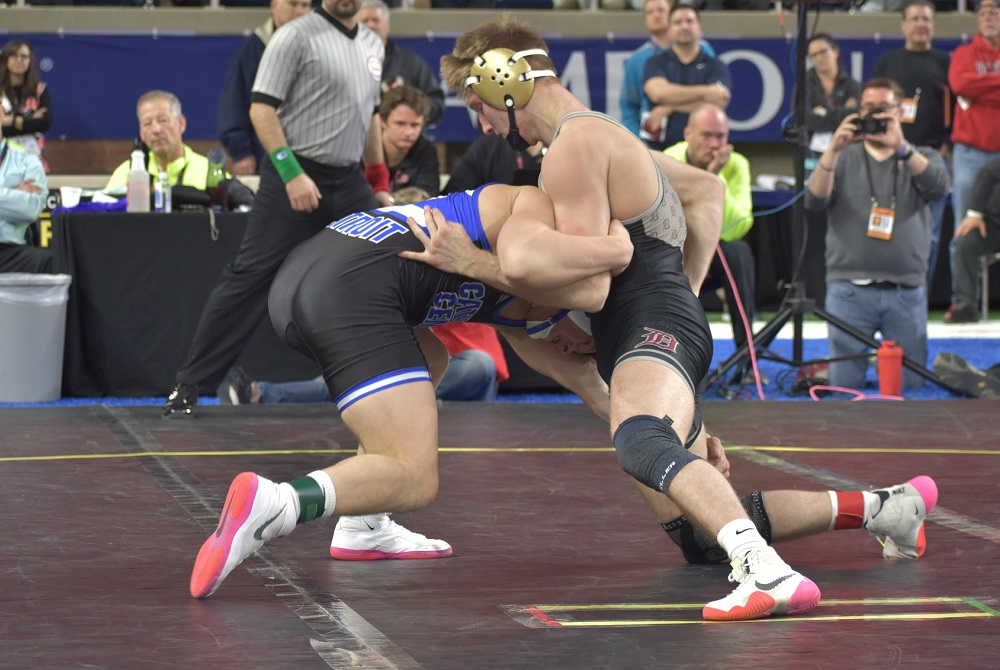
DETROIT – It was fitting that Josh Barr versus Manuel Rojas was the last bout of the night at Saturday’s Division 1 Individual Wrestling Finals, because that’s the match everyone was most excited to see.
Two of the best in the country at 171 pounds, with a combined four state titles between them, Davison’s Barr emerged victorious with a 5-2 win over Detroit Catholic Central’s Rojas, with all eyes on them.
“This is what I’ve been talking about for a long time. I couldn’t wait to be part of something like this. Practically main eventing the state championships against one of the best wrestlers in the state, it’s amazing,” Barr said. “Having all these people around watching, it was awesome.”
Barr (28-1), a junior, set the tone right away with a takedown in the first period to lead 2-0.
Rojas (37-3) managed an escape in the first and another in the second to even the match at 2-2. Barr would answer with an escape to start the third and then drive home the win with a takedown in the final minute to earn his third title.
“It means a lot,” Barr said of his third championship. “It means what we’re doing is right, it’s working. Going to bed early, waking up early, eating clean. It all adds up.”
Rojas had just two losses in-state during his senior season, both coming to Barr over the last eight days. Barr edged Rojas 4-3 in last weekend’s Division 1 Team Final while leading Davison to a 29-21 victory.
“I think it just shows my character. I got right back to it last week. Winning that team state title was cool, but as soon as I got in my car, it was over,” Barr said. “I started training again right away. I knew (Rojas) was going to be sitting here waiting for me, so I got right back to it.”
103
Champion: Conor McAlary, Hudsonville, Fr. (45-1)
Decision, 4-2 (OT), over Ozia Wilson, Macomb Dakota, Fr. (47-1)
In a thrilling finish, McAlary scored a takedown in sudden victory to hand Wilson his only loss of the season.
“I knew going into this match that I had to take (Wilson) into deep waters to win this match,” McAlary said. “Heading into overtime, my coach told me this is right where we wanted to be. I knew I had it.”
The first two periods were scoreless, but McAlary got a takedown in the third to counter a pair of escapes from Wilson. It then came down to a quick takedown from McAlary in OT to earn the state title.
“I still can’t believe it,” he said. “The goal is always to win, but sometimes you can’t really wrap your head around it even after you win. I don’t really know what to feel. It’s wild.”
112
Champion: Caleb Weiand, Macomb Dakota, Jr. (48-0)
Decision, 3-1, over Mariano Lopez, Holt, Jr. (35-5)
After suffering his only loss of the 2021 season in a championship match, Weiand was determined not to suffer the same fate this year.
“Losing in the state finals was the worst feeling I ever had. I didn’t want to experience that again,” Weiand said.
His takedown in the first period proved to be the difference, as he held off a game Lopez over the final minutes.
“I just had to stay tough,” Weiand said. “I knew I could ride him out for most of the period. I feel very confident on top.”
119
Champion: Drew Heethuis, Detroit Catholic Central, Jr. (32-3)
Decision, 4-1, over Justin Gates, Davison, Soph. (30-4)
In a match that featured a pair of 2021 champions, Heethuis scored a takedown in the first period and a reversal in the second to secure his second title.
“It’s awesome. I had a couple of bumps in the road earlier in the year, and I wasn’t in the right mindset,” Heethuis said. “Over the past couple of months, because of my coaches, I was able to dial it in for the last half of the year. It feels great.”
The two met in last week’s Division 1 Team Final, with Heethuis grinding out a 2-1 victory over Gates.
“We wrestled last weekend and I knew it would be a tough match this time, too,” Heethuis said. “I knew that if I was able to get into a good attack in the first, it would be key.”
125
Champion: Cade Horwath, Davison, Jr. (30-0)
Decision, 10-5, over Fritz Mueller, Macomb Dakota, Sr. (40-7)
Horvath earned his 100th career win and locked up his third championship while also capping his second-consecutive undefeated season.
“This one means a little more,” Horwath said of his third title. “We had some team adversity this year, so it took a lot of hard work by the team to get everyone at their best.”
Horwath scored two takedowns early in the first period to set the tone and never trailed in the match.
“Honestly, I just wanted to have fun and score some points,” Horwath said. “It was a nice environment, being able to wrestle in front of my family and fans.”
130
Champion: Clayton Jones, Detroit Catholic Central, Jr. (36-3)
Decision, 9-2, over Elijah Bunn, Rockford, Jr. (42-2)
Jones secured his first championship with a dominant effort at 130 pounds, earning a 9-2 win over the top-seeded Bunn.
“I’m just thinking that all the hard work that we’ve been putting in got (me) the state championship,” Jones said.
Jones came out aggressive with an early takedown in the first and added two more in the second to keep in control.
“I made sure to get the first takedown,” Jones said. “I came out the gates and just kept going at him, going at him.”
135
Champion: Aidan Smith, Brighton, Sr. (44-1)
Decision, 8-4, over Caleb Youngblood, Romeo, Sr. (26-4)
Smith added his name to Brighton’s championship history with a hard-fought win.
“I have waited for this for a very long time,” Smith said. “I had previous teammates ahead of me that won state titles, and that was a lot of pressure on me. I just feel like all of that pressure has been lifted.”
Smith never trailed, as he scored the opening takedown and sprinkled in a few more throughout the bout.
“I knew the match was going to be tough. I just had to wrestle all six minutes hard,” he said. “I felt like I was getting into my attacks really well, and I just kept chain wrestling. I was really happy with my performance.”
140
Champion: Dylan Gilcher, Detroit Catholic Central, Jr. (39-0)
Decision, 7-1, over Evan Herriman, Davison, Jr. (20-4)
A quiet and composed Gilcher won his third championship at a third different weight class Saturday.
After winning at 112 pounds in 2020 and 135 pounds in 2021, Gilcher controlled his match from start-to-finish to earn the 140-pound crown.
This Finals matchup was a rematch from the 135-pound final in 2021. Gilcher won that 3-0. These two also met in last weekend’s D1 Team Final, a 7-5 victory for Gilcher.
“I had him last week and last year. I’ve been wrestling him since we were little, growing up. He was always kind of bigger than me, so he could beat me up a little bit,” Gilcher said. “It feels good.”
145
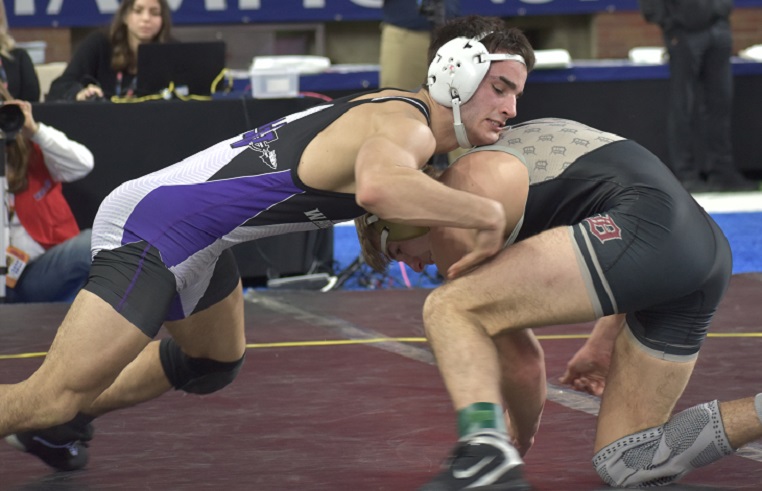
Champion: Nathan Jerore, Brownstown Woodhaven, Sr. (38-1)
Decision, 8-4, over Owen Payne, Davison, Sr. (15-2)
After seeing previous title bids ended prematurely by injuries and the pandemic, Jerore now can call himself a Finals champion.
“I literally can’t believe it. I wanted it so bad. It’s been taken from me for so long,” Jerore said. “Injuries and COVID, it’s been crazy, but I just kept working toward this goal.”
Jerore scored four takedowns in the match and was relentless on his feet against Payne.
“I knew he was going to be tough, but I knew that if I was as tough as I can be, anyone that I wrestled I could break,” Jerore said. “That’s what happened.”
152
Champion: Darius Marines, Detroit Catholic Central, Soph. (35-4)
Decision, 1-0, over Tatum Bunn, Detroit Catholic Central, Jr. (25-12)
For the second consecutive season, Marines had to face a teammate in a championship match.
For the second consecutive season, Marines came out victorious.
“It’s unfortunate, but it had to happen,” Marines said of facing a teammate in the final again. “(Bunn) was one of my best friends on the team. It kind of hurt. But, I had to set all that stuff aside.”
The match didn’t have much action. Marines rode out Bunn in the second period and then earned an escape in the third for the lone point.
“I felt pretty good (after the second period),” Marines said. “I’ve worked my whole life for this, so it feels pretty good (to win).”
160
Champion: Rollie Denker, Temperance Bedford, Sr. (55-2)
Decision, 3-1, over Brayden Mirjavadi, Romeo, Jr. (41-4)
A takedown in the closing second of the third period broke a 1-1 tie and gave Denker his first championship.
Mirjavadi got an escape in the second to take a 1-0 lead, and Denker answered with an escape of his own to start the third. He then turned up the heat late in the match to earn his title.
“I knew late in matches, we all get tired, but I knew (Mirjavadi) would be the exception, so I had to keep going and eventually I just got him,” Denker said.
189
Champion: Remey Cotton, Davison, Jr. (27-3)
Decision, 7-4, over Aidan Wardell, Midland Dow, Sr. (44-4)
Cotton got a takedown early in the bout and built a 5-1 lead in the second period before hanging on for the victory.
“I’ve trained for this my whole life,” Cotton said of the win. “Being able to come out here and get it done just feels amazing.”
Along with his first championship, Cotton also avenged a prior loss to Wardell to cap off his season.
“I practice every day to win every match,” Cotton said. “If I lose one match, I just look forward to the next one to be able to move that to the past.”
215
Champion: Jimmy Colley, Davison, Sr. (32-2)
Decision, 14-7, over Avery Dickerson, Hartland, Sr. (45-2)
Colley collected his second consecutive championship at 215 pounds in a wild scramble of a match.
“It feels great to come back here and end your career as a state champ two times in a row, as well as a team champ two times in a row,” Colley said. “It shows you are one of the best.”
The two contenders traded position often, but it was Colley who found himself with the advantage more consistently. He led 8-5 after two periods and then handled his business in the third.
“We both had that same funky style, and we always put on an exciting match,” Colley said. “You never know what (Dickerson) is going to do. It looks like we are just rolling around sometimes.”
285
Champion: Joshua Terrill, Holt, Sr. (43-2)
Decision, 6-2, over Giulian Bodiu, Canton, Sr. (28-1)
After finishing runner-up in 2021, Terrill grinded his way to a championship.
“I just kept telling myself to not be content. I wasn’t content, and I just won a state title,” Terrill said.
After a scoreless opening period, Terrill turned up the aggression and scored a pair of takedowns in the second period to take control. He credited his coaches for his strong finish.
“This means a whole lot to me, but this really goes to my coaches,” Terrill said. “None of this is about me, it’s about the coaches that got me here.”
PHOTOS (Top) Davison’s Josh Barr (right) and Detroit Catholic Central’s Manuel Rojas contend for the 171-pound title Saturday at Ford Field. (Middle) Woodhaven’s Nathan Jerore, left, works toward a win at 145 pounds. (Click for more from HighSchoolSportsScene.com.)