


Wrestling’s Next Big Thing
August 13, 2013
“The next big thing” is what marketers often seek. But it’s what school sports administrators usually dread because the “next big thing” is routinely a problem.
And so it is with the sport of wrestling which, at the high school level, has had an admirable record of solving the big issues that have threatened the sport’s existence.
School-based wrestling addressed unhealthy practices for weight loss, first with rules about what could not be done – e.g., rubber suits were banned from practices – and then with rules about what must be done, including a weight management program.
Twenty years ago, MHSAA member schools became one of the early adopters of policies and procedures that include the training of skinfold assessors who are employed to do measurements of all wrestlers, from which each wrestler learns his/her lowest allowed weight and the rate at which he/she may descend to that weight and still remain eligible to compete. These rules, and a nutrition education program, saved interscholastic wrestling from much public criticism and, possibly, from continuing drops in participation.
In addition, the Wrestling Committee has been unique among MHSAA sport committees in recognizing that a season that is too long is neither healthy for nor desired by student-athletes; and the committee has reduced the length of season and number of matches. All of this, combined with the MHSAA team tournament, have greatly increased the sport’s popularity among both participants and spectators.
But in spite of all this, the sport of wrestling is “one communicable skin disease outbreak from extinction,” according to those discussing the state of high school wrestling at a national meeting in June. We’ve already seen an outbreak lead to the suspension of all interscholastic wrestling for two weeks in Minnesota during the 2006-07 school year.
To avoid this next big thing, the rule makers have banned taped headgear, because tape can’t be properly cleaned. The NFHS Sports Medicine Advisory Committee, which is the MHSAA’s advisory body as well, is urging schools to mandate that all participants shower or perform an antiseptic wipe-down after every match.
The MHSAA will make this issue a point of special emphasis in its online, print and face-to-face communications this fall. In addition, an excellent free webinar is provided by the National Wrestling Coaches Association. Click here for the webinar.
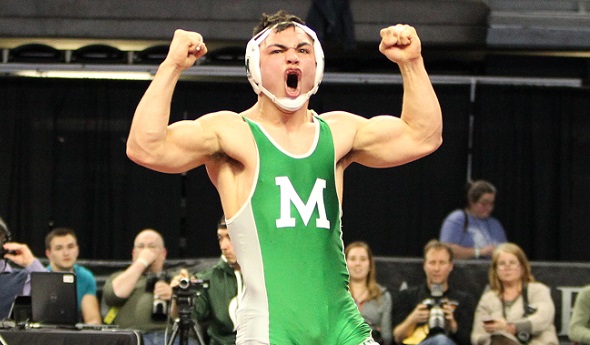
Gonzalez Locks Down Emeralds' 1st Title
By
John Vrancic
Special for MHSAA.com
March 10, 2017
MANISTIQUE — It was a celebration nearly fit for a king Sunday as the city of Manistique welcomed home its first MHSAA Finals champion.
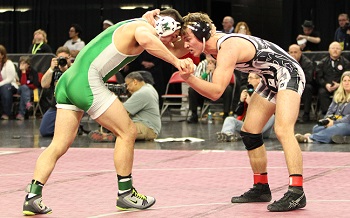
 Senior Tanner Gonzalez became the first Manistique wrestler to capture an individual title by taking a 5-4 double-overtime decision from Dansville’s Johnathon Stid last Saturday night in a Division 4 160-pound Final at The Palace of Auburn Hills.
“It was awesome,” he said. “When I came out (at the high school), the whole community and people from all over the U.P. were there. We also had the cop cars, fire trucks, ambulance and the chief of police were there.”
Gonzalez secured the title on a reversal shortly after Stid took a 4-3 lead with an escape.
He became only the third Upper Peninsula grappler to take an MHSAA wrestling title, four years after Joe Ostman and Galloway Thurston of St. Ignace were crowned champions. Ostman also captured Division 4 titles in 2012 and 2011, and Thurston additonally was a champion in 2012 and runner-up in 2011.
Gonzalez began wrestling when he was in kindergarten, but said it took him a while to really get into it.
“I always liked football, but didn’t like wrestling when I was a little kid,” he added. “I did it because my brothers were doing it, and it kind of rubbed off on me. Things started coming together during my sophomore year, and I started taking practices more seriously. I started working at it harder.”
Gonzalez came up through the ranks in the Manistique youth wrestling program, but transferred to Norway before his freshman year.
After spending two years in Norway, he returned to Manistique for his junior and senior years.
“My dad had a job in Norway which was the reason for the transfer,” he said. “Then, he got a job in Manistique as a truck driver and now owns his own company. While we were in Norway, it was nice to go to Wisconsin and see different competition. It was different once we came back to Manistique because we didn’t have (brothers) Cole or Zavier on our team. I felt a lot of kids looked up to me.”
Tanner qualified for the Individual Regional as a freshman. As a sophomore, he placed seventh in the MHSAA Finals and moved up to sixth in his junior year.
 “Losing in the state tournament is a bad feeling because it’s so final,” he said. “I wasn’t putting in the extra time. I worked all of last summer and my brother Matt helped me a lot with my strength program. There was more sense of urgency this year.”
His first tournament last summer took place in early June at Disney World in Orlando, Fla.
“The first kid I had to wrestle was ranked 11th in the nation and he pinned me in about 1:30,” said Tanner. “It was kind of an eye-opener because there’s always somebody better out there. I was more calm down there because there was no pressure. I tried moves I normally wouldn’t try in a high school match and got better at finishing my shots and cradling. I finished 4-4, then I got a concussion and was out for about a month. I didn’t wrestle too much the rest of the summer. My wrestling became a little more rusty.”
Gonzalez, who finished 49-0 this season, says he had a close call with Gladstone senior Austin Demeuse at St. Ignace. Demeuse held a five-point lead before Tanner rallied for a 9-5 victory.
“That motivated me to get into better shape,” he added. “I wasn’t moving my feet as well as I did all summer and had to get my weight down. I realized I wasn’t disciplined enough and picked up my intensity level. I raised the bar after losing to him in the U.P. Finals as a junior.”
Tanner says he worked a lot with youth wrestling coach Tim Nixon prior to his transfer to Norway.
“I worked with him a lot when I was in eighth grade and learned the importance of staying disciplined and working hard,” he added.
Tanner is undecided about his college choice, but is looking at Ellsworth Community College, a wrestling power in Iowa Falls, Iowa. He plans to major in criminal justice.
“I visited the college and really liked it,” he said. “It’s a little town and I feel comfortable with the small town setting. Their team took fourth in the (National Junior College Athletic Association) national tournament. They have five All-Americans and one was a national champion.”
PHOTOS: (Top) Manistique's Tanner Gonzalez celebrates his MHSAA Division 4 title Saturday at The Palace of Auburn Hills. (Middle) Gonzalez (left) locks up with championship match opponent Johnathon Stid of Dansville. (Click to see more from HighSchoolSportsScene.com.)