

10 to Remember from 2011-12
By
Geoff Kimmerly
MHSAA.com senior editor
July 11, 2012
Second Half's mission in this, its first school year, was to tell the best stories behind the scores and highlights of MHSAA competition.
Of course, every score and especially every championship has a story behind it. The MHSAA awarded 127 team and many more individual championships in 2011-12. Obviously we can't reflect on them all. But these 10 performances were loaded with prestige, drama and accomplishment that made them incredible stories for high school sports fans regardless of hometown or allegiance.
10. Grand Ledge gymnasts earn No. 5
The Comets had to fend off a charge by Canton, but won their fifth-straight MHSAA team title by 0.825 of a point with a final score of 149.400. The fifth-straight title tied the record set by Ludington from 1975-79 and extended Grand Ledge's first-place streak to 75 consecutive events. The next day, senior Christine Wilson and junior Sara Peltier swept the Division 1 and 2 individual titles, respectively.
9. West Bloomfield's Erin Finn joins elite
The Lakers junior said after her Division 1 cross country win that she'd dreamt of winning that title since she learned how to walk. She finished fourth as a sophomore before winning the championship by a little more than a second. After establishing herself as one of the top distance runners in the country in competitions over the winter, Finn finished the school year by winning the 3,200-meter run at the Division 1 Track and Field Final.
8. More and more Morley Stanwood
The Mohawks girls pulled off a rare feat this school year -- after winning their second MHSAA volleyball title in the fall, they added a first-ever girls basketball championship. Both efforts were keyed by seniors Alexis Huntey and Bailey Cairnduf, who had the most and second-most kills in the Class C Volleyball Final and then combined for 45 points and 25 rebounds in the basketball championship game.
That argument was made after Lansing Sexton claimed its second-straight Class B boys basketball championship in dominant fashion. The Big Reds finished 27-1, their only loss by a point to Detroit Pershing, and have won 74 games over the last three seasons -- tied for sixth-most in MHSAA history for that long of a stretch. Guards Denzel Valentine (Michigan State), Anthony Clemmons (Iowa) and Bryn Forbes (Cleveland State) all signed to play at Division I colleges this fall, with junior Jalen Hayes and freshman Trevor Manuel likely joining them in a few years.
Coyotes junior Sami Michell established herself as one of the top hurdlers in MHSAA history at the Division 3 Final by becoming the first Lower Peninsula girl to win four events at a championship meet since Mason County Eastern’s Maria Shoup in 1979. She set Division 3 records in the 100 hurdles, 300 hurdles and long jump, and her 300 time also was the best in MHSAA Finals history, regardless of division or class. She also won the 200.
Top-ranked Grand Haven's latest run at an MHSAA championship seemed all but over when Grosse Pointe South led the Class A final by 18 points with just under 10 minutes to play. But Shar'Rae Davis' fullcourt sprint and score that began with 12 seconds to play gave the Buccaneers a 54-53 win and their first title. It was the third-longest comeback in MHSAA Girls Basketball Finals history.
Livonia Ladywood had been a favorite to win its first MHSAA title all season -- with four-year pitcher Briana Combs in the circle. But when Combs couldn't finish the Semifinal because of an injury, rarely-thrown sophomore Lauren Hayes stepped in. All she did was finish that game and throw a three-hitter against Saginaw Swan Valley in the Final, while also getting three hits and driving in two of the team's four runs in the championship win.
St. Johns senior Taylor Massa finished off one of the most celebrated careers in MHSAA wrestling history with his fourth championship and not one loss during his high school career. Massa claimed the title at 171 pounds this year to go with others at 145, 152 and 160. He became the 15th in MHSAA history to win four titles, ranks 20th with 221 wins and seventh in the national record book for consecutive victories.
Grosse Pointe South's girls running teams had arguably the most dominant school year in MHSAA history, first winning the Division 1 cross country title before doing the same this spring in track and field. And the Blue Devils did it with mostly the same nucleus contributing to both -- particularly juniors Hannah and Haley Meier, sophomore Kelsie Schwartz and freshman Ersula Farrow. Those four combined to run a national record time of 8:48.29 in the 3,200 relay at the Division 1 Final this spring.
1. Short walk, championship run
Second Half was created as a place to tell great stories, Cass Tech made it easy on the first day of the Football Finals. The Technicians arrived at Ford Field after a short walk from their school. They had never played in a Final before and were unranked entering the postseason. They arrived with a strong group of seniors, but also a freshman quarterback named Jayru Campbell who ended up throwing five touchdown passes in a 49-13 win over No. 2 and perennial powerhouse Detroit Catholic Central.
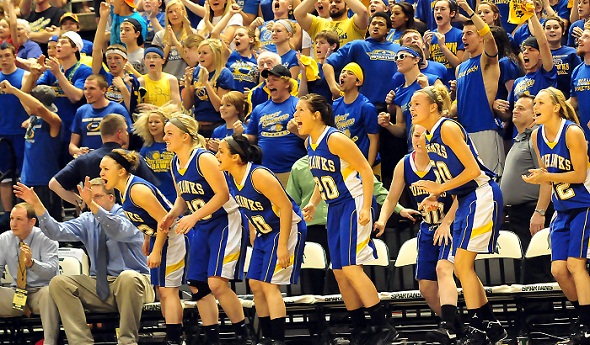
PHOTO: The Morley Stanwood girls basketball team prepares to celebrate as the final seconds tick off in the Mohawks' Class C Final win. (Click to see more photos from High School Sports Scene.)
Expert Teammates Fill Health Roster
January 2, 2020
By Rob Kaminski
MHSAA benchmarks editor
Teamwork is a necessity in athletics. The MHSAA has put together the beginnings of a solid roster to combat mental health ailments throughout schools in the state.
Among the experts listed on the MHSAA Mental Health Speakers Bureau are Christy Buck, executive director, and Cat Lanting, program coordinator at the Mental Health Foundation of West Michigan; and Brooke Buys, mental and behavioral health specialist and founder of BLND Health. They already are serving MHSAA schools in various capacities.
Through personal appearances, promotional videos and staff availability, both organizations emphasize the same strategy when tackling mental health issues: recognition and treatment from within the school buildings and districts.
“We wanted to create self-starting kits that anyone in the district can implement,” said Lanting. “We have in-person trainings and opportunities for students to get together – students talking to students – for high schools and for middle schools.”
Lanting coordinates the be nice.® Action Plan, founded by Buck. The plan calls for people to “notice, invite, challenge and empower” when recognizing changes in those close to them.
“It’s an attractive statement, but the key to the action plan is that it’s transferable. It can work from the pre-K level to senior citizens,” she said. “We want people to notice change, invite people into the conversation, challenge stigmas, and empower themselves with knowledge surrounding mental health.”
Buys, meanwhile, is one of a team of behavioral health specialists delivering messages to student-athletes around the state. Many of her associates in BLND (pronounced “blend”) not only talk the talk, but have walked the walk as collegiate athletes.
“The best course of action for administrators, teachers, coaches is to strive to build and maintain trust with the student-athlete; have genuine, non-judgmental conversations to include open-ended questions and authentic concern,” said Buys, who played soccer at Kalamazoo College.
Both be nice.® and BLND staff members made appearances at schools this year to assist in promoting recognition. A 90-second video produced by be nice.® was included in all MHSAA online rules meetings this year, featuring endorsements from University of Michigan coaches Jim Harbaugh and Carol Hutchins and Michigan State University coaches Mark Dantonio and Tom Izzo.
“When our team met with Mark (Uyl) and some athletic directors in Spring 2019, the room was filled with people who have just started to recognize mental health as an issue. The challenge was to deliver a 90-second video promoting the be nice.® Action Plan with a quick turnaround so it was ready for the fall rules meetings,” said Lanting.
She encourages people to visit be nice.org and “take the be nice.® pledge.”
“be nice.® started in 2010, and when people first see it they think, ‘bullying prevention,’ but really it is an action plan that is evidence-based,” Lanting said. “The be nice.® Action Plan can be used anywhere – in the workplace, community organizations – but schools is where we started and where we are currently having the most impact.”
 Connecting with the most people possible is the goal across the board. Buys encourages schools to utilize the “one-stop shopping method” in the BLND programming.
“An external referral service that is qualified, efficient, dynamic, and integrated in nature – like BLND – helps provide a one-stop shop for student-athletes and parents to receive the support they need,” said Buys.
Lanting agrees, stating, “The more students and parents become familiar with some of the signs and symptoms, the better. Coaches and teammates might be the first to notice a change in someone’s behavior whether through daily interaction or social media activity.”
Buys and company have noticed a few recent trends leading to school-aged anxiety and stress, and have people in place to visit groups and lead discussions.
“The signs and symptoms can be very individualized, but some general factors may include isolation, irritability, drastic changes to an individual’s common mood or behavior,” noted Buys. “Students can also be affected by major life changes such as parent divorce, break-up with significant other, changing schools, things of that nature.”
When Lanting receives inquiries from individual coaches regarding the be nice.® program, she encourages them to get entire teams or districts involved, because, “it’s a K-12 initiative, and sports is really a great place to start.”
Sport participation offers a different set of variables. Student-athletes enjoy additional support and guidance, but there is a flip side.
“Student-athletes do have access to more adult guidance through coaches, and certainly enjoy inclusion as part of a team, but they also tend to be more at risk for anxiety,” Lanting said.
Buys points out several reasons for this, including added expectations – whether from within or from peers, parents and coaches. They are also busier than many others.
“Time management is an issue for all of us, but student-athletes can have difficulties finding that rhythm,” Buys said. “This can cause a lot of anxiety if an area of the athlete’s life that they value is perceived as not getting the attention it needs.”
Another source of stress more likely to affect athletes is injuries.
“One of the biggest challenges in the athlete population dealing with stress and anxiety is the strong relationship between stress and injury,” said Buys. “Susceptibility to injury as well as the length of time for recovery are affected by stress.”
Identifying physical conditions is much simpler than recognizing behavioral ailments. That’s why it’s important for groups like BLND and be nice.® to teach the school population to self-diagnose.
Lanting coordinated a be nice.® football game between Holland/Zeeland-area high schools last fall, and is planning a similar event during a Fennville-Saugatuck boys basketball game this winter.
“We see all the ‘pink-out’ games and events for other causes, and that’s great,” Lanting said. “But a person in high school is so much more likely to be affected by mental health than suffer a physical ailment. That’s why the student-led part of this is so important; they tell us when things happen that might trigger certain behaviors.”
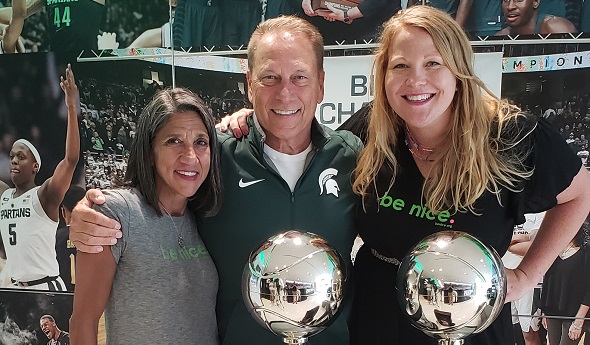
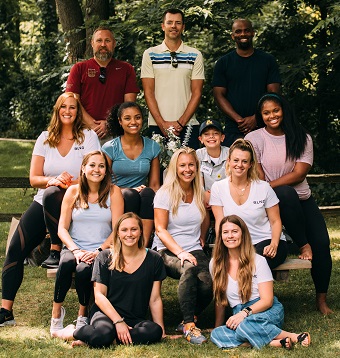
PHOTOS: (Top) be nice. founder Christy Buck (left) and program coordinator Cat Lanting pose with MSU men’s basketball coach Tom Izzo during production of a promotional video this summer. (Middle) The BLND Health Detroit Metro Team, including founder Brooke Buys (seated middle, second row from bottom.)