

10 to Remember from 2011-12
By
Geoff Kimmerly
MHSAA.com senior editor
July 11, 2012
Second Half's mission in this, its first school year, was to tell the best stories behind the scores and highlights of MHSAA competition.
Of course, every score and especially every championship has a story behind it. The MHSAA awarded 127 team and many more individual championships in 2011-12. Obviously we can't reflect on them all. But these 10 performances were loaded with prestige, drama and accomplishment that made them incredible stories for high school sports fans regardless of hometown or allegiance.
10. Grand Ledge gymnasts earn No. 5
The Comets had to fend off a charge by Canton, but won their fifth-straight MHSAA team title by 0.825 of a point with a final score of 149.400. The fifth-straight title tied the record set by Ludington from 1975-79 and extended Grand Ledge's first-place streak to 75 consecutive events. The next day, senior Christine Wilson and junior Sara Peltier swept the Division 1 and 2 individual titles, respectively.
9. West Bloomfield's Erin Finn joins elite
The Lakers junior said after her Division 1 cross country win that she'd dreamt of winning that title since she learned how to walk. She finished fourth as a sophomore before winning the championship by a little more than a second. After establishing herself as one of the top distance runners in the country in competitions over the winter, Finn finished the school year by winning the 3,200-meter run at the Division 1 Track and Field Final.
8. More and more Morley Stanwood
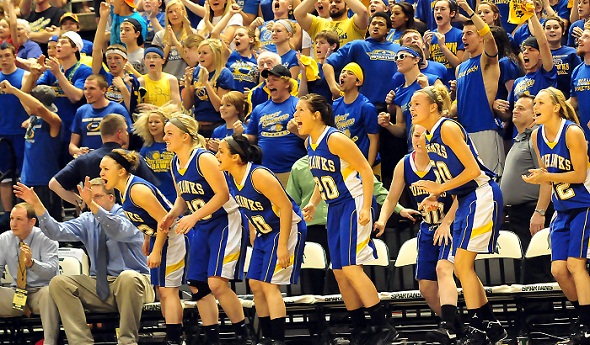
The Mohawks girls pulled off a rare feat this school year -- after winning their second MHSAA volleyball title in the fall, they added a first-ever girls basketball championship. Both efforts were keyed by seniors Alexis Huntey and Bailey Cairnduf, who had the most and second-most kills in the Class C Volleyball Final and then combined for 45 points and 25 rebounds in the basketball championship game.
That argument was made after Lansing Sexton claimed its second-straight Class B boys basketball championship in dominant fashion. The Big Reds finished 27-1, their only loss by a point to Detroit Pershing, and have won 74 games over the last three seasons -- tied for sixth-most in MHSAA history for that long of a stretch. Guards Denzel Valentine (Michigan State), Anthony Clemmons (Iowa) and Bryn Forbes (Cleveland State) all signed to play at Division I colleges this fall, with junior Jalen Hayes and freshman Trevor Manuel likely joining them in a few years.
Coyotes junior Sami Michell established herself as one of the top hurdlers in MHSAA history at the Division 3 Final by becoming the first Lower Peninsula girl to win four events at a championship meet since Mason County Eastern’s Maria Shoup in 1979. She set Division 3 records in the 100 hurdles, 300 hurdles and long jump, and her 300 time also was the best in MHSAA Finals history, regardless of division or class. She also won the 200.
Top-ranked Grand Haven's latest run at an MHSAA championship seemed all but over when Grosse Pointe South led the Class A final by 18 points with just under 10 minutes to play. But Shar'Rae Davis' fullcourt sprint and score that began with 12 seconds to play gave the Buccaneers a 54-53 win and their first title. It was the third-longest comeback in MHSAA Girls Basketball Finals history.
Livonia Ladywood had been a favorite to win its first MHSAA title all season -- with four-year pitcher Briana Combs in the circle. But when Combs couldn't finish the Semifinal because of an injury, rarely-thrown sophomore Lauren Hayes stepped in. All she did was finish that game and throw a three-hitter against Saginaw Swan Valley in the Final, while also getting three hits and driving in two of the team's four runs in the championship win.
St. Johns senior Taylor Massa finished off one of the most celebrated careers in MHSAA wrestling history with his fourth championship and not one loss during his high school career. Massa claimed the title at 171 pounds this year to go with others at 145, 152 and 160. He became the 15th in MHSAA history to win four titles, ranks 20th with 221 wins and seventh in the national record book for consecutive victories.
Grosse Pointe South's girls running teams had arguably the most dominant school year in MHSAA history, first winning the Division 1 cross country title before doing the same this spring in track and field. And the Blue Devils did it with mostly the same nucleus contributing to both -- particularly juniors Hannah and Haley Meier, sophomore Kelsie Schwartz and freshman Ersula Farrow. Those four combined to run a national record time of 8:48.29 in the 3,200 relay at the Division 1 Final this spring.
1. Short walk, championship run
Second Half was created as a place to tell great stories, Cass Tech made it easy on the first day of the Football Finals. The Technicians arrived at Ford Field after a short walk from their school. They had never played in a Final before and were unranked entering the postseason. They arrived with a strong group of seniors, but also a freshman quarterback named Jayru Campbell who ended up throwing five touchdown passes in a 49-13 win over No. 2 and perennial powerhouse Detroit Catholic Central.
PHOTO: The Morley Stanwood girls basketball team prepares to celebrate as the final seconds tick off in the Mohawks' Class C Final win. (Click to see more photos from High School Sports Scene.)

NFHS Voice: Source of HS Playing Rules
November 12, 2019
By Karissa Niehoff
NFHS Executive Director
When it comes to writing playing rules for major sports in the United States, it’s all in the acronyms. In football, you have the NFL, NCAA and NFHS. In basketball, it’s the NBA, NCAA and NFHS. In baseball, the rules-makers are MLB, NCAA and NFHS.
While the NFL, NBA, MLB and NCAA can be used on first reference without explanation, many people are unfamiliar with the NFHS. And yet the NFHS has been around as long – or longer – than the other four major sports organizations.
In many cases, references to NFHS rules – not only in these three major sports but the other 14 sports for which the organization writes rules – are simply noted as “high school rules.” The reality, however, is that the NFHS – the National Federation of State High School Associations – has been the national organization most directly focused on sports playing rules in the past 90 years since it published its first Football Rules Book in 1932.
With almost eight million participants in high school sports, NFHS rules are written for more individuals than all other levels of sports combined. As a result, risk minimization and the fundamentals of good sportsmanship are paramount to the rules-writing process for the NFHS and often are the distinguishing factors from rules at the higher levels of the sport.
Perhaps football is the best example of the commitment to risk minimization. In the mid-1970s, the NFHS was at the forefront of change when it outlawed spearing in high school football. The 1976 rule revision changed the landscape of high school football from an injury standpoint – from a high of 36 direct fatalities in 1968 to an average of about two per year by 2018.
Some people have questioned why there are multiple rules codes for a sport. Very simply, NFHS rules for high school play must be different than at the college and professional levels.
As an example, while professional baseball is concerned with how fast a baseball exits the batter’s box (Velocity Exit Speed) and how far the ball travels on a home run, the NFHS has enacted bat standards during the past 20 years to reduce the speed of balls coming off aluminum bats. In wrestling, the NFHS has enacted strict weight-management plans to reduce the risk of health issues. In ice hockey, while fighting is an accepted part of the sport at the professional level, NFHS rules have strict rules prohibiting all forms of unsportsmanlike conduct. In football, NFHS rules do not permit the excessive celebration displays following touchdowns that occur during NFL games.
In addition to risk minimization and sportsmanship, the NFHS must also weigh financial implications for schools when considering equipment and uniform changes. With schools ranging in size from less than 100 to more than 5,000 students, decisions must be made for the masses and cannot put undue financial hardships on schools.
NFHS rules are also written with the understanding that appropriate behavior begins with the coach, who is responsible for ensuring that his or her team exhibits good sporting behavior. Many penalties for unsportsmanlike conduct on the team are first directed against the coach.
While the NFHS and its member state associations govern the high school place in various sports – not only with playing rules but other issues as well – we maintain relationships with the National Governing Bodies (NGBs) in these sports to assist in meeting the needs of all participants.
Last week, the NFHS hosted a summit of various leaders of NGBs in Indianapolis. Leaders from about 15 NGBs were set to meet with NFHS staff to discuss various initiatives and opportunities for collaborative programs. We hope this is the first of many such meetings as it is crucial that all levels of sport work together to ensure ongoing opportunities for all sports participants.
Dr. Karissa L. Niehoff is in her second year as executive director of the National Federation of State High School Associations (NFHS) in Indianapolis, Indiana. She is the first female to head the national leadership organization for high school athletics and performing arts activities and the sixth full-time executive director of the NFHS, which celebrated its 100th year of service during the 2018-19 school year. She previously was executive director of the Connecticut Association of Schools-Connecticut Interscholastic Athletic Conference for seven years.