

10 to Remember from 2011-12
By
Geoff Kimmerly
MHSAA.com senior editor
July 11, 2012
Second Half's mission in this, its first school year, was to tell the best stories behind the scores and highlights of MHSAA competition.
Of course, every score and especially every championship has a story behind it. The MHSAA awarded 127 team and many more individual championships in 2011-12. Obviously we can't reflect on them all. But these 10 performances were loaded with prestige, drama and accomplishment that made them incredible stories for high school sports fans regardless of hometown or allegiance.
10. Grand Ledge gymnasts earn No. 5
The Comets had to fend off a charge by Canton, but won their fifth-straight MHSAA team title by 0.825 of a point with a final score of 149.400. The fifth-straight title tied the record set by Ludington from 1975-79 and extended Grand Ledge's first-place streak to 75 consecutive events. The next day, senior Christine Wilson and junior Sara Peltier swept the Division 1 and 2 individual titles, respectively.
9. West Bloomfield's Erin Finn joins elite
The Lakers junior said after her Division 1 cross country win that she'd dreamt of winning that title since she learned how to walk. She finished fourth as a sophomore before winning the championship by a little more than a second. After establishing herself as one of the top distance runners in the country in competitions over the winter, Finn finished the school year by winning the 3,200-meter run at the Division 1 Track and Field Final.
8. More and more Morley Stanwood
The Mohawks girls pulled off a rare feat this school year -- after winning their second MHSAA volleyball title in the fall, they added a first-ever girls basketball championship. Both efforts were keyed by seniors Alexis Huntey and Bailey Cairnduf, who had the most and second-most kills in the Class C Volleyball Final and then combined for 45 points and 25 rebounds in the basketball championship game.
That argument was made after Lansing Sexton claimed its second-straight Class B boys basketball championship in dominant fashion. The Big Reds finished 27-1, their only loss by a point to Detroit Pershing, and have won 74 games over the last three seasons -- tied for sixth-most in MHSAA history for that long of a stretch. Guards Denzel Valentine (Michigan State), Anthony Clemmons (Iowa) and Bryn Forbes (Cleveland State) all signed to play at Division I colleges this fall, with junior Jalen Hayes and freshman Trevor Manuel likely joining them in a few years.
Coyotes junior Sami Michell established herself as one of the top hurdlers in MHSAA history at the Division 3 Final by becoming the first Lower Peninsula girl to win four events at a championship meet since Mason County Eastern’s Maria Shoup in 1979. She set Division 3 records in the 100 hurdles, 300 hurdles and long jump, and her 300 time also was the best in MHSAA Finals history, regardless of division or class. She also won the 200.
Top-ranked Grand Haven's latest run at an MHSAA championship seemed all but over when Grosse Pointe South led the Class A final by 18 points with just under 10 minutes to play. But Shar'Rae Davis' fullcourt sprint and score that began with 12 seconds to play gave the Buccaneers a 54-53 win and their first title. It was the third-longest comeback in MHSAA Girls Basketball Finals history.
Livonia Ladywood had been a favorite to win its first MHSAA title all season -- with four-year pitcher Briana Combs in the circle. But when Combs couldn't finish the Semifinal because of an injury, rarely-thrown sophomore Lauren Hayes stepped in. All she did was finish that game and throw a three-hitter against Saginaw Swan Valley in the Final, while also getting three hits and driving in two of the team's four runs in the championship win.
St. Johns senior Taylor Massa finished off one of the most celebrated careers in MHSAA wrestling history with his fourth championship and not one loss during his high school career. Massa claimed the title at 171 pounds this year to go with others at 145, 152 and 160. He became the 15th in MHSAA history to win four titles, ranks 20th with 221 wins and seventh in the national record book for consecutive victories.
Grosse Pointe South's girls running teams had arguably the most dominant school year in MHSAA history, first winning the Division 1 cross country title before doing the same this spring in track and field. And the Blue Devils did it with mostly the same nucleus contributing to both -- particularly juniors Hannah and Haley Meier, sophomore Kelsie Schwartz and freshman Ersula Farrow. Those four combined to run a national record time of 8:48.29 in the 3,200 relay at the Division 1 Final this spring.
1. Short walk, championship run
Second Half was created as a place to tell great stories, Cass Tech made it easy on the first day of the Football Finals. The Technicians arrived at Ford Field after a short walk from their school. They had never played in a Final before and were unranked entering the postseason. They arrived with a strong group of seniors, but also a freshman quarterback named Jayru Campbell who ended up throwing five touchdown passes in a 49-13 win over No. 2 and perennial powerhouse Detroit Catholic Central.
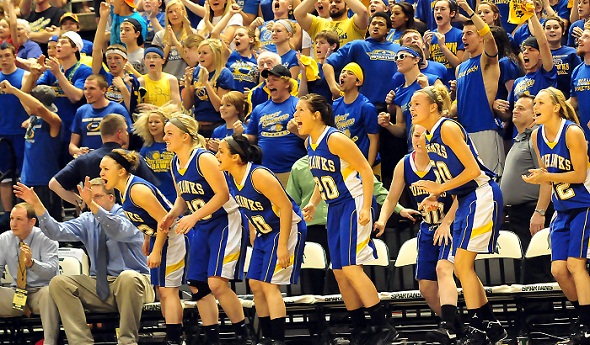
PHOTO: The Morley Stanwood girls basketball team prepares to celebrate as the final seconds tick off in the Mohawks' Class C Final win. (Click to see more photos from High School Sports Scene.)
2018-19 Concussion Data Reinforces Trends
September 26, 2019
By Geoff Kimmerly
Second Half editor
Data on student-athlete concussions collected by the Michigan High School Athletic Association from member high schools during the 2018-19 school year further reinforced findings from the first three years of reporting, and will contribute significantly as a number of MHSAA-associated groups work during the coming year to reduce the incidence of those injuries.
The 2018-19 concussion report found student-athletes at MHSAA member high schools encountered a total of 3,686 head injuries during the past school year – 3.0 percent more than in 2017-18. But that slight increase barely affected two key ratios. The number of injuries per member school was 4.9, up just a tenth of a percent from 2017-18, and for the second straight year only 1.3 percent of participants in MHSAA sports experienced a head injury, still down from 1.4 in 2016-17 and 1.6 percent the first year of the study. Total participation in MHSAA sports for 2018-19 was 281,992 – with students counted once for each sport they played.
The MHSAA has continued to invite Michigan’s universities, health care systems and the National Federation of State High School Associations (NFHS) to take part in analyzing the data and resulting questions that have arisen during the past three years. The 2018-19 results will be examined by the MHSAA’s newly-formed Sports Medicine Advisory Committee and also undergo analysis by representatives of Michigan State University’s Institute for the Study of Youth Sports. Furthermore, the MHSAA is directing its sport committees to study the data as they consider adjustments that could be made to rules for practice and competition.
“The 2018-19 concussion survey further reinforced the findings and trends we have seen emerge; not only in specific sports, but across all of our activities – and this latest set of results also raises new questions,” MHSAA Executive Director Mark Uyl said. “We must continue to look at how changes to playing rules and improvements in equipment may be beneficial moving forward, and also how we can further educate administrators, coaches, athletes and parents to identify and provide treatment for these injuries as soon as possible. We also are excited for the opportunity to have more eyes on these results as we continue to explore more ways to make our games safer.”
As first mandated in 2015-16, member schools are required to report head injuries to the MHSAA identifying the sport that each student-athlete was participating in and whether the injury was sustained during practice or competition. Schools also are required to designate at which level – varsity, junior varsity or freshman – the injury occurred.
The full report of all head injuries experienced during 2018-19 by student-athletes at MHSAA member high schools – including percentages by sport (per 1,000 participants), gender and team level, as well as data tracking when athletes returned to play – is available on the Health & Safety page of the MHSAA Website.
Keeping with the first three years of this survey, the MHSAA continued to receive data from more than 99 percent of its member high schools after the fall, winter and spring seasons. Member junior high and middle schools also were allowed, although not mandated, to report their head injuries; and those findings are not part of the published report.
Boys in 2018-19 experienced 2,404 – or 65 percent – of concussion injuries, just a percent less than during 2017-18, and not surprisingly as boys have a much higher participation in contact sports. More than half of head injuries – 59 percent – were experienced by varsity athletes, a slight increase of three percent from the previous year. A total of 2,441 head injuries – or 66 percent – came in competition as opposed to practice. Just more than half took place during either the middle of practice or middle of competition as opposed to the start or end, and 51 percent of injuries were a result of person-to-person contact.
The MHSAA also asked schools to report the number of days between the head injury and the athlete’s return to activity – and the two largest groups returned to activity after either 6 to 10 days of rest (24 percent) or 11 to 15 days (23 percent). All of these findings were within 1-3 percent of those discovered from the 2017-18 data.
Contact sports again revealed the most head injuries. Ranking first was football, 11 and 8-player combined, with 44 head injuries per 1,000 participants – an increase of three per 1,000 from 2017-18 but the same ratio as 2016-17 and still down from 49 head injuries per 1,000 football participants shown by the first study in 2015-16. Ice hockey again revealed the second-most injuries per 1,000, with 35 (also up three from a year ago but still down from 36 injuries per 1,000 from 2016-17 and 38 per 1,000 in 2015-16), and girls soccer was third with 25 head injuries per 1,000 participants for the second year in a row. Wrestling followed with 22 head injuries per 1,000 participants.
Continuing a noticeable trend of the last few years, the next three sports to show the highest incidences of head injuries were girls sports – girls lacrosse, competitive cheer and basketball also revealed 20 per 1,000 participants, although basketball was down two injuries per 1,000 participants or nearly 10 percent from the previous year. Boys lacrosse (16), boys soccer (14), girls volleyball (11), softball (11) and gymnastics (10) also showed double-digit head injuries per 1,000 participants.
Females again reported significantly more concussions than males playing the same or similar sports – soccer, basketball and baseball/softball. Female soccer players reported nearly double the concussions per 1,000 participants as male soccer players (25 to 14), while female basketball players reported nearly triple the number of concussions per 1,000 participants (20 to 7). Softball players also reported nearly triple the concussions per 1,000 participants of baseball players (11 to 4).
Schools report possible concussions online via the MHSAA Website. Reports are then examined by members of the MHSAA staff, who follow up with school administrators as those student-athletes continue to receive care and eventually return to play. Student privacy is protected.
The reporting of concussions is part of a three-pronged advance by the MHSAA in concussion care begun during the 2015-16 school year. The MHSAA completed in spring 2017 the largest-ever state high school association sideline concussion testing pilot program, with a sample of schools from across the state over two years using one of two screening tests designed to detect concussions. The MHSAA also was the first state association to provide all participants at every member high school and junior high/middle school with insurance intended to pay accident medical expense benefits – covering deductibles and co-pays left unpaid by other policies – resulting from head injuries sustained during school practices or competitions and at no cost to either schools or families.
Previously, the MHSAA also was among the first state associations to adopt a return-to-play protocol that keeps an athlete out of activity until at least the next day after a suspected concussion, and allows that athlete to return to play only after he or she has been cleared unconditionally for activity by a doctor (M.D. or D.O.), physician’s assistant or nurse practitioner.
In addition, the MHSAA’s Coaches Advancement Program – which includes courses that must be completed by all varsity head coaches hired for the first time at a member school – provides substantial instruction on concussion care. Separately, rules meetings that are required viewing for high school varsity and subvarsity head and assistant coaches at the start of each season include detailed training on caring for athletes with possible head injuries.