

10 to Remember from 2011-12
By
Geoff Kimmerly
MHSAA.com senior editor
July 11, 2012
Second Half's mission in this, its first school year, was to tell the best stories behind the scores and highlights of MHSAA competition.
Of course, every score and especially every championship has a story behind it. The MHSAA awarded 127 team and many more individual championships in 2011-12. Obviously we can't reflect on them all. But these 10 performances were loaded with prestige, drama and accomplishment that made them incredible stories for high school sports fans regardless of hometown or allegiance.
10. Grand Ledge gymnasts earn No. 5
The Comets had to fend off a charge by Canton, but won their fifth-straight MHSAA team title by 0.825 of a point with a final score of 149.400. The fifth-straight title tied the record set by Ludington from 1975-79 and extended Grand Ledge's first-place streak to 75 consecutive events. The next day, senior Christine Wilson and junior Sara Peltier swept the Division 1 and 2 individual titles, respectively.
9. West Bloomfield's Erin Finn joins elite
The Lakers junior said after her Division 1 cross country win that she'd dreamt of winning that title since she learned how to walk. She finished fourth as a sophomore before winning the championship by a little more than a second. After establishing herself as one of the top distance runners in the country in competitions over the winter, Finn finished the school year by winning the 3,200-meter run at the Division 1 Track and Field Final.
8. More and more Morley Stanwood
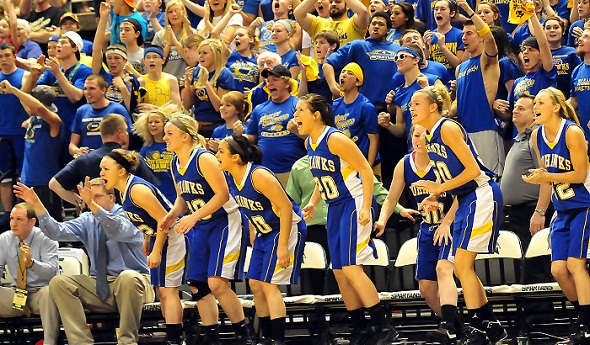
The Mohawks girls pulled off a rare feat this school year -- after winning their second MHSAA volleyball title in the fall, they added a first-ever girls basketball championship. Both efforts were keyed by seniors Alexis Huntey and Bailey Cairnduf, who had the most and second-most kills in the Class C Volleyball Final and then combined for 45 points and 25 rebounds in the basketball championship game.
That argument was made after Lansing Sexton claimed its second-straight Class B boys basketball championship in dominant fashion. The Big Reds finished 27-1, their only loss by a point to Detroit Pershing, and have won 74 games over the last three seasons -- tied for sixth-most in MHSAA history for that long of a stretch. Guards Denzel Valentine (Michigan State), Anthony Clemmons (Iowa) and Bryn Forbes (Cleveland State) all signed to play at Division I colleges this fall, with junior Jalen Hayes and freshman Trevor Manuel likely joining them in a few years.
Coyotes junior Sami Michell established herself as one of the top hurdlers in MHSAA history at the Division 3 Final by becoming the first Lower Peninsula girl to win four events at a championship meet since Mason County Eastern’s Maria Shoup in 1979. She set Division 3 records in the 100 hurdles, 300 hurdles and long jump, and her 300 time also was the best in MHSAA Finals history, regardless of division or class. She also won the 200.
Top-ranked Grand Haven's latest run at an MHSAA championship seemed all but over when Grosse Pointe South led the Class A final by 18 points with just under 10 minutes to play. But Shar'Rae Davis' fullcourt sprint and score that began with 12 seconds to play gave the Buccaneers a 54-53 win and their first title. It was the third-longest comeback in MHSAA Girls Basketball Finals history.
Livonia Ladywood had been a favorite to win its first MHSAA title all season -- with four-year pitcher Briana Combs in the circle. But when Combs couldn't finish the Semifinal because of an injury, rarely-thrown sophomore Lauren Hayes stepped in. All she did was finish that game and throw a three-hitter against Saginaw Swan Valley in the Final, while also getting three hits and driving in two of the team's four runs in the championship win.
St. Johns senior Taylor Massa finished off one of the most celebrated careers in MHSAA wrestling history with his fourth championship and not one loss during his high school career. Massa claimed the title at 171 pounds this year to go with others at 145, 152 and 160. He became the 15th in MHSAA history to win four titles, ranks 20th with 221 wins and seventh in the national record book for consecutive victories.
Grosse Pointe South's girls running teams had arguably the most dominant school year in MHSAA history, first winning the Division 1 cross country title before doing the same this spring in track and field. And the Blue Devils did it with mostly the same nucleus contributing to both -- particularly juniors Hannah and Haley Meier, sophomore Kelsie Schwartz and freshman Ersula Farrow. Those four combined to run a national record time of 8:48.29 in the 3,200 relay at the Division 1 Final this spring.
1. Short walk, championship run
Second Half was created as a place to tell great stories, Cass Tech made it easy on the first day of the Football Finals. The Technicians arrived at Ford Field after a short walk from their school. They had never played in a Final before and were unranked entering the postseason. They arrived with a strong group of seniors, but also a freshman quarterback named Jayru Campbell who ended up throwing five touchdown passes in a 49-13 win over No. 2 and perennial powerhouse Detroit Catholic Central.
PHOTO: The Morley Stanwood girls basketball team prepares to celebrate as the final seconds tick off in the Mohawks' Class C Final win. (Click to see more photos from High School Sports Scene.)

- Field Hockey
- Boys Soccer
- Girls Swim & Dive
- Boys Tennis
- Girls Tennis
- Girls Volleyball
- Girls Cross Country
- Boys Cross Country
- Football
- Girls Golf
- MHSAA News
Field Hockey Debut, Tennis Finals Change Among Most Notable as Fall Practices Set to Begin
By
Geoff Kimmerly
MHSAA.com senior editor
August 8, 2025
The addition of girls field hockey as a sponsored postseason championship sport and a revised schedule for Lower Peninsula Boys Tennis Finals are the most significant changes to fall sports as practices are set to begin Monday, Aug. 11, for an anticipated 100,000 high school athletes at Michigan High School Athletic Association member schools.
The fall season includes the most played sports for both boys and girls; 36,210 football players and 19,679 girls volleyball players competed during the Fall 2024 season. Teams in those sports will be joined by competitors in girls and boys cross country, field hockey, Lower Peninsula girls golf, boys soccer, Lower Peninsula girls swimming & diving, Upper Peninsula girls tennis and Lower Peninsula boys tennis in beginning practice next week. Competition begins Aug. 15 for cross country, field hockey, golf, soccer and tennis, Aug. 20 for swimming & diving and volleyball, and Aug. 28 for varsity football.
Field hockey is one of two sports set to make its debut with MHSAA sponsorship during the 2025-26 school year; boys volleyball will play its first season with MHSAA sponsorship in the spring.
There are 37 varsity teams expected to play during the inaugural field hockey season. There will be one playoff division, with the first MHSAA Regionals in this sport beginning Oct. 8 and the first championship awarded Oct. 25.
To conclude their season, Lower Peninsula boys tennis teams will begin a pilot program showcasing Finals for all four divisions at the same location – Midland Tennis Center – over a two-week period. Division 4 will begin play with its two-day event Oct. 15-16, followed by Division 1 on Oct. 17-18, Division 2 on Oct. 22-23 and Division 3 played Oct. 24-25.
Also in Lower Peninsula boys tennis, and girls in the spring, a Finals qualification change will allow for teams that finish third at their Regionals to advance to the season-ending tournament as well, but only in postseason divisions where there are six Regionals – which will be all four boys divisions this fall.
The 11-Player Football Finals at Ford Field will be played this fall over a three-day period, with Division 8, 4, 6 and 2 games on Friday, Nov. 28, and Division 7, 3, 5 and 1 games played Sunday, Nov. 30, to accommodate Michigan State’s game against Maryland on Nov. 29 at Ford Field.
Two more changes affecting football playoffs will be noticeable this fall. For the first time, 8-Player Semifinals will be played at neutral sites; previously the team with the highest playoff-point average continued to host during that round. Also, teams that forfeit games will no longer receive playoff-point average strength-of-schedule bonus points from those opponents to which they forfeited.
A pair of changes in boys soccer this fall will address sportsmanship. The first allows game officials to take action against a team’s head coach in addition to any cautions or ejections issues to players and personnel in that team’s bench area – making the head coach more accountable for behavior on the sideline. The second change allows for only the team captain to speak with an official during the breaks between periods (halftime and during overtime), unless another coach, player, etc., is summoned by the official – with the penalty a yellow card to the offending individual.
A few more game-action rules changes will be quickly noticeable to participants and spectators.
- In volleyball, multiple contacts by one player attempting to play the ball will now be allowed on second contact if the next contact is by a teammate on the same side of the net.
- In swimming & diving, backstroke ledges will be permitted in pools that maintain a 6-foot water depth. If used in competition, identical ledges must be provided by the host team for all lanes, although individual swimmers are not required to use them.
- Also in swimming & diving – during relay exchanges – second, third and fourth swimmers must have one foot stationary at the front edge of the deck. The remainder of their bodies may be in motion prior to the finish of the incoming swimmer.
- In football, when a forward fumble goes out of bounds, the ball will now be spotted where the fumble occurred instead of where the ball crossed the sideline.
The 2025 Fall campaign culminates with postseason tournaments beginning with the Upper Peninsula Girls Tennis Finals during the week of Sept. 29 and wrapping up with the 11-Player Football Finals on Nov. 28 and 30. Here is a complete list of fall tournament dates:
Cross Country
U.P. Finals – Oct. 18
L.P. Regionals – Oct. 24 or 25
L.P. Finals – Nov. 1
Field Hockey
Regionals – Oct. 8-21
Semifinals – Oct. 22 or 23
Final – Oct. 25
11-Player Football
Selection Sunday – Oct. 26
District Semifinals – Oct. 31 or Nov. 1
District Finals – Nov. 7 or 8
Regional Finals – Nov. 14 or 15
Semifinals – Nov. 22
Finals – Nov. 28 and 30
8-Player Football
Selection Sunday – Oct. 26
Regional Semifinals – Oct. 31 or Nov. 1
Regional Finals – Nov. 7 or 8
Semifinals – Nov. 15
Finals – Nov. 22
L.P. Girls Golf
Regionals – Oct. 6, 7, 8, 9, 10, or 11
Finals – Oct. 17-18
Boys Soccer
Districts – Oct. 8-18
Regionals – Oct. 21-25
Semifinals – Oct. 29
Finals – Nov. 1
L.P. Girls Swimming & Diving
Diving Regionals – Nov. 13
Swimming/Diving Finals – Nov. 21-22
Tennis
U.P. Girls Finals – Oct. 1, 2, 3, or 4
L.P. Boys Regionals – Oct. 8, 9, 10, or 11
L.P. Boys Finals – Oct. 15-16 (Division 4), Oct. 17-18 (Division 1), Oct 22-23 (Division 2), and Oct. 24-25 (Division 3)
Girls Volleyball
Districts – Nov. 3-8
Regionals – Nov. 11 & 13
Quarterfinals – Nov. 18
Semifinals – Nov. 20-21
Finals – Nov. 22
The MHSAA is a private, not-for-profit corporation of voluntary membership by more than 1,500 public and private senior high schools and junior high/middle schools which exists to develop common rules for athletic eligibility and competition. No government funds or tax dollars support the MHSAA, which was the first such association nationally to not accept membership dues or tournament entry fees from schools. Member schools which enforce these rules are permitted to participate in MHSAA tournaments, which attract more than 1.4 million spectators each year.