


Did you see that?
March 12, 2012
Check out our must-know scores and news from March 5-10.
(Click on links for coverage.)
Gymnastics
Where no team has gone before: Grand Ledge indeed accomplished what no team had before Friday by winning its fifth-straight MHSAA team championship. Senior Christine Wilson and junior Sara Peltier then won the Division 1 and 2 individual titles, respectively, on Saturday. (Second Half Team) (Second Half Individual)
Swimming and Diving
Celebratory dip: Saline isn’t the first boys swimming and diving program to win three straight MHSAA championships. But it’s definitely the program of the day after claiming another Division 1 title Saturday and breaking four records -- including two all-division/class records -- in the process. (Second Half)
Hockey
Consider it avenged: There are few better ways to go out than with a championship after falling in the Final the year before. That’s how Bloomfield Hills Brother Rice and super senior Mackenzie MacEachern finished off this season Saturday, beating Grosse Pointe South 4-1 after falling by the same score in the 2011 championship game. (Second Half)
Girls Basketball
Only one can move on: Detroit Martin Luther King won its third and final meeting this season against Detroit Pershing to move on to this week’s Class A Quarterfinals. King had lost to Pershing by five during the regular season, then beat Pershing by three in the Detroit Public School League Final before defeating Pershing again 54-53 on Thursday in a Regional Final. (Mlive.com)
Boys Basketball
Another championship down, two to go: Top-ranked and reigning Class B champion Lansing Sexton eliminated what was perceived heading into the postseason as one of the biggest obstacles standing between the Big Reds and a repeat. They downed No. 4 Lansing Catholic 66-56 in a District Final on Friday to improve to 22-1. (Lansing State Journal)
Editor's note: Did we miss something? Comment below and tell us about it. Is there an event coming up that we should make sure to note? Comment or e-mail [email protected].
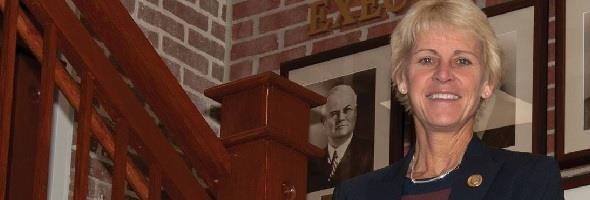
NFHS Voice: Amateurism Benefits
October 9, 2019
By Karissa Niehoff
NFHS Executive Director
While we addressed a number of important issues with our member state associations at section meetings the past month, perhaps none of the topics are as significant as the tremor that occurred in California on September 30 – the signing of the “Fair Pay to Play Act” by California Governor Gavin Newsom.
Although there are more questions than answers at this point, this ruling would allow college athletes in the state of California to make money from their name, image and likeness through endorsement deals, sponsorships, autograph signings and other opportunities. The legislation is due to take effect in 2023.
Obviously, the NCAA opposes this legislation and is working through its governance structure to address the issue. As Mark Emmert, NCAA president, told the Indianapolis Star, “for all intents and purposes, athletes become employees of the schools. This is just a new form of professionalism and a different way of converting students into employees.”
And since it would not work for athletes in one state to be receiving money legally while athletes in the other 49 could not, a national bill similar to California’s is already being considered by U. S. Representative Anthony Gonzalez of Ohio.
Needless to say, the NFHS and its member state associations oppose the California ruling as it could further erode the concept of amateurism in the United States. At the high school level, current issues with parents pushing their kids into specialization in the fight for scholarships would only be exacerbated as they considered the “best offer” from colleges.
In the aforementioned Indianapolis Star article, Emmert noted the following: “Under the California law, there would be complete elimination of all of those rules (regulations related to shoe companies). It would also include the use of agents in that process and the agent could represent high school students.”
There is nothing more sacred and fundamental to the past – and future – history of high school sports in the United States than the concept of amateurism. While this California ruling addresses college sports directly, it undoubtedly would have an impact on sports at the high school level as well.
The signing of the “Fair Pay to Play Act” comes on the heels of the Alston v. NCAA case earlier this year in which a federal judge in California found the NCAA’s scholarship rules to be illegal – to a point. The NFHS filed an amicus curiae brief in support of the NCAA noting the following:
“Amateurism in athletics is not only valuable for its own sake, but also is a key aspect of a well-rounded education. The NFHS is concerned that the district court’s opinion does not fully appreciate either the concept of amateurism or the many benefits it brings to college and high school sports – and to American sports in general.
“... If amateurism were to give way to professionalism at the collegiate level ... high schools would struggle to fulfill their ultimate goal of preparing large numbers of well-rounded individuals for futures beyond athletics. … The NCAA should be afforded the freedom to define amateurism in a way that preserves the ideal of the student-athlete in higher education which would protect important values of education-based sports at all levels.”
The NFHS will continue to support the NCAA in its efforts to preserve amateurism as it is our belief that paying student-athletes – whether it is in the form of selling one’s name, image or likeness, or whether it eventually becomes a paycheck – will erode the spirit of sport at all levels in this country.
Dr. Karissa L. Niehoff is in her second year as executive director of the National Federation of State High School Associations (NFHS) in Indianapolis, Indiana. She is the first female to head the national leadership organization for high school athletics and performing arts activities and the sixth full-time executive director of the NFHS, which celebrated its 100th year of service during the 2018-19 school year. She previously was executive director of the Connecticut Association of Schools-Connecticut Interscholastic Athletic Conference for seven years.