


Did you see that? (10/15-10/21)
October 22, 2012
Three MHSAA fall sports came to an end over the weekend, and the tournament for a fourth has begun. Those finishes highlight the non-football best from the week that was Oct. 15-21.
Golf
Rankings play out: The Lower Peninsula girls season came to a close with all four top-ranked teams claiming championships. Plymouth won its first MHSAA title in any sport in Division 1, while Mona Shores became the first Lower Peninsula girls golf team to win four straight by doing so in Division 2. Ada Forest Hills Eastern made it two titles in three seasons by winning Division 3, and Lansing Catholic won its third straight in Division 4. Second Half covered them all. (Division 1) (Division 2) (Division 3) (Division 4)
Tennis
Dynasties continue: Three of four top-ranked teams also won MHSAA Lower Peninsula Boys Tennis Finals over the weekend, with the other champion hardly unfamiliar with first place. Ann Arbor Huron was ranked only No. 3 before winning Division 1 for the third time in five seasons. Midland Dow won its fourth straight Division 2 title and Ann Arbor Greenhills won its fifth straight in Division 4. But the biggest headline goes to Detroit Country Day, which tied Ann Arbor Pioneers’ dominance in 2002 with 39 points in claiming the Division 3 title. Second Half also covered all four of these Finals.(Division 1) (Division 2) (Division 3) (Division 4)
Cross country
One streak ends, another begins: The Upper Peninsula season came to an end with its Finals for three divisions. Calumet’s Tara Kiilunen led her team to the Division 1 girls title by winning the individual championship for the fourth consecutive season. On the boys side, Sault Ste. Marie won its first title in 11 years thanks to the individual Division 1 championship of freshman Parker Scott, who finished this season undefeated. Second Half covered all the races. (Girls Finals) (Boys Finals)
Soccer
Powers emerge in Division 1: Lower Peninsula Districts whittled the number of teams still alive down to 64 – 16 in each of four divisions. And the two toughest Districts to navigate were arguably in Division 1. Top-ranked East Kentwood beat Caledonia 6-0 to win that District, but only after the Falcons knocked out No. 2 Rockford in a semifinal and the Rams did the same to No. 7 Okemos in an opener. Rochester Stoney Creek, ranked No. 4, emerged from a district at Rochester that included No. 9 Utica Eisenhower and honorable mention Troy Athens by beating Rochester Adams 2-1 in the title game – after Adams upset Eisenhower in a semi. (Grand Rapids Press) (Oakland Press)
Expert Teammates Fill Health Roster
January 2, 2020
By Rob Kaminski
MHSAA benchmarks editor
Teamwork is a necessity in athletics. The MHSAA has put together the beginnings of a solid roster to combat mental health ailments throughout schools in the state.
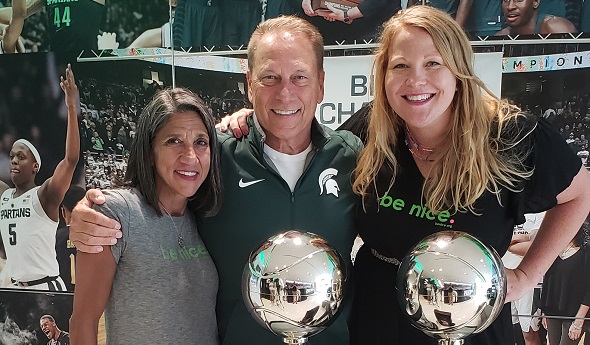
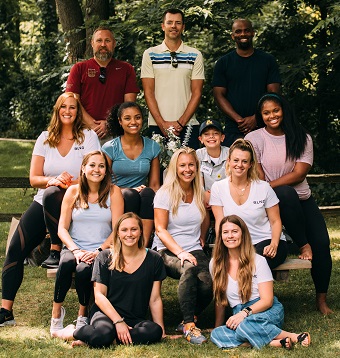
Among the experts listed on the MHSAA Mental Health Speakers Bureau are Christy Buck, executive director, and Cat Lanting, program coordinator at the Mental Health Foundation of West Michigan; and Brooke Buys, mental and behavioral health specialist and founder of BLND Health. They already are serving MHSAA schools in various capacities.
Through personal appearances, promotional videos and staff availability, both organizations emphasize the same strategy when tackling mental health issues: recognition and treatment from within the school buildings and districts.
“We wanted to create self-starting kits that anyone in the district can implement,” said Lanting. “We have in-person trainings and opportunities for students to get together – students talking to students – for high schools and for middle schools.”
Lanting coordinates the be nice.® Action Plan, founded by Buck. The plan calls for people to “notice, invite, challenge and empower” when recognizing changes in those close to them.
“It’s an attractive statement, but the key to the action plan is that it’s transferable. It can work from the pre-K level to senior citizens,” she said. “We want people to notice change, invite people into the conversation, challenge stigmas, and empower themselves with knowledge surrounding mental health.”
Buys, meanwhile, is one of a team of behavioral health specialists delivering messages to student-athletes around the state. Many of her associates in BLND (pronounced “blend”) not only talk the talk, but have walked the walk as collegiate athletes.
“The best course of action for administrators, teachers, coaches is to strive to build and maintain trust with the student-athlete; have genuine, non-judgmental conversations to include open-ended questions and authentic concern,” said Buys, who played soccer at Kalamazoo College.
Both be nice.® and BLND staff members made appearances at schools this year to assist in promoting recognition. A 90-second video produced by be nice.® was included in all MHSAA online rules meetings this year, featuring endorsements from University of Michigan coaches Jim Harbaugh and Carol Hutchins and Michigan State University coaches Mark Dantonio and Tom Izzo.
“When our team met with Mark (Uyl) and some athletic directors in Spring 2019, the room was filled with people who have just started to recognize mental health as an issue. The challenge was to deliver a 90-second video promoting the be nice.® Action Plan with a quick turnaround so it was ready for the fall rules meetings,” said Lanting.
She encourages people to visit be nice.org and “take the be nice.® pledge.”
“be nice.® started in 2010, and when people first see it they think, ‘bullying prevention,’ but really it is an action plan that is evidence-based,” Lanting said. “The be nice.® Action Plan can be used anywhere – in the workplace, community organizations – but schools is where we started and where we are currently having the most impact.”
 Connecting with the most people possible is the goal across the board. Buys encourages schools to utilize the “one-stop shopping method” in the BLND programming.
“An external referral service that is qualified, efficient, dynamic, and integrated in nature – like BLND – helps provide a one-stop shop for student-athletes and parents to receive the support they need,” said Buys.
Lanting agrees, stating, “The more students and parents become familiar with some of the signs and symptoms, the better. Coaches and teammates might be the first to notice a change in someone’s behavior whether through daily interaction or social media activity.”
Buys and company have noticed a few recent trends leading to school-aged anxiety and stress, and have people in place to visit groups and lead discussions.
“The signs and symptoms can be very individualized, but some general factors may include isolation, irritability, drastic changes to an individual’s common mood or behavior,” noted Buys. “Students can also be affected by major life changes such as parent divorce, break-up with significant other, changing schools, things of that nature.”
When Lanting receives inquiries from individual coaches regarding the be nice.® program, she encourages them to get entire teams or districts involved, because, “it’s a K-12 initiative, and sports is really a great place to start.”
Sport participation offers a different set of variables. Student-athletes enjoy additional support and guidance, but there is a flip side.
“Student-athletes do have access to more adult guidance through coaches, and certainly enjoy inclusion as part of a team, but they also tend to be more at risk for anxiety,” Lanting said.
Buys points out several reasons for this, including added expectations – whether from within or from peers, parents and coaches. They are also busier than many others.
“Time management is an issue for all of us, but student-athletes can have difficulties finding that rhythm,” Buys said. “This can cause a lot of anxiety if an area of the athlete’s life that they value is perceived as not getting the attention it needs.”
Another source of stress more likely to affect athletes is injuries.
“One of the biggest challenges in the athlete population dealing with stress and anxiety is the strong relationship between stress and injury,” said Buys. “Susceptibility to injury as well as the length of time for recovery are affected by stress.”
Identifying physical conditions is much simpler than recognizing behavioral ailments. That’s why it’s important for groups like BLND and be nice.® to teach the school population to self-diagnose.
Lanting coordinated a be nice.® football game between Holland/Zeeland-area high schools last fall, and is planning a similar event during a Fennville-Saugatuck boys basketball game this winter.
“We see all the ‘pink-out’ games and events for other causes, and that’s great,” Lanting said. “But a person in high school is so much more likely to be affected by mental health than suffer a physical ailment. That’s why the student-led part of this is so important; they tell us when things happen that might trigger certain behaviors.”
PHOTOS: (Top) be nice. founder Christy Buck (left) and program coordinator Cat Lanting pose with MSU men’s basketball coach Tom Izzo during production of a promotional video this summer. (Middle) The BLND Health Detroit Metro Team, including founder Brooke Buys (seated middle, second row from bottom.)