


Did you see that? (10/22-10/28)
October 30, 2012
Qualifiers for the final week of the boys soccer and cross country seasons were determined over the weekend, while volleyball teams finished up league tournaments before serving up District play beginning today.
Soccer
Unity Christian downs 1 and 2: No. 3 Hudsonville Unity Christian became the highest-ranked team left in Division 2 by defeating No. 2 Ada Forest Hills Eastern in a Regional Semifinal and then top-ranked Spring Lake in the Regional Final. (Grand Rapids Press)
Hornets win first Regional: Williamston’s boys had never won a Regional game before last week, but ended it with their first Semifinal berth after a 2-0 win over No. 10 Frankenmuth in Division 3. (Saginaw News)
Cross country
Seaholm girls, Mott boys win: The top-ranked Birmingham Seaholm girls put seven among the top 11 at Saturday's Division 1 Regional at Waterford to finish ahead of No. 7 Northville and claim the championships. The Waterford Mott boys, ranked No. 6, put five among the top 13 to win their race. (Oakland Press)
Volleyball
No. 1 in league, No. 1 overall: Richland Gull Lake secured the top ranking in Class A heading into the MHSAA tournament by winning the Southwestern Michigan Athletic Conference tournament Saturday. The Blue Devils beat No. 7 Mattawan in the semifinal before taking down Niles in the championship match. (Battle Creek Enquirer)
Marysville ready for playoffs: The Class B No. 5 Vikings won their home invitational Saturday, beating No. 10 Croswell-Lexington in three games in the championship match. (Port Huron Times-Herald)
Swimming and Diving
Records fall: Division 2 No. 9 Midland Dow broke all three relay pool records as it hosted rival Midland on Thursday. The Chargers won 141-42 to move to 13-0 in dual meets this fall. (Midland Daily News)
Tennis
Jenshak, Erickson named Players of the Year: Escanaba’s Codi Jenshak and Iron River West Iron County’s Kylee Erickson played three times this season and won the MHSAA Division 1 and 2 Upper Peninsula No. 1 singles championships, respectively. They were named Co-Player of the Year in the Upper Peninsula last week. (Escanaba Daily Press) (Iron Mountain Daily News)
Sparked by Offense Switch, Summerfield Sets Record-Breaking Scoring Pace
By
Doug Donnelly
Special for MHSAA.com
October 29, 2024
Dylan Szegedi might only be in his second season as a head varsity football coach, but he knows when to pull the plug on an offensive scheme.
 A change from the veer to a version of the gun-T has been the catalyst behind Petersburg-Summerfield’s 8-1 season, the best at the Monroe County school in more than a decade.
“I really love the veer. I’ve seen it work very well,” Szegedi said. “It just didn’t work for us. We always say we were trying to put a round peg through a square hole. It just didn’t jell with our guys, and we were smart enough to realize it.”
The Bulldogs went 5-4 last season but missed the playoffs for the second straight. With several second- and third-year starting seniors back, Szegedi decided to change offenses despite having spent nearly all his years coaching the veer. He and his coaching staff started researching offenses and landed on one that is the mastermind of a coach in Alabama that puts a lot of YouTube videos together and travels around the country talking about his offensive concepts.
“This offense is perfect for our guys,” Szegedi said. “It’s a good mix of running and passing. It’s a good mix of spread but still some downhill-style run concepts. It fits our athletes to a T. It is a spread-T concept, wing-T running concepts with a spread flair to it. It was exactly what we needed.”
Heading into Friday’s home Division 8 playoff game against Manchester – the first hosted by Summerfield since 2015 – the Bulldogs are one point shy of the school record for points scored in a season. Since a 20-14 win over Ottawa Lake Whiteford in Week 5, Summerfield has scored 48, 62, 70 and 58 points in victories. The 70 points against Vanlue, Ohio, was a single-game school record.
 “It’s come together seamlessly. The proof is in the pudding. We have done great, and hopefully we will continue to do so,” Szegedi said.
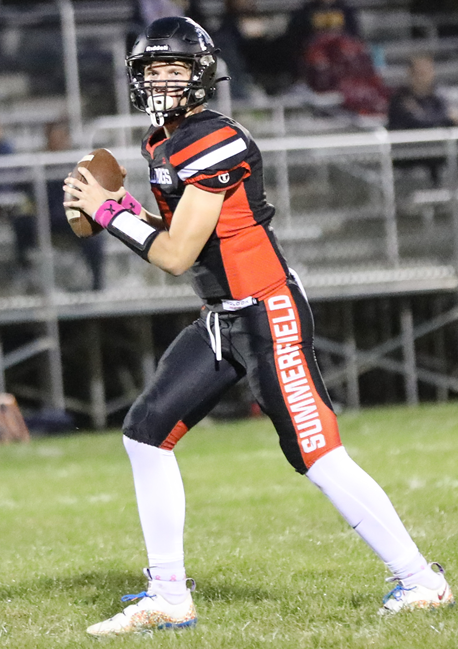
The new offense suits quarterback Trace Secor much better.
“I like this one,” Secor said. “It fits our style of play and the players we have. It complements us.”
Secor has passed for 1,248 yards and 21 touchdowns.
Senior receiver Tyler Dafoe has 743 yards and 12 touchdowns receiving. Bruising tight end Brenden Myshock has six touchdown receptions, and big-play Eli VanHuysen has caught 18 passes for 391 yards and another six touchdowns.
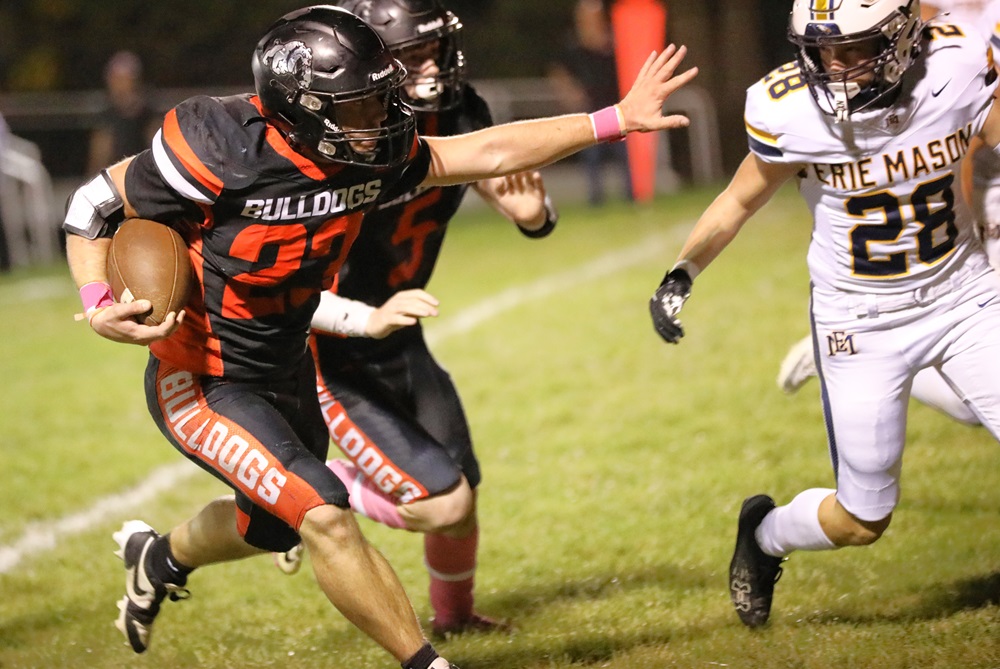
Senior running back Mitchell Gomulinski has had a tremendous season as well. Through nine games, he has rushed for 1,398 yards, averaging more than nine per carry. He has scored 17 touchdowns.
“Mitchell is he is our emotional leader,” Szegedi said. “He keeps everybody going and is the guy the other people look for to set the example. He’s worked very hard. I’m just proud of what he was able to do.”
The Summerfield defense has been rock-solid too. Since halftime of the Whiteford game, the Bulldogs have allowed just two touchdowns over 18 quarters. Gomulinski has 80 tackles. Dafoe and Gabe Ostrosky have five interceptions apiece.
The biggest win came against Whiteford, which played in MHSAA Finals in 2022 and 2023. It propelled the Bulldogs to the Tri-County Conference championship.
“When we beat Whiteford, that really changed the attitude of a lot of our guys,” Szegedi said. “Not that they didn’t believe before, but after that victory, I think we just started believing even more. It gave them affirmation that if we could beat them, we could hang with anybody. It gave them the belief that, ‘Hey, maybe we are pretty good.’”
The community has rallied behind the team. At a watch party Sunday when the MHSAA released the playoff pairings, about 150 parents, students and other community members met in the high school cafeteria.
 “There is talk about how they are going to decorate the town and decorate the stadium,” Szegedi said. “Last Friday the stadium was packed. That’s the way it should be.”
The Oregon, Ohio, native graduated from Toledo St. Francis in 2011 where he played football and was on the Knights swim team. He then continued at Wayne State University and was a two-time Division II national champion diver, earning All-America honors eight times. He was the Great Lakes Intercollegiate Athletic Conference Diver of the Year multiple times and was inducted into the Wayne State Athletic Hall of Fame.
After college he came home and decided he wanted to get into coaching football. He called his former freshman coach at St. Francis, Geoff Skibinski, and joined the coaching staff.
Since then, he and Skibinski have coached at multiple stops together. When Szegedi was hired at Summerfield in 2023, his first call was to Skibinski, who runs the Summerfield offense.
“He and I work well together,” Szegedi said. “We have a good trust in one another.”
Summerfield’s 8-1 record is the best for the school since 2010, which was also the last time the Bulldogs won a conference championship.
Szegedi is glad to see the success the 11 seniors are enjoying.
“These are guys who have played a ton of varsity football,” he said. “It’s fun to see all of the time they spent in the summer running and all of the extra lifting pay off. They are guys who deserve it. They’ve worked very hard and deserve the success they are now experiencing.”
 Doug Donnelly has served as a sports and news reporter and city editor over 25 years, writing for the Daily Chief-Union in Upper Sandusky, Ohio from 1992-1995, the Monroe Evening News from 1995-2012 and the Adrian Daily Telegram since 2013. He's also written a book on high school basketball in Monroe County and compiles record books for various schools in southeast Michigan. E-mail him at [email protected] with story ideas for Jackson, Washtenaw, Hillsdale, Lenawee and Monroe counties.
PHOTOS (Top) Petersburg Summerfield’s Mitchell Gomulinski (23) prepares to take on a defender from Erie Mason this season. (Middle) Bulldogs quarterback Trace Secor considers his options from the pocket. (Below) Summerfield coach Dylan Szegedi. (Action photos by Kendra Dafoe; Szegedi photo by Doug Donnelly.)