


Did you see that? (10/29-11/4)
November 5, 2012
We had champions upon champions upon champions last week, whether they were winners of MHSAA Finals in cross country and soccer, Districts in volleyball or league champs in swimming and diving.
Girls cross country
Favorites make good: Reigning individual champions Erin Finn of West Bloomfield, Julia Bos of Grand Rapids Christian and Kirsten Olling of Breckenridge all repeated Saturday at Michigan International Speedway, with Macomb Lutheran North's Gina Patterson joining the group. Second Half talked to all four. (Division 1) (Division 2) (Division 3) (Division 4)
Boys cross country
Taking two titles: Highland Milford and Concord won both the MHSAA Lower Peninsula team championships in their respective divisions Saturday and also had the top individuals in those races. Second Half provided same-day coverage from every race. (Division 1) (Division 2) (Division 3) (Division 4)
Soccer
Headed west: A year after Detroit-area teams claimed all four MHSAA LP boys soccer championships, Grand Rapids area teams took back three. East Kentwood, Hudsonville Unity Christian and Grand Rapids South Christian won titles, while Hamtramck Freedom International kept one on the east side of the state with its first Finals win. Second Half covered them all. (Division 1) (Division 2) (Division 3) (Division 4)
Volleyball
Hang that banner: Bay City John Glenn won its first volleyball District championship in the 47-year history of the school, beating Essexville-Garber in four sets to claim a Class B title. John Glenn had to come back after dropping the first game. (Bay City Times)
Hang that banner, part II: Three Rivers also won its first volleyball District championship, downing Vicksburg in four games to claim the Class B championship. (Sturgis Journal)
Copper Kings, once again: After finding itself only two points from the District championship in 2011, and then giving up the final five to lose it, Calumet defeated rival Houghton in three games to take back the trophy after two straight Houghton wins. The Copper Kings are ranked No. 4 in Class C. (Houghton Daily Mining Gazette)
West Iron ends near-decade of dominance: Iron River West Iron County had last won a District title in 2002, before nine straight by rival Iron Mountain. But the Wykons knocked out the Mountaineers in a Semifinal and came back from match point to score the final five and beat Ironwood for a Class C championship. (Escanaba Daily News)
Swimming and Diving
Holland still rules: Coming off their first MHSAA championship in 2011, the Dutch continue to roll and piled up seven O-K Green records in winning that league championship meet. Cassie Misiewicz and Holly Morren each set two individual marks. (Holland Sentinel)
Double Dow: Midland Dow won the Saginaw Valley League championship meet with 638 points, more than double that of the runner-up. The title was Dow's seventh straight. (Midland Daily News)
Wrestling
Longtime Napoleon coach steps down: Todd Anderson announced his resignation after running the program since 1990-91. His father Don Anderson started the program in 1967. (Jackson Citizen-Patriot)
Tennis
Forman is Mr. Tennis: Troy senior Brett Forman, the MHSAA Division 1 champion at No. 1 singles as a sophomore and runner-up this fall, was named Mr. Tennis by the Michigan High School Tennis Coaches Association. He finished his career with a 77-8 record. (Oakland Press)
Story of the Week
Kirsten fights on: A little more than a year ago, doctors found cancerous tumors throughout Kirsten Longstreth's body, including multiple in her lungs. But the Beaverton senior had fought back to nearly knock the cancer completely out, and while continuing to play sports including volleyball this fall. (Midland Daily News)
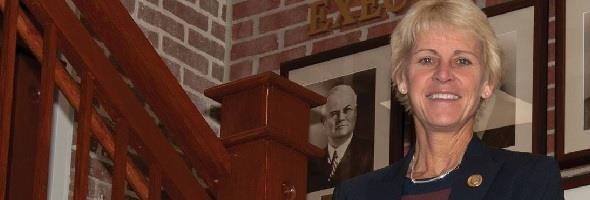
NFHS Voice: March Madness Begins Again
March 4, 2020
By Karissa Niehoff
NFHS Executive Director
The calendar has turned to March, which in the world of high school sports can only mean one thing – Basketball. It is time for state tournaments, March Madness and, yes, the annual rhetoric about the merits of the shot clock.
For the almost one million boys and girls who participate in high school basketball, there is nothing quite like the state tournament. Although there are great memories from the one-class days, led by Carr Creek’s almost upset of powerhouse Ashland in Kentucky in 1928 and Milan’s Cinderella victory in Indiana in 1954, today, basketball provides more opportunities for girls and boys teams to be crowned state champion than any other sport.
This month, about 450 girls and boys teams will earn state basketball titles in championships conducted by NFHS member state associations. Multiple team champions are crowned for both boys and girls in all states but two, with the majority of states sponsoring tournaments in 4-6 classifications for each, and four states conducting state championships in seven classes.
That is truly March Madness, which is appropriate since the term was first used in connection with high school basketball. Although the tag line became familiar to millions on a national scale in relation to the NCAA Division I Men’s Basketball Championship, the NCAA shares a dual-use trademark with the Illinois High School Association (IHSA), thanks to H. V. Porter, the first full-time executive director of the NFHS.
In his final year as IHSA executive director in 1939, Porter published his “March Madness” essay in reference to the mania surrounding the IHSA’s annual state basketball tournament. Eight years later, in a 1947 Associated Press article, Porter said, “Naturally, we think basketball has done a lot for high school kids, but it’s done something for the older people, too. It has made community life in general a lot more fun each winter.”
While many things have changed in the past 73 years, the value of high school sports – and especially state basketball tournaments – remains as strong as ever today. In some states, seemingly the entire community will travel to the site of the state tournament in support of the high school team.
As a footnote to the use of March Madness, Scott Johnson – recently retired assistant executive director of the IHSA in his book “Association Work” – discovered through research that the first recorded mention of March Madness in relation to basketball occurred in 1931 by Bob Stranahan, sports editor of the New Castle Courier-Times in Indiana.
While the sport remains strong and March Madness is set to begin in earnest across the nation, there is a belief by some that the addition of a shot clock would make the game even better.
Although there are some arguments for implementing the shot clock, the
NFHS Basketball Rules Committee, similar to the other 14 NFHS rules committees, must make decisions based on what is best for the masses – the small schools with less than 100 students as well as large urban schools with 3,000-plus students. Rules changes will always be made with considerations for minimizing risks, containing costs and developing rules that are best for high school athletes.
Nine of our member state associations have elected to use a shot clock in their states, which certainly adds to the clamor for its implementation nationally. And, we at the NFHS have read the headlines, seen the social media posts and received the phone calls advocating for the shot clock’s adoption. However, the Basketball Rules Committee will continue to assess the shot clock based on the aforementioned considerations, as well its members representing all areas of the country.
We encourage everyone to support their local high school teams by attending this year’s exciting state basketball tournaments.
Dr. Karissa L. Niehoff is in her second year as executive director of the National Federation of State High School Associations (NFHS) in Indianapolis, Indiana. She is the first female to head the national leadership organization for high school athletics and performing arts activities and the sixth full-time executive director of the NFHS, which celebrated its 100th year of service during the 2018-19 school year. She previously was executive director of the Connecticut Association of Schools-Connecticut Interscholastic Athletic Conference for seven years.