


Did you see that?
May 21, 2012
Track and field, tennis and lacrosse teams have begun their marches toward MHSAA championships, but a number of sports are making offseason news as well.
Here's our sampling of some of the most intriguing from all over the state last week.
Track and Field
Setting up a showdown: In perhaps the most notable race of last week’s Regionals, Birmingham Seaholm’s Aubrey Wilberding edged Southfield’s Latipha Cross in the 400-meter dash in Division 1 at Farmington. Wilberding ran the race in 56.48 seconds, 19 hundredths of a second faster than Cross, who set an all-Finals record in the race in 2011. Click the link next to each Regional site for results. (MHSAA)
Soccer
Shooting for 67: Lake Fenton sophomore Jordan Newman scored a combined eight goals in the semifinal and championship games of the Genesee Area Conference tournament to lead her team to the championship. She has 54 goals this season – only 13 shy of the MHSAA single-season record with Districts beginning next week. (Tri-County Times) (Flint Journal)
KVA belongs to Kalamazoo Christian: The Kalamazoo Valley Association soccer championship came down to two of the top teams statewide in Division 4 – and No. 2 Kalamazoo Christian edged No. 3 Kalamazoo Hackett Catholic Central 1-0 in the final. The two were flip-flopped in the rankings heading into the game. (Kalamazoo Gazette)
Athletes of the Year
Pinning down a major award: St. Johns wrestler Taylor Massa and Rochester Hills Stoney Creek's Gabby Yurik received the annual Michigan Student-Athlete of the Year Awards from the Detroit Athletic Club, from a group of nominees including Holland's Courtney Bartholomew, Birmingham Marian's Jaynie Pulte, Grosse Pointe Woods University Liggett's Madison Ristovski, Plainwell's Lauren Saar and Charlotte's Raychel Wolever, and Grand Blanc's Zachary Carroll, Saginaw Heritage's Evan Chiplock, Bay City Western's Matt Costello, Lowell's Gabe Dean and Oxford's Prescott Line.
Golf
Plymouth rocks: The Wildcats topped a field that included 17 state-ranked teams in claiming the East Lansing Invitational with a two-round score of 595. The tournament was played at Michigan State University’s Forest Akers West and East. Scroll to the bottom of link for full results. (Michigan Interscholastic Golf Coaches Association)
Tennis
Match points: Five of the top seven ranked teams in Division 2 emerged from two suburban Detroit Regionals to advance to the Division 2 Finals: No. 1 Birmingham Marian, No. 2 Bloomfield Hills Andover, No. 3 Birmingham Seaholm and co-No. 7s Bloomfield Hills Lahser and Farmington Hills Marcy. Click next to each Regional site to see who qualified for their respective Finals. (MHSAA)
Softball
Perfect, again: Breckenridge’s Sam Willman threw her fifth perfect game this season, striking out 18 and 64 for the day as her team won the Montrose Snowball Tournament on Saturday. She also threw a perfect game two days before. (Midland Daily News)
Stacking numbers: Decatur senior pitcher Erika Southworth won her 100th game last week, then notched her 1,000th strikeout two days later. (Kalamazoo Gazette)
Basketball
Detroit mourns coach: Southeastern High girls coach Lisa Blackburn died Saturday at the age of 52. She was a former Detroit Pershing star who went on to play at the University of Detroit. (Detroit News)
Stolz legacy ends: Longtime Okemos boys basketball coach Dan Stolz retired with a record of 428-99 and a winning percentage of .812 in 18 seasons at Okemos and five at Williamston. Stolz took over the Chieftains program from his father Stan, who coached the varsity from 1968-93. (Lansing State Journal)
Wrestling
New coach at St. Johns: The reigning three-time Division 2 MHSAA team champion now will be coached by assistant Derek Phillips, who was promoted last week to take over for the recently-resigned Zane Ballard. (Lansing State Journal)
Media
Longtime editor announces retirement: The state’s print media will wave good-bye to another valuable member when longtime Escanaba Daily Press sports editor Denny Grall retires in two months. He’s been putting pen to paper for 42 years and is especially legendary across the Upper Peninsula. (Escanaba Daily Press)
Editor's note: Did we miss something? Comment below and tell us about it. Is there an event coming up that we should make sure to note? Comment or e-mail [email protected].

Red Devils Impress as Ironwood Honors Record-Setter with Jim LaBlonde Invitational
By
John Vrancic
Special for MHSAA.com
May 20, 2024
IRONWOOD — The Ironwood track & field teams provided themselves with an opportunity to do a victory lap on a very special Saturday earlier this month.
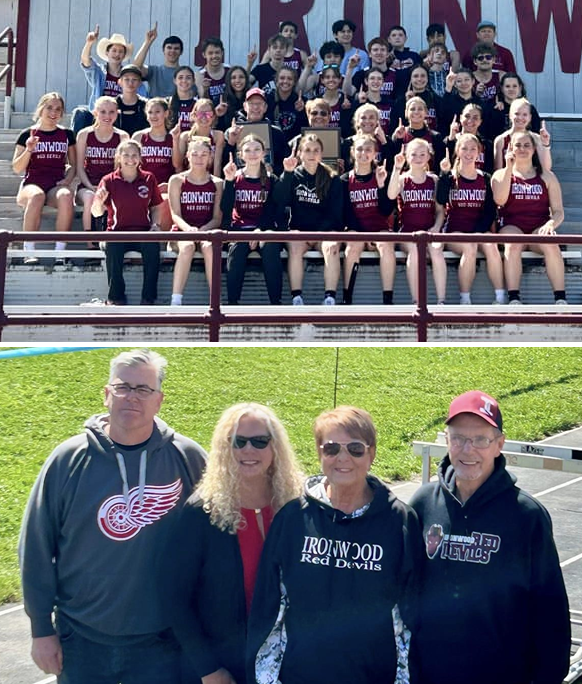
 Both teams were crowned champions at the first Jim LaBlonde Invitational on May 11 on their 350-meter track during a sunny and mild afternoon.
The Ironwood girls scored 126 points, followed by Hurley, Wis., with 43, Ontonagon 37 and Watersmeet with 13. Ironwood’s boys collected 100 points, followed by Hurley at 84, Ontonagon 32 and Watersmeet with seven in a meet held in honor of the former Luther L. Wright High School star athlete who passed away due to an aneurysm on March 31, 2019.
LaBlonde, who was recently inducted into the school’s Hall of Fame, was an all-Upper Peninsula football player and still holds school records in the 100 and 200-meter dashes from his senior year in 1997.
“This is very special to me personally,” Ironwood coach Cecilia Aho said. “Jim was a great person and athlete. I came to Ironwood from Argentina in December 2003 and know the family very well. I had some good conversations with Jim before he passed. This is a great tribute to him. It turned out to be a beautiful day. We had perfect weather and the kids from all four schools were smiling and having fun.
“Jim was well known in the community, not only as a coach, but as a parent. He was a phenomenal runner and football player.”
LaBlonde played football for three years at Wisconsin-LaCrosse and was on the school’s track team for a year while earning his bachelor’s degree in physical education in 2003.
He was a middle school teacher and coach in the Howard-Suamico District near Green Bay, Wis., at the time of his passing.
“He always asked about what was going on in Ironwood and was a good leader,” Aho said. “He would never turn his back on you when you asked him a question. The kids loved him. I wish I would have had a chance to work with him.”
 Senior Aubrey Smith topped a field of four Ironwood runners in the 1600-meter run in 5 minutes, 55.69 seconds, followed by freshman Iyla Lagalo (6:54.08) and sophomore Aubrey Balduc (7:21.16).
Smith also won the 300 hurdles at 52.43, more than six seconds ahead of the rest of the field.
“It was nice to have everyone here,” Smith said. “It’s nice to have a home meet, especially on a Saturday. I think it’s a fun meet. It’s nice to know everyone here. I think this gives me a little momentum going into our remaining meets.”
Sophomore Emma Wardon was also a double winner for the Red Devils, taking shot put (32-11) and discus (87-0).
Ironwood sophomore Logan Holm took the 110 hurdles (20.17) and 300s (48.05), and Hurley had a triple-winner in junior Jeremiah Wallis, who captured the 100 (12.0), 200 (24.52) and long jump (17-3).
Watersmeet junior Thomas Carson won the 400 (54.06), five days after setting the school record (52.31) while placing second in the Welker Invitational at Ashland, Wis. (52.31).
“I strained my hamstring in Ashland,” he said. “It was a little windy up by the big lake (Superior) and there were a lot of good runners up there. I’m probably about 80-90 (percent), but everything went okay. I just wanted to make sure I didn’t overdo it. This is a nice little meet, especially for a Saturday.”
Ontonagon sophomore Violet Amos took the 200 (28.26) and 400 (1:02.03) and was runner-up to Hurley senior Jaana Aukee on a lean (13.65) in the 100.
“I’ve been in the 27s in the 200, but I’m very happy with my time in the 400” Amos said. “This being a little smaller track was probably a factor because the curves are a little tighter. I prefer to run a 400-meter track, although I like the running surface and competition.
“It’s always fun to come here. Our track is getting resurfaced. I’m looking forward to running on it the next couple years.”
Ontonagon coach Brian Amos said he also enjoys going to Ironwood.
“Ironwood runs a nice meet, and we get a chance to see Hurley,” he added. “It’s always nice to run against somebody different.”
 John Vrancic has covered high school sports in the Upper Peninsula since joining the Escanaba Daily Press staff in 1985. He is known most prominently across the peninsula for his extensive coverage of cross country and track & field that frequently appears in newspapers from the Wisconsin border to Lake Huron. He received the James Trethewey Award for Distinguished Service in 2015 from the Upper Peninsula Sportswriters and Sportscasters Association.
PHOTOS (Top) Ribbons and medals are set out to be awarded during the first Jim LaBlonde Invitational at Ironwood. (Middle) The Ironwood teams take a photo together, at top, after sweeping the meets. Below, from left, LaBlonde’s brother-in-law Dave Lundin, sister Dena Lundin and parents Marlene and Jim LaBlonde attend the meet. (Photos provided by the Ironwood Red Devil Booster Club.)