


Did you see that?
May 21, 2012
Track and field, tennis and lacrosse teams have begun their marches toward MHSAA championships, but a number of sports are making offseason news as well.
Here's our sampling of some of the most intriguing from all over the state last week.
Track and Field
Setting up a showdown: In perhaps the most notable race of last week’s Regionals, Birmingham Seaholm’s Aubrey Wilberding edged Southfield’s Latipha Cross in the 400-meter dash in Division 1 at Farmington. Wilberding ran the race in 56.48 seconds, 19 hundredths of a second faster than Cross, who set an all-Finals record in the race in 2011. Click the link next to each Regional site for results. (MHSAA)
Soccer
Shooting for 67: Lake Fenton sophomore Jordan Newman scored a combined eight goals in the semifinal and championship games of the Genesee Area Conference tournament to lead her team to the championship. She has 54 goals this season – only 13 shy of the MHSAA single-season record with Districts beginning next week. (Tri-County Times) (Flint Journal)
KVA belongs to Kalamazoo Christian: The Kalamazoo Valley Association soccer championship came down to two of the top teams statewide in Division 4 – and No. 2 Kalamazoo Christian edged No. 3 Kalamazoo Hackett Catholic Central 1-0 in the final. The two were flip-flopped in the rankings heading into the game. (Kalamazoo Gazette)
Athletes of the Year
Pinning down a major award: St. Johns wrestler Taylor Massa and Rochester Hills Stoney Creek's Gabby Yurik received the annual Michigan Student-Athlete of the Year Awards from the Detroit Athletic Club, from a group of nominees including Holland's Courtney Bartholomew, Birmingham Marian's Jaynie Pulte, Grosse Pointe Woods University Liggett's Madison Ristovski, Plainwell's Lauren Saar and Charlotte's Raychel Wolever, and Grand Blanc's Zachary Carroll, Saginaw Heritage's Evan Chiplock, Bay City Western's Matt Costello, Lowell's Gabe Dean and Oxford's Prescott Line.
Golf
Plymouth rocks: The Wildcats topped a field that included 17 state-ranked teams in claiming the East Lansing Invitational with a two-round score of 595. The tournament was played at Michigan State University’s Forest Akers West and East. Scroll to the bottom of link for full results. (Michigan Interscholastic Golf Coaches Association)
Tennis
Match points: Five of the top seven ranked teams in Division 2 emerged from two suburban Detroit Regionals to advance to the Division 2 Finals: No. 1 Birmingham Marian, No. 2 Bloomfield Hills Andover, No. 3 Birmingham Seaholm and co-No. 7s Bloomfield Hills Lahser and Farmington Hills Marcy. Click next to each Regional site to see who qualified for their respective Finals. (MHSAA)
Softball
Perfect, again: Breckenridge’s Sam Willman threw her fifth perfect game this season, striking out 18 and 64 for the day as her team won the Montrose Snowball Tournament on Saturday. She also threw a perfect game two days before. (Midland Daily News)
Stacking numbers: Decatur senior pitcher Erika Southworth won her 100th game last week, then notched her 1,000th strikeout two days later. (Kalamazoo Gazette)
Basketball
Detroit mourns coach: Southeastern High girls coach Lisa Blackburn died Saturday at the age of 52. She was a former Detroit Pershing star who went on to play at the University of Detroit. (Detroit News)
Stolz legacy ends: Longtime Okemos boys basketball coach Dan Stolz retired with a record of 428-99 and a winning percentage of .812 in 18 seasons at Okemos and five at Williamston. Stolz took over the Chieftains program from his father Stan, who coached the varsity from 1968-93. (Lansing State Journal)
Wrestling
New coach at St. Johns: The reigning three-time Division 2 MHSAA team champion now will be coached by assistant Derek Phillips, who was promoted last week to take over for the recently-resigned Zane Ballard. (Lansing State Journal)
Media
Longtime editor announces retirement: The state’s print media will wave good-bye to another valuable member when longtime Escanaba Daily Press sports editor Denny Grall retires in two months. He’s been putting pen to paper for 42 years and is especially legendary across the Upper Peninsula. (Escanaba Daily Press)
Editor's note: Did we miss something? Comment below and tell us about it. Is there an event coming up that we should make sure to note? Comment or e-mail [email protected].
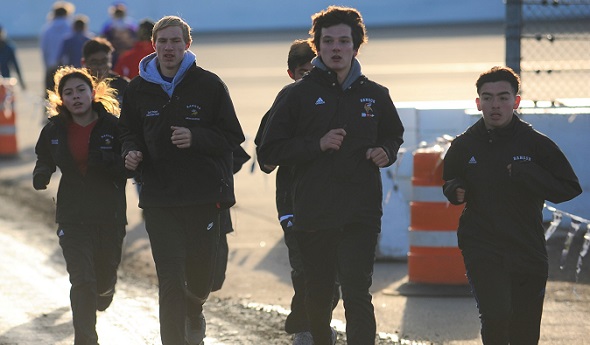
Workout Basics: Warm-Ups & Cool-Downs
February 3, 2021

By Nick Parkinson, M.Ed., AT, ATC, TSAC-F
Henry Ford Health Systems
You may know a good warm-up — and cool-down — are essential to getting a good workout. You may also know that warming up your muscles and stretching them out after exercise can help prevent injury and keep you at the top of your game.
They’re the two bookends that help maximize a workout. Unfortunately, a lot of exercise enthusiasts don’t know how to warm up and cool down correctly.
Warm-Up Basics
A warm-up is exactly what it sounds like: The goal is to warm up your muscles and prepare your body for whatever you’re asking it to do. Warming up increases your body temperature and helps blood flow to the muscles that you’re using.
So if you’re going to play soccer, your warm-up should touch all of the muscles in your legs and core. Shooting hoops? You’ll need to add shoulders and arms to your routine. Circuit training at the gym? Choose a warm-up that flexes all of the muscles you’re about to use.
The thing that all warm-ups have in common is that they require dynamic (or constantly moving) motion, not static stretching (holding poses for a certain amount of time). In fact, static stretching prior to a workout can inhibit power and strength, especially if you’re doing something like weightlifting.
The anatomy of a solid warm-up:
• Before any activity, do about 10 minutes of light cardiovascular activity, whether walking, biking or jogging.
• Dynamic stretches. After you get your muscles moving, do a series of lunges, jumping jacks or toe touches to stretch a bit.
• Dive in. When you start your workout, begin slowly and gradually increase power and speed.
Cool-Down Basics
After you’ve put your body through a challenge, a good cool-down is essential. It helps slow down your heart rate gradually, relax your muscles and stretch them out.
Cool-down routines should always include some type of motion before you get to static stretching, especially if you’ve just finished a high-intensity workout. Static stretching improves flexibility and performance and it can also help stave off future injury.
As with warm-ups, the right cool-down exercises depend on the activity you engaged in. If you biked for 20 miles, you might coast on your cycle for a while before coming to a stop. If you ran, you might jog or walk before you begin stretching. As with your warm-up, the key is addressing every muscle group you worked during your workout.
The anatomy of a solid cool-down:
• At the end of your workout, slow the pace and intensity of whatever activity you’re doing. So, if you’re running, slow to a jog and then a walk for 5 to 10 minutes before stopping.
• Stretch out the muscles you work, but don’t push past the point where you feel tight. Then, hold the position for at least 30 seconds. That’s how long it takes for the body to overcome its stretch reflex.
• Breathe through your stretches and make sure to finish your cool-down with deep, belly breaths.
Running short on time? Target muscle groups you may have injured in the past or that tend to get sore after activity. Cooling down will preserve your athleticism — and your ability to participate in daily activities — over the long term.
Be Good to Your Body
While there’s some controversy about whether warming up and cooling down can help prevent injury, there’s little dispute that they can help you ease in and out of activity.
The key is to find something that works for you. Your warm-up could be as simple as walking to the gym and doing a set of jumping jacks when you arrive. Your cool-down might just involve ending your workout 10 minutes early so you can slow down.
It doesn’t have to be complicated. It just has to give your heart and blood vessels a chance to breathe before and after activity.
Nick Parkinson, M.Ed., AT, ATC, TSAC-F, is the Supervisor of Athletic Training with Henry Ford Sports Medicine and also leads Sports Performance training at the William Clay Ford Center for Athletic Medicine. Learn more about Nick.
Want to learn more? Henry Ford Health System sports medicine experts are treating the whole athlete, in a whole new way. From nutrition to neurology, and from injury prevention to treatment of sports-related conditions, they can give your athlete a unique game plan.
Visit henryford.com/sports or call (313) 972-4216.