


Did you see that?
May 29, 2012
The last full week of May usually represents the calm before the storm, at least relatively speaking, that is the MHSAA Spring Finals.
Although the weekend is generally one of the calmest of the season, the week was again filled with local championships, plus the start of lacrosse Regional play.
Here’s our look at some of the highlights from May 21-26:
Track and Field
All Tech in the PSL: Detroit Cass Tech’s girls and boys teams swept the Detroit Public School League championships Thursday, finishing ahead of Renaissance atop the standings in both meets. The girls are the reigning MHSAA Division 1 runner-up and led by senior Kyra Jefferson, who will run at the University of Florida next season. The boys team has hints of the team that won the MHSAA Division 1 football championship in the fall – this team also is coached by Thomas Wilcher, and quarterback Jayru Campbell was among those who shined. (Detroit News)
Still Hornets, with a side of Cougars: In a matchup of two of the best in Michigan from Divisions 2 and 3, the Williamston boys and girls again won Capital Area Activities Conference White championship meet titles -- with Lansing Catholic's boys then splitting the overall league title with Williamston. The Hornets boys are ranked No. 3 in Division 2 and the Cougars are No. 1 in Division 3. Williamston and Lansing Catholic's girls are both ranked No. 5 in their respective divisions. (Lansing State Journal)
Soccer
Okemos claims Gold: The Lansing area boasts top-four ranked teams in all four divisions, and two met for the CAAC Gold Cup championship Thursday – with Division 1 No. 2 Okemos downing Division 2 No. 4 DeWitt 3-1. The CAAC Cup pulls teams from each of its four divisions into a series of tournaments, based on league standings, with the top teams from each division playing for the Golf Cup. To advance to the championship game, DeWitt downed Division 3 No. 3 Williamston in a semifinal, while Okemos beat Division 2 honorable mention Mason. (Lansing State Journal)
Lacrosse
Final countdown: Girls and boys teams statewide began Regionals, with those finishing up this weekend. Of the few early games, the most significant might’ve been in Division 2 girls, where No. 9 Farmington Hills Mercy defeated Ann Arbor Skyline 18-6. (Observor & Eccentric)
Golf
Best by the Bay: For the first time in 18 seasons, Essexville-Garber won the Bay County Invitational, which matches teams from the Bay City area including larger Bay City Central and Western. (Bay City Times)
Fennville
Wes remembered: When Fennville’s Class of 2012 walked Thursday, Wes Leonard was with them. This year’s commencement included a remembrance of the standout, who died on March 3, 2011, as a junior, of cardiac arrest moments after hitting the game-winning shot for his basketball team. Classmate and close friend Selena Beltran-Pena walked with an additional cap, for Leonard, with accompanied by Leonard’s younger brother Mitchell. (Holland Sentinel)
Editor's note: Did we miss something? Comment below and tell us about it. Is there an event coming up that we should make sure to note? Comment or e-mail [email protected].
Century of School Sports: Why Does the MHSAA Have These Rules?
By
Geoff Kimmerly
MHSAA.com senior editor
September 18, 2024
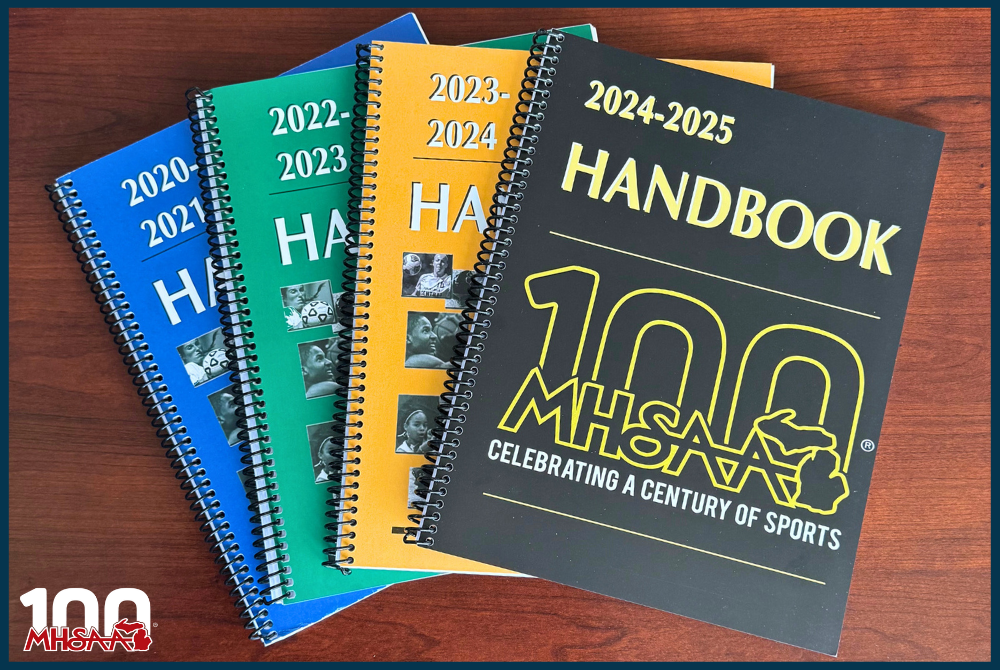
MHSAA administrators are two trips into their annual seven-stop fall tour that has become a tradition during nearly half of the Association’s “Century of School Sports” – and this year, a focus has been on answering a key question at the heart of educational athletics since long before the MHSAA was formed during the 1924-25 school year.
The MHSAA’s Update meeting series is in its 47th year and includes half-day conferences in seven locations – generally in the Kalamazoo, Metro Detroit, Grand Rapids, Saginaw, northern Lower Peninsula and mid-Michigan areas, and at Northern Michigan University in Marquette. The six Lower Peninsula sessions begin with an athletic director in-service during which MHSAA assistant directors explain recent rules changes and discuss challenges our administrators face on a daily basis (with Upper Peninsula athletic directors participating in a similar in-service during the spring).
Those in-services are followed by a session with executive director Mark Uyl, who speaks to athletic directors, superintendents, principals and school board members on a variety of topics including the MHSAA’s current objectives and ideas for the future, while also reinforcing the longstanding values that remain the bedrock of our daily work.
And that leads to the question he’s presenting across the state this fall:
Why does the MHSAA have these rules?
Frankly, the answer goes back to the beginning of school sports in Michigan – all the way back to 1895, when the first MHSAA predecessor organization was formed.
The first MHSAA Representative Council president Lewis L. Forsythe explained in his book “Athletics in Michigan High Schools – The First Hundred Years” how regulations always have been necessary:
“Eligibility rules are a necessity in interscholastic competition. It was common acknowledgement of this fact that led to the first State inter-school organization in 1895. The rules at first were few, simple and liberal. But with the passing of the years they came to be more numerous, more complex, and more restrictive, again through common acknowledgment of desirability if not of necessity.”
That necessity – and the reasoning behind it – has not changed.
Two main points explain why rules are absolutely imperative for educational athletics to thrive.
► 1. Participation – through providing as many opportunities as possible for students to play – has been the mission of school sports since their start. Rules contribute to the value of participation.
If there are requirements for children to participate in athletics – for example, an academic standard or rules that dissuade students from switching schools every year – then school sports programs mean more to all involved.
If we raise the bar, raise the standards of eligibility and conduct, we raise the value of our school sports programs. If we lower the bar, we lower the value of being part of school sports – because without rules, contest results are meaningless, and the value of participating is diminished.
► 2. We have rules where the stakes are higher, and agreement is lower – because where the stakes are highest, there is the greatest tendency for some people to try to gain an unfair advantage, and the greatest need for rules to curb possible dishonest activity.
This statement goes to the heart of the history, rationale and application of MHSAA rules. Obviously and simply put, school sports mean a lot to those who take part, and that significance is high enough to stoke disagreement – and we need rules to govern those disagreements. We have the most rules for high school sports, where championships are at stake and the possibility of disagreement is greatest.
***
Finally – and perhaps providing the strongest reinforcement of the two points above – is this:
Schools choose to make MHSAA rules their own.
Quite literally, school districts vote annually to be part of the MHSAA – and confirming this voluntary membership comes with the requirement to follow all MHSAA rules.
When schools challenge our rules, they literally are seeking to break the rules they already have committed to uphold.
These rules, and this commitment, are the strength of our organization across 752 member high schools and several hundred more middle schools and junior high schools. They have been constructed on a century of precedents and after considerations by representatives of those same member schools – representatives those schools have voted to elect every school year during the MHSAA’s history.
Previous "Century of School Sports" Spotlights
Sept. 10: Special Medals, Patches to Commemorate Special Year - Read
Sept. 4: Fall to Finish with 50th Football Championships - Read
Aug. 28: Let the Celebration Begin - Read