


Did you see that?
June 4, 2012
Saturday annually is the busiest high school sports day on the MHSAA calendar.
The Spring Finals match began with Girls and Boys Track and Field and Girls Tennis Finals at sites all over both peninsulas. There were Regionals for both boys and girls lacrosse, which finish up this weekend. And, of course, there were Districts galore for softball, baseball and girls soccer.
Here's our sampling of some of the highlights:
Girls Track and Field
19 records fall: It was quite day across the seven MHSAA Girls Track and Field Finals, with 19 records broken, and two athletes – Reed City’s Sami Michell and Norway’s Dani Gagne – winning four individual events apiece. (Second Half)
Coast to coast: The Grosse Pointe South 3,200 relay was responsible for one of two all-Finals records, and ran a time of 8:48.29 that also surpassed the national record for that event (but may or may not stand as the national record, depending on what other times were run and will be submitted after this spring.) (Detroit Free Press)
Boys Track and Field
LP filled with first-time champs: Lake Orion in Division 1, Auburn Hills Avondale in Division 2 and Lansing Catholic in Division 3 won their first MHSAA team championships. Also, nine records fell across the state. (Second Half)
Quite a comeback: Marquette trailed Gladstone by 27 points at the Upper Peninsula Division 1 Final with four events to run. But the Redmen outscored Gladstone 42-0 over those events to win their third straight championship. (Marquette Mining Journal)
Girls Tennis
Southeast sweep: Detroit suburban schools claimed all four MHSAA Lower Peninsula team championships – Grosse Pointe South in Division 1, Birmingham Seaholm in Division 2, Bloomfield Hills Cranbrook-Kingswood in Division 3 and Bloomfield Hills Academy of the Sacred Heart in Division 4. (Second Half)
Freshman reigns: Utica freshman Davina Nguyen beat both the first and second seeds on her way to claiming the individual championship at No. 1 singles in Division 1. Nguyen was seeded fifth. (Macomb Daily)
Boys lacrosse
Cranbrook comes out on top: Cranbrook-Kingswood, ranked No. 3 in Division 2, emerged from a Regional that also included No. 4 Haslett/Williamston and No. 5 East Grand Rapids, beating the latter 8-4 in the Final. (Bloomfield Patch)
Girls lacrosse
EGR plays to top ranking, again: Rivals East Grand Rapids and Grand Rapids Catholic Central met in one of the multiple close Regional Finals, with the top-ranked Pioneers downing No. 2 GRCC one more time, 11-9. (Grand Rapids Press)
Baseball
It’s Holt, again: The Rams claimed their second championship in a week over rival Grand Ledge – both have been ranked in Division 1 this season. Two weeks ago, Holt split with the Comets to win the Capital Area Activities Conference Blue. Standout Justin Alleman gave up two hits and struck out 18 as Holt also won Saturday to claim a District title. (Lansing State Journal)
Softball
In the end, it’s Mattawan: The season-long battle for statewide Division 1 and Kalamazoo-area supremacy was decided in part at Saturday’s District at Portage Central. Reigning MHSAA champion Mattawan emerged as the winner from a field that included top-ranked Portage Central – which was upset by Kalamazoo Loy Norrix in a semifinal. (Kalamazoo Gazette)
Soccer
AAGR moves on: Ann Arbor Gabriel Richard, No. 8 in Division 3, shut out No. 7 Jackson Lumen Christi 3-0 in the Division 3 District final at Brooklyn Columbia Central (AnnArbor.com)
Hastings Relays Reigns as State's Oldest Continuous Track & Field Meet
By
Steve Vedder
Special for MHSAA.com
April 10, 2024
Bob Branch remembers dabbling in other sports, but his first love was always running.
 The Hastings High School graduate admits he could never hit a baseball, football didn't especially appeal to him and basketball was just another way to spend time with friends. But for Branch, now 93, there was always track. That's the sport where his fondest and sharpest memories remain. And if you're talking track, many of his favorite memories come from participation in the state's oldest continuous track meet, the Hastings Relays.
Always held in early April, the meet dates back to 1937 – a bygone time that saw the first hostilities of World War II, gas at 20 cents a gallon and a loaf of bread selling for a dime.
And at a dusty old track surrounding the county fairgrounds in Hastings, a small relay event that included a scattering of participants from a dozen high schools was taking its first tentative steps.
Branch recalls a time when kids would run home after track practice because there were no buses, inexperienced young coaches had little actual knowledge of running fundamentals, and athletes looked at the sport as an afterthought after spending most of their high school days playing football and basketball.
 For Branch, the relays were the ideal way to ease into the track season.
"I just liked to run," said Branch. "I remember I anchored a relay with my brother, and it always seemed cold when we had that meet. I remember teams would come from all over and you saw a lot of good athletes. Everybody seemed to have someone who was really good. Track wasn't very popular at that time, but I have a lot of good memories from running."
The Hastings Relays, which has changed formats and even names during its nearly nine-decade history, would traditionally kick off the track season. The meet was originally held at a makeshift quarter-mile track which surrounded the town's fairgrounds and was part of the city's annual Hastings Carnival – the track would become the midway during fair time.
The meet eventually moved to Johnson Field when the football field was dedicated in 1949 and ballooned to as many as 50 teams at its peak in 1957. For more than seven decades it was known as the Hastings Relays and then the Hastings Co-Ed relays before becoming the current Hastings Invitational, with the latest edition scheduled for Friday.
Johnson Field had a cinder track before it became an all-weather surface in the 1980s. During a time long before computers would be used to organize meet heats in mere minutes, Hastings coaches of all sports – defined as "volunteers" by the athletic department – would meet on the Friday before competition to hash out events.
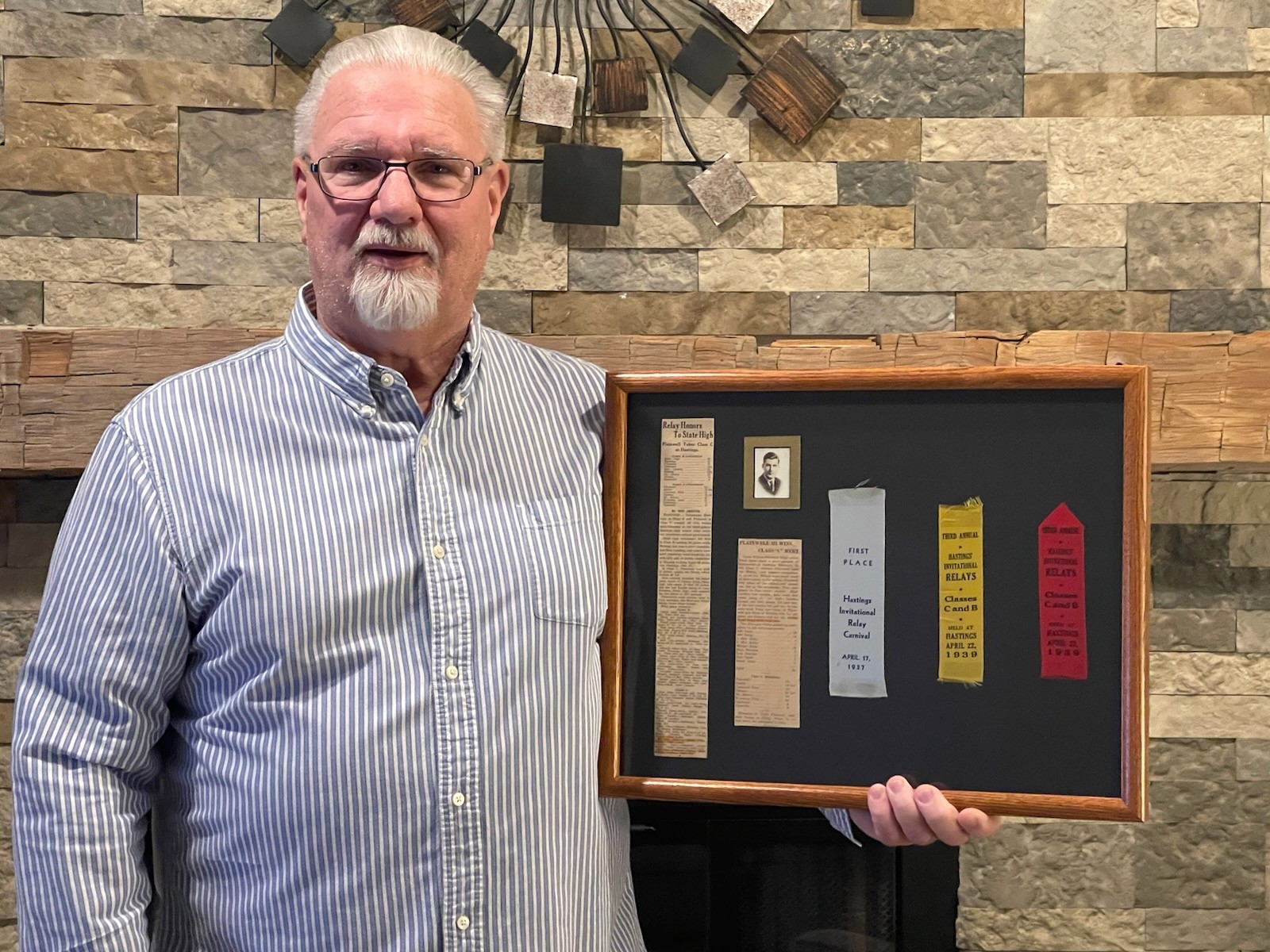
People associated with the meet still recall the camaraderie built on those long Friday nights, followed by working what would often become 10-hour meets. Steve Hoke has been involved since watching his father, Jack, who coached teams at 15 of the meets beginning in 1951 and also had run in the first Hastings Relays. Steve Hoke later competed in the Relays as well during the early 1970s before becoming an assistant track coach, later the Hastings athletic director and now a volunteer worker.
"It was always a huge deal," said Hoke, who said the meet began as a pure relay event before transitioning to its current team format in the 1990s. "I remember we'd line the track the night before, and all the coaches would come to the house to organize everything. There was a brotherhood.”
 If you quiz many of the fleet of volunteers who've worked the relays over the years, each has a different memory from the meet. While Hoke describes the brotherhood and Branch the outstanding competition, others remember weather and the time a thunderstorm wiped out the line markings on the cinder track, or waking up to find three inches of snow that caused a rare cancellation of the meet. Others recall the shock of moving from the cinder to all-weather track or using the meet as an early measuring stick of what it would take to qualify for the state meet. The real old-timers remember the meet disappearing for three years during World War II.
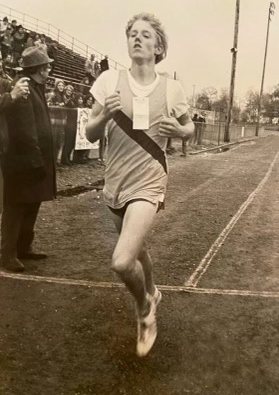
Hastings native and Western Michigan grad Tom Duits was the state’s second collegian to break the four-minute mile when he ran a 3:59.2 at a meet in Philadelphia in 1978. Duits, who ran in three Hastings Relays, was in line to join the U.S. Olympic team in 1980 before the United States pulled out of the games due to tension with Russia.
Duits has his own memories of the meet and the competition he faced there.
"I remember sunshine and being excited to be competing again. There were all these athletes swarming around; it was an awesome display of talent," he said. "It was always one of the best meets we'd be in. You could pretty much see the level of runners who would be at state, which made it a big deal. It was always early, but you could tell where you stood. It was great exposure."
Hastings track star Wayne Oom competed in four Hastings Relays from 1984-87. One of his sharpest memories was the difference between running on a raw cinder track versus the far more comfortable all-weather surface.
"Those cinders would grind into your skin," said Oom, part of the Hastings school record in the two-mile relay. "But I think it helped us because when we'd go to other tracks, it seemed we would run faster. I remember how competitive it was, especially in the distances. There were some great runners."
While participants have their unique memories, so do coaches. Former Saxons coach Paul Fulmer remembers 2008 when his team finished first on the boys side of the meet while his wife, Grand Haven coach Katie Kowalczyk-Fulmer, saw her girls team win the championship.
 "I knew we were one of the favorites to win because we were usually near the top of our conference and Regional," he said. "But then Katie's team was pretty good, and it was cool for them to win too."
Fulmer, who coached Hastings from 1978-81 and then 1985-2010, said at least part of the meet's popularity was derived from a unique way of scoring. Instead of individuals earning points solo, participants worked in pairs. For instance, two athletes would combine their shot put or long jump scores. New events such as the 1,500 relay and sprint medley were added.
"We had a tradition of being the state's oldest meet, and that was a big deal," Fulmer said. "And we ran a good relay; that attracted teams too. We took a lot of pride in that.
"And we'd get quite a lot of people to come to the meet. We'd set up until like 9 or 10 p.m., and then we'd have a party with all the coaches on Friday night."
While the meet has stretched 87 years, Branch said early participants and current runners have one thing in common: a drive to win. Branch ran in an era when the popularity of high school track was in its infancy. Today some of the best all-around athletes at a school are involved in the track program. The relays span the nearly nine decades in between.
"The quality of teams has gotten better and better," said Branch, the 1947 Lower Peninsula Class B Finals champ in the 220. "And this has made for a better meet. We would get guys who played football or baseball kind of drift into track, and that made the sport better. I think people began to appreciate track because we'd get teams from all over.
"We went from not really knowing what we were doing to track being a good sport. Even then, I'm not sure we appreciated what we had. We really liked the Hastings Relays and always wanted to do well there. It became popular and quite an honor to do well. Those are the kind of things I remember."
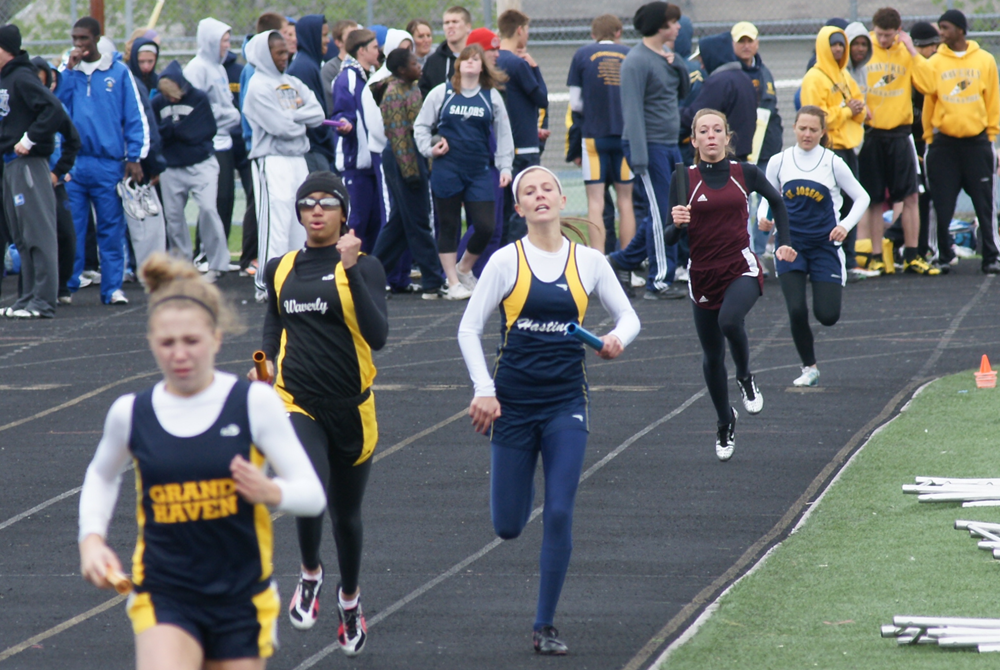
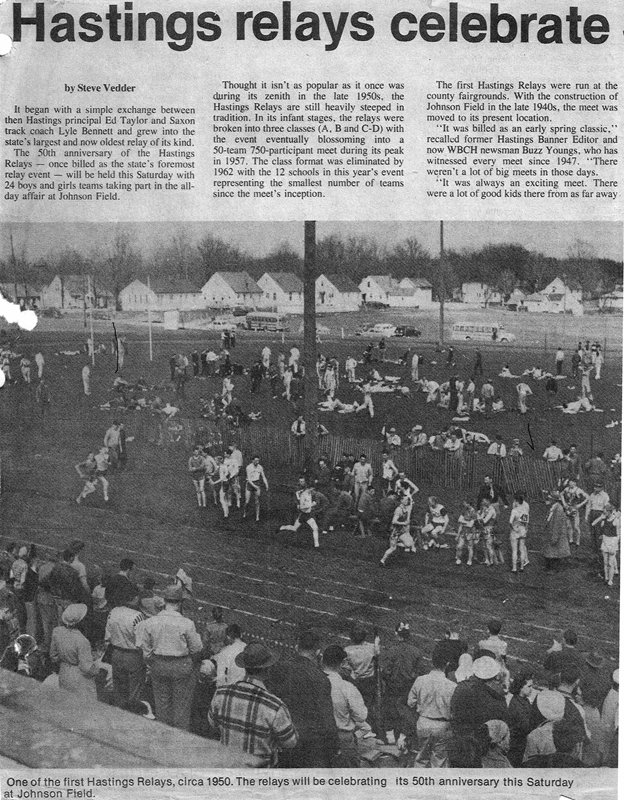
PHOTOS (Top) Racers run at the Hastings Relays, with several more awaiting their turns to compete at the longtime meet. (2) The author wrote on the 50th anniversary of the Relays for the Hastings Banner nearly 40 years ago. (3) Past athlete, coach and athletic director Steve Hoke shows some of the Relays awards from the 1930s. (4) Tom Duits was one of the state’s biggest track stars of the 1970s and ran in three Hastings Relays. (Top photo by Dan Goggins, Hoke photo provided by Steve Hoke and Duits photos provided by Tom Duits.)