


Did you see that?
June 4, 2012
Saturday annually is the busiest high school sports day on the MHSAA calendar.
The Spring Finals match began with Girls and Boys Track and Field and Girls Tennis Finals at sites all over both peninsulas. There were Regionals for both boys and girls lacrosse, which finish up this weekend. And, of course, there were Districts galore for softball, baseball and girls soccer.
Here's our sampling of some of the highlights:
Girls Track and Field
19 records fall: It was quite day across the seven MHSAA Girls Track and Field Finals, with 19 records broken, and two athletes – Reed City’s Sami Michell and Norway’s Dani Gagne – winning four individual events apiece. (Second Half)
Coast to coast: The Grosse Pointe South 3,200 relay was responsible for one of two all-Finals records, and ran a time of 8:48.29 that also surpassed the national record for that event (but may or may not stand as the national record, depending on what other times were run and will be submitted after this spring.) (Detroit Free Press)
Boys Track and Field
LP filled with first-time champs: Lake Orion in Division 1, Auburn Hills Avondale in Division 2 and Lansing Catholic in Division 3 won their first MHSAA team championships. Also, nine records fell across the state. (Second Half)
Quite a comeback: Marquette trailed Gladstone by 27 points at the Upper Peninsula Division 1 Final with four events to run. But the Redmen outscored Gladstone 42-0 over those events to win their third straight championship. (Marquette Mining Journal)
Girls Tennis
Southeast sweep: Detroit suburban schools claimed all four MHSAA Lower Peninsula team championships – Grosse Pointe South in Division 1, Birmingham Seaholm in Division 2, Bloomfield Hills Cranbrook-Kingswood in Division 3 and Bloomfield Hills Academy of the Sacred Heart in Division 4. (Second Half)
Freshman reigns: Utica freshman Davina Nguyen beat both the first and second seeds on her way to claiming the individual championship at No. 1 singles in Division 1. Nguyen was seeded fifth. (Macomb Daily)
Boys lacrosse
Cranbrook comes out on top: Cranbrook-Kingswood, ranked No. 3 in Division 2, emerged from a Regional that also included No. 4 Haslett/Williamston and No. 5 East Grand Rapids, beating the latter 8-4 in the Final. (Bloomfield Patch)
Girls lacrosse
EGR plays to top ranking, again: Rivals East Grand Rapids and Grand Rapids Catholic Central met in one of the multiple close Regional Finals, with the top-ranked Pioneers downing No. 2 GRCC one more time, 11-9. (Grand Rapids Press)
Baseball
It’s Holt, again: The Rams claimed their second championship in a week over rival Grand Ledge – both have been ranked in Division 1 this season. Two weeks ago, Holt split with the Comets to win the Capital Area Activities Conference Blue. Standout Justin Alleman gave up two hits and struck out 18 as Holt also won Saturday to claim a District title. (Lansing State Journal)
Softball
In the end, it’s Mattawan: The season-long battle for statewide Division 1 and Kalamazoo-area supremacy was decided in part at Saturday’s District at Portage Central. Reigning MHSAA champion Mattawan emerged as the winner from a field that included top-ranked Portage Central – which was upset by Kalamazoo Loy Norrix in a semifinal. (Kalamazoo Gazette)
Soccer
AAGR moves on: Ann Arbor Gabriel Richard, No. 8 in Division 3, shut out No. 7 Jackson Lumen Christi 3-0 in the Division 3 District final at Brooklyn Columbia Central (AnnArbor.com)
50 Years Later, 'Charlie' Remains Legendary
By
Ron Pesch
MHSAA historian
September 30, 2018
There is no official record of the proceedings, only a short newspaper recap of the event that was hosted 50 years ago at Michigan State’s Kellogg Center. In attendance was a who’s who of high school sports administrators. They were there to honor the man, affectionately known to his friends as “Charlie.”
A parade of guests presented gifts and citations, then sang his praises.
Dr. Clifford Fagan, Executive Secretary of the National Federation of High School Athletics, attended. State Directors of Athletics from Indiana and Ohio were on hand for the Monday, October 7, 1968, celebration.
Dr. Ira Polly, State Superintendent of Public Instruction, called him “noble, honest and courageous.” John F. Toepp, a state senator and radio sports broadcaster from the Cadillac area, “hailed him as ‘Mr. High School Athletics.’”
Sportswriter Bob Gross, six years into his career at the Lansing State Journal, wrote that Charles E. Forsythe, seated next to his wife Josephine, “only grinned with each word of gratitude.”
More than 350 friends attended the testimonial dinner, honoring the second director of the Michigan High School Athletic Association upon his retirement. For 39 years, Forsythe had served the MHSAA, dedicated to bettering the world of high school sports in Michigan and beyond. His years of service would formulate the mold for those who would follow in his footsteps.
“For five minutes they applauded,” wrote Gross, capturing the moment. Forsythe was humbled by the appreciation. When it was his turn to speak, he thanked the assembled crowd.
 “This is a great night. It’s just wonderful so many of you came to my party. I’m deeply honored,” Forsythe said. “I can’t stand here and accept all the thanks. It was teamwork that made our organization go. And, may I ask of all of you to please help make it grow bigger and better than it is.”
The MHSAA had announced Forsythe’s retirement in late May.
With the exception of a 39-month tour as a Navy Commander, assisting former heavyweight boxing champion Gene Tunney in directing Navy physical fitness activities during World War II, Forsythe had been with the Association since July of 1929, originally as an assistant to Alden W. Thompson, the first director of the MHSAA. (Forsythe remains considered the Association’s first fulltime executive director.)
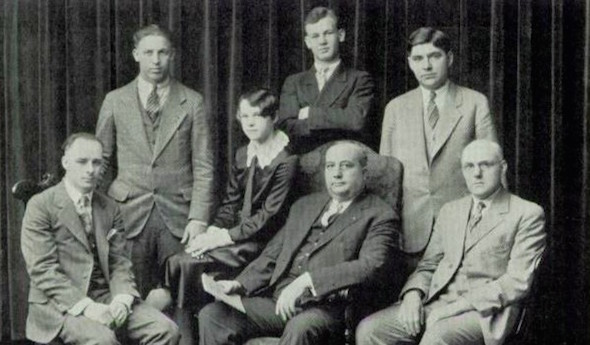
A graduate and prominent athlete at Milan High School, Forsythe earned his undergraduate degree from Michigan State Normal College (today’s Eastern Michigan University) in 1920 and his Master of Arts degree from the University of Michigan in 1926. He coached basketball and baseball at Milan High School during 1922-23 and taught science. He moved to Lansing Central High School the following year, where he taught history. In the fall of 1926, Forsythe was named director of athletics. According to news reports, he was also “one (of) the leading high school football and basketball officials in the state, working in the district and regional basketball tournaments …”
In his introduction of Forsythe as his new assistant, Thompson said “his presence in this office will make it possible to extend the service rendered by the State Association for the ultimate good of the athletic program throughout the state. The growth of the basketball tournaments, the addition of regional track meets as well as tournaments in tennis and golf, and state association participation in swimming and cross country have all added to the details of business handled through the office of the state director …”
In his book, “Athletics in Michigan High Schools: The First Hundred Years” published in 1950, Lewis L. Forsythe noted that additional help definitely was needed. The elder Forsythe, who was Charles’ uncle, was principal of Ann Arbor High School from 1917 until his retirement in 1946. He twice had served as president of the Michigan Interscholastic Athletic Association, the predecessor to the MHSAA. Elected president of the MHSAA Representative Council in 1924, Lewis Forsythe continued serving in that role until 1942. He had seen, first-hand, Thompson’s need for help.
 “Ever since the new association was organized, it had been the wonder of every informed person that Mr. Thompson could stand up under the strain of the work he felt compelled (or impelled) to do. We knew the strain was terrible and unwise,” Lewis Forsythe wrote.
“(Charles’) appointment not only relieved Mr. Thompson of a great deal of detail, but enabled the association to enlarge and improve its services to the schools.”
As assistant director, Charlie traveled Michigan, supervising state officials and conducting MHSAA tournaments. While he was in the office, he improved Association communication with member schools by preparing and expanding the State Association Bulletin. When Thompson was appointed to State Director of Health and Physical Education in Michigan in 1931, it opened the door for Forsythe to become director of the MHSAA.
“Thompson had the job of building the Michigan High School Athletic Association ‘from scratch’ and he built very well,” said Charles several years later. “He was thorough in his application of rules and in seeing that they all were interpreted alike both to large and small schools, so no favoritism or any difference were shown.” If there has been any success in the (years I) served, much of it can be credited to the background and good training I received during the period that I served under Thompson …”
In 1939, Forsythe released the first of four editions of his book, “The Administration of High School Athletics.” It quickly found a home as a textbook at various colleges and universities around the country. For 19 summers, he travelled as a visiting lecturer or staff member of the Universities of Michigan, Wisconsin, Ohio State, Southern California, West Virginia, Indiana, Oregon and elsewhere.
In 1941, George Maskin of the Detroit Times wrote about Charlie’s impact after 12 years in the position.
“This Forsythe fellow is a short, stocky gent of 41. There’s a touch of gray circling around the edge of his head, probably caused by the nights he’s stayed awake worrying whether one of his new ventures would turn out successfully,” Maskin wrote.
“There have been some mighty changes, as well as improvements, since Forsythe was hired to boss the preps. But when he talks, Forsythe speaks in terms of ‘we.’ There’s nothing egotistical about Forsythe’s way of doing things. “
Maskin noted some of the achievements that had occurred under the Forsythe regime. During those dozen years, the number of schools competing in Michigan prep sports jumped from 600 to 750. Six-man football had spread to 100 of Michigan’s smaller schools, which formerly passed over the fall sport. Under Forsythe’s leadership, local and regional tournaments in basketball play increased, “thus reducing the amount of traveling and time lost from school during the state championships.” A team competing in state tournament basketball games would play no more than one game per day – against two in other states adjoining Michigan. Minor sports – tennis, golf, cross country, swimming – had come into their own. Forsythe recognized their value in drawing additional students into athletics and increasing athletic participation. He would take that knowledge with him when he entered the Navy (and would return from the service with an even broader view of their value).
 Yet, perhaps his greatest achievement was his emphasis on safety in sports.
In 1937, at the 13th annual MHSAA football rules meeting, “leaders drafted a program to address and demonstrate “techniques intended to make football a safer game for high school boys.” A mandatory rule to require “a three minute warm-up on the practice field before the start of the second half of each game” was put in place. The association had recognized that more serious injuries in football occurred at the start of the second half, because players had rested between periods and weren’t stretching out before resuming play. The creation of an accident benefit plan administered by the MHSAA for the state’s athletes had been discussed for six years, but had failed to engage because of a lack of participation. In December of 1939, it was finally ratified. The plan went into effect with the 1940-41 school year and required schools participating in the program to report all injuries. That led to more accurate data, and, in turn, an increased focus on safety and attention to equipment.
“There has been a decided improvement in the type of equipment worn, especially in football” said Forsythe to Maskin in 1954. “Rules have been written much more with the idea of protecting participants than formerly used to be the case.”
In 1961, Forsythe noted that face guards helped reduce the number of eye injuries and fractured noses. In the fall of 1962 a compulsory mouth guard rule went into effect in football, resulting in a 58-percent reduction in claims filed against the plan for dental injuries.
But at the time of his retirement, it was still apparent that the state basketball tournament was Forsythe’s pride and joy, and the event that allowed the MHSAA to function financially. Attendance at all District, Regional and Final games in 1930 was 126,000. At the time of his retirement in 1968, postseason attendance topped 775,000.
“I remember the time when we used to have to advertise to try to get people to come to our Finals,” said Forsythe to an Associated Press reporter shortly before his final day. “Now they all are automatic sellouts before the games are played,”
Tighter regulation reduced the use of illegal players, as seen in the earliest years of the tournament.
“Some of the coaches used to go out recruiting,” continued Forsythe. “… In the old days, we were more of a police agency. The coaches would try anything they thought they could get by with. Now they generally ask us first or turn themselves in if they discover they are playing a boy who is ineligible.”
“At 69, he still looks fit enough to play running instead of standing guard in any basketball game. He credits this mostly to a strict diet and sensible exercise, such as working in his garden. Forsythe also plans some traveling. “I might take in next year’s basketball finals,” he added with a grin, “If I can get a ticket.”
But a return trip to Michigan State University’s Jenison Field House, home to the MHSAA Basketball Finals since 1940, wasn’t in the cards. The September 1968 issue of the MHSAA Bulletin featured Forsythe on the cover, celebrating his career. In December, he passed away unexpectedly at his Lansing home. The February 1969 Bulletin presented a memoriam, praising his service and “his keen appraisal of athletics, their place in our society and their administration.”
With the August retirement of John E. “Jack” Roberts after 32 years of service, and the appointment of Mark Uyl as executive director, there have been only seven executive directors since the MHSAA was formed in 1924. Beside Thompson and Forsythe, Julian Smith handled the organization between 1943 and 1944 during Forsythe’s military service. Allen W. Bush (1968-78), who served as an MHSAA assistant for eight years to Forsythe, was followed by Vern Norris (1978-86).
 Ron Pesch has taken an active role in researching the history of MHSAA events since 1985 and began writing for MHSAA Finals programs in 1986, adding additional features and "flashbacks" in 1992. He inherited the title of MHSAA historian from the late Dick Kishpaugh following the 1993-94 school year, and resides in Muskegon. Contact him at [email protected] with ideas for historical articles.
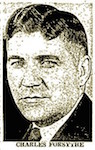
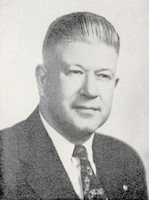
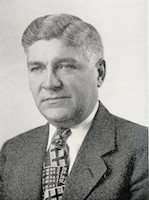
PHOTOS: (Top) Charlie Forsythe, standing far right, served at Lansing Central at the time of this photo in 1927. (Top middle) Forsythe in 1938. (Middle) MHSAA Executive Director Alden Thompson. (Below) Forsythe. (Photos gathered by Ron Pesch.)