


Did you see that?
June 4, 2012
Saturday annually is the busiest high school sports day on the MHSAA calendar.
The Spring Finals match began with Girls and Boys Track and Field and Girls Tennis Finals at sites all over both peninsulas. There were Regionals for both boys and girls lacrosse, which finish up this weekend. And, of course, there were Districts galore for softball, baseball and girls soccer.
Here's our sampling of some of the highlights:
Girls Track and Field
19 records fall: It was quite day across the seven MHSAA Girls Track and Field Finals, with 19 records broken, and two athletes – Reed City’s Sami Michell and Norway’s Dani Gagne – winning four individual events apiece. (Second Half)
Coast to coast: The Grosse Pointe South 3,200 relay was responsible for one of two all-Finals records, and ran a time of 8:48.29 that also surpassed the national record for that event (but may or may not stand as the national record, depending on what other times were run and will be submitted after this spring.) (Detroit Free Press)
Boys Track and Field
LP filled with first-time champs: Lake Orion in Division 1, Auburn Hills Avondale in Division 2 and Lansing Catholic in Division 3 won their first MHSAA team championships. Also, nine records fell across the state. (Second Half)
Quite a comeback: Marquette trailed Gladstone by 27 points at the Upper Peninsula Division 1 Final with four events to run. But the Redmen outscored Gladstone 42-0 over those events to win their third straight championship. (Marquette Mining Journal)
Girls Tennis
Southeast sweep: Detroit suburban schools claimed all four MHSAA Lower Peninsula team championships – Grosse Pointe South in Division 1, Birmingham Seaholm in Division 2, Bloomfield Hills Cranbrook-Kingswood in Division 3 and Bloomfield Hills Academy of the Sacred Heart in Division 4. (Second Half)
Freshman reigns: Utica freshman Davina Nguyen beat both the first and second seeds on her way to claiming the individual championship at No. 1 singles in Division 1. Nguyen was seeded fifth. (Macomb Daily)
Boys lacrosse
Cranbrook comes out on top: Cranbrook-Kingswood, ranked No. 3 in Division 2, emerged from a Regional that also included No. 4 Haslett/Williamston and No. 5 East Grand Rapids, beating the latter 8-4 in the Final. (Bloomfield Patch)
Girls lacrosse
EGR plays to top ranking, again: Rivals East Grand Rapids and Grand Rapids Catholic Central met in one of the multiple close Regional Finals, with the top-ranked Pioneers downing No. 2 GRCC one more time, 11-9. (Grand Rapids Press)
Baseball
It’s Holt, again: The Rams claimed their second championship in a week over rival Grand Ledge – both have been ranked in Division 1 this season. Two weeks ago, Holt split with the Comets to win the Capital Area Activities Conference Blue. Standout Justin Alleman gave up two hits and struck out 18 as Holt also won Saturday to claim a District title. (Lansing State Journal)
Softball
In the end, it’s Mattawan: The season-long battle for statewide Division 1 and Kalamazoo-area supremacy was decided in part at Saturday’s District at Portage Central. Reigning MHSAA champion Mattawan emerged as the winner from a field that included top-ranked Portage Central – which was upset by Kalamazoo Loy Norrix in a semifinal. (Kalamazoo Gazette)
Soccer
AAGR moves on: Ann Arbor Gabriel Richard, No. 8 in Division 3, shut out No. 7 Jackson Lumen Christi 3-0 in the Division 3 District final at Brooklyn Columbia Central (AnnArbor.com)

MHSAA's Roberts to Retire in August
By
Geoff Kimmerly
MHSAA.com senior editor
April 24, 2018
For 32 years, Jack Roberts has served as much more than a caretaker of the Michigan High School Athletic Association.
In announcing his retirement Tuesday, he called working for 1,500 schools and hundreds of thousands of student-athletes over three decades his "purpose."
John E. “Jack” Roberts, who has served as executive director of the MHSAA since the fall of 1986, will retire in August.
Roberts will conclude his tenure as the second-longest serving full-time executive director during the MHSAA’s 94-year history. He is the fourth person to serve that leadership role full time, following Charles E. Forsythe (1931-42, 1945-68), Allen W. Bush (1968-78) and Vern L. Norris (1978-86). Roberts currently is also the nation’s longest-serving executive director of a state high school athletic association.
The MHSAA has enjoyed continued growth under Roberts’ guidance, particularly in the number of Michigan high school students participating in athletics and in the number of MHSAA-sponsored tournament sports available to them.
The Association also has made unprecedented advances in providing for the health and safety of athletes and promoting sportsmanship and the values of educational athletics and while working to preserve competitive equity for its more than 1,500 member high school and junior high/middle schools.
“I don’t think anybody could have been luckier than I to enjoy their work so much and to enjoy the people he worked with so much,” Roberts said. “It has been a blessing to be able to bring my passions to work every day and be able to act on my convictions. I don’t think anybody could ever feel more called to a job than I did."
Under Roberts’ leadership, overall participation in high school athletics in Michigan has increased 10 percent, and the MHSAA has added more than 200 schools in increasing its membership by more than 15 percent at the high school and junior high/middle school levels combined. Most recently, in 2016, 6th-graders were allowed to compete for member schools for the first time as a push was made to increase junior high/middle school membership and serve the state’s students earlier in their athletic careers.
His tenure has seen the addition of girls competitive cheer (1994), girls & boys bowling (2004) and girls & boys lacrosse (2005) to the tournament sport lineup, the creation of separate wrestling tournament to determine champions by team format (1988) and 8-player football (2010, first playoffs 2011) as many small schools across the state began having trouble fielding 11-player teams because of enrollment and population decreases. Meanwhile, also under his leadership, the 11-player Football Playoffs expanded, doubling to 256 teams in 1999.
A number of key rules changes came under Roberts’ watch and direction, including the addition of opportunities for multiple schools to create cooperative teams in sports where participation is lagging, as well as the creation of down time and dead periods (2006) to ease pressure for year-round activity. A comprehensive sportsmanship package enacted in 1996 set a statewide tone for appropriate behavior and perspective that continues to make an impact today.
But the most significant and arguably lasting work influenced by Roberts came on topics not related to specific sports or competition. The MHSAA has led nationally in concussion care with its first programming in 2000 and return-to-play protocols enacted in 2010, and with concussion pilot testing, mandated reporting and insurance for those who suffer head injuries rolled out in 2015.
A heat management policy and CPR requirements for coaches were introduced in 2013. The first program for coaches education was launched in 1987 and evolved into the Coaches Advancement Program that is now required for all newly-hired varsity head coaches, and all coaches (head or assistant) at all high school levels (varsity and subvarsity) are now required to take annual rules/health meetings.
The Women in Sports Leadership Conference was created in 1989 and remains the first, largest and longest-running program of its type in the country, regularly drawing upwards of 500 participants. The first of now-annual statewide Athletic Director In-Service Programs was conducted in 1992, and the MHSAA’s website – MHSAA.com – was launched in 1997. That same year the first of the now-annual Sportsmanship Summits was held, and Michigan remains a national leader in student services thanks to a variety of programs that have been introduced over the last three decades.
 “We have accomplished a great deal over 32 years, but there is very much more to do – and it will always be that way,” Roberts said. “People ask me if I have any regrets, and I don’t have many. But two come to mind right now.
“I regret that I didn’t spend more time writing notes to the folks I’ve been serving at the local level who work so hard delivering the program every day, every week, every season, every year to the young people that we serve. I wish I’d done more of that – that encouraging word to people in the trenches doing the work.
“And I suppose the second regret is that in spite of everything that we’ve done, there’s still a lot more to do to keep school sports as safe, sane and sportsmanlike as it ought to be – as it must be for schools to continue to sponsor these programs. You see, school sports done right brings help and hope to parents and to schools who are trying as hard as they can to raise up and educate kids in very, very scary times. School sports helps parents and helps schools bring stability and engagement into young people’s lives that can provide them life lessons and turn some good athletes into great citizens down the road.”
Roberts privately made the decision to retire during May 2017. But even as he has prepared for his retirement this summer, he’s catalyzed a Multi-Sport Participation Task Force charged with promoting the benefits of playing more than one sport and led the facilitating of statewide discussion on a sport-based transfer rule proposal that will come before the MHSAA's Representative Council in May.
In addition to his work specifically in Michigan, Roberts has carried significant influence at the national level. With his retirement, he also will be leaving the National Federation of State High School Associations (NFHS) Board of Directors. He led the creation of the NFHS Network for video productions in 2012 and is finishing an extended term as that board’s chairperson. He also has served on the board of directors of the National Association of Sports Officials (NASO).
Roberts previously served as an assistant director for the National Federation from 1973-80. He came to the MHSAA in 1986 from the Fellowship of Christian Athletes, which he served as executive vice president. During the last 45 years, Roberts has spoken to education, business and civic groups in nearly every state and five Canadian provinces and continues to be hailed as one of the nation’s most articulate advocates for educational athletics.
"We have always felt that we had the best executive director in the United States. What he's done for interscholastic athletics in Michigan is incredible," said MHSAA Representative Council President Scott Grimes, who serves as assistant superintendent of human services for Grand Haven Area Public Schools.
"Jack has always had student-athletes' best interests in mind when making all decisions, and he's had tough decisions to make. We certainly will miss his leadership in our state."
In addition to his MHSAA work, Roberts has served as board president for the Refugee Development Center in Lansing for nine years and this year is the chair of the board of trustees for the Capital Regional Community Foundation. He is a 1970 graduate of Dartmouth College and taught English and coached football at high schools in Milwaukee and Denver before joining the NFHS staff. He and his wife Peggy reside in East Lansing, and his late father, John Roberts, served as the executive director of the Wisconsin Interscholastic Athletic Association (WIAA) from 1957-86.
The MHSAA is a private, not-for-profit corporation of voluntary membership by more than 1,500 public and private senior high schools and junior high/middle schools which exists to develop common rules for athletic eligibility and competition. No government funds or tax dollars support the MHSAA, which was the first such association nationally to not accept membership dues or tournament entry fees from schools. Member schools which enforce these rules are permitted to participate in MHSAA tournaments, which attract more than 1.4 million spectators each year.
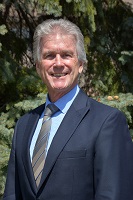
PHOTOS: From left, Jack Roberts during an interview in 1986, at Ford Field in 2005 and during a Representative Council meeting in 2014.