


Did you see that?
April 2, 2012
Check out our must-know scores and news from March 26-31.
(Click on links for coverage.)
Girls lacrosse
Marian takes early advantage: In a match-up of 2011 Division 1 contenders, Bloomfield Hills Marian edged Ann Arbor Pioneer 10-9 in the second game of the season for both teams. Marian advanced to the Semifinals last season before falling to eventual champion Brighton by one, while Pioneer then fell to Brighton in the Final by two in overtime.
East Grand Rapids wins battle of D2 powers: In another game between regular MHSAA title favorites, East Grand Rapids got a big win downing Okemos 16-7. The Chieftains won the 2009 and 2010 Division 2 championships before falling in a Regional Final in 2011. East Grand Rapids ended last season with a one-goal loss to eventual champion Grand Rapids Catholic Central.
Girls soccer
Troy remains tops in town: Last season’s Division 1 runner-up got a solid March win, 2-0 over rival and returning District champion Troy Athens. The match-up had a little bit different feel this season, with Athens coach Todd Heugh running the show in his first season after taking over for longtime great Tim Storch. (The Oakland Press)
Baseball
State coaches release preseason polls: The Michigan High School Baseball Coaches Association released its preseason polls, and three of four reigning MHSAA champions have top rankings in their respective divisions – Rockford in Division 1, Madison Heights Bishop Foley in Division 3 and Grosse Pointe Woods University Liggett in Division 4. Reigning Division 2 champion St. Clair comes in No. 2 behind Grand Rapids Christian. (Click for full rankings.)
Softball
Best of 2011 expected to be best of 2012: The Michigan High School Softball Coaches Association also released its preseason rankings, and all four reigning MHSAA champions are starting out in the top spots – Mattawan in Division 1, Stevensville Lakeshore in Division 2, Clinton in Division 3 and Petersburg Summerfield in Division 4. (Click for full rankings.)
Editor's note: Did we miss something? Comment below and tell us about it. Is there an event coming up that we should make sure to note? Comment or e-mail [email protected].
Century of School Sports: Why Does the MHSAA Have These Rules?
By
Geoff Kimmerly
MHSAA.com senior editor
September 18, 2024
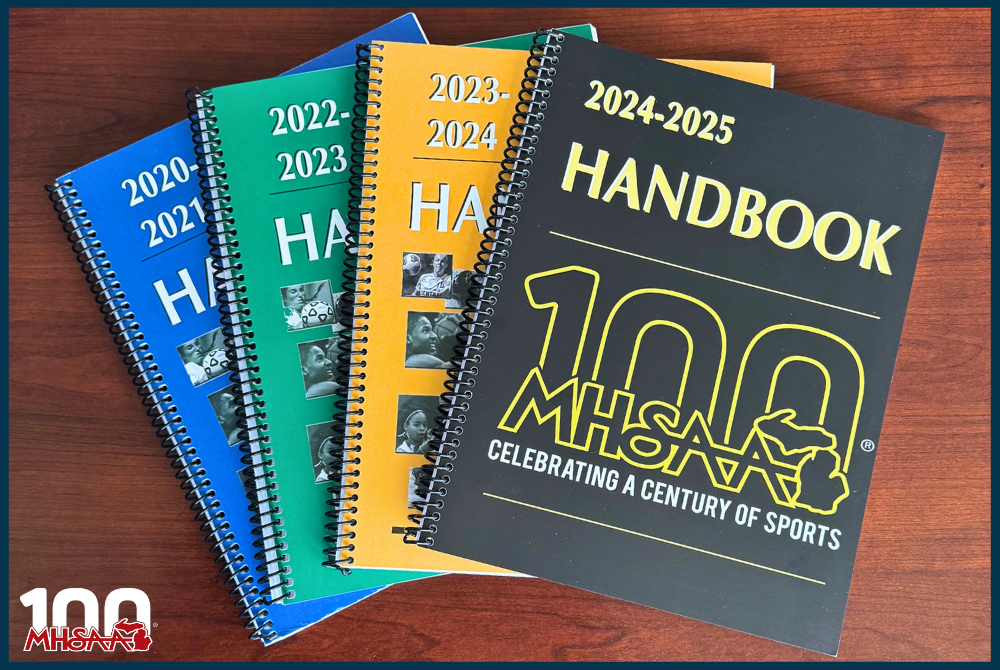
MHSAA administrators are two trips into their annual seven-stop fall tour that has become a tradition during nearly half of the Association’s “Century of School Sports” – and this year, a focus has been on answering a key question at the heart of educational athletics since long before the MHSAA was formed during the 1924-25 school year.
The MHSAA’s Update meeting series is in its 47th year and includes half-day conferences in seven locations – generally in the Kalamazoo, Metro Detroit, Grand Rapids, Saginaw, northern Lower Peninsula and mid-Michigan areas, and at Northern Michigan University in Marquette. The six Lower Peninsula sessions begin with an athletic director in-service during which MHSAA assistant directors explain recent rules changes and discuss challenges our administrators face on a daily basis (with Upper Peninsula athletic directors participating in a similar in-service during the spring).
Those in-services are followed by a session with executive director Mark Uyl, who speaks to athletic directors, superintendents, principals and school board members on a variety of topics including the MHSAA’s current objectives and ideas for the future, while also reinforcing the longstanding values that remain the bedrock of our daily work.
And that leads to the question he’s presenting across the state this fall:
Why does the MHSAA have these rules?
Frankly, the answer goes back to the beginning of school sports in Michigan – all the way back to 1895, when the first MHSAA predecessor organization was formed.
The first MHSAA Representative Council president Lewis L. Forsythe explained in his book “Athletics in Michigan High Schools – The First Hundred Years” how regulations always have been necessary:
“Eligibility rules are a necessity in interscholastic competition. It was common acknowledgement of this fact that led to the first State inter-school organization in 1895. The rules at first were few, simple and liberal. But with the passing of the years they came to be more numerous, more complex, and more restrictive, again through common acknowledgment of desirability if not of necessity.”
That necessity – and the reasoning behind it – has not changed.
Two main points explain why rules are absolutely imperative for educational athletics to thrive.
► 1. Participation – through providing as many opportunities as possible for students to play – has been the mission of school sports since their start. Rules contribute to the value of participation.
If there are requirements for children to participate in athletics – for example, an academic standard or rules that dissuade students from switching schools every year – then school sports programs mean more to all involved.
If we raise the bar, raise the standards of eligibility and conduct, we raise the value of our school sports programs. If we lower the bar, we lower the value of being part of school sports – because without rules, contest results are meaningless, and the value of participating is diminished.
► 2. We have rules where the stakes are higher, and agreement is lower – because where the stakes are highest, there is the greatest tendency for some people to try to gain an unfair advantage, and the greatest need for rules to curb possible dishonest activity.
This statement goes to the heart of the history, rationale and application of MHSAA rules. Obviously and simply put, school sports mean a lot to those who take part, and that significance is high enough to stoke disagreement – and we need rules to govern those disagreements. We have the most rules for high school sports, where championships are at stake and the possibility of disagreement is greatest.
***
Finally – and perhaps providing the strongest reinforcement of the two points above – is this:
Schools choose to make MHSAA rules their own.
Quite literally, school districts vote annually to be part of the MHSAA – and confirming this voluntary membership comes with the requirement to follow all MHSAA rules.
When schools challenge our rules, they literally are seeking to break the rules they already have committed to uphold.
These rules, and this commitment, are the strength of our organization across 752 member high schools and several hundred more middle schools and junior high schools. They have been constructed on a century of precedents and after considerations by representatives of those same member schools – representatives those schools have voted to elect every school year during the MHSAA’s history.
Previous "Century of School Sports" Spotlights
Sept. 10: Special Medals, Patches to Commemorate Special Year - Read
Sept. 4: Fall to Finish with 50th Football Championships - Read
Aug. 28: Let the Celebration Begin - Read